Police Reform and Fake Capitalism (They’re Not Related)

Calling the police can be dangerous. New Jersey is doing something about it. The state created a program called ARRIVE Together. A mental health professional accompanies the police when they go out on a call involving someone in mental distress. A study showed that in 342 such cases, only 3% resulted in the use of force and only 2% resulted in an arrest (usually because of an unrelated issue, such as an outstanding warrant). The program is being expanded and should serve as a model for police departments around the country (see this report from the Brookings Institution).

So much for some good news. Now back to harsh reality. From The Guardian:

One of the most deeply held and frequently heard propositions about capitalism is that it revolves around private companies and individuals taking risks. When, earlier this year, the US government arranged a rescue package for Silicon Valley Bank, for instance, among the many objections to it was the claim that the rescue contravened capitalism’s risk norms.

This view of the world directly informs wide swaths of economic policymaking today….But examine the economy, and it becomes clear: capitalism has become less and less about corporate risk-taking in recent decades. To be sure, many businesses do take significant risks. The independent small business owner who opens a new cafe in London generally faces intense competition and massive risk. But as political scientist Jacob Hacker has argued, business in general has been enormously skilled in recent times at offloading risk – principally by dumping it on those least able to bear it: ordinary households.

… The best example of a business usually regarded as being fundamentally about risk-taking, but which in fact is not, is … alternative asset management, an umbrella term for hedge funds, private equity and the like. (“Alternative” here means anything other than publicly listed stocks and bonds.) Asset managers are anything but marginal, exotic firms – they manage more than $100 trillion of clients’ money globally and control everything from [Benihana to PetSmart to Westinghouse].

But let’s look at what asset management companies in places like Britain and the US actually do. Three considerations are paramount.

First, there is the matter of whose capital is put at risk when alternative asset managers such as Citadel, Blackstone and KKR invest. In large part, it’s not theirs. The proportion of equity invested by a typical hedge or private equity fund that is the asset manager’s own is usually between 1% and 3%. The rest is that of their external investor clients (the “limited partners”), which include pension funds.

Second, consider how an asset manager’s investments are designed. For one thing, its own financial participation in, and management of, its investment funds is usually through a vehicle (the “general partnership”) that is constituted as a separate entity, precisely in order to insulate the firm and its professionals from liability risk.

Furthermore, the fund and its manager is generally distanced from underlying investments by a chain of intermediary holding companies that protect it from the risk inherent in those investments. In leveraged buyouts, where money is borrowed to help finance a deal,the debt goes on to the balance sheet of the company the fund has acquired. This means if trouble arises in repaying the debt, it is not the investment fund that is on the hook, still less its manager.

Third and last, fee structures also distance asset managers from risk. If a fund underperforms, they may earn no performance fee (based on fund profits), but they do have the considerable consolation – a form of risk insurance, if you like – of the guaranteed management fee, usually representing about 2% of limited partners’ committed capital, year after year. Essentially, management fees pay asset managers’ base salaries; performance fees pay bonuses.

In short, then, it would be far-fetched to suggest that what hedge funds and the like do amounts substantially to risk-taking. The only meaningful risk they themselves face is that of losing customers if fund returns prove underwhelming…. In reality, the business of alternative asset management is less about taking on risk than, in Hacker’s terms, moving it elsewhere. So when things go wrong, others bear the brunt….

Why does this matter? Because unless elected policymakers understand how risk is produced and distributed in modern economies, they will not be in a position to act appropriately and proportionately. That is why vague talk from politicians of being “pro-business” or “entrepreneurship” mean so little; the point is to learn from economic realities as they actually are, as opposed to how economics textbooks say they could or should be.

There is one very obvious policy recommendation for alternative asset management that flows from our understanding what they actually do with “risk”: taxing them more.

The main performance fee earned by alternative asset managers is “carried interest” – effectively, a profit share. In the UK and US, most asset management firms pay tax on this revenue at the capital gains rate, rather than the usually higher income tax rate. This is because the asset manager has typically been understood to be “taking on the entrepreneurial risk of the [investment]” – a standard justification for taxation as capital gain.

But as we have seen, this simply does not hold water. In 2017, the New York Times called the beneficial tax treatment of carried interest “a tax loophole for the rich that just won’t die”. It’s time to close it….

Note: To pass Biden’s Inflation Reduction Act last year, Democrats needed Sen. Kyrsten Sinema’s vote. But she wouldn’t vote for the bill unless Democrats dropped the provision that would have closed the carried interest loophole. She insisted on preserving the tax break that favors the securities and investment industry. Wouldn’t you know that hedge fund managers and private equity executives gave her more than $2 million between 2018 and 2022? Since then, she left the Democratic Party to run in Arizona as an “Independent” [CNBC].
How Poverty Helps the Rest of Us

Ezra Klein of The New York Times writes about poverty and the American economy:

I’m not going to pretend that I know how to interpret the jobs and inflation data of the past few months. My view is that this is still an economy warped by the pandemic, and that the dynamics are so strange and so unstable that it will be some time before we know its true state. But the reaction to the early numbers and anecdotes has revealed something deeper and more constant in our politics.

The American economy runs on poverty, or at least the constant threat of it. Americans like their goods cheap and their services plentiful and the two of them, together, require a sprawling labor force willing to work tough jobs at crummy wages. On the right, the barest glimmer of worker power is treated as a policy emergency, and the whip of poverty, not the lure of higher wages, is the appropriate response.

Reports that low-wage employers were having trouble filling open jobs sent Republican policymakers into a tizzy and led at least 25 Republican governors — and one Democratic governor [the one in Louisiana] — to announce plans to cut off expanded unemployment benefits early. Chipotle said that it would increase prices by about 4 percent to cover the cost of higher wages, prompting the National Republican Congressional Committee to issue a blistering response: “Democrats’ socialist stimulus bill caused a labor shortage, and now burrito lovers everywhere are footing the bill.” The [right-wing] outlet The Federalist  complained, “Restaurants have had to bribe current and prospective workers with fatter paychecks to lure them off their backsides and back to work.”

But it’s not just the right. The financial press, the cable news squawkers and even many on the center-left greet news of labor shortages and price increases with an alarm they rarely bring to the ongoing agonies of poverty or low-wage toil.

As it happened, just as I was watching Republican governors try to immiserate low-wage workers who weren’t yet jumping at the chance to return to poorly ventilated kitchens for $9 an hour, I was sent “A Guaranteed Income for the 21st Century,” a plan that seeks to make poverty a thing of the past. The proposal, developed . . .  for the New School’s Institute on Race and Political Economy, would guarantee a $12,500 annual income for every adult and a $4,500 allowance for every child. It’s what wonks call a “negative income tax” plan — unlike a universal basic income, it phases out as households rise into the middle class.

“With poverty, to address it, you just eliminate it,” [one of the authors, Darrick Hamilton] told me. “You give people enough resources so they’re not poor.” Simple, but not cheap. The team estimates that its proposal would cost $876 billion annually. To give a sense of scale, total federal spending in 2019 was about $4.4 trillion, with $1 trillion of that financing Social Security payments and another $1.1 trillion support Medicaid, Medicare, the Affordable Care Act and the Children’s Health Insurance Program.

Beyond writing that the plan “would require new sources of revenue, additional borrowing or trade-offs with other government funding priorities,” [the authors] don’t say how they’d pay for it, [but] it’s clearly possible. Even if the entire thing was funded by taxes, it would only bring America’s tax burden to roughly the average of our peer nations.

I suspect the real political problem for a guaranteed income isn’t the costs, but the benefits. A policy like this would give workers the power to make real choices. They could say no to a job they didn’t want, or quit one that exploited them. They could, and would, demand better wages, or take time off to attend school or simply to rest. When we spoke, Hamilton tried to sell it to me as a truer form of capitalism. “People can’t reap the returns of their effort without some baseline level of resources,” he said. “If you lack basic necessities with regards to economic well-being, you have no agency. You’re dictated to by others or live in a miserable state.”

But those in the economy with the power to do the dictating profit from the desperation of low-wage workers. One man’s misery is another man’s quick and affordable at-home lunch delivery. “It is a fact that when we pay workers less and don’t have social insurance programs that, say, cover Uber and Lyft drivers, we are able to consume goods and services at lower prices,” Hilary Hoynes, an economist at the University of California at Berkeley . . . 

This is the conversation about poverty that we don’t like to have: We discuss the poor as a pity or a blight, but we rarely admit that America’s high rate of poverty is a policy choice, and there are reasons we choose it over and over again. We typically frame those reasons as questions of fairness (“Why should I have to pay for someone else’s laziness?”) or tough-minded paternalism (“Work is good for people, and if they can live on the dole, they would”). But there’s more to it than that.

It is true, of course, that some might use a guaranteed income to play video games or melt into Netflix. But why are they the center of this conversation? We know full well that America is full of hardworking people who are kept poor by very low wages and harsh circumstance. We know many who want a job can’t find one, and many of the jobs people can find are cruel in ways that would appall anyone sitting comfortably behind a desk. We know the absence of child care and affordable housing and decent public transit makes work, to say nothing of advancement, impossible for many. We know people lose jobs they value because of mental illness or physical disability or other factors beyond their control. We are not so naïve as to believe near-poverty and joblessness to be a comfortable condition or an attractive choice.

Most Americans don’t think of themselves as benefiting from the poverty of others, and I don’t think objections to a guaranteed income would manifest as arguments in favor of impoverishment. Instead, we would see much of what we’re seeing now, only magnified: Fears of inflation, lectures about how the government is subsidizing indolence, paeans to the character-building qualities of low-wage labor, worries that the economy will be strangled by taxes or deficits, anger that Uber and Lyft rides have gotten more expensive, sympathy for the struggling employers who can’t fill open roles rather than for the workers who had good reason not to take those jobs. These would reflect not America’s love of poverty but opposition to the inconveniences that would accompany its elimination.

Nor would these costs be merely imagined. Inflation would be a real risk, as prices often rise when wages rise, and some small businesses would shutter if they had to pay their workers more. There are services many of us enjoy now that would become rarer or costlier if workers had more bargaining power. We’d see more investments in automation and possibly in outsourcing. The truth of our politics lies in the risks we refuse to accept, and it is rising worker power, not continued poverty, that we treat as intolerable. You can see it happening right now, driven by policies far smaller and with effects far more modest than a guaranteed income.

Hamilton, to his credit, was honest about these trade-offs. “Progressives don’t like to talk about this,” he told me. “They want this kumbaya moment. They want to say equity is great for everyone when it’s not. We need to shift our values. The capitalist class stands to lose from this policy, that’s unambiguous. They will have better resourced workers they can’t exploit through wages. Their consumer products and services would be more expensive.”

For the most part, America finds the money to pay for the things it values. In recent decades, and despite deep gridlock in Washington, we have spent trillions of dollars on wars in the Middle East and tax cuts for the wealthy. We have also spent trillions of dollars on health insurance subsidies and coronavirus relief. It is in our power to wipe out poverty. It simply isn’t among our priorities.

“Ultimately, it’s about us as a society saying these privileges and luxuries and comforts that folks in the middle class — or however we describe these economic classes — have, how much are they worth to us?” Jamila Michener, co-director of the Cornell Center for Health Equity, told me. “And are they worth certain levels of deprivation or suffering or even just inequality among people who are living often very different lives from us? That’s a question we often don’t even ask ourselves” . . . 

What the Hell Is Private Equity?

What is private equity? According to Investopedia, “private equity is composed of funds and investors that directly invest in private companies, or that engage in buyouts of public companies”. This means that a private equity firm puts its money directly into target companies, either companies that are themselves privately owned (like Koch Industries) or ones that sell publicly traded stock (like General Motors and I.B.M.).

The people who run a private equity firm are able to do this because they have vast sums of money, either their own or their partners’ or money they’ve collected from their customers (i.e., investors who pay the private equity firm to manage their money, the same way investors in a mutual fund company pay management fees to the mutual fund company). 

Sometimes a private equity firm invests so much in a target company that they control its finances. This allows them to sell the most profitable parts of the target company or saddle it with enormous amounts of debt (I don’t know how, but private equity firms somehow suck profits out of companies they control without ever having to pay back the debt they’ve taken on).

This brings us to an article in The New York Times about how private equity firms avoid taxes, not always legally:

Private equity has conquered the American tax system.

The industry has perfected sleight-of-hand tax-avoidance strategies so aggressive that at least three private equity officials have alerted the Internal Revenue Service to potentially illegal tactics, according to people with direct knowledge of the claims and documents reviewed by The New York Times. The previously unreported whistle-blower claims involved tax dodges at dozens of private equity firms.

But the I.R.S., its staff hollowed out after years of budget cuts, has thrown up its hands when it comes to policing the politically powerful industry.

While intensive examinations of large multinational companies are common, the I.R.S. rarely conducts detailed audits of private equity firms, according to current and former agency officials.

Such audits are “almost nonexistent,” said Michael Desmond, who stepped down this year as the I.R.S.’s chief counsel. The agency “just doesn’t have the resources and expertise.”

One reason they rarely face audits is that private equity firms have deployed vast webs of partnerships to collect their profits. Partnerships do not owe income taxes. Instead, they pass those obligations on to their partners, who can number in the thousands at a large private equity firm. That makes the structures notoriously complicated for auditors to untangle.

Increasingly, the agency doesn’t bother. People earning less than $25,000 are at least three times more likely to be audited than partnerships, whose income flows overwhelmingly to the richest 1 percent of Americans.

The consequences of that imbalance are enormous.

By one recent estimate, the United States loses $75 billion a year from investors in partnerships failing to report their income accurately — at least some of which would probably be recovered if the I.R.S. conducted more audits. That’s enough to roughly double annual federal spending on education.

It is also a dramatic understatement of the true cost. It doesn’t include the ever-changing array of maneuvers — often skating the edge of the law — that private equity firms have devised to help their managers avoid income taxes on the roughly $120 billion the industry pays its executives each year.

Private equity’s ability to vanquish the I.R.S., Treasury and Congress goes a long way toward explaining the deep inequities in the U.S. tax system. When it comes to bankrolling the federal government, the richest of America’s rich — many of them hailing from the private equity industry — play by an entirely different set of rules than everyone else.

The result is that men like Blackstone Group’s chief executive, Stephen A. Schwarzman, who earned more than $610 million last year, can pay federal taxes at rates similar to the average American.

Lawmakers have periodically tried to force private equity to pay more, and the Biden administration has proposed a series of reforms, including enlarging the I.R.S.’s enforcement budget and closing loopholes. . . . 

The private equity industry, which has a fleet of almost 200 lobbyists and has doled out nearly $600 million in campaign contributions over the last decade, has repeatedly derailed past efforts to increase its tax burden.

“If you’re a wealthy cheat in a partnership, your odds of getting audited are slightly higher than your odds of getting hit by a meteorite,” Senator Ron Wyden, the committee’s chairman, told Mr. Rettig at the hearing. “For the sake of fairness and for the sake of the budget, it makes a lot more sense to go after cheating by the big guys than focus on working people.”

Yet that is not what the I.R.S. has done.

Private equity firms typically borrow money to buy companies that they see as ripe for turnarounds. Then they cut costs and resell what’s left, often laden with debt. The industry has owned brand-name companies across nearly every industry. Today its prime assets include Staples, Petco, WebMD and Taylor Swift’s back music catalog.

The industry makes money in two main ways. Firms typically charge their investors a management fee of 2 percent of their assets. And they keep 20 percent of future profits that their investments generate.

That slice of future profits is known as “carried interest.” The term dates at least to the Renaissance. Italian ship captains were compensated in part with an interest in whatever profits were realized on the cargo they carried.

The I.R.S. has long allowed the industry to treat the money it makes from carried interest as capital gains, rather than as ordinary income.

For private equity, it is a lucrative distinction. The federal long-term capital gains tax rate is currently 20 percent. The top federal income tax rate is 37 percent.

The loophole is expensive. Victor Fleischer, a University of California, Irvine, law professor, expects it will cost the federal government $130 billion over the next decade.

Back in 2006, Mr. Fleischer published an influential article highlighting the inequity of the tax treatment. It prompted lawmakers from both parties to try to close the so-called carried interest loophole. The on-again, off-again campaign has continued ever since.

Whenever legislation gathers momentum, the private equity industry — joined by real estate, venture capital and other sectors that rely on partnerships — has pumped up campaign contributions and dispatched top executives to Capitol Hill. One bill after another has died, generally without a vote.

Unquote.

There’s much more in the article, including how these guys pretend they aren’t collecting management fees (which are taxable as regular income) by disguising them as capital gains (which are taxed less). But you get the idea.

More People Will Work If You Pay Them To

From David Leonhardt of The New York Times:

The chief executive of Domino’s Pizza has complained that the company can’t hire enough drivers. Lyft and Uber claim to have a similar problem. A McDonald’s franchise in Florida offered $50 to anybody willing to show up for an interview. And some fast-food outlets have hung signs in their windows saying, “No one wants to work anymore.

The idea that the United States suffers from a labor shortage is fast becoming conventional wisdom. But before you accept the idea, it’s worth taking a few minutes to think it through.

Once you do, you may realize that the labor shortage is more myth than reality.

Let’s start with some basic economics. The U.S. is a capitalist country, and one of the beauties of capitalism is its mechanism for dealing with shortages. In a communist system, people must wait in long lines when there is more demand than supply for an item. That’s an actual shortage. In a capitalist economy, however, there is a ready solution. . . . 

When a company is struggling to find enough labor, it can solve the problem by offering to pay a higher price for that labor — also known as higher wages. More workers will then enter the labor market. Suddenly, the labor shortage will be no more.

One of the few ways to have a true labor shortage in a capitalist economy is for workers to be demanding wages so high that businesses cannot stay afloat while paying those wages. But there is a lot of evidence to suggest that the U.S. economy does not suffer from that problem.

If anything, wages today are historically low. They have been growing slowly for decades for every income group other than the affluent. As a share of gross domestic product, worker compensation is lower than at any point in the second half of the 20th century. Two main causes are corporate consolidation and shrinking labor unions, which together have given employers more workplace power and employees less of it.

Just as telling as the wage data, the share of working-age Americans who are in fact working has declined in recent decades. . . . 

Corporate profits, on the other hand, have been rising rapidly and now make up a larger share of G.D.P. than in previous decades. As a result, most companies can afford to respond to a growing economy by raising wages and continuing to make profits, albeit perhaps not the unusually generous profits they have been enjoying.

Sure enough, some companies have responded to the alleged labor shortage by doing exactly this. Bank of America announced Tuesday that it would raise its minimum hourly wage to $25 and insist that contractors pay at least $15 an hour. Other companies that have recently announced pay increases include Amazon, Chipotle, Costco, McDonald’s, Walmart, J.P. Morgan Chase and Sheetz convenience stores.

Why the continuing complaints about a labor shortage, then?

They are not totally misguided. For one thing, some Americans appear to have temporarily dropped out of the labor force because of Covid-19 [or partially closed schools and lack of childcare]. Some high-skill industries may also be suffering from a true lack of qualified workers, and some small businesses may not be able to absorb higher wages. Finally, there is a partisan debate about whether expanded jobless benefits during the pandemic have caused workers to opt out.

For now, some combination of these forces — together with a rebounding economy — has created the impression of labor shortages. But companies have an easy way to solve the problem: Pay more.

That so many are complaining about the situation is not a sign that something is wrong with the American economy. It is a sign that corporate executives have grown so accustomed to a low-wage economy that many believe anything else is unnatural [or against their interests].

Texans in the Cold: A Few Completely Random Thoughts

Houston is the “energy capital of the world.” It is home to 4,600 energy-related firms, according to the Greater Houston Partnership. We have the expertise in our own backyard to ensure energy reliability for the state. However, Texas’s leaders have chosen to prioritize profit over people. When there are no regulations requiring power plants to winterize, and the generous tax abatements they receive don’t have those requirements, it creates an incentive not to do so for once-in-a-decade storms. The added cost of preparing a plant for extreme weather would cause the price of electricity provided to be higher, thus making the responsible plant operator unable to compete in a market where these costs are often skipped. — Heather Golden, “Failing Government, Freezing Texans”, The Bulwark

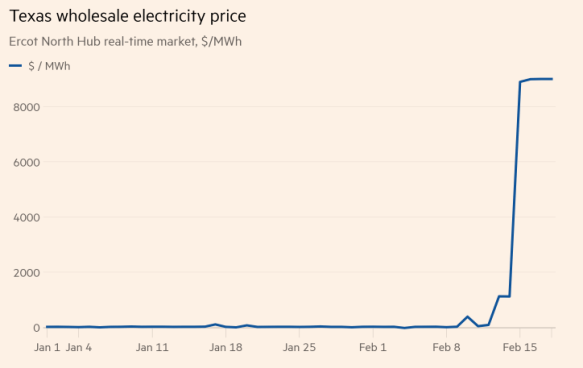
When a deep freeze shut down half the power generation capacity in Texas this week, the wholesale price of electricity exploded 10,000 per cent, with the financial consequences now being felt all the way from individual households to huge European energy companies. Astronomical bills face customers who opted for floating-rate contracts tied to wholesale prices in the state’s freewheeling electric market.

The wholesale power price was at the maximum allowable $9,000 a megawatt hour for five days from last Sunday. For a household, that translates to a $9 a kilowatt-hour electricity rate, compared with a typical cost of 12 cents.

EuqxyxkXYAA6ix6

In Burleson, a suburb of Fort Worth, Valerie Williams has been charged more than $6,000 by her electricity retailer Griddy to power her 1,400 sq ft home over the past few days. As the storm approached, Griddy told its customers to switch to more typical fixed-rate plans from other providers, but not everyone did, since there was little indication of just how extreme prices would become.

Griddy was charging her credit card multiple times a day, Williams said. She struggled to find a new provider during the crisis before finally identifying one that would switch her service on Friday. “I’m guessing it will be close to $7,000 by the time we get moved,” she said of her bill. . . .

On Friday, the city council in Denton, Texas, met to approve emergency borrowing to cover $300m the city-owned utility would pay Ercot this week — more than quadruple its purchases in full-year 2020. — “Freeze Sends Prices Soaring: Grid Operator Ercot Requires Billions in Payments”, Financial Times

The idea behind Texas energy policy was that a deregulated market didn’t require any oversight to protect the system from crisis, because profit-maximizing utilities would build in robust excess capacity to take advantage of possible price spikes. But they didn’t, even though the price spike has been incredible. — Paul Krugman

Yes, there are numerous places where Smith deplores the impact of government, and specifically the effects of intrusive regulation on trade . . . . But overall the view of Smith as anti-government seriously mistakes him. . . .He was quite clear that markets — and indeed society as a whole — are generally sustained by trust and confidence, and that for these and other things they rely on external institutions, notably of law and government, for their viability. By contrast, if merchants are left entirely to their own devices, the result is corrosive. He robustly asserts that “People of the same trade seldom meet together, even for merriment and diversion, but the conversation ends in a conspiracy against the public, or in some contrivance to raise prices”. No one who has read Smith closely can rationally believe he is an out-and-out free-marketeer. — Jesse Norman, Adam Smith: Father of Economics

The divide in our politics isn’t between proponents of big vs. small government. It’s between those trying to use government to help people and those who just want to troll the other side. When we elect responsible people, we end pandemics. When we don’t, people freeze to death. — Rep. Tom Malinowski (D-NJ)