How Much Respect Do Authoritarians Deserve?

Someone recommended an article called “Authoritarianism Is Not a Momentary Madness, But an Eternal Dynamic Within Liberal Democracies”. It was written by two psychologists, Karen Stenner and Jonathan Haidt, and appears in a collection of essays called Can It Happen Here?: Authoritarianism in America, edited by Cass Sunstein. I read it. .

The thesis of the article comes in two parts. The first is that roughly one-third of Americans have an “authoritarian” personality. By this, they mean that a certain percentage of human beings consider values like uniformity and obedience to be extremely important.

Authoritarianism inclines one toward attitudes and behaviors … concerned with structuring society and social interactions in ways that enhance sameness and minimize diversity of people, beliefs and behaviors. It tends to produce a characteristic array of … stances, all of which have the effect of glorifying, encouraging and rewarding uniformity and disparaging, suppressing and punishing difference. Since enhancing uniformity and minimizing diversity [affects other people] and requires some control over their behaviors, ultimately these stances involve actual coercion of others (as in driving a black family from the neighborhood) and, more often, demands for the use of group authority (i.e., coercion by the state).

… Authoritarianism is far more than a personal distaste for difference. It becomes a normative worldview about the social value of obedience and conformity (versus freedom and difference), the prudent and just balance between group authority and individual autonomy. This worldview induces bias against different others (racial and ethnic outgroups, immigrants and refugees, radicals and dissidents, moral “deviants”), as well as political demands for authoritative constraints on their behavior. The latter will typically include legal discrimination against minorities and restrictions on immigration, limits on free speech and association, and the regulation of moral behavior (e.g., policies regarding abortion and homosexuality, and their punitive reinforcement) [184-185].

Personally, I don’t think this is an acceptable outlook on life. It sounds misguided, stupid, even immoral.

The authors don’t see it that way. They view the existence of a substantial subset of human beings with this personality type as a fact of life. It’s just the way some people are. One of the authors, Linda Stenner, puts it this way in the first sentence of her book, The Authoritarian Dynamic: “Some people will never live comfortably in a liberal democracy”. By “liberal democracy”, she means a nation like ours, a “nation of immigrants”, in which we, the majority at least, celebrate individual freedoms (as stated, for example in a “Bill of Rights”) and the diversity of our fellow citizens.

This brings me to the second part of the authors’ thesis. They argue that the rest of us should treat the authoritarian minority’s views with more respect.

Democratic enthusiasts and multiculturalists sometimes make the mistake of thinking we are [all] evolving [into] more perfect democratic citizens. This is why the populist “wave” strikes many observers as a momentary madness that “comes out of the blue”, and why the sentiments that seem to fuel these movements are often considered merely the products of frustration, hatred, and manipulation by irresponsible populist leaders — certainly not serious, legitimate preferences that a democracy must attend to.

When authoritarians raise concerns about, say, the rates or sources of immigration, they are not actually saying “I’m scared I might lose my job”, but in fact, “This is making me very uncomfortable and I don’t like where our country is headed”. Moreover, “Nobody will let me say so, and only [this Trump-like figure] is listening to me”. Our sense is that if Trump had not come along, a Trump-like figure would have materialized eventually….

The gleeful reactions of Trump’s supporters to his “strongman” posturing attested to their anger and bitterness regarding the “political correctness” of the “liberal elite”, and the pleasure they seemed to derive from watching someone like “us” finally sticking it to “them” [211-213].

All right. It’s pretty clear that a third of our fellow Americans are uncomfortable living in a liberal democracy and would prefer that more of us looked and behaved like they do. In practical terms, what should the rest of us do about it?

In the case of immigration, the authors suggest that current immigration policy doesn’t take into account that millions of Americans, the authoritarians among us, would prefer less immigration or more tightly-controlled immigration.

If citizens say they’re concerned about the rate of immigration, we ought to at least consider the possibility they they’re concerned about the rate of immigration [and not racists]….Common sense and historical experience tell us that there is some rate of newcomers into any community that is too high to be sustainable… some newcomers are more difficult to integrate than others… some might, accordingly, need to be more carefully selected, or more heavily supported…. Ignoring these issues is not helpful to either the hosts or the newcomers. It is implausible to maintain that the host community can successfully integrate any kind of newcomer at any rate whatsoever, and it is unreasonable to assert that any other suggestion is racist [213-214].

One problem with this paragraph is that hardly anyone, nobody in Congress anyway, maintains that we should allow in “any kind of newcomer at any rate whatsoever”. To claim otherwise is to adopt the Republican lie that Democrats are in favor of “open borders”. The fact is that we already have lots of border security and many restrictions on who can live here. The debate concerns the amount and type of border security and the number of people who should be allowed to immigrate, from which countries, and with which restrictions, as well as what to do with immigrants who don’t have permanent resident status (“green cards”).

Another problem is that the authors suggest there is a golden mean that will be broadly acceptable to the American people, whether they have authoritarian personalities or not: “Frank consideration of these matters is the key to broad acceptance of immigration policy” [214]. It isn’t clear at all that opponents of immigration, especially immigration from the president’s “shithole countries”, would approve of immigration policy that is acceptable to the majority of the population. All authoritarians may not be racists, but a good percentage of them must be. Otherwise they wouldn’t be so uncomfortable with people who are “different”. Seriously, isn’t being uncomfortable with masses of people because they don’t look like you or speak your language a pretty good definition of “racist”. So what kind of immigration policy would be acceptable to the average authoritarian Trump supporter, racist or not, and how would it differ from current policy?

If there is one thing we could do in order to foster broader acceptance of immigration policy, it would be to make the facts about immigration clear to more people. Having a president who constantly lies about immigration and immigrants doesn’t help. Neither does having “news” channels that broadcast those lies over and over. If more people knew how legal immigration works and understood the facts regarding illegal immigration, we might achieve broader approval of immigration policy. But it will never be possible to convince large numbers of people who are made uncomfortable by “difference” that a reasonable immigration policy is a good idea. We should be able to live with that, however, as long as we have elections and our representatives do their jobs.

,
How Fascism Works: The Politics of Us and Them by Jason Stanley

Jason Stanley is a philosophy professor at Yale. He previously published a book called How Propaganda Works. His new book is a guidebook to fascism. He doesn’t spend much time on its history. His purpose is to explain how fascism and similar approaches to politics work.

The mechanisms of fascist politics all build on and support one another. They weave a myth of a distinction between “us” and “them”, based on a romanticized fictional past featuring “us” and no “them”, and supported by a corrupt liberal elite, who take our hard-earned money and threaten our traditions. “They” are lazy criminals on whom freedom would be wasted (and who don’t deserve it, in any case). “They” mask their destructive goals with the language of liberalism or “social justice”, and are out to destroy our culture … and make “us” weak. “We” are industrious and law-abiding … “they” are lazy, perverse, corrupt and decadent [188].

Among the mechanisms Stanley cites are: the idea that some kinds of people are inherently better than others; the creation of a mythic past; the widespread use of propaganda; the promotion of conspiracy theories; the use of contradictory statements to demonstrate power and obscure reality; anti-intellectualism; encouraging feelings of victimhood among the majority population; the celebration of law and order and military might; and respect for “traditional family values”.

Stanley doesn’t spend much time on the economic aspects of fascism, except for fascism’s general opposition to labor unions. Perhaps it’s enough to say that fascist leaders are authoritarians and wield extraordinary power over economic affairs. One possible problem with the book is that his use of contemporary examples may suggest that there is no significant difference between fascism and contemporary conservatism (or whatever we should call the reactionary politics of today’s Republican Party). His point, however, is that contemporary “conservatives”, in particular the current occupant of the White House, exhibit behavior that matches many of the distinctive behaviors of history’s best-known fascists.

Finally, one aspect of fascism that sets it apart is what Stanley calls the “Führer Principle”:

The father, in fascist ideology, is the leader of the family; the CEO is the leader of the business; the authoritarian leader is the father or CEO of the state. When voters in a democratic society yearn for a CEO as president, they are responding to their own implicit fascist impulses.

The pull of fascist politics is powerful. It simplifies human existence, gives us an object, a “them” whose supposed [defects highlight] our own virtue and discipline, encourages us t oidentify with a forceful leader who helps usmakese sense of the world, whose bluntness regarding the “undeserving” people in the world is refreshing…. If the CEO is tough-talking and cares little for democratic institutions, even denigrates them, so much the better. Fascist politics preys on the human frailty that makes our own suffering seem bearable if we know that those we look down upon are being made to suffer more [183].


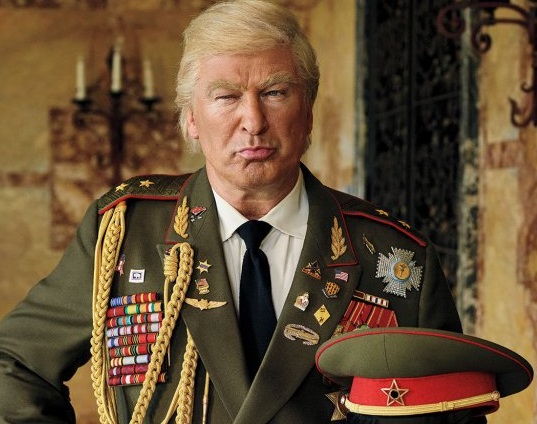
I Want to Wear a Uniform with a Big Hat Too

It’s no surprise that our president is a big fan of military parades. He loved the Bastille Day parade he attended in Paris last year and a similar parade he saw in China. Regarding the latter one, he remarked:

The hosting of the military parade this morning was magnificent, and the world was watching. I’ve already had people calling from all parts of the world. They were all watching. Nothing you can see is so beautiful.

It is now being reported that the president has directed the Pentagon to plan a military parade in Washington. November 11th (Veteran’s Day) has been mentioned as a possible date (although I bet he’ll want to stage it before Election Day, not after).

In response, Major General (Retired) Paul Eaton, an adviser to the progressive organization Vote Vets, issued the following statement:

Donald Trump has continually shown himself to have authoritarian tendencies, and this is another worrisome example.

For someone who just declared it was “treasonous” not to applaud him, and for someone who has, in the past, admired the tactics of everyone from Saddam Hussein to Vladimir Putin, it is clear that a military parade isn’t about saluting the military — it is about making a display of the military saluting him.

The military is not Donald Trump’s to use and abuse in this way. Our military is the very best in the world — they are not to be reduced to stagecraft to prop up Donald Trump’s image. Any commander-in-chief who respects the traditions of the military would understand that.

Unfortunately, we do not have a commander-in-chief right now, as much as we have a wannabe banana republic strongman.

splash_baldwin1-thr_exclusive

It’s only a matter of time.

Things Are Not Getting Better

The news has not been good, leading various journalists to summarize the past few days the way Jamelle Bouie did for Slate:

After months of sustained public criticism from Trump, Andrew McCabe stepped down as deputy director of the FBI. The rationale behind McCabe’s decision is still not entirely known, but there’s little doubt it involves the Russia investigation. In addition to being a verbal target of Trump’s, McCabe had become a bête noire of conservative media, the subject of baroque conspiracies about a “deep state” that is allegedly conspiring against the president….

Republicans on the House Intelligence Committee voted to release a … memo [that] accuses the FBI of abusing its surveillance powers, using partisan opposition research in order to attack Donald Trump’s campaign and undermine his presidency, and singling out officials like McCabe, Deputy Attorney General Rod Rosenstein, and former FBI Director James Comey, all targets of Trump and his allies in the GOP and conservative media… Democrats on the committee have called the document a “misleading set of talking points”, and federal law enforcement officials had warned that releasing the memo would be “extraordinarily reckless”….

In the wake of this vote, Republicans on the Intelligence Committee also opened an inquiry into the FBI and the Justice Department… On Tuesday, House Speaker Paul Ryan announced his support for both moves, calling for a “cleanse” of the FBI….

What began as Trump venting on Twitter has now become official administration policy, carried out with the blessing of White House aides who were at one time seen as bulwarks against such behavior. Bloomberg reported on a phone call between White House chief of staff John Kelly and senior officials in the Justice Department, where the former conveyed the president’s “displeasure” and reminded them of his expectations, albeit adding that the White House doesn’t expect them “to do anything illegal or unethical”.

To all of this, add the fact that—during this same period of time—President Trump declined to sanction Russia for its interference in the 2016 presidential election [after Congress voted almost unanimously for new sanctions to be imposed].

Senator Claire McCaskill, a Missouri Democrat, said this about the president’s decision:

Congress voted 517-5 to impose sanctions on Russia. The President decides to ignore that law. Folks, that is a constitutional crisis. There should be outrage in every corner of this country.

There should be, but there hasn’t been. Most of us are suffering from outrage overload.

Earlier in the week, Mr. Bouie wrote about “ICE Unbound”:

[The president has unleashed] the Immigration and Customs Enforcement agency, giving it broad authority to act at its own discretion. The result? An empowered and authoritarian agency that operates with impunity, whose chief attribute is unapologetic cruelty.

…. The most striking aspect of ICE under this administration has been its refusal to distinguish between law-abiding immigrants, whose undocumented status obscures their integration into American life, and those with active criminal records—the “bad hombres” of the president’s rhetoric.

Erasing that distinction is how we get the arrest and detention of Lukasz Niec, a Polish immigrant and green card holder who was brought to the United States as a young child. Last week, ICE agents arrested Niec …, citing two misdemeanor convictions for offenses committed when he was a teenager… A practicing physician, Niec now sits in a county jail, awaiting possible deportation….

Bouie didn’t mention Amer Othman Adi, a 57-year-old Palestinian who had been in the U.S. since he was 19. A married man with four daughters, he helped revitalize the city of Youngstown by opening several businesses. He was deported to Jordan on Monday night.

It all makes these Twitter thoughts from author G. Willow Wilson worth thinking about:

It may be time to start thinking about how we can effectively push back against authoritarianism once the last of the checks and balances have fallen.

It’s a mistake to think a dictatorship feels intrinsically different on a day-to-day basis than a democracy does. I’ve lived in one dictatorship and visited several others–there are still movies and work and school and shopping and memes and holidays.

The difference is the steady disappearance of dissent from the public sphere. Anti-regime bloggers disappear. Dissident political parties are declared “illegal”. Certain books vanish from the libraries.

The press picks a side. The military picks a side. The judiciary picks a side. This part should already feel familiar.

The genius of a true, functioning dictatorship is the way it carefully titrates justice. Once in awhile it will allow a sound judicial decision or critical op-ed to bubble up. Rational discourse is never entirely absent. There is plausible deniability.

People still have rights, in theory. The right to vote, to serve on a jury, etc. The difference is that they begin to fear exercising those rights. Voting in an election will get your name put on “a list”.

So if you’re waiting for the grand moment when the scales tip and we are no longer a functioning democracy, you needn’t bother. It’ll be much more subtle than that. It’ll be more of the president ignoring laws passed by congress. It’ll be more demonizing of the press.

Until one day we wake up and discover the regime has decided to postpone the 2020 elections until its lawyers are finished investigating something or other. Or until it can ‘ensure’ that the voting process is ‘fair’.

A sizable proportion of the citizenry will support the postponement. Yes, absolutely, we must postpone elections. The opposition is corrupt! Our leader is just trying to protect us! A dictator is never without supporters.

And hey, if we pull ourselves back from the brink and the midterms go ahead and the 2020 election is free and transparent and on time, you are cordially invited to point at me and laugh. Honestly. No one will be happier to be wrong than me.


That Was the Year That Was

The title of Michelle Goldberg’s overview of the past year in The New York Times is “The Anniversary of the Apocalypse”. I thought “apocalypse” was too much, but Merriam-Webster says it means “a great disaster”. That’s fair. In what follows, I’ve removed all descriptions of particular offenses:

In the terror-struck and vertiginous days after [the] election a year ago, as I tried to make sense of America’s new reality, I called people who lived, or had lived, under authoritarianism to ask what to expect. I wasn’t looking for concrete predictions — one of the disorienting things about that moment was that no one, no matter how learned, had any idea what was happening — but for insights into how the texture of life changes when an autocratic demagogue is in charge.

A secular Turkish journalist told me, her voice sad and weary, that while people might at first pour into the streets to oppose [him], eventually the protests would probably die out as a sense of stunned emergency gave way to the slog of sustained opposition. The Russian dissident writer Masha Gessen warned that there’s no way, with a leader who lays siege to the fabric of reality, to fully hold on to a sense of what’s normal. “You drift, and you get warped,” she told me.

They were both right. The country has changed in the past year, and many of us have grown numb after unrelenting shocks. What now passes for ordinary would have once been inconceivable….

… this nightmare year has upended assumptions about the durability of the rules, formal and informal, governing our politics. There’s a metaphysical whiplash in how quickly alarm turns into acceptance and then into forgetfulness….

Hannah Arendt once wrote of the role vulgarity played in undermining liberalism in pre-totalitarian societies: “The temporary alliance between the elite and the mob rested largely on this genuine delight with which the former watched the latter destroy respectability”…. In this administration, crassness has become a weapon, annihilating social codes that once restrained political behavior, signaling that old standards no longer apply.

Lately, the pace of shocks has picked up, even if our capacity to process them has not….In another administration this [take your pick] would have been a major scandal. In this one it barely registers.

How can America ever return from this level of systematic derangement and corruption? I wish there was someone I could ask, but we know more about how countries slide into autocracy than how they might climb out of it. It’s been a year, and sometimes I’m still poleaxed by grief at the destruction of our civic inheritance.

In moments of optimism I think that this is just a hideous interregnum….

Hey, all we have to do is win more elections, like we did tonight in Virginia and New Jersey. Or we could get the opposition to develop a sense of shame. One of those should be manageable.