More Insanity

I started this blog 14 months ago, a few days after the massacre in Aurora, Colorado (the one in which 12 people were killed and 70 injured during a Batman movie). The title of my first post was “Insanity”.

Now we have another 12 people murdered in Washington, D.C. And their killer shot dead by the police.

According to an article called “Facing the Real Gun Problem” in the New York Review of Books, there have been 1.3 million Americans killed by firearms since 1960, either in suicides, homicides or accidents. The author of the article, David Cole, argues that we should strengthen background checks and improve gun safety in order to reduce the ongoing toll of death and injury. He thinks gun owners would support these kinds of measures if they could be convinced that their right to own guns wasn’t threatened.

For that reason, Cole doesn’t think we should try to ban assault weapons, since relatively few people are killed with assault weapons and gun owners fear that a ban on those guns would eventually lead us down a slippery slope toward banning all kinds of guns. I don’t agree with him about the assault weapon ban, but he makes some good points, including the need to decriminalize certain drugs and reduce our prison population. He believes that guns are here to stay in America, so we should do whatever we can as a nation to limit the carnage.

To get a sense of how guns are used every day to kill and maim, you can check out a blog called “The Gun Report” in the New York Times. One of their columnists, Joe Nocera, uses the blog to discuss gun-related issues, but he also presents a daily list of shootings from around the country. It’s a daily accounting of American insanity.

There are 19 incidents described in today’s entry of “The Gun Report”. Here are a couple, chosen at random:

Lance Wilson, 3, was shot in the head and killed at a mobile home park in Michigan City, Ind., Sunday afternoon. 24-year-old Zachariah L. Grisham, who is romantically involved with the victim’s mother, was charged with reckless homicide. Investigators found that Grisham and the victim had been playing a game, with the boy using his hand to pretend to shoot Grisham. During the game, Grisham took out a handgun and, thinking it was not loaded, pulled the trigger.

A man was shot in the face and critically wounded after a verbal altercation in the Caddo Heights neighborhood of Shreveport, La., Monday afternoon. Police said someone in a car opened fire on the victim, who was in a Toyota Camry. A white SUV was spotted leaving the scene.

——————————————————————————————————————-

Facing the Real Gun Problem:
http://www.nybooks.com/articles/archives/2013/jun/20/facing-real-gun-problem/

The Gun Report:
http://nocera.blogs.nytimes.com/
Class Warfare Is a Fact – Part 3

After some discussion in the comments on Part 2 of what has turned into a brief series, I thought it would be a good idea to post the concluding paragraphs of the underlying paper by Emmanuel Saez (winner of the John Bates Clark Medal, periodically awarded to an outstanding young economist).

Here are his conclusions (my emphasis added):

“Interestingly, the income composition pattern at the very top has
changed considerably over the century. The share of wage and salary income
has increased sharply from the 1920s to the present, and especially since the
1970s. Therefore, a significant fraction of the surge in top incomes since 1970
is due to an explosion of top wages and salaries. Indeed, estimates based
purely on wages and salaries show that the share of total wages and salaries
earned by the top 1 percent wage income earners has jumped from 5.1
percent in 1970 to 12.4 percent in 2007.

(Footnote:  this dramatic increase in top wage incomes has not been mitigated by an increase in mobility at the top of the wage distribution.As Wojciech Kopczuk, myself, and JaeSong have shown in a separate paper,the probability of staying in the top 1 percent wage income group from one year to the next has remained remarkably stable since the 1970s.)

Evidence based on the wealth distribution is consistent with those
facts. Estimates of wealth concentration, measured by the share of total
wealth accruing to top 1 percent wealth holders, constructed by Wojciech
Kopczuk and myself from estate tax returns for the 1916-2000 period in the
United States show a precipitous decline in the first part of the century with
only fairly modest increases in recent decades. The evidence suggests that
top incomes earners today are not “rentiers” deriving their incomes from past
wealth but rather are “working rich,” highly paid employees or new
entrepreneurs who have not yet accumulated fortunes comparable to those
accumulated during the Gilded Age. Such a pattern might not last for very
long. The drastic cuts of the federal tax on large estates could certainly
accelerate the path toward the reconstitution of the great wealth concentration
that existed in the U.S. economy before the Great Depression.
The labor market has been creating much more inequality over the
last thirty years, with the very top earners capturing a large fraction of
macroeconomic productivity gains.

A number of factors may help explain this increase in inequality, not only underlying technological changes but also the retreat of institutions developed during the New Deal and World War II – such as progressive tax policies, powerful unions, corporate provision of health and retirement benefits, and changing social norms regarding pay inequality. We need to decide as a society whether this increase in income inequality is efficient and acceptable and, if not, what mix of institutional and tax reforms should be developed to counter it.

End quote.

By the way, the latest column by Paul Krugman (winner of the Nobel Prize in economics and one of the most astute op-ed columnists writing today) is called “Rich Man’s Recovery”:

“Whatever is causing the growing concentration of income at the top, the effect of that concentration is to undermine all the values that define America. Year by year, we’re diverging from our ideals. Inherited privilege is crowding out equality of opportunity; the power of money is crowding out effective democracy.

So what can be done? For the moment, the kind of transformation that took place under the New Deal — a transformation that created a middle-class society, not just through government programs, but by greatly increasing workers’ bargaining power — seems politically out of reach. But that doesn’t mean we should give up on smaller steps, initiatives that do at least a bit to level the playing field.”

End quote.

This isn’t a war in the usual sense, but the fact remains that the people in this country who have the most money are using their high incomes and wealth to manipulate the political system and other levers of power in order to increase their advantages still more. It’s not a shooting war, but it’s an assault on America as a prosperous and democratic nation.

——————————————————————————————————————-

Professor Saez’s relatively short paper:

http://elsa.berkeley.edu/~saez/saez-UStopincomes-2012.pdf

Professor Krugman’s most recent column:

http://www.nytimes.com/2013/09/13/opinion/krugman-rich-mans-recovery.html?hp

Class Warfare Is a Fact – Part 2

Paul Krugman makes the important point that the substantial gains in income for the richest Americans has been concentrated in a very small group. It’s not the top 10% or the top 5% or even the top 1% that has prospered the most — it’s the top tenth of 1% and the top hundredth of 1% who have substantially increased their share of the national income:

Of the gains made by the top 10 percent [since 1979], almost none went to the 90-95 group; in fact, the great bulk went to the top 1 percent. The bulk of the gains of the top 1, in turn, went to the top 0.1; and the bulk of those gains went to the top 0.01. We really are talking about the flourishing of a tiny elite.

In other words, income has only increased for the top 5.0% since 1979, and more than half of that increase went to the top 0.1%. It’s as if the bottom 95.0% of Americans haven’t received a raise in 30 years.

http://krugman.blogs.nytimes.com/2013/09/12/good-times-at-the-top/

Class Warfare Is a Fact

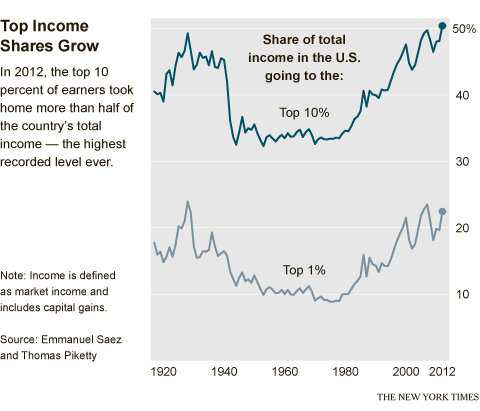
An updated study by economist Emanuel Saez of U.C. Berkeley shows that the the top 1% of earners in the United States received more than 20% of the country’s total income in 2012, while the top 10% of earners received more than half of the country’s income. The share of income going to the wealthiest Americans is now at or near the highest levels on record since the government began keeping the relevant statistics and the federal income tax was created in 1913.

What’s even more remarkable, perhaps, is that the income of the top 1% went up nearly 20% in 2012, while the income of the remaining 99% rose only 1%. Since 2009, the wealthiest 1% have taken 95% of the income gains in our supposedly classless society.

We should remember these statistics when we hear Republican politicians, who pretend to be friends of the middle class, claim that lower taxes for the wealthy benefit everyone. It’s past time to raise taxes on the rich, invest in America’s infrastructure and start creating decent jobs again. Otherwise we’re going to continue to get economically screwed.

Note the year 1980 in this chart, when class warrior and demagogue supreme Ronald Reagan was elected President:

10economix-sub-wealth-blog480

http://takingnote.blogs.nytimes.com/2013/09/11/the-rich-got-richer/

Responding to the Use of Chemical Weapons (3rd Edition)

Getting killed or maimed by a chemical weapon isn’t necessarily worse than being killed or maimed by a bullet or high explosive. Being aware of their terrible effects, however, almost all countries have agreed not to use chemical weapons. And despite the fact that we’ve been lied to before by our political leaders (for example, regarding the Gulf of Tonkin incident and Iraq’s weapons program), it seems likely that President Obama is telling the truth and correctly interpreting the evidence that the Syrian government has used chemical weapons — to devastating effect.

Before the President spoke yesterday, I would have bet that he was going to tell the Navy to launch cruise missiles against targets in Syria. Other presidents have made similar decisions, without Congressional approval and certainly without a declaration of war. That can be the right thing for a President to do in extraordinary circumstances. Yet I was hoping that Obama would wait for the report of the U.N. inspectors and also seek approval from Congress. If it’s clear that the Syrian government launched this attack, there should be a response, but that response doesn’t need to be immediate. It should also be a response supported by Congress, since we’re supposed to be a democracy.

Now there will be a debate in Congress. as well as a continuing debate in the media. We’ll hear many good reasons why the United States shouldn’t do anything, and some very good reasons for doing something. Maybe this will be one of those cases in which the “wisdom of crowds” will result in a good decision, even an improvement on what the President wants to do. Unfortunately, Congress, especially this Congress, rarely does anything wise.

This is the third time I’ve written this post, after deleting it twice. There is a strong moral case for doing something to stop the Syrian government and other governments from using chemical weapons, even though that may be a difficult thing to do and there will be unforeseeable consequences. We can’t know yet whether those possible consequences tip the scale toward doing nothing. 

The truth is that I don’t know what I’d do if I were Obama or a member of Congress. What’s happening in Syria (and Egypt, Iraq, etc.) may be so sick and so irrational that there is nothing for the rest of us to do but watch, hoping that these people will get tired of hating and killing each other or that someone will eventually exert control over the situation. One of those things might happen, probably after we’re dead and gone.