The Usual Fear Mongering Baloney

Fox News headline: “ObamaCare could lead to loss of nearly 2.3 million US jobs, report says”.

Speaker of the House John Boehner tweets: “Pres. Obama’s [health care law] expected to destroy 2.3 million jobs”.

What the Congressional Budget Office really said:

CBO estimates that the ACA will reduce the total number of hours worked, on net, by about 1.5 percent to 2.0 percent during the period from 2017 to 2024, almost entirely because workers will choose to supply less labor — given the new taxes and other incentives they will face and the financial benefits some will receive….the largest declines in labor supply will probably occur among lower-wage workers….

The estimated reduction stems almost entirely from a net decline in the amount of labor that workers choose to supply, rather than from a net drop in business’ demand for labor, so it will appear almost entirely as a reduction in labor force participation and in hours worked relative to what have occurred otherwise rather than as an increase in unemployment (that is, more workers seeking, but not finding jobs) or underemployment (such as part-time workers who would prefer to work more hours per week)….

In other words, some people, especially low-wage workers, will decide to work less because of the ACA, mostly because of the benefits they’ll receive.

I don’t know why those who wrote the report believe this will result in fewer hours being worked. In the case of anyone but the self-employed, employers will presumably still want someone to work those hours. As the supply of labor declines, the demand for labor should increase, resulting in rising wages for some workers and job openings for others (and, of course, low wages and unemployment are still two of our major problems). 

You might even argue (incorrectly) that everybody should work as much as possible, because that’s the capitalist way. That’s very different, however, from saying the ACA is going to destroy millions of jobs. 

As usual, Paul Krugman offers thoughtful commentary on the economics and the social impact here and here.

We Should Expect Divided Government For a Long Time

Back in July, I wrote about the unrepresentative nature of the House of Representatives:

The House doesn’t represent the will of the people, because small states are over-represented (some congressional districts are nearly twice as large as others) and recent gerrymandering results in more Republicans being elected than Democrats, even though Democrats get more votes.

What I should have said is that some small states are over-represented and others are under-represented. For example, Rhode Island’s two members of Congress each represent only 525,000 people. Wyoming’s single member represents about 580,000. Yet Delaware‘s one member of Congress represents 925,000 and Montana‘s represents more than one million.

That might be a wash in political terms, because some small states lean left and some lean right. Unfortunately, of the 12 states that have no more than two representatives in Congress, eight lean right and only 4 lean left.

In addition, we shouldn’t forget the District of Columbia, which has more people than Vermont and Wyoming, definitely leans left and isn’t properly represented in Congress at all (they don’t have a senator and their representative gets to talk but not vote). This all adds up to an advantage for the Republicans.

In that post, I also said that gerrymandering resulted in more Republicans being elected to the House in 2012 than Democrats, even though Democrats got more votes. I was right about the numbers: the Republicans received only 47.6% of the total House vote, but ended up with 51.7% of the seats, which resulted in the Republicans having almost total control of the House of Representatives, since the House is run more efficiently (i.e. less democratically) than the Senate.

It might be the case, however, that gerrymandering doesn’t explain the Republicans’ success. That’s not to say the Republicans haven’t done their best to draw Congressional district boundaries to their advantage. They clearly did so the last time they got the chance and did it with more dedication than the Democrats.

Nevertheless, a recent study suggests that the Republicans have a natural advantage in House races. The reason could be that Democrats have gerrymandered themselves by tending to live in big cities, college towns and old manufacturing centers. That’s how gerrymandering works. You try to clump together people who vote for your opponents in as few districts as possible. This creates a few extremely safe seats for your opponents (ideally, they’d get 100% of the vote in a few districts), and a bunch of relatively safe seats for your side. It’s basically voter segregation or ghettoization. By living close together in places like Atlanta, Ann Arbor and Toledo, Democratic voters appear to have put themselves at a natural geographical disadvantage in House races.

The people who did the study claim to have tried out thousands of different district boundaries in 49 states (no Alaska? no Rhode Island?). The results were not encouraging for Democrats or opponents of gerrymandering:

In the vast majority of states, our nonpartisan simulations produced Republican seat shares that were not much different from the actual numbers in the last election. This was true even in some states, like Indiana and Missouri, with heavy Republican influence over redistricting.

It might be possible to counteract this Republican advantage by creating lots of districts that radiate out from the centers of towns and cities and would include a nice mix of urban, suburban and rural voters. The authors of the study seem to discount this possibility. At any rate, their point is that by living in relatively close quarters, Democrats are at a natural disadvantage when it comes to electing members of the House of Representatives.

A reasonable conclusion to draw from all of this is that Congress is even less representative than it seems to be. The Senate was explicitly designed to favor the interests of lightly-populated states, which now tend to vote Republican, while the House exhibits some favoritism toward small states, but more importantly is gerrymandered, whether on purpose or by simple geography, to favor Republicans as well.

The good news is that Democratic presidential candidates may continue to do relatively well, since most people pay at least some attention to politics during presidential elections and most people agree with Democratic policies (progressive taxation, more social spending, less military spending). Democrats who run for President will do well, that is, until they actually have to govern. Then they’ll have to deal with too many Republicans in Congress.

After a Major Event, Life Goes On, But Surreptitiously

gnote1A major event? Yes, finally replacing my aging but handy Blackberry with a new Android smartphone (good-bye, Verizon, you bloodsuckers!).

Some might say it’s only a phone. It feels more like a lifestyle. You can’t do that anymore. Do this now. How do I do that? Guess! Or download an app. Which app? That app! Wait, what did I just do? I must have touched something. Oh, no!

Come on, why do you zoom in on Google Maps by pinching your fingers together instead of spreading them apart? Isn’t spreading them apart a more expansive gesture? And why can’t I spread my fingers apart in the prescribed way? It’s probably a genetic defect. Those of us who can easily carry out the correct two-finger spreading motion are now better-suited to getting around and finding mates. The rest of us will tend to stay put and die alone. If only I could remember the Alternate Zoom Technique:

In addition to pinching the screen to zoom, you can also double-tap on your map, hold, and then scroll down to zoom in, or scroll up to zoom out.

Coincidentally, the New York Times reported more from the Snowden Files today:

When a smartphone user opens Angry Birds, the popular game application, and starts slinging birds at chortling green pigs, spy agencies have plotted how to lurk in the background to snatch data revealing the player’s location, age, sex and other personal information, according to secret British intelligence documents.

In their globe-spanning surveillance for terrorism suspects and other targets, the National Security Agency and its British counterpart have been trying to exploit a basic byproduct of modern telecommunications: With each new generation of mobile phone technology, ever greater amounts of personal data pour onto networks where spies can pick it up….

[Among] the most valuable of those unintended intelligence tools are so-called leaky apps that spew everything from users’ smartphone identification codes to where they have been that day.

Fortunately, I don’t play with angry birds. But Google Maps is said to be one of the best sources of information for the intelligence agencies. The Times quotes a secret report from Britain’s G.C.H.Q. suggesting that “anyone using Google Maps on a smartphone is working in support of a G.C.H.Q. system”. Thank you. No problem.

We know that corporations collect whatever information they can about us. Now we know that the NSA and GCHQ are doing the same.

But assuming that we don’t want to stop using our phones or the internet and we can’t get our governments to stop this spying, we can take some solace in the fact that these people are collecting so much data, they don’t know what to do with it. Most of us will never stand out in the crowd.

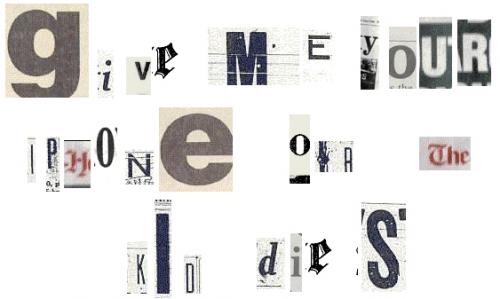
However, if you happen to be planning a terrorist attack, or want to tell the President he or she is a jerk, you should definitely avoid Angry Birds. Or communicate the old-fashioned way:

ransom-note

Reasonable and Customary

We just received a notice in the mail telling us we are part of another class action lawsuit. This time the defendant in the case is our health insurance company. When we’ve been included in a class action lawsuit in the past, it’s usually meant that a small check was coming our way. It’s always good to get an unexpected check in the mail, even a small one. And there’s the justice angle, too. Some corporation or other is paying for its bad behavior.

In this case, our health insurance company has agreed to stop relying on two questionable databases when they determine those wonderful “reasonable and customary” charges: “We could give you 80% of what your doctor charged. Instead, we’ll give you 80% of the reasonable and customary charges where you live”.

Unfortunately, as we all know, everyone’s doctor always seems to charge more than what is “reasonable and customary”, according to the insurance companies.

So it’s good news that the company will stop short-changing its customers by underestimating “reasonable and customary” charges. That’s the principal result of our class action lawsuit being settled.

Another result is that the two named plaintiffs in the case (the “class representatives”) are going to receive a total of $35,000 as “incentive payments”. In other words, they’re being rewarded for bringing the lawsuit, and to encourage other injured parties to bring their own lawsuits in similar cases. 

Ok, that’s all well and good, but how about that check for $25 or $11.95 that’s going to be coming our way? The settlement is supposed to be “fair, reasonable and adequate to the members of the Class”, and we are definitely members of the unfortunate class shortchanged by our insurance company, so some financial compensation is in order, even if it’s only enough to buy lunch.

To our surprise, however, the settlement doesn’t include cash compensation to anyone but the two named plaintiffs. Maybe the lawyers forgot about us (we’ve never been introduced).

What the lawyers clearly did remember was to collect their fees. The settlement calls for our insurance company to pay “an award of attorneys’ fees and costs for Class Counsel not to exceed the sum of $2,500,000”.

So the two plaintiffs get $35,000, the rest of us get a notice in the mail and a promise of good behavior from our insurance company, while the lawyers who handled the lawsuit get no more than $2.5 million, which the insurance company can pay off by adding a few pennies to its rates. 

I believe that’s what lawyers call “reasonable and customary”.

It’s the Austerity and Lack of Trust

The chart below shows government spending after our last four recessions (that’s total federal, state and local spending, corrected for inflation, with the numbers at the bottom representing yearly quarters after the recessions).

After three recessions, government spending went up. After the most recent recession, it’s gone down:

blog_austerity_state_local_federal_spending_0

It makes sense for families to cut spending if they run into economic difficulty, but it makes no sense for the government to do the same. In situations like we’re in now, the government has to counteract the natural tendency of families and businesses to cut back when economic times are hard. Common sense and economic theory tell us the government should spend more after a recession in order to help the economy recover, even if that means increasing government debt until things get better. Yet we’ve been following the opposite policy the past few years. The result has been a relatively weak recovery that has left too many Americans unemployed and underemployed.

Why have we acted so stupidly? The obvious answer is that there were Republicans in the White House after those earlier recessions. Now there’s a Democrat. That’s why Republicans in Congress supported government spending after the earlier recessions, but have vigorously opposed it this time. (After all, Republicans love certain kinds of government spending, despite what they claim.) Hypocrisy, foolishness, the desire to recapture the White House, combined with the failure of Democrats to make the case for more stimulus. It’s all those things and more. 

The chart is from “How Austerity Wrecked the American Economy” at Mother Jones. The author updates the story here.

Meanwhile, Paul Krugman sees a connection between the declining acceptance of evolution among Republicans and their rejection of stimulus spending: in order to be a good Republican these days, you have to deny climate change, evolution and modern economics.

Another economist who has repeatedly pointed out the stupidity of what we’ve been doing is Joseph Stiglitz. In a New York Times article called “In No One We Trust”, he explains how we’re losing trust in each other and our institutions as inequality increases. The article is especially interesting when he shows how a lack of trust and an excess of bad behavior got us into the economic mess we’re still trying to get out of:

Trust is becoming yet another casualty of our country’s staggering inequality: As the gap between Americans widens, the bonds that hold society together weaken. So, too, as more and more people lose faith in a system that seems inexorably stacked against them, and the 1 percent ascend to ever more distant heights, this vital element of our institutions and our way of life is eroding….

The banking industry is only one example of what amounts to a broad agenda, promoted by some politicians and theoreticians on the right, to undermine the role of trust in our economy. This movement promotes policies based on the view that trust should never be relied on as motivation, for any kind of behavior, in any context. Incentives, in this scheme, are all that matter.