Democrats and Republicans

Today, Rep. Nancy Pelosi, the leader of the Democrats in the House of Representatives, gave the longest speech in the history of the House, which goes back to 1789. After it was discovered that the House rules allow party leaders to speak as long as they want, Pelosi stood and spoke for a little over eight hours.

The longest speech in the history of the U.S. Senate lasted 24 hours. It was given in 1957 by a racist Southerner in opposition to that year’s Civil Rights Act. At the time, he was a Democrat (because most Southerners were), but he became a Republican after passage of the 1964 Civil Rights act (as most Southerners did). He remained a Republican for the next thirty-nine years.

That basically sums up our two political parties. A woman wants people illegally brought here as children to be protected against deportation and to have a chance to become American citizens. A man wanted to stop everyone from having equal rights, especially black people.

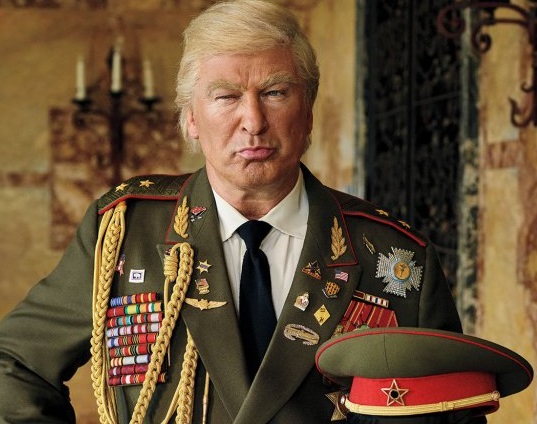
I Want to Wear a Uniform with a Big Hat Too

It’s no surprise that our president is a big fan of military parades. He loved the Bastille Day parade he attended in Paris last year and a similar parade he saw in China. Regarding the latter one, he remarked:

The hosting of the military parade this morning was magnificent, and the world was watching. I’ve already had people calling from all parts of the world. They were all watching. Nothing you can see is so beautiful.

It is now being reported that the president has directed the Pentagon to plan a military parade in Washington. November 11th (Veteran’s Day) has been mentioned as a possible date (although I bet he’ll want to stage it before Election Day, not after).

In response, Major General (Retired) Paul Eaton, an adviser to the progressive organization Vote Vets, issued the following statement:

Donald Trump has continually shown himself to have authoritarian tendencies, and this is another worrisome example.

For someone who just declared it was “treasonous” not to applaud him, and for someone who has, in the past, admired the tactics of everyone from Saddam Hussein to Vladimir Putin, it is clear that a military parade isn’t about saluting the military — it is about making a display of the military saluting him.

The military is not Donald Trump’s to use and abuse in this way. Our military is the very best in the world — they are not to be reduced to stagecraft to prop up Donald Trump’s image. Any commander-in-chief who respects the traditions of the military would understand that.

Unfortunately, we do not have a commander-in-chief right now, as much as we have a wannabe banana republic strongman.

splash_baldwin1-thr_exclusive

It’s only a matter of time.

That He’s Against Democracy Is Considered a Plus

Another big question about this president — besides “why didn’t they realize he’s a con man?” — is “why don’t Republican politicians stand up to him?” Jonathan Chait of New York Magazine offers an answer:

Republican elites who opposed Trump during the primary, as most of them did, had different reasons for their opposition. But a central rationale for conservative opposition was the belief that Trump would deviate from conservative policy. The keystone editorial in National Review’s celebrated “Against Trump” special issue revolved around the candidate’s lack of ideological consistency:

“Trump is a philosophically unmoored political opportunist who would trash the broad conservative ideological consensus within the GOP in favor of a free-floating populism with strong-man overtones … Trump’s political opinions have wobbled all over the lot. The real-estate mogul and reality-TV star has supported abortion, gun control, single-payer health care Ă  la Canada, and punitive taxes on the wealthy…. Since declaring his candidacy he has taken a more conservative line, yet there are great gaping holes in it … Donald Trump is a menace to American conservatism.”

The key phrase here is the last one, “menace to American conservatism.” It is distinct from, say, a menace to the republic. Non-conservatives may have read into conservative anti-Trumpism a set of shared, small-d democratic concerns. But the major fear that stalked the right was the specter of higher marginal tax rates and bipartisan health-care legislation. To the extent that conservatives raised concerns about Trump’s ignorance and authoritarianism, it was harnessed to his lack of ideological commitment. Conservatives could imagine Trump as an American Perón, catering to the masses with a populist agenda while sidelining the conservative elite.

What did not especially trouble them was the prospect of Trump as an American Pinochet. (Augusto Pinochet was the Chilean general who overthrew a democratically elected socialist government and implemented free-market policies, with the advice and enthusiastic support of American conservatives.) And while Trump has proven every bit as ignorant and instinctively authoritarian as his worst enemies feared, he has vanquished nearly all right-wing doubts about his ideological bona fides (or, at least, his malleability to the same end).

The idea that Trump’s anti-democratic qualities per se would alienate him from his party is a fantasy that rests upon a deep misunderstanding of conservatism. The Republican Party is attracted to anti-democratic means, so long as they’re used for the correct ends. Look at North Carolina, where Republicans designed a vote-restriction measure that, a judge found, would “target African-Americans with almost surgical precision” and then greeted the election of a Democratic governor by stripping him of his powers before he could assume office. Or look at Pennsylvania, where the party is so determined to lock in a voting map that allows them to rule as a minority that, when the State Supreme Court ruled its anti-democratic scheme unconstitutional, the party first defied the court’s authority, and is now working to impeach the justices. None of these maneuvers has provoked any significant intra-party dissent.

Against this chilling backdrop, the president’s frequently stated intent to make federal law enforcement a weapon to protect his party and investigate his opponents hardly even registers. Indeed, Trump’s routine authoritarian bluster nestles comfortably into a party where panic about unfriendly demographic changes has curdled into deep suspicion of the principle of majority rule. Trump as an individual is surely a grotesque outlier. But the overall direction of his presidency is an outgrowth of the party’s long-standing direction. Conservatives once feared Trump as a blunt instrument. Now they recognize and appreciate that the blunt instrument is a weapon of their cause.

He campaigned as if he was a “small-d” democrat, but he governs like a Republican, only more so.
Summing Him Up

Last night, I was musing about the current crisis and asked myself again why they didn’t see that he’s a con man, so his promises about “the forgotten men and women of our country” were pure baloney. The answer that occurred to me was that he said what they wanted to hear about race and immigration. That was enough for them to give him the benefit of the doubt on economics.

This morning, Neera Tanden summed him up very well:

The economic populism was always the con. The racism was always real.

Secretary Nielsen Bullshits. Senator Booker Speaks.

Before today, very few people could identify Kirstjen Nielsen. She has been the U.S. Secretary of Homeland Security for less than six weeks. But that means she is a senior official in the Trump administration, responsible for enforcing our immigration laws and making sure nobody travels to America with a bomb in their underwear. The Department of Homeland Security was created in the aftermath of the 9/11 attack.

Now Secretary Nielsen will be well-known. She testified (under oath) before the Senate Judiciary Committee today. Here’s the brief exchange that will make her famous:

Senator Leahy: “Norway is a predominantly white country, isn’t it?”

Secretary Nielsen: “I actually don’t know that, sir. But I imagine that is the case.”

It’s certainly peculiar that she wasn’t sure, or wasn’t willing to admit, that most Norwegians are white, especially since her position involves protecting America’s international borders; she attended the meeting at which the president made his infamous comment about Norwegian immigrants being preferable to those from Africa and Haiti; she has the ultra-Scandinavian name of “Kirstjen Nielsen”; and she isn’t seven years old.

I’ve recounted this vignette (one more moment in that ongoing story “America, How Could You Possibly Have Done This?”) to provide some context for something else that happened at today’s Judiciary Committee hearing. Senator Cory Booker was there. He used to be the mayor of Newark, New Jersey, an old industrial city that our president must think is a shithole. Now he represents New Jersey in the U.S. Senate. He could have asked Secretary Nielsen questions, but chose instead to make an eight-minute speech. The whole thing is worth listening to. He speaks with such intensity that it goes by quickly.

Senator Booker may be our president one day. What an upgrade that would be!