Whereof One Can Speak 🇺🇦

Nothing special, one post at a time since 2012

Section 3 of the 14th Amendment Should Matter

No person shall … hold any office, civil or military, under the United States … who, having previously taken an oath … to support the Constitution of the United States, shall have engaged in insurrection or rebellion against the same, or given aid or comfort to the enemies thereof. 

The 14th Amendment was ratified in 1868. Section 3 was designed to stop anyone who had rebelled against the United States from ever having a role in the government again. It’s not commonly applied (we don’t have that many insurrections or rebellions), but it’s still in the Constitution. The New York Times reports that legal experts are paying attention:

Two prominent conservative law professors have concluded that [the Orange Menace] is ineligible to be president under a provision of the Constitution that bars people who have engaged in an insurrection from holding government office. The professors are active members of the Federalist Society, the conservative legal group, and proponents of originalism, the method of interpretation that seeks to determine the Constitution’s original meaning.

“Originalism” is bullshit, but others have reached the same conclusion, including a University of Virginia professor and Citizens for Responsibility and Ethics in Washington (CREW). What’s interesting about these two professors is that they would ordinarily be expected to bend over backwards to support the Orange Menace, like so many other Federalist Society members have done.

The Times article suggests the likelihood of lawsuits:

The scope and depth of the article may encourage and undergird lawsuits from other candidates and ordinary voters arguing that the Constitution makes him ineligible for office.

“There are many ways that this could become a lawsuit presenting a vital constitutional issue that potentially the Supreme Court would want to hear and decide,” [one of the authors] said.

Of course, the Supreme Court deciding that the 14th Amendment applies to the former president would require two of the Court’s right-wing, so-called “originalist” Justices to accept the Constitution’s plain language, not something they’re used to doing.

Nevertheless, here’s the authors’ summary of the article:

Section Three of the Fourteenth Amendment forbids holding office by former office holders who then participate in insurrection or rebellion. Because of a range of misperceptions and mistaken assumptions, Section Three’s full legal consequences have not been appreciated or enforced. This article corrects those mistakes by setting forth the full sweep and force of Section Three.

First, Section Three remains an enforceable part of the Constitution, not limited to the Civil War, and not effectively repealed by nineteenth century amnesty legislation.

Second, Section Three is self-executing, operating as an immediate disqualification from office, without the need for additional action by Congress. It can and should be enforced by every official, state or federal, who judges qualifications.

Third, to the extent of any conflict with prior constitutional rules, Section Three repeals, supersedes, or simply satisfies them. This includes the rules against bills of attainder or ex post facto laws, the Due Process Clause, and even the free speech principles of the First Amendment.

Fourth, Section Three covers a broad range of conduct against the authority of the constitutional order, including many instances of indirect participation or support as “aid or comfort.”

[Section Three] covers a broad range of former offices, including the Presidency. And in particular, it disqualifies [the former president], and potentially many others, because of their participation in the attempted overthrow of the 2020 presidential election.

Please Ignore The Nonsense

The usual suspects claim the Orange Menace (hereafter OM) shouldn’t be prosecuted for what he did to stay in office. They offer three main reasons, all of them bullshit:

  1. He’s being prosecuted for lying about the election.
  2. He actually believed he won the election.
  3. He relied on the advice of his lawyers

Unfortunately, these excuses are being treated with a degree of respect by people who should know better.

First, he’s not being prosecuted for telling lies.

As the indictment states, [OM] “had a right, like every American, to speak publicly about the election and even to claim, falsely, that there had been … fraud during the election and that he had won”. He is being prosecuted for the illegal actions he took to change the result.

There are legal ways to challenge an election, both of which OM took advantage of. He demanded recounts. They didn’t change the result. He went to court. All of his lawsuits were rejected, even by judges he nominated.

But OM went much further than that. From Ruth Marcus of The Washington Post:

“The heart of our jurisprudence with respect to the First Amendment is the difference between regulating speech and regulating conduct,” Rep. Jamie B. Raskin (D-Md.), once a constitutional law professor, [explained]. “Everything charged in the indictment involves criminal conduct by [OM] and not the mere expression of political views….

Thus, the indictment doesn’t accuse [OM] of breaking the law by claiming the election was stolen. It asserts, instead, that … [he] pushed state officials to ignore the popular vote; that he organized “fraudulent slates of electors,” including some who were “tricked into participating,” and that he and his co-conspirators [pressured] the vice president to refuse to certify the election results.

Those actions were illegal and have nothing to do with the First Amendment right to free speech.

But what if [OM] truly believed he won the election? From Judd Legum of Popular Information:

[The Washington Post, Axios, CNN and The New York Times] are all “reporting” that, to convict [OM], Jack Smith has to prove [he] knew he was lying about the 2020 election. [His] lawyer is saying the same thing. And so is Fox.

The problem with this analysis is it’s completely wrong.

A successful prosecution does not hinge on what [he] BELIEVED about the 2020 election. If [he] is convicted, it will be based on his ACTIONS….

Creating a fake set of electors and then pressuring your VP to declare them valid is not one of your legal options. [Attorney Marc Elias] explained it this way: “I walk into a bank, and I think they are wrongfully holding my money. I think my balance is $5,000, and they think my balance is zero… That doesn’t excuse me from robbing the bank. I can’t pull out a gun and take the money”.

Smith spends time on evidence establishing [OM] knew he was lying to show [his] motivation. He is not required to prove motive under the law, but juries generally are looking for a motive. In this case, Smith is showing [OM] was trying to remain in power. But the media coverage is confusing a trial tactic with a legal requirement. Proving [OM] knew he was lying will be helpful to Smith, but it’s not central to his legal case. The coverage suggesting otherwise is wrong.

Finally, was the defendant simply relying on the advice of his lawyers?

One of the ways OM has successfully avoided prosecution in the past is that he’s insulated himself behind teams of lawyers and accountants. There is always somebody else to blame for whatever he did. Returning to that earlier example, your lawyer telling you it’s okay to rob a bank doesn’t make it so. You need to use your common sense. What happened in this case is that OM was desperate to overturn the election, so he looked for lawyers who’d help him, ignoring all the ones who wouldn’t. From Greg Sargent of The Washington Post:

The indictment contains lots of ammunition against this defense. For instance, it shows Pence repeatedly told [OM] he had no such authority. On one occasion, [OM] blithely suggested he would “prefer” to believe otherwise. On another, [OM] rebuked Pence for refusing to abuse his authority: “You’re too honest.”

It wasn’t just the Vice President who told OM the truth. His Attorney General and others in his administration told him the same thing. On top of that, judges, lawyers and law professors all over the country were saying there was no way to stop or pause the counting of the electoral votes on January 6, 2021. For example, from NBC News at the time:

A federal district court in Washington recently ruled against a last-ditch effort suit by [OM] supporters against Pence, Congress and the Electoral College that sought to stop the certification of Biden’s win.

The plaintiffs’ theory “lies somewhere between a willful misreading of the Constitution and fantasy,” a judge ruled Monday, denying the motion.

From Salon in December 2020:

“Pence’s constitutional role is to ‘open’ the certificates. That’s it,” said Harry Litman, a former Justice Department official and constitutional law expert at UCLA. “Not to certify. Not even technically to count. He has no way even to purport to change the count. It’d be like saying the Oscar presenters get to decide who wins best picture.”

“The idea that Pence is going to overturn the election in January is pure fantasy-land nonsense,” Justin Levitt, an election law expert at Loyola Marymount University, told Vice News.

From the right-wing National Review on January 5, 2021:

I’m starting to wonder if this is a gag: Like, in order to amuse himself, President [OM] is trying to see how far erstwhile “constitutional conservative” Republicans are willing to beclown themselves … Whatever it may be, it’s time to stop. It was actually time to stop a few weeks ago, but this has gotten so irrational it no longer rises even to the level of farce.

The president now says Vice President Pence has the unilateral authority to invalidate state electoral votes that he decides are fraudulent. That is a ridiculous claim. 

OM preferred to ignore a national chorus of legal experts and people with common sense who said he lost and there was nothing he could do about it. He preferred to work with a tiny minority willing to tell him what he wanted to hear. It’s no surprise that the leading members of that tiny minority are now known as his co-conspirators, numbers 1 through 6.

It Used To Be the Blue and the Gray; Now It’s Blue and Red

One of the most moronic members of Congress was in the news recently when she proposed a “national divorce”. Red and blue states would go their separate ways. She’d have us remain one country, but the national government would have much less authority than it does now.

American politics being what it is these days, many of us, probably most of us, have thought it would be a good idea if those other states — the crazy ones — went off and formed their own damn country. Unfortunately, this would be a very difficult thing to do.

Back in 1861, the country was geographically divided between the North and South. The South  had slavery, its “peculiar institution”, and the North didn’t. But the division wasn’t that clearcut. There were five “border states” (Missouri, Kentucky, West Virginia, Maryland and Delaware, moving from west to east) that permitted slavery but didn’t secede from the Union. They’re the light blue ones below (the gray areas were relatively unsettled “territories” that hadn’t yet become states).
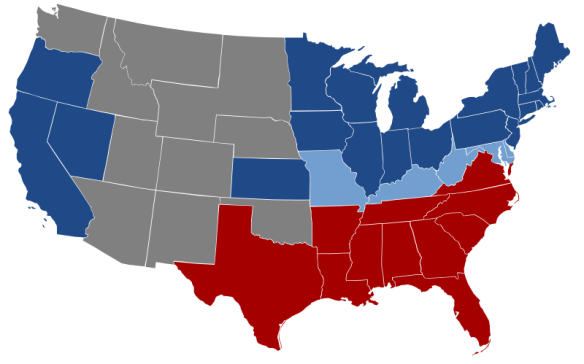
US_map_1864_Civil_War_divisions.svg

President Lincoln’s Emancipation Proclamation was only intended to end slavery in the eleven states that had seceded. It wasn’t until the 13th Amendment to the Constitution was ratified in 1865 that slavery was abolished everywhere. But geography made it relatively easy for the southern states to try to leave.

Dividing America by red and blue states is more complicated today. This map shows the results of the 2020 presidential election. The blue states voted for the Democratic winner; the red ones for the Republican loser. The red states are connected; the blue ones aren’t. And look at Georgia all by itself. (That’s where the Republican moron who proposes a national divorce was voted into Congress. Based on this election, she’d want to relocate.)
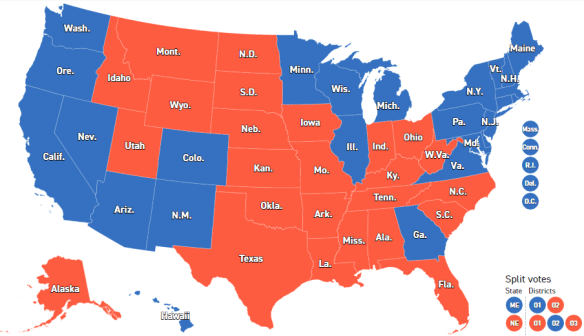
Untitled This way of portraying an election makes sense in terms of our obsolete Electoral College, since it requires each state to hold its own separate presidential election. In almost every state, a candidate gets all of that states “electoral votes” if they beat their opponent by one vote in that state’s election.

But a state-level map hides something important about American politics. After the 2004 election, the editors of a Seattle alternative paper called “The Stranger” wrote about our Urban Archipelago:

Look at our famously blue West Coast. But for the cities—Seattle, Portland, San Francisco, Los Angeles, and San Diego—the West Coast would be a deep, dark red. The same is true for other nominally blue states. Illinois is almost entirely red—Chicago turns the state blue. Michigan is almost entirely red—Detroit, Lansing, Kalamazoo turn it blue. And on and on. What tips these states into the blue column? Their urban areas do, their big, populous counties….

Liberals, progressives, and Democrats do not live in a country that stretches from the Atlantic to the Pacific, from Canada to Mexico. We live on a chain of islands. We are citizens of the Urban Archipelago, the United Cities of America. We live on islands of sanity, liberalism, and compassion—New York City, Chicago, Philadelphia, Seattle, St. Louis, Minneapolis, San Francisco, and on and on.

And we live on islands in red states too—a fact obscured by that state-by-state map. Denver and Boulder are our islands in Colorado; Austin is our island in Texas; Las Vegas is our island in Nevada; Miami and Fort Lauderdale are our islands in Florida. Citizens of the Urban Archipelago reject heartland “values” like xenophobia, sexism, racism, and homophobia, as well as the more intolerant strains of Christianity that have taken root in this country….

For Democrats, it’s the cities, stupid—not the rural areas, not the prickly, hateful “heartland,” but the sane, sensible cities—including the cities trapped in the heartland.

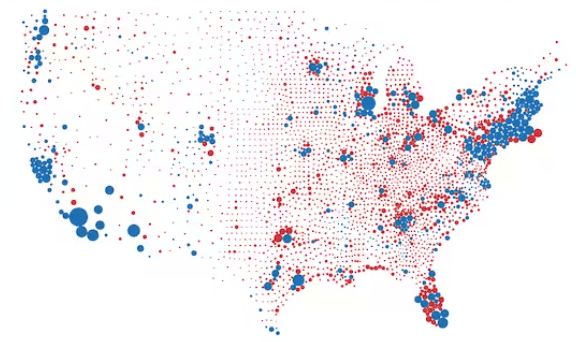
This map shows the 2020 election by county instead of state. The blue dots are the Urban Archipelago, the United Cities of America. (The map also shows how Biden managed to win by 7.5 million votes, unlike state-level maps that ignore how many people are in those states.)
Untitled

Of course, not everybody in Los Angeles County or Miami-Dade voted for Democrats. But on top of all its other problems, a “national divorce” by state would strand millions of Democratic city dwellers in red Republican states free to become even more reactionary and dangerous to live in.

Even though un-uniting the United States is unlikely, thinking about the possibility helps us understand our country’s political geography. According to a 2019 paper by Will Wilkinson of the Niskanen Center, it’s all about cities and population density. The title of the paper is “The Density Divide: Urbanization, Polarization and the Populist Backlash”. Here’s his summary of his findings:

We’ve failed to fully grasp that urbanization is a relentless, glacial social force that transforms entire societies and, in the process, generates cultural and political polarization by segregating populations along the lines of the traits that make individuals more or less responsive to the incentives that draw people to the city. I explore three such traits — ethnicity, ideology-correlated aspects of personality, and level of educational achievement — and their intricate web of relationships. The upshot is that, over the course of millions of moves over many decades, high density areas have become economically thriving, multicultural havens while whiter, lower density places are facing stagnation and decline as their populations have become increasingly uniform in terms of socially conservative personality, aversion to diversity, and lower levels of education. This self-segregation of the population, I argue, created the polarized economic and cultural conditions that led to populist backlash [note: and the election of You Know Who in 2016].

Because the story of urbanization just is the story of a strengthening relationship between density, human capital and economic productivity, it’s also the story of relative small town and rural decline. The same process that has filtered better-educated, more temperamentally liberal whites out of lower density places has left those places with less vibrant economies, but also with more place-bound, ethnocentric populations.

It’s no shock that leavers leave and stayers stay. What’s surprising is that, if you’re white…,  the personality traits that make you more or less inclined to leave or stay — that make you more or less magnetized to the rising attractive force of the city — also predict how socially conservative or liberal you’ll tend to be, and which political party you’ll tend to support.

So the pull of urbanization has segregated us geographically on those traits, and it has done it so thoroughly that Democratic vote share now rises, and Republican vote share drops, in a remarkably linear fashion as population density rises. The relationship between density and party affiliation is, with few exceptions, similar everywhere — in “red states” and “blue states,” in sprawling metro regions and bucolic small towns — and majorities tend to flip at the density typical of a big city’s outer suburbs. I call this partisan polarization on population density the “density divide.”

When populations segregate geographically on traits relevant to ideology and party affiliation, political polarization is sure to follow. The increasing concentration of the economy in big cities, which is both a cause and effect of urbanization, amplifies this polarization. Rising prosperity reliably produces a liberalizing, tolerant, positive-sum mood. Material insecurity, in contrast, tends to elicit a grim, zero-sum, us-or-them mindset. Because the sunshine of prosperity has become increasingly focused on urban populations, lower density white populations — which, thanks to the sorting logic of urbanization, are already more conservative and ethnocentric — have been left with objectively darkening prospects and a mounting sense of anxiety that is, at once, economic and ethno-cultural.

This combination of conditions created a political opportunity [a certain orange demagogue]  managed to exploit. Because urbanization is reshaping societies everywhere around the world, it has created similar conditions, and similarly illiberal strongman leaders, in other countries as well. If we’re going to be able to do anything about the acrimony of polarization and the peril of ethno-nationalist populism, we’re going to have to get the story straight. This cross-disciplinary account of the social and psychological forces behind the density divide is my preliminary attempt to put us, finally, on the right track.

When It’s Time to Throw in the Towel

Imagine you are one of the millions of high school students who take the Scholastic Aptitude Test in your senior year. You get your results and believe the company that administers the test, the College Board, made a serious mistake. You must have scored much higher than they say. A few people you know think you could be right, but most people you talk to are doubtful. You sue the College Board and a judge, citing your lack of evidence, quickly dismisses your case. So you spend thousands of dollars hiring a respected research firm to confirm your suspicions. They find out if other students are disputing the results. They look at your grades and previous test results. They even give you a practice test and your score is no better than the official result you got in the mail. Would anybody believe you if you said you just know you scored much higher?

Now imagine that you ran for president and lost. From The Washington Post:

Former president T____’s 2020 campaign commissioned an outside research firm in a bid to prove electoral fraud claims, but never released the findings because the firm disputed many of his theories and could not offer any proof that he was the rightful winner of the election, according to four people familiar with the matter. A person familiar with the findings said there were at least a dozen hypotheses that T____’s team wanted tested.

The campaign paid researchers from Berkeley Research Group, the people said, to study 2020 election results in six states, looking for fraud and irregularities to highlight in public and in the courts. Among the areas examined were voter machine malfunctions, instances of dead people voting and any evidence that could help T____ show he won, the people said. None of the findings were presented to the public or in court.

About a dozen people at the firm worked on the report, including econometricians, who use statistics to model and predict outcomes, the people said. The work was carried out in the final weeks of 2020, before the Jan. 6 riot of T____ supporters at the U.S. Capitol….

“They looked at everything: change of addresses, illegal immigrants, ballot harvesting, people voting twice, machines being tampered with, ballots that were sent to vacant addresses that were returned and voted,” said a person familiar with the work who, like others, spoke on the condition of anonymity to describe private research and meetings. “Literally anything you could think of. Voter turnout anomalies, date of birth anomalies, whether dead people voted. If there was anything under the sun that could be thought of, they looked at it.”

The findings were not what the T____ campaign had been hoping for, according to the four people. While the researchers believed there were voting anomalies and unusual data patterns in a few states, along with some instances in which laws may have been skirted, they did not believe the anomalies were significant enough to make a difference in who won the election….

“None of these were significant enough,” this person said. “Just like any election, there are always errors, omissions and irregularities. It was nowhere close enough to what they wanted to prove, and it actually went in both directions”….

The research group’s officials maintained privately that they did not come into the research with any predetermined conclusions and simply wanted to examine the data provided by the T____ campaign in the battleground states….

The findings from Berkeley were among the many streams of information after the election that showed T____ he lost. According to testimony presented to the Jan. 6 committee, T____ was repeatedly told by advisers that he did not win the election, but continued to cast about for others who would entertain his theories and say that he had won. Dozens of judges — including many T____ appointees — rejected his campaign’s attempts to challenge election results in court….

The Berkeley research was done through a subsidiary company called East Bay Dispute and Advisory. FEC filings show the T____ campaign paid East Bay Dispute and Advisory more than $600,000 in the final weeks of 2020. A person familiar with the matter said there were also other researchers commissioned to help prove electoral fraud from outside Berkeley Research Group…..

Those who worked on the report included Janet Thornton, who has about 40 years of experience in accounting and investigations, according to Berkeley Research Group’s website. [The] professional biographies [of others] describe decades of experience in accounting, investigating corporate fraud and handling other complicated inquiries.

They didn’t make the company’s findings public because they just know he won.

Election Correction

Almost two years after a defeated president tried to undo the election he lost, Congress has made changes designed to make that kind of thing harder to do. Vox summarized the changes:

States must appoint electors in accordance with state laws “enacted prior to election day” — no mischief allowed after the fact. States have to set the rules of the game before the election, and can’t change them afterward.

The state’s governor has a “duty” to certify appointment of electors. But just in case an election-denying governor plans some shenanigans, … federal courts have oversight over these certifications, and creates a special expedited process by which courts can quickly hear challenges, which could then rapidly be appealed to the Supreme Court.

The vice president’s role in counting electoral votes is “solely ministerial.” He or she “shall have no power to solely determine, accept, reject, or otherwise adjudicate or resolve disputes” over electoral votes.

One representative and senator objecting can no longer break up the vote count — it will take one-fifth of both the House and Senate objecting for that to happen… If the House and Senate do separate to deal with objections, time to debate and vote on each objection is limited to two hours, so no indefinite delays.

The only permissible grounds for an objection are if the electors aren’t lawfully certified, or if an elector vote isn’t regularly given. And Congress must treat certifications from a state’s governor as conclusive except if courts say otherwise….

If some electoral votes aren’t counted for whatever reason, the majority threshold for winning the presidency falls [instead of remaining at 270 electoral votes, since in that situation, 270 would be more than a simple majority].

With a big enough majority, sufficient ingenuity and a lack of shame, future politicians might still find a way to put the loser in the White House. These changes will make that less likely,  but there’s a different, even bigger problem these reforms don’t address: the Constitution sometimes requires that the candidate who got fewer votes wins the election. From The Guardian:

Recent reforms to the laws governing the counting of Electoral College votes for presidential races are “not remotely sufficient” to prevent another attack like the one … at the Capitol on January 6, a member of the congressional committee which investigated the uprising has warned.

In an interview on CBS’s Face the Nation, the Maryland House representative Jamie Raskin … renewed calls echoed by others – especially in the Democratic party to which he belongs – to let a popular vote determine the holder of the Oval Office.

“We should elect the president the way we elect governors, senators, mayors, representatives, everybody else – whoever gets the most votes wins,” Raskin said. “We spend hundreds of millions of dollars every year exporting American democracy to other countries, and the one thing they never come back to us with is the idea that, ‘Oh, that electoral college that you have, that’s so great, we think we will adopt that too’”…

Raskin said the US insistence on determining presidential winners through the Electoral College [which allocates a certain number of votes to each state] facilitated the attempt by [the loser’s] supporters to keep him in power. “There are so many curving byways and nooks and crannies in the electoral college that there are opportunities for a lot of strategic mischief.”

Raskin [argued that the new rules] don’t solve “the fundamental problem” of the Electoral College vote, which in 2000 and 2016 allowed both George W Bush and D___ T___ to win the presidency despite clear defeats in the popular vote….

Many Americans are taught in their high school civics classes that the electoral college prevents the handful of most populated areas in the US from determining the presidential winner because more voters live there than in the rest of the country combined.

[Although] states determine their presidential electoral vote winner by the popular vote, [almost all] give 100% of their electoral vote allotment to the winner of the popular vote even if the outcome is razor-thin. Critics say that, as a result, votes for the losing candidate end up not counting in any meaningful way, allowing for situations where the president is supported only by a minority of the populace….

“I think,” Raskin said, “that the Electoral College … has become a danger not just to democracy, but to the American people”.

And therefore to the world.