I Wish Everyone Realized How Serious This Is

Dan Rather, the former face of CBS News, is mad as hell (the page has an audio link if you’d rather listen to him read this):

. . . Where I find myself today: Usher out the children. Cover sensitive ears. Because this old reporter is full of a little fire. 

The topic at hand is the truth, and not some esoteric notion to be debated in a college philosophy seminar. This is a truth so urgent, so important, so obvious, that attempts to undermine it would be laughable if they weren’t so dangerous. So here it is. 

Joe Biden won the 2020 presidential election. It wasn’t particularly close. He won the total national vote overwhelmingly and won decisively in the Electoral College. There is no credible suggestion to the contrary. Election officials confirmed it. The courts confirmed it. It is apparent to everyone who doesn’t live in an alternate reality, who doesn’t harbor seditionist impulses, who isn’t a craven opportunist, or who doesn’t marinate in the cesspool of these forces, otherwise known as Fox News. For those who suggest otherwise (who say that Biden is not the legitimately elected President of the United States), many have been deceived and others are willfully deceiving them for their own cynical, and dangerous, ends. 

And yet that’s where a majority of Republicans find themselves today, if you believe the polls. And it is certainly where a majority of elected officials are if you just listen to what they say, or more importantly don’t say. The origin of this lie-laden authoritarianism is the former president, who couldn’t fall back on his usual playbook of suing, sulking, and skedaddling to get himself out of the loser spotlight. So he decided to do what he does best, the tool he used to propel himself to the presidency. He lied. Not a small half-truth. Not a wee fib. Not even a bald-faced lie. A lie so big it deserves to be written as a proper noun — the Big Lie. 

This Big Lie led to violent insurrectionists storming the United States Capitol, attempting to stop final certification of election results. It has led to Republican state representatives falling over themselves to try to cut back on voting rights. And how do they try to justify it? They say their supporters have lost faith in the voting system. But that is because their supporters have been lied to by the same politicians who are now using that as an excuse to stifle democracy. Propaganda and authoritarianism play on in a destructive feedback loop. . . . 

Now to be fair, not EVERY Republican has fallen in line. Take the high-profile case of Liz Cheney, the daughter of former vice president, Dick Cheney. She’s certainly no liberal . . . but she has had the temerity to say what her colleagues won’t, that the would-be emperor has no clothes . . . [So] her fellow House Republicans are coming for her like a political version of Murder on the Orient Express . . . 

Who thrives in such an environment? Craven opportunists like Elise Stefanik. You would think this Harvard-educated congresswoman from upstate New York would know better about the Constitution and the ridiculousness of the Big Lie, but she long ago pegged her future to prostrating at the altar of [the former president]. And now she is poised to replace Cheney in Republican leadership. Some conservative groups are grumbling that Stefanik’s voting record is far more “liberal” than they would like, but . . . whatever tenuous links the Republican Party had to a consistent ideology [are now broken]. It’s now a cult of personality, not a political party. And fealty is prized over all else. . . .

It brings me no joy in saying that one of the factors that is exacerbating this dangerous era in our national history is a Washington press corps that is struggling to make sense of a disorienting landscape. The bedrock of American democracy, for better and worse, has been a stable two party system — with some notable moments of exception. The press is used to two opposing forces waging battle over policy. At least nominally. Now the no man’s land between Republicans and Democrats is over a belief in democracy itself and not things like taxes or foreign policy.

Once again, this is not a theoretical musing. Is it too much to say that giving oxygen to the Big Lie, let alone actively espousing it, is a form of sedition? Full stop. Think about it. Is lying about the truth of last November making a mockery of any pledge of patriotism? No matter how many flag lapel pins you wear or how often you quote the “Founding Fathers,” to deny a fair and honest election and the orderly transfer of power risks placing you squarely in the camp of dictators and autocrats, and helping with the demise of democracy.

The press needs to start taking this even more seriously than it does now. Every elected Republican who has played footsie with the Big Lie should have to defend that record before they can speak on any other topic. They can’t be allowed to dodge. The questions aren’t difficult. Did Joe Biden win the election? Where is your evidence to the contrary? And because there is no such evidence, if they try to quote something, they should be pressed on the truth. Live interviews are particularly problematic because politicians can stretch out a string of lies so long that they can spin their way to a commercial break. Those with a history of such actions should not be given prominent platforms for their performance art. 

The Big Lie must be the context for everything that is taking place in Washington, and political stories across the country. It is not old news. January 6 is not old news. This denial of reality is the animating principle driving the Republican Party. We can’t talk about legislation in Washington, immigration, climate change, fiscal policy, foreign policy, civil rights, education, or any other issue politicians are “debating” without talking about the Big Lie. . . . 

Republicans desperately want the mainstream press to cover the daily news cycle through the lens of traditional party politics. At the same time, they go on their propaganda channels and stir up their base against the mechanics of fair and open elections. They spread the poison of illegitimacy to attack the Biden Administration. On Fox News you get a concerted and coordinated attack. Outside of that echo chamber you get what was once the normal news diet of a spectrum of different stories. But this is not a normal news environment. This is an attack on American values, and our ability to continue to function as a government that represents the will of the majority of Americans. The Big Lie is everything right now and the press and the American people must not provide safe harbor for it to continue to metastasize. 

I want to end with a note of some optimism. I believe the Big Lie is so ludicrous and outrageous that it can be made to collapse under the weight of its own perfidy. If it is put into the proper spotlight, if it becomes so radioactive that big business, the press, and the public at large refuse to bestow any legitimacy to those who traffic in it, then it can and will be defeated. . . .

Unquote.

Some in the press are finally referring to a Republican lie as a lie, which is progress. But it’s hard to believe anything but the passage of time (a lot of time) will weaken the Big Lie’s hold on what is now a reactionary cult.

Paul Waldman of The Washington Post, who is much less optimistic than Dan Rather, explains why:

Let’s not beat around the bush: The Republican Party has pretty much lost its mind. In the time since the 2020 election, rather than trying to make a new start after the disaster of the [previous four] years, it has become more radical and more extreme. Most important of all, it has emphatically and comprehensively rejected democracy itself.

Now here’s the scariest part: There’s almost no reason to believe that this will hurt the ability of Republicans to win elections and take back the power they’ve lost. . . . 

Outside of a few truly deranged members, almost all elected Republicans in Congress know that [their candidate] lost. But they’re making a calculation that because of polarization, it doesn’t matter how extreme they get, what kind of lies they encourage people to believe, or what kind of damage they do to our system. If they can keep their base angry, it will give them the path back to power . . . despite the fact that the Republican Party is still in thrall to the most disastrous president of any of our lifetimes, one whose incompetence helped result in hundreds of thousands of American deaths and the implosion of our economy.

Yes, [he] lost. But not by the 23-point margins of the 1964 and 1972 elections. By just 4½ percentage points.

In today’s Republican Party, polarization doesn’t just mean there’s almost nothing the party could do that would cause its support to collapse. It means there is literally nothing it could do.

. . . [The Republican] base remains sizable enough that they’re always in a position to win, even with those defections. And at the state level, they not only hold the bulk of the power, they’ve gerrymandered state legislative seats so ruthlessly that in some places it’s essentially impossible for Democrats to take control no matter how resoundingly they win the support of the electorate.

So show me the Republicans in Washington who will lose their seats for being too supportive of [their leader] and the “big lie” of the stolen election. . . . The combination of gerrymandering, geographical sorting and polarization means there are almost none. The party can get steadily more unhinged and more implacably opposed to democracy, with consequences for its electoral fortunes that are temporary at most.

All it would take to return them to complete power in Washington is an ordinary midterm election [when the president’s party usually loses seats] followed by an economic downturn in 2024, whereupon whichever cynical extremist they nominate for president could sneak into the White House.

We keep waiting for the moment when the country says, “Now you’ve gone too far, Republicans,” and sends them into oblivion. But the truth is, they see no reason to change the path they’re on. . . .
Once You Accept a Big Lie, All Bets Are Off

A scary article from David Atkins of The Washington Monthly:

. . . The entire left-leaning political world has spent the months after the 2020 election obsessed over the fairness of elections, and conservative attempts to rig the vote through gerrymandering and voter suppression. This is for good reason, of course: Republicans know they lack the support to win majority support in a fair contest, but believe they have the right to rule nonetheless for reasons that ultimately boil down to white supremacy, religious dominionism and antiquated patriarchal beliefs. So Republicans have been busy passing bills to restrict voting among young people and non-whites, while doing their best to ensure that exurban conservative whites continue to be dramatically and unfairly overrepresented in the House, Senate and Electoral College.

But there’s another even more sinister trend among conservative politicians that deserves greater attention: an unwillingness to concede any electoral victory by a Democrat as legitimate, and an eagerness to punish any Republican elected official who concedes the will of the voters. The Big Lie that [their candidate] really won the election is now canon among a majority of Republican voters. Any Republicans who refuses to toe the line is branded a heretic, and elections officials who dared to certify Biden’s win are being censured or stripped of their power. Arizona Republicans have sponsored a bogus “audit” of the election full of crackpot conspiracy theories, and Republican legislatures have been busy taking control of both running and certifying elections out of the hands of county official in Democratic-run cities and counties.

The context of the January 6th insurrection at the Capitol was the attempt by Congressional Republicans to refuse to certify the Electoral College tally, in the hopes of sending the election back to gerrymandered Republican state legislatures and handing [themselves] a win as part of a anti-democratic coup. It was a physical coup attempt designed to intimidate Congress into enforcing a legislative coup. Republicans who refused to back the latter are facing steep primary challenges.

It’s hard to overstate how dangerous this is, and what its consequences might entail in the very near future. As Greg Sargent notes, the “GOP appears to be plunging headlong into a level of full-blown hostility to democracy that has deeply unsettling future ramifications.”

Biden’s electoral college win was only certified because enough Republican secretaries of state and county election board officials did their duty to democracy and resisted pressure to thwart the will of the voters. Every lever of Republican power has since been wielded to punish them. Minor county board officials have been receiving organized harassment and death threats. Secretary of state Raffensperger in Georgia is not only facing a major primary challenge, he was also stripped of his power to certify the election in the future. Every Republican not already committed to preserving their power by any means necessary has been put on notice that if they do not cooperate they will be physically threatened and politically replaced.

So what happens in 2024 if President Biden or Vice President Harris win the Electoral College, but local Republicans on county boards with majority Democratic votes refuse to certify the election; when state legislatures who have seized control of certification refuse to certify their state tallies; when a potential Republican majority in the House of Representatives refuses to certify the Electoral College tally? What happens when they refuse to certify Democratic wins in purple state Senate races, throwing control of the Upper Chamber into limbo and chaos? What happens if Biden/Harris wins the popular vote by 8 million votes and 30 electoral college votes, only to see Republicans in states like Georgia and Wisconsin decide that their GOP legislatures will send electors for . . . Tucker Carlson or Josh Hawley instead? What happens if Democrats legitimately add to their lead in the Senate, only to see Republicans refuse to certify those tallies as well, keeping GOP Senators in place for the next session?

The short answer is that the matter would go to the courts. The clear rule of law says that state legislatures cannot overrule the will of the voters. But if the vote isn’t officially certified, there is no official will of the voters. There are laws stating that elections must be certified by certain dates, but there a dearth of precedent around what happens if they don’t. And given the [previous] administration’s stacking of the lower courts and the wildly conservative imbalance on the Supreme Court, it’s not clear that the outcome would favor the preservation of democracy. Nor is it clear that the matter would be resolved in time to prevent civil conflict–or, in fact, that Republicans in the state or federal legislative branches would honor the Court’s authority should it side against them.

A Republican Party hostile to democracy can use America’s creaky Constitutional system to create a series of unprecedented roadblocks to majority rule. Not just by suppressing the vote or drawing unfair districts, but by refusing to accept the vote itself. The result could throw the nation into political violence unseen since the days of Ku Klux Klan terrorism if not the Civil War itself.

There are ways of addressing these problems. The role of certifying elections can be taken out of the hands of either local or state partisan officials and given to independent judicial boards, electoral courts and elections commissions as in many other developed democracies. The electoral college can be bypassed by the National Popular Vote. We can strengthen laws around the requirement to certify elections per the tabulated results, and increase the transparency and security of those results by requiring paper trails and open source software on voting machines. We can end the gerrymandering that allows anti-democracy conservatives to control legislatures and House delegations in states where the majority of the population votes against them. We can stop the end-run tactics used to take elections administration out of the hands of local officials secretaries of state and put them under the thumb of partisan legislatures, and make it harder for legislatures to send separate slates of electors.

But to do almost any of those things would require at a minimum ending the filibuster. If Republican attempts at voter suppression and gerrymandering are not enough to spur Senators Sinema and Manchin to take appropriate action, then perhaps the threat of ending democracy itself might. The Senate won’t be a very collegial place if the country is melting down in violence from an anti-majoritarian coup. . . .

Unquote. 

It’s comforting to think “they’ll never go that far”, but given what we’ve seen in recent years, and since January 6th, it’s probably too optimistic.

Looking Toward January 6, 2025

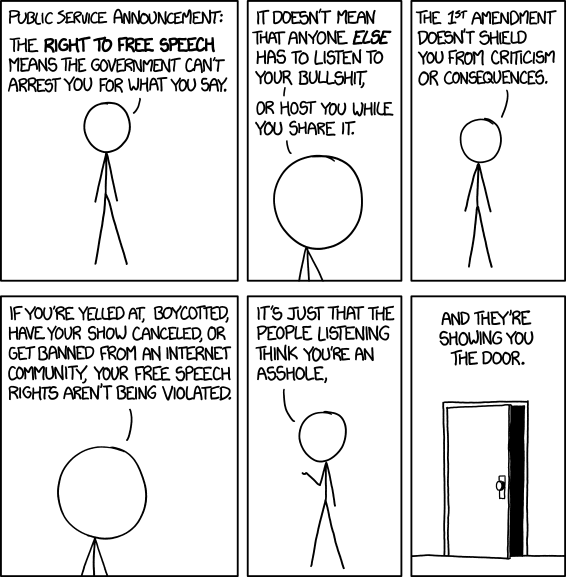
Republicans are predictably screaming about their cult leader being kept off Facebook for the time being. They’re citing the First Amendment, of course, but that’s got nothing to do with social media platforms (until the government starts operating its own platform or regulating their content).

Or as our congressman, Tom Malinowski, tweeted:

The 1st Amendment gives us the right to say crazy things without gov’t interference. It doesn’t require Random House to give us a book contract, or FOX to give us a prime time show, or Facebook to amplify our rantings to billions of people. Freedom of speech is not freedom of reach.

A much more significant issue is the speed with which the Republican Party is deteriorating. From Greg Sargent of The Washington Post: 

Rep. Liz Cheney’s fate appears sealed: Republicans are set to oust the Wyoming Republican as the No. 3 in the House GOP leadership . . . This is being widely depicted as a battle over the past . . . Most accounts portray it as a sign that in today’s GOP, fealty to the former president is a bedrock requirement, denouncing his lies about 2020 has become unacceptable, and telling the truth about the Jan. 6 insurrection is disqualifying.

All that is true, but the forward-looking dimension to this story is getting lost. What also seems unavoidably at stake is that the GOP appears to be plunging headlong into a level of full-blown hostility to democracy that has deeply unsettling future ramifications.

. . . Republicans may be unshackling themselves from any obligation to acquiesce to future presidential election outcomes they don’t like — that is, liberating themselves to overturn those outcomes by any means necessary.

. . . A Cheney spokesperson denounced her GOP enemies for wanting to “perpetuate lies about the 2020 election and attempt to whitewash what happened on Jan. 6.” This comes after Cheney told GOP colleagues that those lies are “poison in the bloodstream of our democracy” and that insurrection “is a line that cannot be crossed.”

Cheney has also urged Republicans not to turn “their back on the rule of law.” And she insists that the commission examining Jan. 6 should focus on the insurrection, not on leftist extremism that Republicans are hyping to muddy the waters around their ongoing radicalization.

So why is all this disqualifying? [It’s because] she’s demanding something important from fellow Republicans: a full and unequivocal renunciation of the lie that the election’s outcome was dubious. . . .

Now consider what else we’re seeing. Some Republicans are increasingly asserting a willingness to overturn future elections: Rep. Jody Hice’s primary challenge to the Georgia secretary of state is driven by the promise to use his power to invalidate future outcomes.

Other Republicans are asserting the freedom to keep alive the fiction that the election was stolen forever. In Arizona, a GOP-sponsored recount is underway [in hopes of] bolstering that false conclusion.

This combination is toxic: Republicans are untethering themselves from any obligation to recognize future legitimate election outcomes, which will provide the rationale to overturn them, a freedom they are also effectively in process of appropriating. Cheney is insisting on a GOP future premised on a full repudiation of these tendencies, and getting punished for it.

Guess what: These same House Republicans might control the lower chamber when Congress is counting electors after the 2024 presidential election.

“We should start to very much worry about what Jan. 6, 2025, looks like,” Edward Foley, a renowned election law scholar and a Post contributing columnist, told me.

Imagine a 2024 election decided in one state, where a GOP-controlled legislature sends electors for the GOP candidate in defiance of a close popular vote. The same House Republicans who punished Cheney — many of whom already voted against President Biden’s electors, but now control the House and have continued radicalizing — could vote to certify that slate. . . .

This places burdens on Democrats. Democratic strategist Simon Rosenberg told me that this obliges Democrats to level with voters about the threat Republicans pose to democratic stability.

“If Cheney is ousted, Democrats will have to make the radicalization of the GOP a major part of the 2022 conversation,” Rosenberg said.

And as elections scholar Rick Hasen told me, Democrats should try to get patriotic Republicans to support revisions to the Electoral Count Act, to make it “harder for a legislature to send a separate slate when there was no problem with how the election was run.”

Cheney’s ouster should prompt this, along with a much greater public and media focus on the brute reality of the GOP’s fundamental turn away from democracy.

“The core component of the democratic process is that we count the votes as cast,” Foley told me. The punishing of Cheney, Foley concluded, suggests that the Republican Party might [might???] be institutionally “abandoning the very essence of democracy”.

Looking Back at Another Age of Acrimony

I’ve got two big books in a holding pattern. First, there’s Grant, Ron Chernow’s enormous biography of Ulysses S. Grant. I’ve read most of it, but now that the Civil War is over and Grant’s been elected president, I’m having trouble going forward. The other one is the almost equally enormous The Republic For Which It Stands by the historian Richard White. Its subtitle is “The United States during Reconstruction and the Gilded Age, 1865-1896”. I’m only a few pages into that one.

The problem is that White’s book and the next 300 pages of Chernow’s both deal with Reconstruction — the failed attempt to give Black people equal rights in the South after the war — and the Gilded Age — the period from around 1870 to 1900 that featured rapid economic growth and increasing inequality in the whole country. It might be too much to read further about that important and relevant period while living through our own version of the Gilded Age, with its astounding inequality and troubled politics (now featuring dangerous attacks on voting rights).

Anyway, Smithsonian Magazine has an interesting article about the same period. It’s by Jon Grinspan, the author of The Age of Acrimony: How Americans Fought to Fix Their Democracy, 1865-1915. The article is much shorter than any of these books. Here’s most of it: 

. . . Most people don’t often think about the politics of the late 1800s. Call it “historical flyover country,” an era stranded between more momentous times, when U.S. presidents had funny names and silly facial hair. But for our current political crisis, this period is the most relevant, vital and useful. The nation’s wild elections saw the highest turnouts and the closest margins, as well as a peak in political violence. Men and women campaigned, speechified and fought over politics, in a system struggling with problems all too familiar today. . . .

American democracy held revolutionary new promise in the mid-1800s. For all its flaws, the nation was experimenting with a bold new system of government—one of the first in world history to give decisive political power to people without wealth, land or title. Working-class voters predominated at the polls. Poor boys grew up to be president. And reformers fought for votes for women and Black Americans.

At the end of the Civil War in 1865, with slavery dead, the old aristocracy vanquished, and four million formerly enslaved people hoping for new rights, Americans began to talk about “pure democracy.” That concept was never well defined, but for many activists, it meant that it was time for the people to rule. But how to get a busy, distractable, diverse nation to participate?

Decades earlier—from the 1820s to the 1850s—campaigners tried to engage voters by building bonfires, holding barbecues and offering plenty of stump speeches while handing out booze. Then, on the eve of the Civil War, supporters of Abe Lincoln’s hit on a new style. Lincoln’s Republican party introduced the “Wide Awakes” clubs to America. Gangs of young partisans, wearing dark, shimmering martial uniforms and armed with flaming torches, stormed through towns and cities in midnight marches. For the half century after 1860, every political campaign worth mentioning borrowed this approach, organizing massive rallies of tens of thousands of uniformed, torch-waving marchers. Diverse crowds turned out, from boisterous veteran voters to rowdy boys, from grandmothers to young women, from journalists armed with pens to political rivals armed with their revolvers.

Such public politics became, in the words of one comedian, “our great American game.” Political rancor grew precipitously. Saloons resounded with heated debates. On train cars, Americans took straw polls to see how strangers would vote. At dinner tables, families bonded—or broke up—debating an upcoming race. Even when exhausted Americans threw down their newspapers, they looked up only to find partisan broadsides slathered on every wall. “Ignorance is bliss now,” complained one woman as she canceled her political newspapers, weary of the whole spectacle.

For voters, participation meant an even deeper immersion. Election Day was a communal, combative, boozy bacchanal. White’s metaphor was apt, when people voted, they literally got drunk on Election Day. One Norwegian wrote home from Chicago, remarking that “it was fun to see” crowds of workers leaving their factories to go vote, “either before or after stopping at a bar.” During the 1876 election, which drew an unprecedented 81.8 percent turnout—Rutherford B. Hayes’s campaign handed out massive oversize beer steins, despite the fact that Hayes and his wife were devout teetotalers.

All the carousing culminated at a rambunctious polling place, when a voter selected a colorful ticket from his party’s ballot “peddlers,” made his way past the opposing party’s intimidating “challengers,” and placed his vote in a wooden or glass ballot box. Amid singing, shouting and heckling from the other voters in his community, it was a scene of heated, convulsive political theater. The system seemed designed to take over life, distort opinions, attract bad actors, raise voices and destroy civility.

In northern cities, a sneering establishment worried that the system was dominated by a working-class majority who could always outvote them. The celebrated Boston aristocrat Francis Parkman famously complained that democracy didn’t work in his 1878 “The Failure of Universal Suffrage,” a screed that claimed that the voters were “a public pest” and that the real threat to America came not from above, but beneath. Belief in equality and majority rule, Parkman argued, was destroying America.

Equal suffrage met even more aggressive attacks in the South. White supremacist ex-Confederates, who lost the war and had remained on the fringes of politics for most of a decade after, used the Democratic party to terrorize Black voters, end Reconstruction and dramatically suppress voter participation. Within a few short years of the end of slavery, one million formerly enslaved Americans became voters, but most lost their rights nearly as quickly as Reconstruction ended and the Jim Crow era began.

In the North, voter turnouts peaked from 1876 to 1896, and elections were never closer. No president in this period came to office by winning a majority of the popular vote [i.e. the presence of multiple candidates in the elections from 1876 to 1892 meant nobody got more than 50% ]. Even with racial issues falling out of the national spotlight, fights over money and inequality fired up voters.

Though the electorate turned out in huge numbers, marchers filled squares and newspapers attacked rivals, politics failed to bring real change. This system—overheating and yet standing still—led only to anger and agitation. In 1881, the mentally ill drifter Charles Guiteau, who had campaigned for President James Garfield at torchlit rallies, felt slighted and decided that America would be better off if the “President was out of the way.” So Guiteau bought the largest pistol he could find, and shot Garfield—the murder was the second assassination of a president in just 16 years. Within two decades, another madman would gun down President William McKinley. And every seven years, on average, a sitting congressman was murdered.

American politics had hit on an amazing ability to mobilize citizens, but also to agitate them to unspeakable violence. Citizens looked for someone to blame. Presidents were criticized, but really the executive branch was so weak that they could do very little. Powerful party bosses often nominated friendly, malleable do-nothings to the job. More people blamed politicians as a class. Brilliant cartoonists like Thomas Nast and Joseph Keppler mocked politicians as snarling beasts, overfed vultures, sniveling rats and thuggish bosses. Others attacked the rising immigration rates, like Francis Willard, the leader of the Women’s Christian Temperance Union, who blamed America’s out-of-control politics on “alien illiterates.” Others still aimed (more accurate) attacks at railroads, corporations, robber barons and lobbyists who seemed to be buying up America. The muckraking reporter Henry Demarest Lloyd wrote that “liberty produces wealth, and wealth destroys liberty.”

. . . Some well-to-do reformers blamed, not individuals or groups, but the culture and etiquette of American democracy. All those noisy rallies were nothing more than a “silly sort of show,” those busy polling places were “vulgar,” “venal” and “filthy.” American democracy, a growing upper middle-class movement argued, needed an intervention, and in an era of Temperance politics, reformers knew just how to achieve it.

First, they went after the booze. Reform organizations pulled the liquor licenses from political fundraisers, closed saloons on Election Day and passed prohibition laws on the county and state level. Voters were more clearheaded, but those partisan saloons had been key institutions for working-class men. Shutting them down meant shutting many out.

Cities banned marches without permits and used police and militias to punish unlawful assembly. And parties desperate to win over “the better class of people,” as one reformer put it, stopped paying for torches, uniforms, fireworks and whiskey. Campaigners shifted from thrilling street-corner oratory to printed pamphlets. To some, these changes looked like innovations. The Los Angeles Times cheered the citizens who had spent previous elections “on the street corner shouting, or in the torchlight procession,” but could now be “found at home” reading quietly.

Starting in 1887, state after state switched to the secret ballot—a dense government form that was cast privately—and dispatched with party-printed tickets. By isolating each voter “alone with his conscience” in the polling booth, or behind a voting machine’s curtain, he was certainly made more reflective, but also more removed. Those who could not read English, who had previously voted by color-coded ballots, were out of luck with the complicated machines, text-heavy ballots or unsympathetic poll workers. And those who participated in Election Day because they enjoyed the day as a nationwide happening, with its the sense of community and membership, saw little appeal with the new confessional box style.

Predictably, turnout crashed. In the 1896 presidential election, 80 percent of eligible Americans were still voting, but by 1924, voter participation plummeted to fewer than 49 percent. Voters who were poorer, younger, less well-educated, African American, or immigrants or children of immigrants were especially shut out of the political arena. White, middle class Americans cheered the trend, with some even bragging about the low turnouts. “It was gratifying,” reported an Augusta, Georgia, newspaper in 1904 “to see voting booths free of noisy crowds.”

The revolution lasted for a century. What Americans now consider “normal politics” was really stifled Democracy, the post-intervention cool, calm model—lower drama but lower participation. Now, however, those old tendencies may be creeping back.

. . . Tribalism, division and “general cussedness” (as they used to call it) is up, but so is attention and turnout. The two might go hand-in-hand; the 2020 election was the first since 1900 to boast turnouts above 66 percent. . . .

Unquote.

I agree with the author that more democracy would be a good thing. The question is whether more democracy can be achieved without more political turmoil and strife (and more bullshit peddled by one of our major parties).

I’m Intentionally Avoiding This Topic

It’s too damn depressing. But for the record, here are two stories from the front page of The New York Times:

— With Florida Bill, Republicans Continue Unrelenting Push to Restrict Voting

Republican lawmakers are marching ahead to overhaul voting systems in states where they control the government, Next up: Texas

— G.O.P. Seeks to Empower Poll Watchers, Raising Intimidation Worries

As Republican lawmakers seek to make voting harder and more confusing, they are simultaneously making a push to grant more autonomy to partisan poll watchers. In the past, poll watchers have been used to intimidate voters and harass workers.

One from The Washington Post:

— As [ex-president] seizes on Arizona ballot audit, election officials fear partisan vote counts could be the norm in future elections

The GOP-backed recount of Maricopa County’s ballots has been criticized for abandoning state guidelines and allowing the rules to be set by a private contractor who promoted claims that the election was stolen.

And a full story from The Guardian:

— Why a filibuster showdown in the US Senate is unavoidable

During Joe Biden’s first 100 days in office, there are few issues more pressing than the escalating attack on the right to vote in America. Democrats may be running out of time to address it.

As Republicans have pushed more than 360 bills across the country to restrict access to the ballot, the president and Democrats have strongly condemned those efforts, but they’ve been unable to stop them. Even though Democrats control both chambers of Congress in Washington, they can’t pass a sweeping voting rights bill because they don’t have enough votes to get rid of the filibuster, an arcane senate rule that requires 60 votes to advance legislation. A showdown over the filibuster has loomed over the first 100 days of the Biden administration, but during the next 100 days, it’s clear that a showdown over getting rid of the procedure is unavoidable.

Amanda Litman, the executive director of the Run for Something, a group that recruits candidates for state legislative races, told me this week she thinks some Democrats still don’t fully appreciate how dangerous and consequential the GOP’s ongoing efforts are. “This is really an existential crisis. It’s a five-alarm fire. But I’m not sure it’s quite sunk in for members of the United States Senate or the Democratic party writ large,” she told me.

“If the Senate does not kill the filibuster and pass voting rights reforms … Democrats are going to lose control of the House and likely the Senate forever. You don’t put these worms back into a can. You can’t undo this quite easily,” she added.

Chuck Schumer, the Democratic leader in the Senate, last week set August as a deadline for Democrats to pass their sweeping voting rights bill, which would require early voting, automatic and same-day registration, among other measures. . . . 

But the window for Democrats to have the most impact with their legislation is rapidly closing. The decennial process of redrawing district lines is set to take place later this year, and a critical portion of the Democratic bill would set new limits to prevent state lawmakers, who have the power to draw the maps, from severely manipulating districts for partisan gain. While it’s probably already too late to set up independent redistricting commissions for this year, Democrats could still pass rules to prevent the most severe partisan manipulation.

“You could pass new criteria, including a ban on partisan gerrymandering…require greater transparency in the process,” Michael Li, a redistricting expert at the Brennan Center for Justice, told me. “There’s a lot that could be done.”

I also asked the Minnesota senator Amy Klobuchar, a Democrat who chairs the Senate committee currently considering the bill, what kind of message it would send if Democrats failed to take any action to protect voting rights while they held the reins of government. “Failure is not an option,” she said, adding she wasn’t going to let the filibuster stand in the way.

“This is our very democracy that’s at stake,” she said. “I’m not gonna let some old senate rule get in the way of that.”

The prime example of a purported Democrat who doesn’t recognize the crisis is Senator Joe Manchin of West Virginia. From Vox’s profile of Manchin:

Some filibuster reformers hope that, as the year goes on, the reality of Republican obstruction will become clear to Manchin and he’ll be driven to change his mind — that Senate rules will in the end be just as negotiable to him as the details of Biden’s stimulus bill. For instance, reformers hoped a GOP filibuster of Democrats’ big voting rights bill, the For the People Act, could spur holdout senators to change the rules to pass it, because it’s so important.

Manchin recoils at the very idea. “How in the world could you, with the tension we have right now, allow a voting bill to restructure the voting of America on a partisan line?” he asked. He says that 20 to 25 percent of the public already doesn’t trust the system and that a party-line overhaul would “guarantee” that number would increase, leading to more “anarchy” like that at the Capitol on January 6. He added: “I just believe with all my heart and soul that’s what would happen, and I’m not going to be part of it.”

Unquote.

What Manchin is saying is that the millions of Republicans who have bought the Big Lie — that the 2020 election was stolen from the leader of their cult — are so angry that interfering with Republican efforts to make voting as hard as possible would make the crazier ones even crazier. For that reason, he’s willing to let Republican politicians in the Senate and across the country do whatever they want to get Republicans elected, by, for instance, insuring that fewer poor people, Black people, Spanish speakers and college students vote, and when they do vote, their votes don’t matter, because Congressional districts have been gerrymandered to, yes, get Republicans elected.

It’s positions like these that get Manchin referred to as a “moderate” Democrat.