The Problem Is Facebook and Twitter Themselves

From The Washington Post:

Facebook said Saturday evening that an article raising concerns that the coronavirus vaccine could lead to death was the top performing link in the United States on its platform from January through March of this year, acknowledging the widespread reach of such material for the first time. It also said another site that pushed covid-19 misinformation was also among the top 20 most visited pages on the platform.

In related news, the German Marshall Fund issued a study of interactions on Facebook. The study found that sites that share news in misleading ways attracted a record-level percentage of Facebook users:

More than 1 in 5 interactions — such as shares, likes or comments — with U.S. sites from April to June happened on “outlets that gather and present information irresponsibly,” according to [the study].

This includes outlets such as the Daily Wire, TMZ, the Epoch Times and Breitbart that researchers say “distort or misrepresent information to make an argument or report on a subject,” a metric determined by NewsGuard, a website cited in the study that rates the credibility of news sources. Researchers say these sources, which they argue spread subtler but still harmful forms of misinformation, are decidedly different from sites that publish overtly false news.

“These are the kinds of sites that will cherry pick anecdotes and are giving rise to vaccine hesitancy and other kinds of conspiracy theories,” said [the study’s director].

Researchers highlighted articles that they say “disproportionately amplify vaccine-hesitant voices over experts” and “fail to mention risks of not being vaccinated against covid-19″ . . .

While platforms have cracked down on black-and-white cases of fiction masquerading as fact, they are still grappling with how to handle murky yet wide-reaching cases that stop short of falsehood. . . . 

The ratio of misleading content marks a five-year high for Facebook, where “false content producers” have received a higher share of engagement in the past, according to the findings (The Washington Post).

Unquote.

What should we do about a company like Facebook that seems hell-bent on spreading harmful misinformation? One answer is to prosecute Mark Zuckerberg and his ilk as dangers to public health.

However, Vinay Prasad, a professor at the University of California medical school, suggests a more measured approach: we should deal with social media companies the way we dealt with tobacco companies thirty years ago. From Medpage Today: 

Many Americans, and especially healthcare providers, are frustrated as we watch yet another rise in COVID-19 cases. Severely ill and hospitalized patients are often unvaccinated, which is particularly disheartening, given the widespread availability — surplus — of mRNA vaccines in the U.S. . . .

One potential reason why a sizable fraction of Americans are reluctant to be vaccinated is the widespread availability of inaccurate, unbalanced, or irrational rhetoric. This speech falls across a spectrum from overtly delusional — vaccines contain microchips so Bill Gates can track you — to lesser degrees of pejorative and doubtful comments. . . .

[But] regulating or policing medical misinformation is doomed. It’s easy for most (sensible) people to recognize that mRNA vaccines do not contain microchips that allow Bill Gates to track you. But very quickly we find statements about vaccines that are unknown, disputed, and worthy of further dialogue. Lines between legitimate debate and misinformation become scientifically impossible to draw. . . .

Even on a social media website for medical professionals that restricts who can comment and regulates comments, as Doximity does, there are a number of erroneous statements, mis-statements and ill-informed comments, suggesting that regulating speakers is not an effective solution either. Some doctors may say incorrect things, and some lay people may be spot on. Policing speakers can’t solve the content issue.

. . . It is easy to feel that some erroneous views should not be permitted on social media, but the hard part is to define what should not be allowed. Notably, despite the Surgeon General’s report and much debate on the issue, no one has actually delineated what counts as misinformation. I suspect that it cannot be done. No one can create a rule book that separates black and white because the world we live in is only gray. You can’t outlaw what you can’t define.

The problem is Facebook and Twitter themselves.

In 50 years, social media in 2021 will look like the tobacco industry in 1960 — they knowingly offered an addictive product, and, worse, hid the damage the addiction caused, while actively tried to deepen the dependency. Social media companies try to keep you using the platform longer, baiting you with content to trigger your rage, disgust, lust, or hatred. These companies offer products that have been linked to anxiety and depression among users. . . .
When it comes to information, social media does three things.

First, it drives people into irrational poles. On one side are folks who think SARS-CoV-2 is not real or just another seasonal flu. These individuals are often suspicious of vaccination as a path out of the pandemic. On the other side are folks who believe we should lock down until there isn’t a single case of COVID left. . . . The very nature of social media drives individuals into further extreme positions, possibly aided by bots, sock-puppet accounts, or foreign intelligence agencies. The middle ground is lost.

Second, a good or bad idea on these platforms can reach millions of individuals. An anecdote (of dubious validity) of a vaccinated individual suffering a bizarre harm, or one of an unvaccinated person begging for vaccination before the endotracheal tube is placed . . . are both powerful psychological stories that reach millions. This is heroin of the mind.

Third, social media causes deterioration of discourse and harsh proposals. . . . We no longer see individuals with whom we have policy disagreements as people.

The solution is inevitable. Social media of 2021 must be dismantled and crippled like the tobacco industry. These digital tools have hijacked our neurotransmitters, just like tobacco. Denying the pernicious role of these platforms on our society is similar to those who denied the harms of tobacco. Just like tobacco, social media offers pleasures. But, just like tobacco, the industry that supports it has pushed too far, lusting for profits and domination.

. . . Our leaders offer toothless solutions like policing or removing information they view as particularly egregious. This introduces countless problems and immense potential for abuse. . . .

Instead, the platforms need to be crushed, broken up, and regulated. Rather than just censoring specific ideas, measuring attention and trying to capture more of it must be prohibited. . . . The platforms must be brought to their knees, just like Big Tobacco, while human ideas — good, bad, sublime, horrible, true, false, and everything in – between must be free.

An Excellent Appraisal of the Afghanistan Situation

David Roberts produced a Twitter thread last night that’s one of the best analyses of the situation I’ve seen:

. . . I’m going to do a thread on Afghanistan, because something about the current discourse is baffling me. I’ll lay out the situation as I see it & then hopefully someone smart can answer my question. 

We’ve been in Afghanistan for 20 years. At first it was to diminish terrorist capacity, but that pretty quickly faded & the new mission was state-building: building a gov’t & a military that could prevent the Taliban from taking back over. 

Through all those 20 years, all the surges & drone strikes & wasted money & lost lives, we have failed utterly in that mission. The gov’t was weak & lacked support outside Kabul. The military was a [disaster] (often responsible for its own atrocities). 

We’ve known for a while that the state-building is futile (Biden told Obama when he was VP), but in US politics, sticking w/ a disastrous military intervention is less politically risky than ending one, so no one actually did it until Biden. 

More or less everyone knew that, when the US finally left, the Taliban would take back over. Worth repeating: EVERYONE KNEW THIS. No one knew or proposed any way of avoiding it, other than staying there forever. Some hawks would be fine w/ that, but the US people weren’t. 

Now, Biden — along with *everyone else*, including US intelligence agencies — believed that, while the gov’t & military were weak, they would, at least, fight off the Taliban for a few weeks or months. Everyone thought that Taliban takeover would take a while. 

It is obviously clear now that the Taliban was more prepared, and the gov’t & military even weaker, than anticipated. The takeover happened much faster than anyone (again: ANYONE) predicted. It made for some ugly imagery, though things have proceeded fairly well since. 

So, here are some possible criticisms of Biden:

1. He should have prevented the Taliban takeover. But the only way he could have done that is by staying forever. Unless you support that, you’re acknowledging that the harms of Taliban takeover were inevitable. 

2. He should have evacuated Americans & allies before announcing the withdrawal. But as Biden has said, doing so would have been waving a giant red flag — an unmistakable signal to everyone that the gov’t & military were going to collapse. He didn’t want to signal that.

Now in retrospect, given how rapid the takeover was, it probably wouldn’t have made much difference. But again, no one knew it would be so fast. The admin wanted to give the gov’t & military a sporting chance. That made sense given the info they had at the time. 

3. Biden should have slowed down the Taliban takeover, to give more time for orderly withdrawal of Americans & allies. But the only way to do that would have been yet another “surge” of troops. As Biden asked, would you want your kid to be the last one to die in a futile war? 

4. Given how rapid the Taliban takeover turned out to be, Biden should have evacuated more … competently. But what does this mean? There have been comparatively few lost lives. People are getting out now. [note: 37,000 as of the last count] How, *specifically*, should Biden have evacuated differently? 

The characteristic feature of Afghanistan discourse among pundits & Very Serious People is that virtually no one grapples with these questions honestly. You’ve got pundits who haven’t said shit about a disastrous waste of money & lives for 20 years suddenly caring. 

You’ve got Republicans who wouldn’t piss on a refugee if they were on fire going on TV to weep crocodile tears about the Afghanis left behind. You’ve got people waving their hands around “competence” while refusing to say what could have been done differently. 

You’ve got people still putting “Biden’s catastrophe” in their headlines when, after one chaotic/ugly day, we’ve had five days of relatively orderly withdrawal, with very few casualties. You’ve got the Republican architects of this whole epic fuckup on TV backseat driving (?)! 

Here’s what happened: we got hit on 9/11, it activated all our worst impulses, we lunged into an endless war with no chance of success, we predictably failed, and now an elite class with a lifetime of American-exceptionalism delusions just can’t fucking deal with it. 

It is tragic what’s happening in Afghanistan. It’s tragic what’s *going* to happen, especially to women & girls, especially to Afghanis who put their lives on the line to help us. It’s absolutely awful. But after 20 years, we have to accept: there’s not much we can do about it. 

Turns out we’re not the world’s Superman, just a blundering, violent oaf, stepping on rakes. It’s a bitter pill to swallow, especially for a relatively insular US population that has had nationalist mythology blown up its ass for as long as it’s been alive. 

But it is dysfunctional & dishonest to take all that negative feeling, all that humiliation & impotence & rage, & channel it into bashing Joe Biden, the president who finally had the gonads to end this thing. Ending it was always going to be ugly. The choice was an ugly ending or staying there forever.

Just once, I’d like to see this country grow the fuck up & take responsibility for its mistakes & acknowledge the limits of its power, to see itself from the outside rather than from within a haze of self-serving mythologies. 

As it is, looking around at the way US elites have responded to this, I have no faith that we won’t do something equally stupid in response to another attack. We refuse to learn.

Unquote.

Mark Harris added:

The journalistic notion that we could lose a 20-year war in a country we don’t understand, blunder at every turn, and yet pull off a withdrawal/mass evacuation with clockwork precision needs elaboration. What did anyone imagine losing to the Taliban would look like?

I suppose people thought that getting thousands of people out of Afghanistan in a few days should be as easy as getting thousands into Afghanistan one day at a time for twenty years.

Unfortunately, that first day at the airport created the impression, magnified by overheated, often self-interested commentary, that it was the fall of Saigon all over again, or worse. It’s the power of photographs and video to define a moment without providing any context.

The Very Latest on Afghanistan

From Crooked Media’s political newsletter:

Monday’s harrowing scenes out of Karzai airport in Kabul have given way to less-sensational, logistical challenges to completing the evacuation from Afghanistan by August 31, and the media’s verdict is clear: Can’t it still be Monday?

At a White House press conference Friday, President Biden offered a comprehensive update on the withdrawal effort, which he noted has evacuated 13,000 citizens, allied Afghans, and others since the airlift began on August 14. Biden said he still believes the U.S. can complete the evacuation by August 31, notwithstanding operational setbacks. He acknowledged that though the Taliban has committed to allowing U.S. citizens through checkpoints into the airport, many have been stuck in bottlenecks of would-be refugees outside the gates, and that service members have thus pulled over 100 of them in over the airport walls. He also acknowledged that he can’t promise the evacuation will end without loss of life. 

The U.S. had to pause evacuation flights out of Kabul on Friday, not because too many evacuees are stranded outside the airport, but because pilots had nowhere to fly them, after Qatar refused to accept more refugees and asylum seekers. That touched off a multi-hour effort to find new destinations and clear evacuees past transit points, after which the airlift operation resumed. All of these challenges have raised questions about why we couldn’t fly non-Americans to U.S. territory, and house them there while screening them, just as we did for Vietnamese and Iraqi Kurdish refugees. 

There are other reasons 10,000-or-so people are awaiting departure. The Trump administration all but halted processing Special Immigrant Visas, creating a paperwork bottleneck when the Biden administration ramped the processing back up. Washington Post columnist David Ignatius reports further that when now-ousted Afghan President Ashraf Ghani visited the White House in June, he asked Biden to slow the departure of American-allied Afghans “to avoid the destabilizing appearance of a rush for the exit.” Lastly, existing law required evacuees to pay for evacuation assistance (essentially airfare), but the government has now reportedly waived that requirement.

Facing such a big challenge on a compressed time frame, many national political reporters want to know why Biden didn’t do a better job predicting the future.

A diplomatic cable sent through the State Department’s internal dissent channel, and which reportedly reached Secretary of State Anthony Blinken, warned “of the potential collapse of Kabul soon after the U.S.’s Aug. 31 troop withdrawal deadline in Afghanistan,” according to the Wall Street Journal, which broke the story. Astute readers will note that it is currently August 20, meaning that even those who believed the Afghan government would fall very quickly didn’t anticipate that it would actually collapse in mid-August, while the evacuation was ongoing. 

Nevertheless, journalists primed to join the pile-on over the ensuing crisis characterized the report as if it showed the Biden administration had clear warning that Kabul might fall before the evacuation was complete. The Journal reported that the memo “undercut[] the notion that the speed of the collapse caught the administration by surprise. Politico opined that the cable “cast perhaps the harshest light yet on the administration’s performance.”

In their haste to prove they can be tough on “both sides,” many journalists have misplaced their reading comprehension, but so far nothing we’ve learned has contradicted what we initially understood: The Afghan government collapsed faster than anticipated, requiring the ongoing evacuation to occur under Taliban control of the country. We should all hope it continues without violence and that the U.S. makes good on its obligation to those who risked their lives to help us.

Ignore the Bullshit Regarding Afghanistan

Politico describes how the Biden administration responded:

By the morning of Wednesday, Aug. 11, the Afghan government’s already brittle control of the war-torn country was quickly unraveling in the face of a swift Taliban offensive coinciding with the nearly complete withdrawal of U.S. troops that President JOE BIDEN ordered in April.

Most of America’s top diplomats and generals were still operating under the assumption that they had ample time to prepare for a Taliban takeover of the country — it might even be a couple of years until the group was in a position to regain power, many thought. Though some military officials and intelligence agencies had stepped up their warnings about the possibility of a government collapse, officials felt confident about the Afghan security forces’ strategy of consolidating in the cities to defend the urban population centers.

The president and his top aides still had one more meeting scheduled for Wednesday evening — a pre-planned session on a classified national security matter. As word of the deteriorating situation flowed into the Oval Office that morning, Biden ordered that the early evening meeting should focus on Afghanistan.

Sitting in the Situation Room were [the Vice President, Secretary of Defense, chairman of the Joint Chiefs of Staff; the National Security Adviser; the Director of National Intelligence; the Deputy CIA Director and others. Other officials, including the Secretary of State, participated by phone].

Events were growing so dire that the president ordered [Sec. of Defense] Austin and [General] Milley to prepare a plan for deploying additional troops to the region, where they would reinforce those put on standby months earlier to evacuate American personnel.

Biden also directed the State Department to expand the evacuation of Afghan allies — those who had worked with the Americans and were now in mortal danger — to include the use of military aircraft, not just chartered civilian planes.

And he also asked his intelligence officials to prepare an up-to-date assessment on the situation in Afghanistan by the following morning. After the meeting broke up, a classified email was sent to pertinent staffers to convene at 7:30 a.m. the next day [August 12]. 

. . . The principals meeting kicked off with an intelligence briefing concluding that the situation was so “fluid” that the Afghan government’s seat of power in Kabul could fall “within weeks or days,” an official noted.

Austin recommended that Biden send in troops to evacuate the embassy and protect the main international airport in Kabul. [National Security Adviser] Jake Sullivan asked each Cabinet member in the meeting to weigh in. They unanimously agreed.

That was the “Oh, shit” moment, said a U.S. official. It was now officially a crisis.

Sullivan walked into the Oval Office just before 10 a.m. [on August 12] to report to the president. Biden picked up the phone and told Austin to send troops to Kabul’s airport.

Some background from The Hill:

History will mark Aug. 15, 2021, as the date that the Afghan government collapsed and the Taliban retook control over this troubled and war-torn country. But the real date that the Taliban’s victory was assured is Feb. 29, 2020, the day the T____ administration signed what it characterized as a “peace” deal with the Taliban. Once this agreement was signed — the tragic collapse we witnessed this weekend was inevitable. 

Of course, the agreement was not, and could not possibly have been, a “peace” deal since one of the parties currently at war — the Afghan government — was not a signatory. Rather, this was a “withdrawal” agreement between the U.S. and the Taliban that set the terms for the complete departure of American troops from Afghanistan by May 2021.

What did the United States gain in exchange for this withdrawal, for which the Taliban had been fighting for 20 years? Nothing but vague, unenforceable promises that the Taliban would not engage in hostilities against the departing U.S. troops and would “send a clear message” to al Qaeda that it “had no place” in Afghanistan. So eager T____ was to withdraw, we did not even hold out for a clear, firm commitment that the Taliban would not provide aid, safe harbor or weaponry to al Qaeda and like-minded groups. The agreement contained no enforcement mechanisms and included no penalties on the Taliban for failing to comply with its terms.  

Once the agreement was signed, the fate of the Afghan government was signed, sealed and delivered — the Taliban had practically won the war. There was no way that the government could possibly survive. 

The fact that the United States entered into negotiations and then an agreement with the Taliban, without even inviting the Afghan government to the table, undercut the power and legitimacy of the government. The citizenry, including those in the national armed services and police, could plainly see that its own government was being ignored, a helpless bystander in critical discussions about the country’s future. After we had cut the legs out from under this government and rendered it a paper tiger, it is no wonder that when those serving in the Afghan army and police were asked to fight, most said, “No, thanks.”

The agreement also did absolutely nothing to attempt to bring about a peaceful settlement of the war between the Afghan government and the Taliban. A genuine peace deal would have made our withdrawal contingent on the progress of peace negotiations between the Afghan government and the Taliban. But it did not. T____ agreed unconditionally to bring down U.S. troop levels to 8,600 by mid-July 2020 and totally withdraw by May 2021. 

The agreement anticipated there would be peace negotiations, but in August, T____ voluntarily cut troop levels down to 4,500, even more quickly than required by the agreement, even though negotiations had not even begun. This was a clear signal there would be no linkage between withdrawals and peace, contrary to what U.S. diplomats were telling the parties. This signal was received loud and clear by the Taliban. They balked at starting negotiations until December, and even then, had zero incentive to make any concessions since T____ had already announced that there would be only 2,500 troops in Afghanistan by the time he left office, the smallest U.S. force in 20 years. It was clear to the Taliban that the Americans were quickly headed for the exits. . . . . 

To stem the Taliban’s momentum on the ground this spring, the Biden administration would have had to not only abrogate the T____ withdrawal agreement but also deploy more troops and get them more deeply involved in the fighting. This would have breached Biden’s campaign commitment to end the war in Afghanistan and ran against the strong bipartisan public support for withdrawal. 

Paul Waldman of The Washington Post explains why discussion of these events in the media has been so distorted:

As we have watched the rapid dissolution of the Afghan government, the takeover of the country by the Taliban and the desperate effort of so many Afghans to flee, the U.S. media have asked themselves a question: What do the people who were wrong about Afghanistan all along have to say about all this?

That’s not literally what TV bookers and journalists have said, of course. But if you’ve been watching the debate, it almost seems that way.

The number of Afghanistan/Iraq hawks — the ones who brought us those twin disasters in the first place — who have been called on by major media organizations to offer their sage assessment of the current situation is truly remarkable.

Whether it’s retired generals who now earn money in the weapons industry, former officials from the Bush, Obama and T____ administrations who in many cases are directly responsible for the mistakes of the past two decades, or war enthusiast pundits with an unblemished record of wrongness, we’re now hearing from the same people who two decades ago told us how great these wars would be, then spent years telling us victory was right around the corner, and are now explaining how somebody else is to blame for Afghanistan.

One name you almost never hear in all the “Why this is President Biden’s greatest failure” talk is one George W. Bush, who took us to Afghanistan and whose delusion that we could spread democracy at the point of a gun got this whole mess started. You’ll have to look far and wide for an interview with someone who objected to the Afghanistan war when it began, but if you want to hear one former Bush official interview another former Bush official about what a mess Biden made, just turn on your TV.

This isn’t something new. In fact, it has characterized the debate over the entirety of this period.

Back in the early 2000s, the term “Very Serious People” was coined to refer to those who were wrong about Iraq but nevertheless were treated with great deference and respect because they were mouthing conventional wisdom and taking a position that the media and the broader Washington culture treated as hardheaded and rational.

In contrast, the people who were right about Iraq — who said there was no real evidence that Saddam Hussein had weapons of mass destruction, or was in cahoots with al-Qaeda, or was about to attack the United States — were treated as silly, unserious and not worth listening to.

Then as now, the supposedly unserious people continued to be sidelined and ignored even after events proved them right.

It’s not just about who gets a platform in this debate. It’s also about what the limits of that debate are. As Matt Duss, a foreign policy expert and adviser to Sen. Bernie Sanders (I-Vt.), told me, the debate is shaped by “a general hawkish interventionist framing you see in the media and the foreign policy establishment.” It presumes that the deployment of U.S. military power overseas is nearly always justified and likely to accomplish its goals.

In that framework, if things go wrong it must be because of some failure of planning or execution — and you can bet that if you bring a Bush, Obama or T____ official on your show, they’re going to say, “It wasn’t my fault — it must be Biden’s fault!”

What gets left out of that discussion? For starters, the fact that we spent 20 years trying to create and sustain the Afghan government, and it remained so plagued by corruption that it didn’t have legitimacy with the country’s population. . . .

But the problem went deeper. “Even focusing on the failures of the Afghan government lets us off the hook,” [Bernie Sanders adviser Matt Duss] told me. “When we’re talking about corruption, the biggest beneficiaries are U.S. multinationals.” Indeed, another recent government report found that between 2011 and 2019 we spent nearly $100 billion on private contractors in Afghanistan.

Do you think the corporations that have been feeding at that trough for 20 years were eager to have U.S. involvement end? And might we be skeptical of the opinions of people who serve on the boards of those companies?

Now there is a rush for accountability for the failures in Afghanistan — but only, it seems, the failures of the Biden administration. The urge is so powerful that three separate Senate committees led by Democrats are preparing to investigate the administration’s mistakes (though they might look as far back as last year, to the Trump administration’s agreement with the Taliban).

This comes after no one was prosecuted for the torture policy of the Bush administration, and no one was punished for the Iraq debacle. Instead, those most responsible for America’s worst moral and practical foreign policy failures are treated as though they are the possessors of great wisdom and insight to which we all should attend. . . .

Unquote.

There was never going to be a calm, orderly U.S. withdrawal from Afghanistan. Given everything we know about the former president, the withdrawal would have been even more painful if he was still in office. The good news is that competent, sensible people are in charge now and most of us who don’t appear on cable TV support Biden’s decision:

A poll — commissioned by the right-leaning, pro-restraint Concerned Veterans for America but conducted by YouGov — shows a combined 60 percent of respondents either “strongly support” or “somewhat support” the pullout, while 22 percent either “somewhat oppose” or “strongly oppose” Biden’s decision.
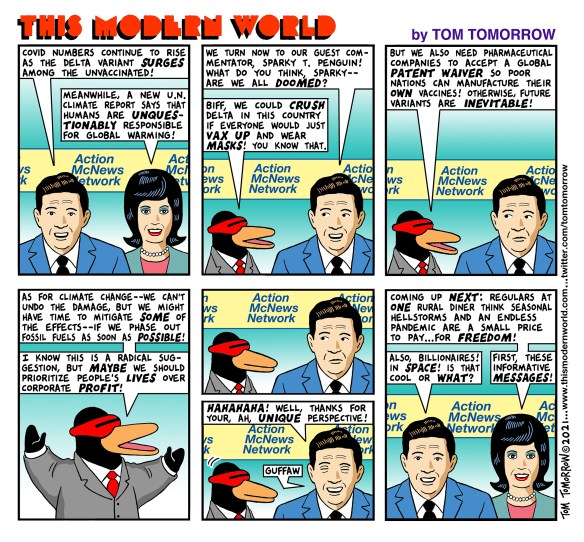
The Penguin Makes a Lot of Sense

Hot off the internet, Tom Tomorrow’s latest commentary:

TMW2021-08-18colorXL

You can support Mr. Tomorrow’s valuable work by subscribing to Sparky’s List for a small sum (Sparky is the penguin).