The History Behind the Crisis

Homegrown: Timothy McVeigh and the Rise of Right-Wing Extremism is the latest book by the lawyer and author Jeffrey Toobin. The New York Review of Books has a long review by Sean Wilentz, a Yale history professor, that provides historical context for our current political crisis. The following 1,800 words are most of the review. I think they (or the whole review) are worth reading:

Ronald Reagan’s pronouncement, in his first inaugural address in 1981, that “government is not the solution to our problem, government is the problem” marked a signal moment in what has become the most successful political counterrevolution in modern American history. Having won a smashing electoral victory, Reagan acted as if he were the latter-day inverse of his long-ago political hero, Franklin Delano Roosevelt. Summoning the American people to “a rendezvous with destiny”—a line he had shamelessly filched from FDR in the 1964 speech on behalf of Barry Goldwater’s presidential campaign that established him as the Republican right wing’s future leader—and pretending that the stubborn stagflation of the 1970s was a crisis of the same magnitude as the Great Depression, Reagan channeled Roosevelt’s optimistic rhetoric to attack the instrument of Roosevelt’s great reforms: the federal government.

He aimed, above all, to revive the laissez-faire economic and social policies that the Depression had discredited, that Roosevelt had supplanted, and that even Richard Nixon had repudiated when he declared himself a Keynesian. But Reagan’s antigovernment politics and policies went much further than rolling back the New Deal.

Reagan’s Republican Party of 1981 was very different from Herbert Hoover’s of 1933: it had become the refuge of millions of formerly Democratic white conservative voters in the Solid South who resisted the civil rights reforms of the 1960s. Accordingly, behind his cheerful veneer Reagan made sure that he tapped into the fierce resentments of federal authority, dating back to the Civil War and Reconstruction, that fueled that resistance. Before they were done, the Reagan Republicans had absorbed into their coalition an array of aggrieved Americans, including quasi-theocratic white Christian nationalists, the gun-manufacturing lobby, antiabortion militants, and antigay crusaders.

The antigovernment fervor that grips the nation today is the long-term product of the right wing that Reagan called to arms (literally, in the case of the National Rifle Association) forty-odd years ago. It was his attorney general Edwin Meese, in tandem with the newly formed Federalist Society, who started packing the federal judiciary with the conservative judges who have gutted federal protections for voting rights, abortion rights, and more, while inventing, with fake history presented as “originalism,” an individual’s Second Amendment right to own and carry military-grade armaments. It was the Reagan administration that eliminated the FCC’s fairness doctrine, which mandated that broadcasters provide balanced coverage of controversial public issues, paving the way for right-wing talk radio inciters like Rush Limbaugh and G. Gordon Liddy and, on cable TV, Rupert Murdoch’s Fox News to amplify antigovernment paranoia.

The Reagan White House also harbored the former Nixon aide Pat Buchanan as its communications director. Buchanan’s politics were rooted in the 1930s America First isolationism of Charles A. Lindbergh and the diatribes of the right-wing “radio priest” Father Charles Coughlin, with their eccentric fixations on imaginary Jewish internationalist cabals. In the waning days of Reagan’s presidency, Buchanan remarked that “the greatest vacuum in American politics is to the right of Ronald Reagan.” He tried to fill that vacuum himself, nearly defeating President George H.W. Bush in the 1992 New Hampshire primary with his “pitchfork brigades.” His convention speech later that year laid out the culture wars to come. Then he followed up with another bid for the Republican nomination in 1996 and an independent campaign in 2000.

All those efforts failed, but their stark themes of isolationism, lost national greatness, immigrant invasion, and racial fear provided a template for T____’s MAGA campaign a quarter-century later. “American carnage” was the favored far-right image at least two decades before T____.

Meanwhile, a step away from Buchanan—how distant a step has long been subject to debate—an assortment of antisemitic and white nationalist organizations remained on the political fringes during the Reagan period. The fringiest may have been the neo-Nazi National Alliance, founded in 1974 by William Luther Pierce, the author of the widely read novel The Turner Diaries, a lurid description of—and in some respects a blueprint for—a white supremacist revolution. The conspiracy-mongering Liberty Lobby, founded in 1958 by Willis Carto, claimed in the early 1990s a membership of 20,000, supplemented by 90,000 subscribers to its weekly newspaper, The Spotlight. In 1968 the Liberty Lobby supported the segregationist hero Governor George Wallace for president. Twenty years later the splinter Populist Party, which Carto helped to organize, nominated the former grand wizard of the Ku Klux Klan David Duke. In both 1992 and 1996 The Spotlight backed Buchanan.

A major turning point in the Republican Party’s rightward radicalization and its fitful convergence with the evolving conspiratorial and white supremacist netherworld—populated today by groups like the Proud Boys, the Oath Keepers, and QAnon—came during the fall and winter of 1994, culminating in the spring of 1995. Much to the shock of Republicans who assumed that Reagan had created a national coalition that would last for decades, a Democrat, Bill Clinton, won the presidency in 1992.

Republican strategists shifted their attention to Congress, and in November 1994, led by the firebrand Newt Gingrich of Georgia, the party captured the majority in the House of Representatives for the first time in forty years. Rewarded with the speakership, Gingrich dominated the news cycle with slash-and-burn denunciations of “sick,” “corrupt,” “anti-flag” Democrats. Advised by the political consultant Frank Luntz, he adopted his poll-tested vocabulary of demonization, published in a private memo entitled “Language: A Key Mechanism of Control”: “anti-child,” “decay,” “welfare,” “traitors.”

Limbaugh, Liddy, and smaller-fry right-wing radio [hosts] added their own blend of conspiracy mongering and personal abuse. The prolonged and fatal siege in 1993 involving an armed religious sect, the Branch Davidians, and federal law enforcement in Waco, Texas, became a cause célèbre on both sides of the increasingly blurry border between the GOP hard right and the paramilitary extremists. “Go for a head shot,” the ex–Watergate plotter Liddy shouted into his radio microphone, instructing listeners on how to kill federal firearms officials. “The second violent American revolution,” Limbaugh declared around the same time, “is just about—I got my fingers about a quarter of an inch apart—is just about that far away.”

Out of this toxic mix of cultism and grifting came Timothy McVeigh, a young, decorated army veteran, subscriber to The Spotlight, gun show enthusiast, and avid fan of Limbaugh’s. He had developed a burning hatred of Bill and Hillary Clinton and studied The Turner Diaries like a field manual. In April 1995, on the second anniversary of the end of the Waco siege, McVeigh parked a Ryder rental truck crammed with barrels of fertilizer explosive, flicked his Bic lighter to fire a five-minute fuse, and blew up the Alfred P. Murrah Federal Building in Oklahoma City, killing 168 people, 19 of them children….

… Not long after high school, McVeigh obtained—via the National Rifle Association’s magazine, American Hunter—a mail-order copy of The Turner Diaries, which offered him a worldview that he never relinquished. From this book, written at the furthest reaches of antigovernment paranoia, he eventually extracted the basic instructions on how to touch off, with a spectacular act of terror, a white supremacist revolution that would overthrow the federal government…..

… He would later tell his lawyers [that reading The Spotlight] pretty much summed up “my world/my culture…the stuff I identify with…stuff I know and live.” Around the same time, McVeigh began listening to Limbaugh, who was just coming into his own as a best-selling author, television performer, and talk radio megastar…. He became an ardent fan.

… Buchanan rounded out McVeigh’s political thinking, above and beyond—but by no means in contradiction to—the crude racism of The Turner Diaries. From Buchanan, McVeigh learned of the menacing New World Order (NWO), purportedly a project of shadowy, powerful, internationalist elites to topple the America created by the Founding Fathers and replace it with a single omnipotent world government run exclusively by and for themselves. From Buchanan, he learned that a new revolutionary resistance could defeat the NWO much as the patriots of 1776 had defeated the British. And from Buchanan, perhaps most important of all, he learned that, just as the redcoats had once tried to strip the patriots of their arsenals, so the nefarious globalists and their liberal minions were out to shred the Founders’ Second Amendment and seize the guns of a God-fearing citizenry….

The author then recounts how passage of the ban on assault weapons during the Clinton administration (which Republicans allowed to lapse in 2004, despite its success in limiting the number of mass shootings) was “the last straw” for McVeigh.

… The plot that led to the bombing began on September 13, 1994, the date that Clinton signed the assault weapons bill.

The links [between the politics of the mid-1990s and those of our own times are vivid: in the assurance that sinister “globalist” forces are either about to take control of the country or already have; in … “the belief in the value and power of violence”; in an obsession with gun ownership that reduces the entire Constitution to a twisted version of the Second Amendment; in a crackpot narrative of American history that turns liberalism into tyranny on the supposed authority of Thomas Jefferson….

The largest difference between now and then … is frightening. Whereas McVeigh … found a kind of community in right-wing periodicals, talk radio call-ins, and far-flung gun shows, the Internet and social media have at once vastly enlarged that community and tightened its connections, with billions of unfiltered rants and orders and falsehoods flashing through the ether….

But while it warns about the present danger, Homegrown also illuminates and bids us to reckon with the larger history of what happened in 1995. Not only do today’s distempers date back well before T____ or the Tea Party; they originated well before the inflamed mid-1990s, taking their modern form during the presidency of Ronald Reagan, who encouraged them with his denunciations of the federal government as a malevolent force.

And there is an even longer history behind that. The great revolutions in American history—from the nation’s founding through Emancipation, Reconstruction, the Progressive Era, and the New Deal—have been predicated on the idea, inscribed in the Constitution, that it is the nation, the more perfect Union striven for in 1787, that is best equipped to secure the common good and the general welfare.

Counterrevolutionaries in their various forms—nullifiers, Confederates, so-called Redeemers overthrowing Reconstruction, anti–New Deal Liberty Leaguers—have fought that idea, never more successfully than in the long counterrevolution begun under Reagan. Though resisted and even halted from time to time, that reaction, steadily radicalized, has now turned a substantial number of Americans against their own government, and they are ready and willing to use violence for their retribution. In the process, large and influential elements of the party of Abraham Lincoln—a party that fought against one such counterrevolution—have become captive to that subversive rage.
Our Former President Invites an Odious Comparison

You’ve probably heard that the first person to mention Hitler or the Nazis automatically loses the argument. That’s not true, of course, but it does suggest that Hitler or Nazi comparisons shouldn’t be made lightly. (This adage is different from Godwin’s Law, which says “As an online discussion continues, the probability of a reference or comparison to Hitler or Nazis approaches 1”.

Yet, these days, with America’s right wing becoming ever more extreme, it’s natural to wonder how far they’ll go. Journalist Brian Beutler names a few names:

We see all around us people clothed in immense power whom we know, to a practical certainty, would have been enthusiastic allies to George Wallace or Jefferson Davis or even Adolf Hitler, and we see many, many more who would quite evidently have made their peace with segregation, or slavery, or genocide as an acceptable moral compromise for maintaining their wealth or social sway. 

It’s a testament to the durable temptation of wickedness—to the fact that “Never Again!” without constant vigilance is a chant of delusion. But it’s also prima facie evidence that we remain insufficiently vigilant, or that a large subset of liberals is in denial about the totalitarian temptation washing over the right. The people would side with us overwhelmingly if they understood the stakes this way, but all too frequently we won’t even tell them. 

Anybody who’s paid to write or speak for a big corporation like The New York Times or a smaller one like the Corporation for Public Broadcasting needs to come across as fair and balanced. That’s a big problem if the subject they’re writing or speaking about, American politics, is no longer balanced at all. What words are appropriate when there is news like this, in this case reported by the Times:

[The former president] and his allies are planning a sweeping expansion of presidential power over the machinery of government if voters return him to the White House in 2025, reshaping the structure of the executive branch to concentrate far greater authority directly in his hands.

Their plans to centralize more power in the Oval Office stretch far beyond the former president’s recent remarks that he would order a criminal investigation into his political rival, President Biden, signaling his intent to end the post-Watergate norm of Justice Department independence from White House political control.

[He] and his associates have a broader goal: to alter the balance of power by increasing the president’s authority over every part of the federal government that now operates, by either law or tradition, with any measure of independence from political interference by the White House, according to a review of his campaign policy proposals and interviews with people close to him.

[He] intends to bring independent agencies — like the Federal Communications Commission, which makes and enforces rules for television and internet companies, and the Federal Trade Commission, which enforces various antitrust and other consumer protection rules against businesses — under direct presidential control.

He wants to revive the practice of “impounding” funds, refusing to spend money Congress has appropriated for programs a president doesn’t like — a tactic that lawmakers banned under President Richard Nixon.

He intends to strip employment protections from tens of thousands of career civil servants, making it easier to replace them if they are deemed obstacles to his agenda. And he plans to scour the intelligence agencies, the State Department and the defense bureaucracies to remove officials he has vilified as “the sick political class that hates our country.”.

[He] and his advisers are making no secret of their intentions — proclaiming them in rallies and on his campaign website, describing them in white papers and openly discussing them….

“What we’re trying to do is identify the pockets of independence and seize them,” said Russell T. Vought, who ran the Office of Management and Budget [for the former president].

The Times reporters don’t draw the obvious conclusion. In response to the Times article, Ryan Cooper of the American Prospect does:

Donald Trump is plotting to make himself dictator. His plan it to make the federal government his plaything, and many Republican elites are behind him.

When Vladimir Putin came to power in Russia in 1999, he did not become dictator overnight. It took him many years to crush independent media, make the oligarch class dependent on him, and suppress organized political opposition… That process of power consolidation has accelerated since the invasion of Ukraine, as the former “hybrid regime” with some tacit limited freedoms has become a full-blown autocracy.

Trump is openly planning something similar, should he win the 2024 election…. Given [his] history, it’s clear that should he become president again, he will try to set up a dictatorship….

When [he] first came to power, he had little idea of how the federal government worked or even what he wanted to do with it, much less how to bend it to his will….

Eventually, [he] figured out how to get what he wanted. The answer was not to conform his acts to the existing system, but to break it. By issuing hundreds of executive orders, threatening those who stood in his way, and above all installing cronies throughout the executive branch and the judiciary, he could break through the procedures and norms that had constrained previous presidents (which turned out to be a lot more feeble than many assumed).

By 2020, Presidential Personnel Office head John McEntee was running a plan to install Trump stooges throughout the federal bureaucracy even over the objections of Trump’s own Cabinet members.

This process culminated in the attempted putsch on January 6, 2021, which as usual was poorly planned and led, yet got alarmingly close to success nonetheless. For the first time in American history, a fascist mob sacked the national legislature and disrupted the process of transferring power—all under the direction of the losing president, who was trying to cling to power through violence….

The Times report is characteristically stuffy about what is going on here. Yet the reporters got enough [of his] cronies on the record to make the stakes abundantly clear. The plan is called Project 2025—a transition project … with the explicit purpose of making the entire government beholden to [the president’s] every whim…. The only way to satisfy his craving for limitless money and power, and to inflict ruthless vengeance against his enemies, is to turn the presidency into a dictatorship.

[He] won’t necessarily succeed, even if he does win the election—it is unwise for a would-be autocrat to cultivate deep unpopularity among the armed forces, just for starters—but that is what he’s determined to do.

The Hitler of 1943? No. The Hitler of 1933? The evidence is clear.

It All Hangs Together

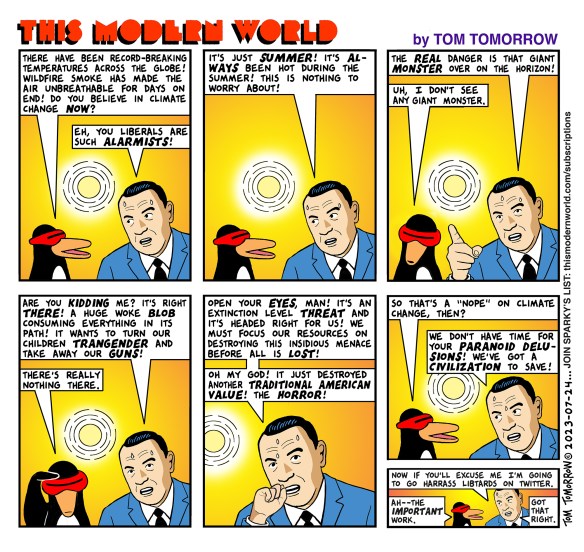
Yesterday, the leader of the Republican Party claimed that the January 6th riot was “staged by the government”. He didn’t explain why he, as head of the government, did nothing to stop the riot as the afternoon wore on or why juries have since convicted hundreds of the riot’s participants, including, given his assessment, many government agents.

That he is still the leader of the party tells us a lot about Republican voters and politicians. It also provides context for Tom Tomorrow’s latest bulletin from This Modern World.

06556a5b-f184-76cb-de64-c6c3fbfc8c81

Ending Military Aid to Israel Shouldn’t Be “Unmentionable”

A New York Times columnist, Nicholas Kristof, feared the reaction when he questioned the military aid we give to Israel, although he makes totally valid points (“Lots of folks will disagree with my column today”). I’ve edited out parts of his column where he goes wishy-washy:

Israel is in the headlines, evoking tumultuous debate. Yet one topic remains largely unmentionable, so let me gingerly raise it: Is it time to think about phasing out American aid for Israel down the road?

This is not about whacking Israel. But does it really make sense for the United States to provide the enormous sum of $3.8 billion annually to another wealthy country?

… Today, Israel has legitimate security concerns but is not in peril of being invaded by the armies of its neighbors, and it is richer per capita than Japan and some European countries. One sign of changed times: Almost a quarter of Israel’s arms exports last year went to Arab states.

The $3.8 billion in annual assistance to Israel is more than 10 times as much as the U.S. sends to the far more populous nation of Niger, one of the poorest countries in the world and one under attack by jihadis. In countries like Niger, that sum could save hundreds of thousands of lives a year, or here in the United States, it could help pay for desperately needed early childhood programs.

Aid to Israel is now almost exclusively military assistance that can be used only to buy American weaponry. In reality, it’s not so much aid to Israel as it is a backdoor subsidy to American military contractors, which is one reason some Israelis are cool to it.

“Israel should give up on the American aid,” Yossi Beilin, a former Israeli minister of justice, told me. He has argued that the money can be used more effectively elsewhere.

Daniel Kurtzer, a former American ambassador to Israel, agreed.

“Israel’s economy is strong enough that it does not need aid; security assistance distorts Israel’s economy and creates a false sense of dependency,” Kurtzer said in an email. “Aid provides the U.S. with no leverage or influence over Israeli decisions to use force; because we sit by quietly while Israel pursues policies we oppose, we are seen as ‘enablers’ of Israel’s occupation.”

“And U.S. aid provides a multibillion-dollar cushion that allows Israel to avoid hard choices of where to spend its own money and thus allows Israel to spend more money on policies we oppose, such as settlements.”

At some point when running for president in the last election, Bernie Sanders, Pete Buttigieg and Elizabeth Warren all suggested conditioning aid to Israel….. [but were apparently concerned about the negative reaction if they called for eliminating it].

It’s not just liberals. “Cut the stranglehold of aid,” Jacob Siegel and Liel Leibovitz argued recently in Tablet magazine, saying that the aid benefited America and its arms manufacturers while undercutting Israeli companies….

Martin Indyk, who twice served as America’s ambassador to Israel, also favored new security agreements and said that it’s time to have this discussion about ending aid.

“Israel can afford it, and it would be healthier for the relationship if Israel stood on its own two feet,” he told me.

The issue is politically sensitive, of course. Just a couple of years ago, more than 325 members of the House of Representatives signed a letter opposing any drop in aid to Israel.

“There’s a serious conversation that should be had ahead of this next memorandum of understanding about how best to use $40 billion in U.S. tax dollars,” said Jeremy Ben-Ami, the president of J Street, an advocacy group. “Yet instead of a serious national security discussion, you’re likely to get a toxic mix of partisan brawling and political pandering.”

… We’d all benefit by finding the maturity to discuss the unmentionable.

Unquote.

The most recommended comments on the Times site all said we should stop giving money to the Israeli government. But, as so often is the case, our politicians haven’t caught up with reality.

Where We Live Matches How We Vote

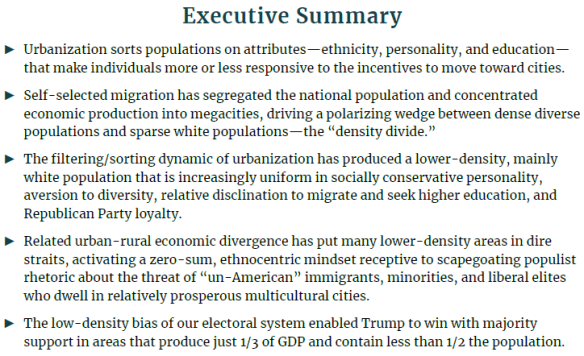
To understand the disheartening state of American politics, we need to consider the growth of cities and suburbs and the related decline of rural areas. That’s the conclusion of a 79-page report issued a few years ago by Will Wilkinson of the Niskanen Center. It’s called “The Density Divide: Urbanization, Polarization and Populist Backlash”. Here the author summarizes his findings: 

I weave recent research in political science, economics, psychology and more into an account of political polarization and the rise of populist nationalism as a surprising and overlooked side-effect of urbanization.

I claim that we’ve failed to fully grasp that urbanization is a relentless, glacial social force that transforms entire societies and, in the process, generates cultural and political polarization by segregating populations along the lines of the traits that make individuals more or less responsive to the incentives that draw people to the city. I explore three such traits — ethnicity, ideology-correlated aspects of personality, and level of educational achievement — and their intricate web of relationships.

The upshot is that, over the course of millions of moves over many decades, high density areas have become economically thriving multicultural havens while whiter, lower density places are facing stagnation and decline as their populations have become increasingly uniform in terms of socially conservative personality, aversion to diversity, and lower levels of education. This self-segregation of the population, I argue, created the polarized economic and cultural conditions that led to populist backlash.

Because the story of urbanization just is the story of a strengthening relationship between density, human capital and economic productivity, it’s also the story of relative small town and rural decline. The same process that has filtered better-educated, more temperamentally liberal whites out of lower density places has left those places with less vibrant economies, but also with more place-bound, ethnocentric populations.

It’s no shock that leavers leave and stayers stay. What’s surprising is that, if you’re white (and if you’re not, you’re almost certainly urban), the personality traits that make you more or less inclined to leave or stay — that make you more or less magnetized to the rising attractive force of the city — also predict how socially conservative or liberal you’ll tend to be, and which political party you’ll tend to support.

So the pull of urbanization has segregated us geographically on those traits, and it has done it so thoroughly that Democratic vote share now rises, and Republican vote share drops, in a remarkably linear fashion as population density rises. The relationship between density and party affiliation is, with few exceptions, similar everywhere — in “red states” and “blue states,” in sprawling metro regions and bucolic small towns — and majorities tend to flip at the density typical of a big city’s outer suburbs. I call this partisan polarization on population density the “density divide.”

When populations segregate geographically on traits relevant to ideology and party affiliation, political polarization is sure to follow. The increasing concentration of the economy in big cities, which is both a cause and effect of urbanization, amplifies this polarization. Rising prosperity reliably produces a liberalizing, tolerant, positive-sum mood. Material insecurity, in contrast, tends to elicit a grim, zero-sum, us-or-them mindset.

Because the sunshine of prosperity has become increasingly focused on urban populations, lower density white populations — which, thanks to the sorting logic of urbanization, are already more conservative and ethnocentric — have been left with objectively darkening prospects and a mounting sense of anxiety that is, at once, economic and ethno-cultural.

This combination of conditions created a political opportunity [our former president] managed to exploit. Because urbanization is reshaping societies everywhere around the world, it has created similar conditions, and similarly illiberal strongman leaders, in other countries as well. If we’re going to be able to do anything about the acrimony of polarization and the peril of ethno-nationalist populism, we’re going to have to get the story straight. This cross-disciplinary account of the social and psychological forces behind the density divide is my preliminary attempt to put us, finally, on the right track.

Untitled

Unquote.

The growth of cities and suburbs tends to make American politics more progressive, but a constitution ratified in 1789 that favors small states doesn’t make it easy.