Brief Political Commentary

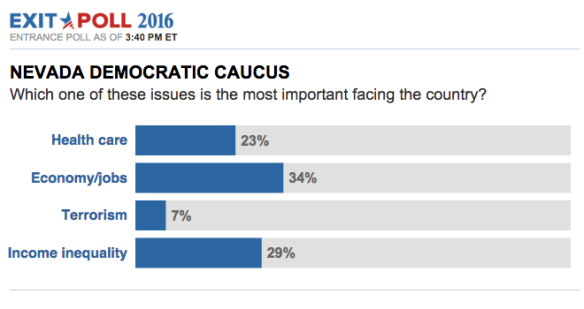
Voters who attended the Democratic caucuses in Nevada yesterday were asked to identify the most important issue facing America. 34% said the economy and jobs; 7% said terrorism.

NVDem_Issues_02202016

Voters in the Republican primary in South Carolina were asked the same question. 28% said the economy and jobs, but 32% said terrorism.

SGOP_IssuesV2_02202016I haven’t been able to determine whether the Democrats and Republicans were given the same list of issues to choose from, but it’s still remarkable that one-third of Republican voters chose terrorism as the most important issue we face. In fact, it’s remarkable that 7% of the Democrats said the same thing.

Unless these people think there is a strong chance that terrorists (of whatever political persuasion, not just Islamic fundamentalists) will attack America with nuclear or biological weapons, it’s silly to put terrorism at the top of the list. (In fact, given how silly it is, I have to wonder – mostly facetiously – whether some of those Democrats were devious Republicans attending the Democratic caucuses in order to make trouble, something the rules in Nevada allowed).

Here in New Jersey, we don’t get to participate in the nomination process until June, when it won’t matter what we think or how we vote. But if anyone asked me, I’d put global warming first, because of its possibly catastrophic consequences. After that, it would be hard to choose between the economy and jobs; money in politics; and the number of Americans who have lost their minds and vote for Republicans.

Meaning Is a Many-Splendored Thing

Since reading a couple of articles that deal with the subject, I’ve been meaning (intending) to write about the meaning (significance) of life.

Back in October, Charlie Hueneman, a philosophy professor at Utah State, posted “Everything Is Meaningless – But That’s Okay”. Then, in December, Roy Scranton, a writer working on his Ph.D. in English, delivered “We’re Doomed. Now What?”. Hueneman and Scranton both start out negative and end up positive. That happens a lot on this topic.

Hueneman begins by describing supposedly meaningless activities, ones that “have no point to them – nothing is achieved, no purpose can be fathomed, and the work we dedicate to them is entirely wasted”. If meaningful activities are the opposite, he says, they have a point. They’re done for reasons.

He then asks the same question about our lives as a whole. Do our lives have a point? Instead of offering an answer, however, he quickly moves to the whole universe. Does the universe have a point?

I don’t think this is a fruitful way to think about the meaning of life. We shouldn’t expect the meaning of particular activities like brushing our teeth to be the same kind of meaning that could attach to a person’s entire life. Why would a person’s life, something that consists of lots of actions but also many, many experiences, most of which have no purpose and aren’t intentionally acquired, be meaningful in the same way as an individual action?

It’s even more questionable to expect the universe to have a meaning in the sense of having a purpose. Hueneman mentions entropy: maybe the universe’s purpose is to wind down and even out. But it’s one thing to say that what happens in the universe tends to go in one direction and another to say that it all happens for a reason. So Hueneman concludes that “all existence is meaningless”. Nothing, not even brushing our teeth, has a point (despite what your dentist says).

To the objection that “we create our own meaning, with the ends we set and the decisions we make”, Hueneman replies that we can’t create meaning. We can merely pretend that our actions are meaningful. Why can we merely pretend? Because we could decide that any activity at all is meaningful, even those that seem obviously meaningless. Furthermore, since all of our actions will come to nothing in the end (when the sun explodes, for example), there is no point to any of our actions now.

None of Huenman’s points are convincing, but even if they were, that wouldn’t be a problem, since he goes on to explain why he thinks living in a meaningless universe is okay. It’s okay because we have the ability to enjoy or find value in pointless activities, even if we understand that they’re pointless. Everything we do is ultimately pointless, but it can still be worth doing:

The distinction I’m invoking is this. A pursuit is made meaningful in virtue of being part of some larger purpose or end that exists apart from us. But a pursuit or activity or achievement can be pleasurable or valuable by meeting some condition set by us – either deliberately (as in staged contests), or simply by us being the sort of beings we are. We generally are the sort of beings who like having fun, seeing beautiful things, and helping one another. And that’s why we value these things – regardless of the fact that they are ultimately meaningless.

What Hueneman has done here is to offer a questionable definition of “meaningful” and then use that questionable definition to declare everything meaningless. Given his definition, only things that serve a higher purpose apart from us are meaningful. But not to worry, since we can find enjoyment and value in life anyway.

It  would have made more sense for Hueneman to admit up front that we find meaning in all kinds of things, whether or not they serve a higher purpose. We don’t pretend to find them meaningful; we actually do. Some activities and experiences are meaningful for us because they’re enjoyable (or painful) or we think they’re valuable or because they serve our purposes or someone else’s. There is no need to confuse the issue by worrying about whether the universe has a purpose, whatever that could possibly be. If you find something meaningful, it’s meaningful for you, whether that something is your teeth, your life, the history of the universe or stories about heaven and hell.

Of course, this doesn’t mean that whatever a person finds meaningful has significance or substance beyond what that person thinks or feels. There are those among us who think the movements and positions of the planets are extremely meaningful. I, for example, was born on a certain day sixty-odd years ago, so I and millions of others should understand that today (actually yesterday) might be hectic. Nevertheless, we should remember not to hurt anyone “who has walked a small distance” with us. We should also use our excellent sense of humor to “bridge the gap” between us and our “superiors” (which will be difficult for me, since I retired several years ago). Astrologists and their fans who really believe in astrology find meaning where more down-to-earth people don’t. Unfortunately, the meaning they find doesn’t correspond to reality in terms of allowing them to make good predictions or devise helpful explanations, but they do find astrology meaningful.

In conclusion, it’s hard to say whether we find meaning or create it. We don’t usually pretend to find it (although there are ministers who have lost their faith, various politicians and hucksters, and those of us who want to protect somebody’s feelings). If we create meaning, most of us don’t consciously create it. If anyone ever has, it’s probably the people who originally made up stories like the ones about Mount Olympus, Shiva and the burning bush; or Plato and Aristotle when they explained the world in terms of ideal forms or final causes. Most of us use the tools we have (our desires, our experiences, our biology) to find meaning where we can. Sometimes we find it. Sometimes we don’t.

Next time I’ll get to that other article, the one that says we’re all doomed but we should take meaningful action anyway.
Myra Breckinridge by Gore Vidal

Gore Vidal’s novel was quite scandalous when it was published in 1968. It’s the story of a man (Myron) who became a woman (Myra). She’s working in Hollywood now and has dedicated herself to something like reformulating the American concept of masculinity. She thinks she’ll accomplish this by having her way with an attractive young man who wants to be a movie star. Along the way, she falls in love with the young man’s girlfriend and schemes to take control of movie cowboy Buck Loner’s Acting Academy for Aspiring Young Actors and Actresses. As one would expect, her mission isn’t a complete success. 

It’s a satirical novel, so there are some larger-than-life characters, including Myra. She has an extraordinarily high opinion of herself, but eventually concludes that she “certainly went through a pretentious phase”. It’s worth reading, partly because Vidal was a talented writer with a gift for wry commentary. But it’s not terribly funny and nowhere near as shocking as it was in 1968.  

A Study in Scarlet by Arthur Conan Doyle

Perhaps Sherlock Holmes could explain why this is the first of Dr. Watson’s writings I’ve ever read. This is the novel that introduces Holmes and Watson. The doctor wants to share a flat. The detective solves two murders. But I sure didn’t expect several chapters about Mormons in America’s Wild West. Next up: The Sign of (the) Four.

Lies, Damn Lies and Some Statistics

I keep intending to update this blog, but end up doing other things. I can’t use those popular but lame “I’m too busy” or “There isn’t enough time” excuses. The truth is that I’m choosing to do other things. Why lie?

But last month I promised to revisit the philosopher Gerald Dworkin’s discussion of permissible lies when Professor Dworkin did. His new article, “How You Justified 10 Lies (Or Didn’t)”, was published a few days ago.

Professor Dworkin begins by listing the ten lies he discussed last time. He still thinks all ten would be permissible. Now, however, we get to see what percentage of 10,000 New York Times readers agreed with him. Even more importantly, from my perspective, we get to see how many of them agreed with me.

Surprisingly, all ten lies were deemed “permissible” by a majority of the Times readers. One lie was approved by 96% of the respondents. One was merely approved by 51%. But every single lie Dworkin listed got a positive reaction. Do the generally liberal New York Times readers who read “The Stone” philosophy blog and respond to opinion polls tend to be liars? Or maybe they were lying when they said these lies would be acceptable?

So here are the ten lies, listed according to my evaluations of them and showing how many Times readers got it right or were seriously mistaken when they responded to Professor Dworkin’s poll.

I think these five would clearly be permissible:

(1) to hold a surprise party. 96% of the Times readers agreed;
(3) to calm down a loved one who has severe dementia. 89% agreed;
(4) to protect a newly-widowed woman from unnecessary pain regarding the violent death of her husband. But only 51% agreed;
(5) to test for racial discrimination in housing. 89% agreed;
(9) to get a better price from a car salesman. 94% agreed (very few sell cars for a living).

I had some concerns about these two, but decided they would also be permissible:

(8) to tell the willing participants in a medical study that they received real knee surgery when they really didn’t. 87% agreed;
(10) to tell a young child that their drawing was great when it really wasn’t. 71%.

I had more trouble with the last three. I wasn’t completely sure about this one, but decided to reject it:

(7) to lie about one’s plans to have children in order to get a job. 62% said it would be permissible. I thought it would be better to deflect the question (being male would make it easier for me to deflect).

Finally, these two were easy to reject:

(2) to tell a young child seriously injured in a plane crash that his parents “were O.K.”, even though neither survived, so that the child might be stronger during his upcoming surgery. 63% said it would be o.k., presumably hoping that somebody else would tell the kid the truth later on: “You know that plane crash you were in, and how the doctor said your parents were o.k.? Well, they weren’t. They were dead all along.” I thought one of those vague answers doctors know how to give would be better in the long run.

(6) During the Cuban Missile Crisis, President Kennedy denied that America’s missiles in Turkey were discussed with the Russians. That was a lie. 55% said it was permissible. Again, I thought it would have been better to deflect the question or give a vague answer, while intending to eventually tell the truth.

After revealing the results of the readers’ poll, Dworkin discusses some of the more contentious lies. For example, a reader argued that it would be better for the woman in the job interview to answer truthfully regarding her plans to have a family, but “to question the heck” out of the interviewer (“How will this affect my chances?”, etc.). Other readers argued that the widow would have a right to know the truth about her husband’s painful death, although Dworkin observes that the woman might ask the question without really wanting to know if her husband suffered.

Most interesting to me is Dworkin’s discussion of the child facing surgery whose parents died in the plane crash. He and 51% of the respondents thought that saying the child’s parents were “O.K.” would be permissible. That’s hard for me to believe. Dworkin wants to protect the child in the short run, hoping that the surgery will go better if the child doesn’t know the truth. He also questions whether a young child has a right to know the truth, since young children aren’t fully autonomous yet. Fortunately, he concludes that if the child would be satisfied with a vague answer, a vague answer would be preferable to lying. I think that’s obviously true and that it’s extremely likely that a doctor could come up with a suitably vague but reassuring answer. So we aren’t as far apart on this case as it seemed.

In fact, while writing the previous paragraph, I realized that I could accept a lie in this situation too. My principal reason for disagreeing with Dworkin and the 51% is that I disagree with the particular lie they endorsed. I believe a lie like “Your parents were hurt too, so other doctors are helping them”, would be permissible, since it would allow for the possibility that the doctors weren’t able to help the parents enough to keep them alive. A lie like that could make the child’s transition to the truth less painful than hearing “your parents are O.K.”.

Dworkin concludes with some general remarks on the morality of lying. I think the most important point he makes is that there are no simple rules for deciding whether a lie is permissible. Life is complicated and so is morality. Different values come into play and need to be balanced in different situations. This is one reason the world needs blogs and other forms of communication, even though the people who communicate often end up doing things other things, some of which are easier or more fun than communicating.