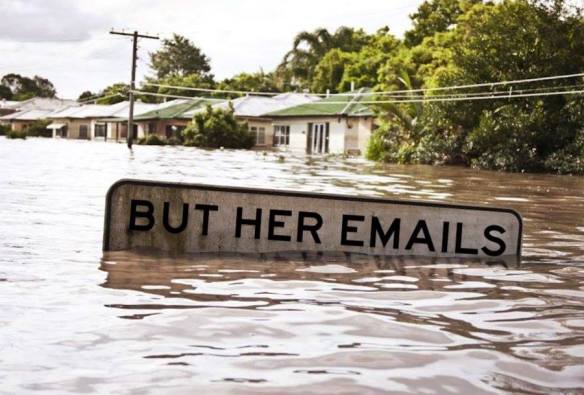
You Can Spare a Few Dollars to Lobby the Electoral College

Politico reports that full-page advertisements are running in several newspapers encouraging Republicans in the Electoral College to vote against the Orange Menace. The advertisements are being paid for by a Go Fund Me campaign that’s raised more than $250,000 so far. You can make a donation here. The complete text of the advertisement, entitled “Letter To Electors”, is available here. 

From that “Letter to Electors”:

Never in our Republic’s history has there been a President-apparent comparable to [the Orange Menace]. His inauguration would present a grave and continual threat to the Constitution, to domestic tranquility, and to international stability…

We place country before party in imploring you, our fellow Americans, to investigate and deliberate. We stand with you as you exercise your conscience and give profound consideration to the consequences of your vote. We affirm your right and your duty to do so free from intimidation, and urge you to cast your ballot for a person with the temperament, integrity and commitment to Constitutional principles necessary in a President.

In doing so, know that you enjoy the support of millions of Americans.

If you’re thinking about contributing, do it today. The Electoral College votes on Monday, December 19th.

Stating the Obvious – It Should Be Stated Again and Again

Although this may be the last time I state it. The election was five weeks ago. Its otherworldly result is likely to be set in stone by 300 members of the Electoral College next week (despite their duty to do otherwise). In the weeks ahead, therefore, I hope to turn my attention to the election’s aftermath, and possibly even other topics of interest, like Brian Wilson’s very good memoir, what to look for in a snow shovel and how to leave the U.S. without a passport. Or maybe where to acquire body armor and the safest way to throw a Molotov cocktail.

Nevertheless, Amanda Marcotte has a very good summary at Salon of how the Russians got away with hacking the election. The long headline is:  

The big problem isn’t that Russian hackers tried to influence our election — it’s more that we let them – Media lameness, a gullible public, useful idiots on the left and the GOP all helped enable Russian propaganda

She makes an excellent point. It’s not a new point, but it bears repeating over and over again (by someone else, not me). Assuming we escape the clutches of the Orange Menace one day, how do we avoid going through something like this again if we don’t understand how it happened? 

She begins:

(The Russian’s apparent) strategy worked because too many power players in the American political ecosystem were too shortsighted, lazy and selfish to look past their own immediate self-interest and consider the big picture. What the purported Russian email hack ended up doing was illustrating the various weaknesses in our political systems and culture — weaknesses that Trump, likely with Vladimir Putin’s assistance, was able to exploit to claw his way into the White House.

First, “mainstream media outlets are more interested in appearing fair than actually being fair”. Fox News, of course, being a propaganda machine, doesn’t care about being balanced. They simply claim to be. Reputable news sources like CNN and the New York Times, however, want to provide “balanced” coverage. They want to acquire and retain customers all along the political spectrum. But, in 2016, their lame attempts to be balanced led to disaster: 

Trump is so corrupt that he coughs up more genuine scandals before breakfast than most dirty politicians can come up with in a lifetime. Hillary Clinton, in contrast, is a clean politician, which we know because she’s been under some kind of dogged investigation for the better part of three decades, without a speck of real dirt coming up on her.

But to report this basic truth — that one candidate was irredeemably corrupt and the other was not — would have drawn accusations from the right that the media was in the tank for Clinton. So, in order to appear fair, mainstream media outlets embraced a policy of being incredibly unfair to Clinton, blowing every non-scandal out of proportion.

Marcotte then points her finger at the average American voter:Most people don’t really read the news, but just glean general themes from headlines and cable TV”. One of the example she cites from Vanity Fair magazine:

juicy

But in the actual text, writer T.A. Frank admitted that “you’ll find nothing close to a scandal in itself” and “Clinton’s campaign is, mostly, reassuringly plodding and rules-bound.”

An honest headline written by someone whose goal was to inform the public would have looked something like this: 

PODESTA EMAILS SHOW PLODDING, SCANDAL-FREE CAMPAIGN

Sensationalism like Vanity Fair‘s is one reason most voters thought Clinton was more corrupt than T—p:

All these stories about “leaked” emails left the indelible impression with voters that there must have been something in them that was worth leaking, even if they had no idea what it was. 

Marcotte then points out that people on the left are open to conspiracy theories, too. Emails stolen from the Democratic National Committee convinced some Sanders supporters that the primary elections were rigged:

The email hack did not actually reveal any evidence that the Democratic National Committee had treated Sanders unfairly during the primary. It did find that some DNC employees expressed negative thoughts about him after his campaign repeatedly accused party officials of dirty pool, but there was no dirt beyond private grousing.

Nevertheless, the impression grew that somehow Sanders had been cheated. That led some who would ordinarily vote Democratic to stay home or vote for a third party. Consider, for example, that in Michigan, Pennsylvania and Wisconsin, the Green Party candidate got more than 133,000 votes. Clinton lost those three states and, as a result, the Electoral College by 78,000. 

Lastly, of course, most Republican politicians put party over country. In particular, Senator McConnell’s refusal to condemn or even acknowledge the Russian hacking was, in Marcotte’s words:

… a neat distillation of Republicans’ attitude toward any Trump-based corruption: They’re happy to look the other way as Trump and his supporters plunder the country, spread racism and bigotry and undermine our democracy, so long as they get a crack at destroying Social Security and Medicare.

So, putting the election aside and looking to the future, Kurt Eichenwald of Newsweek has a long article that shows how T—p’s business would (or will) lead to major conflicts of interest. They even have a 3-minute video that summarizes the sad story.

For All the Special Snowflakes Out There

Who couldn’t bring themselves to vote for a “flawed” candidate.

czlrgidxeaepghr

(Thanks to whoever made this. Assuming it isn’t real. Yet.)

I Am Brian Wilson: A Memoir by Brian Wilson with Ben Greenman

Brian Wilson was the brilliant creative force behind the Beach Boys before his life went sideways. In recent years, he’s had a successful solo career, mainly because he found the right woman to marry and got the mental health treatment he needed.

This memoir is quite good, even better than I expected. Reading it feels like you’re seeing the world from Brian’s perspective, as his recurring thoughts and memories, good and bad, come and go. The book is divided into chapters that bring some organization and chronology to the story, but at times it’s like listening to his stream of consciousness.

Never having heard him speak for any length of time, because he is famously terse in interviews, I wondered if his “voice” was really coming through. I think it was. Brian and his co-writer should be very proud of what they’ve accomplished. They’ve given us an informative look into the mind of this extremely talented man. 

How We Got Here & What To Do

It’s so strange, but I haven’t woken from this nightmare yet. And it’s so realistic, in one sense of that word.

But seriously, Charles Pierce of Esquire has written the best explanation I’ve seen of how we got to this bizarre, dangerous point in our history. It’s called “Russia’s Interference in This Election Should Not Be a Surprise: This kind of thing has been a long time coming”. 

I wish every adult would read it, because it was written for adults, the millions of Americans who are grown up enough and rational enough to perceive reality and then take responsibility for their own and other people’s lives.

If, for example, the 306 Republicans in the Electoral College read it, at least 37 of them might do their duty next Tuesday. They would vote for someone else and let the House of Representatives make the final decision. Otherwise, December 19, 2016 (it’s only one week away) will join the other dates in American history that live in infamy.

So please read Mr. Pierce’s article now. Here it is. It won’t take more than a few minutes.

As Mr. Pierce says, this is the starkest challenge to a free people that has arisen in our lifetimes. So what shall we do?

The first thing you might do is remind the Republican electors of their responsibility to defend the Constitution and protect the United States of America. One patriotic American has created a website with instructions on how to do exactly that. It’s called Direct Election. The site has lots of tools, including letters already addressed to 273 of the 306 Republican electors (the others were hard to locate).

I’m going to start mailing a letter myself, maybe something like this:

Dear …

If you are planning to vote for Mr. Trump on December 19th, or feel obligated to do so, please don’t.

Mr. Trump isn’t a real Republican. He’s not even a real Democrat. He is a dangerous, psychologically-damaged con man who must never become President of our great nation. 

I won’t ask you to vote for a specific person. But I do respectfully ask that you vote for someone other than Mr. Trump. By doing so, you will perform your solemn duty to protect the Constitution and the United States of America.

After all, the Electoral College was designed to forestall the election of a person unfit to be President. That includes anyone who puts his own financial interests or the interests of a foreign power ahead of ours. We need someone who loves America and is both willing and able to fulfill the responsibilities of the job. 

I respectfully submit that Mr. Trump is not such a man. The evidence, including his behavior since winning the election, is clear. You are now our only hope. Thirty-seven of you can let the House of Representatives choose a qualified person. More of you working together can determine who is President. Please vote for anyone else on December 19th.

Please note that any state laws that say an elector must vote a certain way are most likely unconstitutional. Furthermore, thousands of concerned citizens stand ready to pay for any legal fees or fines you might incur, and there are lawyers who have pledged to provide free legal services to any electors who face legal consequences for voting their conscience.

Thank you for reading this letter.

Sincerely yours, and God bless America, …

Assuming the Electoral College fails to do its duty next week, there are other things to do.

First, Timothy Snyder, the Housum Professor of History at Yale University and the author of Bloodlands: Europe Between Hitler and Stalin, offers a “Twenty-Point Guide to Defending Democracy Under a T—p Presidency”. The first item on his list is:

1. Do not obey in advance.

Much of the power of authoritarianism is freely given. In times like these, individuals think ahead about what a more repressive government will want, and then start to do it without being asked. You’ve already done this, haven’t you? Stop. Anticipatory obedience teaches authorities what is possible and accelerates unfreedom.

Second, Thomas Geoghagan, a Chicago labor lawyer and author, describes “Four Things We the People Can Do About Our Unjust Voting System and a President Trump”. Three of his four suggestions require legislative action. One would involve states with Democratic majorities agreeing to an interstate compact: 

This interstate compact … would be a quasi-constitution—a model for what the whole country should have. 

Such a compact might include, for example:

  • A ban on partisan redistricting of U.S. House and state legislature positions.
  • A right to healthcare.
  • A commitment to carry out their share of what the U.S. committed to in the Paris global warming accords.
  • A bill of rights for employees, including a right not to be terminated except for just cause.
  • A formula for a just level of funding for public education.
  • A comprehensive system of background checks for gun purchases.

Mr. Geoghagan concludes:

Since each of the above is an act that the state itself would be free to take, an interstate compact would not infringe on federal sovereignty —or require approval of Congress under Article I, section 10. 

Let one part of America, at least, be a city on a hill.