How Shall We Describe the Orange Menace?

Language helps us cope with the world. That’s why using the right words matters. Telling your companion there’s “something” behind her would be accurate, but telling her it’s a “bear” would be better, assuming it really was a bear.

This explains the continuing effort to find the right terminology for President-elect Orange Menace. He’s been called “insane” and a “demagogue”, a “con man” and a “thug”.  He’s been described as an “arrogant orange idiot”.

In fact, those last three words, “arrogant”, “orange” and “idiot” are the three most popular responses at Trump In One Word. That’s the helpful site where you can submit a pungent word of your choice to describe him, see which words have been chosen most often, and even find out what words your (anonymous) neighbors selected (good job, neighbors!).

Which brings me to the “fascist” issue. Some observers think the next President is clearly a fascist or at least exhibits strong fascistic tendencies. Others see similarities but don’t think he satisfies enough of the criteria (yet anyway) to put him in the same category as Mussolini, Hitler or Francisco Franco. All the experts agree he’s an authoritarian, right-wing demagogue, but they don’t all agree that he’s a “fascist”. The truth is they don’t even agree on how to define the term. Hence, the “fascist” problem.

[Before we proceed, please note that I recently began using the Google Chrome extension Rename T___p. That’s why you will see “*****” where the O.M.’s name appears in the text I’ll be quoting. It’s a very nice tool. I chose “*****” for everyday use, but it was gratifying to see that “Orange Menace” is the 13th most popular T___p replacement – not as popular as “Fuckface Von Clownstick”, of course – but still doing very well. The extension is free and available here.]

One scholar, Sarah Kendzior, has argued that we should compare the O.M. to the rulers of a few countries we don’t usually hear about:

Left out – as always – have been the dictatorships of former Soviet Central Asia: Uzbekistan, Turkmenistan, Tajikistan, Kazakhstan, and (to a lesser degree) Kyrgyzstan.

The Central Asian states are dictatorships. They are also spectacular. And it is by examining this–dictatorship as spectacle–that the parallels to ***** emerge… The nation becomes a brand; the dictator, a brand ambassador; the people, a captive audience….

…Spectacle soothes the masses while distracting them from their suffering. *****, a master of the American reality TV genre which has made a spectacle of human suffering – he made “You’re fired!” a beloved tagline … – knows how to make an audience feel included through the theatrical exclusion of others. This tactic carries over into *****’s rallies, where protesters are booted — and sometimes beaten — with fanfare. It also carries over into his policies, which are structured around exclusion: a wall against Mexico, banned entry for foreign Muslims, a database for U.S. Muslims, and a media denied access unless they acquiesce to *****’s demands…

The most obvious corollary to ***** is Turkmenistan’s deceased leader Niyazov … best known for the monuments and dictates bolstering his personality cult. They included building a giant golden statue of himself which rotated to face the sun; renaming the months and common words, like “bread”, after his relatives; and the Ruhnama, a collection of autobiographical anecdotes … and parables which all citizens were required to read. (A giant electronic version of the Ruhnama blared Niyazov’s wisdom from its perch in the capital.)….

“I’m personally against seeing my pictures and statues in the streets, but it’s what the people want,” explained Niyazov when asked about his ubiquitous visage. It is easy to imagine ***** making similar claims… It is also easy to imagine [him] building a giant golden statue of himself that revolves to face the sun.

Unfortunately, there’s no word that means “the leader of a dictatorship in former Soviet Central Asia”. And the phrase “***** is another Niyzaov” probably wouldn’t catch on.

In a similar vein, however, a few writers have suggested that “caudillo” would be a good label for the Orange Menace. It’s Spanish for “leader”. Thus, Franco proclaimed himself “El Caudillo” just like Mussolini was “Il Duce” and Hitler “Der FĂĽhrer”. One might object that ***** isn’t as fascistic as those other villains, but the word has a longer and more varied history than its use in the glorification of Francisco Franco.

Paul Campos at the Lawyers, Guns & Money blog explains:

The classic Caudillo is a charismatic populist, who attacks the existing political and economic establishment with what might be called trans-ideological enthusiasm.  He claims that he and he alone has the ability to solve the nation’s problems, and to be the voice of the dispossessed.  He bullies his opponents, he persecutes any media who do not grovel before him, he boasts of his supposed sexual prowess, he has a narcissistic and therefore unquenchable thirst for public adulation, he is openly contemptuous of formal legal restraints, and he talks constantly of restoring the nation to its former grandeur.  To bolster his political base he uses the latest social media to speak as directly as possible to his followers, cutting out traditional forms of governmental and journalistic intermediation.  And he loves to make lots of absurd and expensive promises, often in the form of spectacularly ridiculous government projects, many of which are designed to keep out or expel contaminating and subversive foreign influences.

Remind you of anyone?

Mr. Campos then asks why this bizarre and dangerous person has made such an alarming dent in our politics:

I suspect the answer has much to do with the extent that the United States economy is coming to resemble many a Latin American breeding ground for narcissistic despots.  In terms of relative levels of economic inequality, the U.S. now looks much more like Latin America than Europe, and the trend is only getting stronger.  As Omar Encarnacion notes:

“… *****, like many caudillos, has capitalized upon his status as a political outsider. This status, ***** argues, best allows him to blow up the current political system and to replace it with something that would work for everyone, but especially for those feeling left behind.”

… All of which is to say that, especially now, it would benefit us all to pay much more attention to both the history and the present circumstances of our various southern neighbors.

Words matter, because they help us make our way in the world. Beginning January 20, the words we use may be more important than any we living Americans have ever used before.
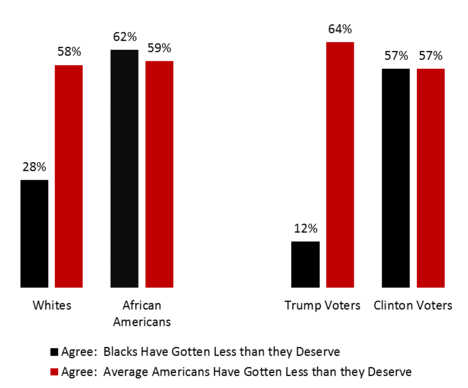
Do You Think Americans Are Getting What They Deserve?

The chart below is the result of a poll of 1,000 Americans who mirror the population of the country as a whole. The question they were asked was:

Do you agree or disagree with the following statements?

  1. Over the past few years, blacks have gotten less than they deserve.
  2. Over the past few years, average Americans have gotten less than they deserve.

The results:

Most blacks and Clinton voters are in very close agreement: neither group has gotten what they deserve.

By the same percentage, whites think that average (i.e. mostly white) Americans haven’t gotten what they deserve. Blacks, however, have done well. 

Trump voters also agree that average Americans haven’t gotten what they deserve. They’re very sure, however, that blacks have been living on easy street.

2016-12-19-1482185503-3679361-trump_deserve-thumb

The political scientist who reported the results concludes:

It appears, then, that Trump voters weren’t simply motivated by their widespread belief that average Americans are being left behind. Rather, their strong suspicion that African Americans are getting too much—a belief held by the overwhelming majority of Trump voters—was a much stronger predictor of their vote choices in last month’s election.

Racially resentful beliefs that African Americans are getting more than they deserve were so strongly linked to support for Trump, in fact, that their impact on both the 2016 Republican Primary and the general election were larger than they had ever been before.

Another conclusion we should draw is that America’s race problem and America’s politics won’t improve much until there are fewer of us white people around.

The Red Menace Isn’t What It Used To Be. It’s Not Even Red. It’s Orange.

One thing everyone needs to understand about the Orange Menace’s love for Russian dictator Vladimir Putin is that Russia isn’t a Communist country anymore. Boris Yeltsin banned the Communist Party of the Soviet Union back in 1991, shortly before the Soviet Union was formally dissolved. Putin resigned from the party that year.

In 1995, Putin helped organize the pro-government “Our Home Is Russia” party. In 1999, he joined the new “Unity” party. That’s the same year he described Communism as “a blind alley, far away from the mainstream of civilization”. In 2008, during his second term as Prime Minister, Putin became the leader of the “United Russia Party”.

Although there are still quite a few Communists in Russia, the Communist Party of the Russian Federation is much less popular than United Russia. In this year’s election, Putin’s party got 54% of the vote. The Communists came in second with 13%.

Since Putin isn’t a Communist anymore, what is he? Here’s how Wikipedia describes United Russia:

The Party has no coherent ideology; however, it embraces specific politicians and officials with a variety of political views who support the administration. The Party appeals mainly to non-ideological voters; therefore, United Russia is often classified as a “catch-all party” or as a “party of power“. 

In 2009 the United Russia Party proclaimed “Russian Conservatism” as its official ideology.

United Russia isn’t so much a political party that tries to win elections in order to carry out a set of policies. Instead, it’s one of the tools used by the rich and powerful to win elections so they can maintain their positions at the top of Russian society.

Putin began his political ascent when he was put in charge of the Presidential Property Management Department in the late 1990s. His job was to manage the transfer of overseas property belonging to the Soviet Union and Communist Party to the new Russian Federation. That process had been going on since the fall of the Soviet Union. But instead of being transferred to the new government, much of that property was “privatized”. In other words, it ended up in the hands of a small number of well-placed people, including Putin, who quickly became extremely rich. 

In the words of the economist and lawyer James S. Henry, whose long article “The Curious World of Donald T___p’s Private Russia Connections” tells the sordid story in detail:

…One of the most central facts about modern Russia [is] its emergence since the 1990s as a world-class kleptocracy, second only to China as a source of illicit capital and criminal loot, with more than $1.3 trillion of net offshore “flight wealth” as of 2016…

[It was] one of the most massive transfers of public wealth into private hands that the world has ever seen.For example, Russia’s 1992 “voucher privatization” program permitted a tiny elite of former state-owned company managers and party apparatchiks to acquire control over a vast number of public enterprises, often with the help of outright mobsters.

A majority of Gazprom, the state energy company that controlled a third of the world’s gas reserves, was sold for $230 million; Russia’s entire national electric grid was privatized for $630 million; ZIL, Russia’s largest auto company, went for about $4 million; ports, ships, oil, iron and steel, aluminum, much of the high-tech arms and airlines industries, the world’s largest diamond mines, and most of Russia’s banking system also went for a song.

In 1994–96, under the infamous “loans-for-shares” program, Russia privatized 150 state-owned companies for just $12 billion, most of which was loaned to a handful of well-connected buyers by the state… The principal beneficiaries of this “privatization”—actually, cartelization—were initially just 25 or so budding oligarchs with the insider connections to buy these properties and the muscle to hold them.… 

For the vast majority of ordinary Russian citizens, this extreme re-concentration of wealth coincided with nothing less than a full-scale 1930s-type depression, a “shock therapy”-induced rise in domestic price levels that wiped out the private savings of millions, rampant lawlessness, a public health crisis, and a sharp decline in life expectancy and birth rates.

Is it any wonder at all that Vladimir Putin, the man in charge of this highly successful criminal enterprise, is one of the Orange Menace’s favorite people? T___p built his real estate career on tax breaks from local government (a billion dollars from New York City alone), tax evasion, loans that were never repaid and a number of shady deals, while Putin should be made an honorary member of the Republican Party. Donnie and anti-Muslim, super-secretive white guy Vladimir have a whole lot in common.

It’s remarkable that the Orange Menace hasn’t said a bad word about Putin or Russia since he began running for President, even though he’s criticized just about everyone else on Earth. It isn’t just admiration on T___p’s part. There has been a lot of money involved. Mr. Henry proceeds:

… For many banks, private bankers, hedge funds, law firms, and accounting firms, for leading oil companies like ExxonMobil and BP, as well as for needy borrowers like the Trump Organization, the opportunity to feed on post-Soviet spoils was a godsend. This was vulture capitalism at its worst.

The nine-lived Trump, in particular, had just suffered a string of six successive bankruptcies. So the massive illicit outflows from Russia … from the mid-1990s provided precisely the kind of undiscriminating investors that he needed. These outflows arrived at just the right time to fund several of Trump’s post-2000 high-risk real estate and casino ventures—most of which failed. As Donald Trump, Jr., executive vice president of development and acquisitions for the Trump Organization, [said] in September 2008 (on the basis, he said, of his own “half dozen trips to Russia in 18 months”):

“In terms of high-end product influx into the United States, Russians make up a pretty disproportionate cross-section of a lot of our assets; say in Dubai, and certainly with our project in SoHo and anywhere in New York. We see a lot of money pouring in from Russia.”

All this helps to explain one of the most intriguing puzzles about Donald Trump’s long, turbulent business career: how he managed to keep financing it, despite a dismal track record of failed projects.

According to the “official story,” this was simply due to a combination of brilliant deal-making, Trump’s gold-plated brand, and raw animal spirits—with $916 million of creative tax dodging as a kicker. But this official story is hokum. The truth is that, since the late 1990s, Trump was also greatly assisted by these abundant new sources of global finance, especially from “submerging markets” like Russia. [T___p and Putin] are not evil twins, exactly, but they are both byproducts of the … scams that were peddled to Russia’s struggling new democracy.

So, maybe the Orange Menace did something very bad on one of his trips to Russia and they’re blackmailing him. Maybe one of his fundamental desires is that the U.S. and Russia form an alliance to make weaker countries give up their nuclear weapons (as reported here). Maybe he sees Putin as an ally in the fight against Islamic radicals or a coming war with China. Maybe he views Vlad as a role model, since Putin often has his critics and enemies murdered. It seems likely, however, that it’s mostly about the money.

(For a look at one way Putin plans to rake in the rubles once the new President and the Secretary of State from Exxon are in charge, take a look at this. There’s a whole lot of oil just north of Russia.)

Nobody Asked Me, But…Oh, Hell, Let’s Beat a Dead Horse

There used to be a newspaper columnist I enjoyed reading who would sometimes use “Nobody Asked Me, But…” as the title of his column. I thought maybe it was Earl Wilson, a gossip columnist who had a big following in his day. Not so. It was the equally popular Jimmy Cannon, who mostly wrote about sports:

On frequent occasions, when Cannon had no particular sports news to report, he would still manage to fill his daily column space by starting off with the phrase “Nobody asked me, but…” and then filling the rest of the column with his random opinions on any and every subject outside of the sports world. This gambit has been eagerly seized upon by newspaper columnists ever since, not only on the sports page but in every other section. Columnists who “borrow” this device will typically lead off with some lip-service tribute to its originator, such as “In the words of the immortal Jimmy Cannon: Nobody asked me, but…” and then they’re off. [Wikipedia]

 Ok, I’m off… 

Causation is a popular topic for philosophers because the idea of a “cause” gets stranger the more you think about it. For example, what causes an apple to fall from a tree? You might say the stem broke. Or you might say the apple got too heavy. Or that the earth’s gravity eventually made the apple fall. Maybe the cause was everything that led up to that moment, in other words, the entire prehistory of the universe.

It’s much harder to identify a single cause of a big event like a Presidential election. But many of us still want to know why the Electoral College went the way it did, as if there was a single cause and a simple explanation for what happened. I’ve tended to focus on the Clinton email story as the deciding factor because the media gave the story such exorbitant attention and the FBI’s involvement was so perverse. I can’t stop thinking that if only the story had received the minimal attention it deserved or if only the FBI had acted properly, the election would have ended differently.

Another factor that’s been bothering me a lot, however, is the media’s overall coverage of the campaign. This wound was reopened yesterday when I read a disturbing article about the Sinclair Broadcast Group. They’re the largest chain of TV stations in America.  Sinclair’s 173 TV stations gave remarkably positive coverage to T___p and negative coverage to Clinton.

We all know that Fox worked as a propaganda outlet for T___p. But consider how CNN showed all those unfiltered T___p rallies from beginning to end and how they recruited T___p mouthpieces to “balance” their talk shows. And let’s not forget NBC’s contributions to the T___p campaign. Remember Matt Lauer’s ridiculous interviews of the two candidates and Jimmy Fallon trying to make T___p look like a human being? T___p has been on NBC for years with his “reality” shows and has had a long business relationship with Jeff Zucker, the non-journalist who runs CNN. 

It’s enough to make you think we just witnessed a coup carried out by the media and the FBI.

On the other hand (there’s always another hand), the single most bizarre aspect of the 2016 Presidential election lies elsewhere. Putting aside the media’s failures, the FBI’s contribution, the Russians feeding Wikileaks, voter suppression, poor turnout in some quarters, Clinton’s minuses, the desire for “change”, the disappearance of manufacturing jobs in the Midwest, white resentment, racism, misogyny, xenophobia, latent authoritarianism and the movements of the planets and we’re still left with one incredible fact:

Sixty-two million adult Americans, including majorities in most states, were willing to vote for a monster.

To me, that says it all.

You may have noticed by now that I haven’t followed in the footsteps of the immortal Jimmy Cannon by filling this post with opinions on a random set of topics. That’s what I intended but failed to do. I trust the title I ended up with is reasonably descriptive.

PS – I forgot to mention the damn National Enquirer. They used their presence on every grocery checkout line in America to promote the Orange Menace and highlight fake Clinton scandals. They were another cog in the propaganda machine that contributed to a 77,000 vote margin in Wisconsin, Michigan and Pennsylvania, après quoi, le dĂ©luge.

Good News: The 25th Amendment Can Be Invoked in 23 Days

Bad news: A man with a serious personality disorder will be sworn in as President on January 20th, only 23 days from now.

But as noted above, the new President will immediately become subject to the provisions of the 25th Amendment to the Constitution. That’s the amendment that allows the Vice-President to become President when the President dies or becomes “unable to discharge the powers and duties of his office” (unfortunately, of course, it’s still “his”).

Here’s the first paragraph of Section 4:

Whenever the Vice President and a majority of either the principal officers of the executive departments or of such other body as Congress may by law provide, transmit to the President pro tempore of the Senate and the Speaker of the House of Representatives their written declaration that the President is unable to discharge the powers and duties of his office, the Vice President shall immediately assume the powers and duties of the office as Acting President.

There is more to it than that, because the President can object to the Vice-President’s declaration. Congress would then decide the issue.

Granted, given the fact that the new President is being extremely careful to appoint people he trusts to his cabinet, it might be difficult for Vice President Pence to get the necessary signatures right away. He’d probably need to wait until at least one of the President’s appointments had been confirmed, but I’m sure the details could be worked out.

Next question: Will the new President be unable to perform his duties as required? That’s an easy one. The man is clearly suffering from a severe psychological disorder. (I mean, seriously.)

It didn’t get much attention, but three professors of psychiatry sent a letter to President Obama last month. They called for the next President to undergo “a full medical and neuropsychiatric evaluation” in order to see if he suffers from an incurable (!) illness called “Narcissistic Personality Disorder”. Professional ethics demand that psychiatrists not diagnose patients from afar, but is there any doubt that the President-elect is not a well person? From their letter:

Here … are the 9 criteria for “Narcissistic Personality Disorder”. If an individual has 5 out of the 9 they have a confirmed diagnosis of this illness…

“Summary : A pervasive pattern of grandiosity (in fantasy or behavior), need for admiration, and lack of empathy, beginning by early adulthood and present in a variety of contexts, as indicated by five (or more) of the following:

1. Has a grandiose sense of self-importance (e.g., exaggerates achievements and talents, expects to be recognized as superior without commensurate achievements)

2. Is preoccupied with fantasies of unlimited success, power, brilliance, beauty, or ideal love.

3. Believe that he or she is “special” and unique and can only be understood by, or should associate with other special or high-status people (or institutions)

4. Requires excessive admiration

5. Has a sense of entitlement

6. Is interpersonally exploitative

7. Lacks empathy: is unwilling to recognize or identify with the feelings and needs of others

8. Is often envious of others or believes that others are envious of him or her.

9. Shows arrogant, haughty behaviors or attitudes.”

Opinions may vary, but I give him roughly nine out of nine. 

The professors continue:

1. People with NPD are extremely sensitive and insecure. They psychologically require constant compliments and acknowledgement because they do not have their own internal self-esteem. They need to get it from others.

2. If someone does criticize them, … it triggers this deep and painful lack of self-esteem and they MUST lash out to relieve the pain of the criticism.

3. They have only two modes: They are either fully your friend and love you or you are their enemy and they will do everything to discredit you or humiliate you. They can’t help it. The pain of having someone in their circle who does not approve of them or acknowledge them, almost constantly, is too great.

4. There are only two ways to deal with someone with NPD, and they are both dangerous. There is no healthy way of interacting with someone with this affliction. If you criticize them they will lash out at you and if they have a great deal of power, that can be consequential. If you compliment them it only acts to increase the delusional and grandiose reality the sufferer has created, causing him to be even more reliant on constant and endless compliments and unwavering support.

5. Because they crave the attention and approval of others they develop great capacity to engage and entertain and can be quite charismatic, even to the point of developing a cult-like following.

6. Someone with NPD will NEVER get along with any member of the press or any media outlet that criticizes him.

7. Someone with NPD will NEVER hire (and will fire) anyone who criticizes him. Therefore, and because they believe they know better than almost everyone else, they have a very hard time listening and taking any advice.

In other words, the President of the United States will be psychologically armed and extremely dangerous as of high noon on January 20th. That’s when the Vice-President of the United States needs to begin the process of saving us from the Electoral College. Never put off until tomorrow what needs to be done today.

PS:

Bad news: Mike Pence, a rock-ribbed Republican jerk, would become President.

Good news: We’ve survived bastards like him before.

More good news: If Pence doesn’t immediately get the 25th Amendment rolling, see Article 2, Section 4, Impeachment. Even Congressional Republicans do their jobs sometimes.