Other Minds: The Octopus, the Sea and the Deep Origins of Consciousness by Peter Godfrey-Smith

Peter Godfrey-Smith is an Australian professor of philosophy who has spent many hours scuba-diving in order to observe the behavior of octopuses and cuttlefish. The book is an attempt to trace the evolution of mental activity from its earliest beginnings hundreds of millions of years ago, when bacteria began reacting to their surroundings. The author believes that mind and consciousness didn’t suddenly spring into existence; they developed gradually through millions of years. But he admits that nobody knows for sure.

Neither do we know what it’s like to be an octopus. We don’t even know for certain that it’s like anything at all. Maybe octopuses go about their business without feelings or anything like consciousness. Godfrey-Smith, however, argues that it’s reasonable to believe that creatures of many sorts feel pain when they are injured. But where to draw the lines (if there are any lines) between bacteria that simply react, animals that feel pain and creatures like us who are self-conscious is a mystery.

Octopuses are especially interesting because our common ancestors lived about 500 million years ago. Octopuses developed complex nervous systems, arranged differently than ours, independently from most other animals, including us. That means, in Godfrey-Smith’s words, “meeting an octopus is, in many ways, the closest we’re likely to get to meeting an intelligent alien”. It’s really too bad that they can’t tell us what it’s like to be them.

I wish the book ended with a summation of the author’s conclusions. I do remember the idea that nervous systems first evolved in order to respond to a living thing’s surroundings, and then to monitor its internal states and control its movements. And I remember a lot about the interesting behavior of octopuses and their close relations, cuttlefish. But I can’t say I came to any solid conclusions about the deep origins of consciousness. If the author reached any conclusions, he should have reminded his readers what they were.

My Country, ‘Tis of Thee

I was thinking about writing a post based on recent statements by Sen. Orrin Hatch (Republican, Utah) and Sen. Charles Grassley (Republican, Iowa), but an actual writer beat me to it.

From Paul Waldman of The Washington Post:

With Republicans well on their way to passing a dramatic overhaul of the tax code, they have presented to the public a sweeping, comprehensive vision not just of what taxes should look like, but of what government is there for, what our obligations are to one another, and even how each of us should think about our value as human beings. This is a moment of uncommon clarity.

…. Let’s start with Iowa’s Chuck Grassley, who made this comment on the estate tax:

“I think not having the estate tax recognizes the people that are investing,” Grassley said, “as opposed to those that are just spending every darn penny they have, whether it’s on booze or women or movies.”

Right now, the first $5.5 million of any estate is not subject to the tax. Because of that, fewer than one in 500 estates owes any tax at all. So Grassley is saying that 99.8 percent of Americans lead contemptible lives of waste and folly, while only that remaining sliver of the extra-wealthy have shown the virtue that should win their heirs the ability not to pay taxes on the fortunes bequeathed to them. The Senate bill would double the tax’s exemption, while the House bill would eliminate the tax entirely; depending on how the final version turns out, Eric Trump may finally be free of the fear that he’ll have to pay taxes on his inheritance.

Now let’s turn to Utah’s Orrin Hatch, who explained why, despite his support of a bill offering trillions of dollars in tax breaks to the wealthy and corporations, we absolutely must start slashing the social safety net immediately:

“I have a rough time wanting to spend billions and billions and trillions of dollars to help people who won’t help themselves, won’t lift a finger, and expect the federal government to do everything.”

… There isn’t much political advantage in saying that if you die with less than $5.5 million in assets, like nearly all Americans do, that means you were lazy and self-indulgent, while only the wealthy have proven their moral worth by the size of their bank accounts. So when someone says something like that, you can be pretty sure he’s expressing his actual beliefs….

Those are value judgments, rooted in how Republicans tend to view the worth of different people. They operate on the presumption that the economic system is fair, and the results of that system provide a measure of different people’s virtue. If you’re rich — even if you got rich by choosing the right parents — they presume that you deserve to be taxed as lightly as possible, while if you’re in need of the kinds of help we offer low-income people, then it reflects a moral failing. If we give you any help at all, it should be as grudging as possible, accompanied by stern lectures and even rituals of humiliation like drug tests.

Their tax bill, and their upcoming assault on the safety net, will weave these principles more deeply into our laws. And these principles are their real rationale; ignore all the practical claims they make about the explosion of economic growth these tax cuts will supposedly produce, and how the benefits will trickle down to everyone, and how it will all pay for itself. Those arguments are transparently bogus. A recent survey of 38 prominent economists found that only one said the tax bill would significantly increase growth…

Confronted with this comprehensive debunking of their practical claims, Republicans are undeterred and undaunted. That’s because they’re driven by a moral imperative, one that says that no matter what effect cutting taxes on the wealthy and corporations might have on the economy, it’s just the right thing to do. It rewards the virtuous, and you can tell who the virtuous are by how much money they have. If you’re asking why they wrote the bill the way they did, that’s just about all you need to know.

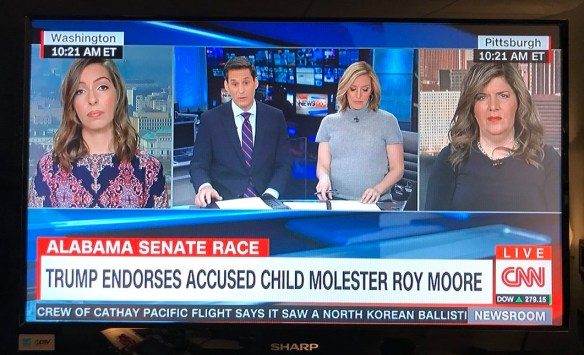
Meanwhile, our law-and-order president (sexual predator D. Trump) has endorsed former judge Roy Moore, who will probably join Grassley and Hatch in the Senate later this month:

DQNlvbQW0AEcCWY

My country, ’tis of thee,
Sweet land of liberty,
Of thee I sing….

If They Wanted Real Tax Reform

The big story in Washington this week is the Senate Republicans scrambling to pass a major tax bill that nobody but their donors and other members of the plutocracy likes. Assuming something like it eventually becomes law, it will give a temporary tax cut to most members of the middle class and raise taxes for others, while giving a permanent tax cut to rich people and corporations. It will also add more than a trillion dollars to the deficit while requiring billions of dollars to be cut from programs like Medicare. (There is a nice summary of the giant con here.)

Republicans and even some journalists are calling it “tax reform”, even though it will make our system of taxation worse than it already is.

Wondering what real reform would look like, I read a book called A Fine Mess: A Global Quest for a Simpler, Fairer and More Efficient Tax System. It’s by a journalist named T. R. Reid. After a lot of research and conversations with tax experts around the world, he reached the same conclusion most experts have. The simplest, fairest and most efficient system of taxation is based on the “Broad Base, Low Rate” (BBLR) model.

The BBLR idea is that countries should tax as much as possible while keeping rates as low as possible. So, in the case of income tax, it’s best to tax all kinds of income at the same low rate. That means getting rid of deductions, exemptions and credits, many of which benefit people with the highest incomes, while categorizing things like health insurance benefits from your employer as personal income. That’s the “broad base” part. Once you’ve broadened the base and made more income subject to taxation, you can then lower everyone’s rates (that, obviously, is the “low rate” part).

The BBLR approach has a number of benefits. Filing and auditing tax returns is far simpler. Since rates are low and everyone’s income is treated the same, fewer people are tempted to avoid or evade taxes. Also, decisions about things like buying a house or building a factory tend to be made on the merits, not on the basis of tax considerations.

Reid also thinks the U.S. should institute a Value Added Tax (VAT). It’s a kind of sales tax, but one that is applied at every step of the manufacturing or distribution process, i.e. whenever money changes hands. We are the only rich country in the world that doesn’t have a VAT. Since it’s a tax on consumption, not income or savings, a VAT apparently has beneficial effects on a nation’s economy. It’s also difficult to evade. That’s why everyone else has one.

Another change Reid recommends is to reduce taxes on corporations. The U.S. has a high corporate tax rate, which results in corporations devoting a lot of effort to reducing or even eliminating their taxes. He thinks it would be better if all of the income people receive from corporations, especially dividends and capital gains, were subject to the same tax rate as other income (today, supposedly in order to foster investment, that income is taxed at a lower rate, which again mainly helps the wealthy). In fact, in a very interesting article in The Washington Post earlier this month, Reid advocated eliminating the corporate tax altogether, since it doesn’t do what it’s supposed to do.

What surprised me most about A Fine Mess, however, was that some of the ideas Reid endorses are included in the Republican tax bill. (Seriously, it doesn’t happen very often that there is overlap between “Republican policy” and “good idea”.) For instance, the Republicans have talked about getting rid of the deductions for medical expenses, state and local taxes and interest on mortgages. They would try to offset the disappearance of those deductions by increasing the standard deduction and lowering everyone’s rates. The result would be that more income would be taxed, but at a lower rate (that’s BBLR). Another result, not so beneficial, would be that millions of average taxpayers, for example, those who have major medical expenses or live in states with high taxes or who have big mortgages, would get a tax increase, even if their tax rates were lowered.

Unfortunately, the Republicans want to combine their few good ideas with many bad ones. For example, they want to get rid of the estate tax, which only affects the truly wealthy, and give more favorable treatment to certain kinds of business income (it’s been said that the Republican tax plan could have been written by Trump’s accountant). They also want to reduce taxes on the rich so much that they’ll have to cut social programs like Medicare, while adding more than a trillion dollars to the deficit.

Reid points out that Congress tends to produce a major tax bill every 32 years. The last one was in 1986. Congress worked on it for two years. The bill had bipartisan support and actually deserved being called “tax reform”. This year, the Republicans are trying to pass their bill in a matter of weeks, without hearings and without input from the Democrats. That indicates how screwed up our government is and how far away we are from getting actual reform.
A Fine Mess: A Global Quest for a Simpler, Fairer and More Efficient Tax System by T. R. Reid

The journalist T. R. Reid argues that America’s national tax system is a disaster, but we could fix it if we started over and adopted the best ideas about taxation from other countries. According to Reid, better systems of taxation are based on the BBLR model, i.e. they tax as much as possible (a “Broad Base”) but at rates that are as low as possible (“Low Rates”). So, instead of allowing lots of deductions and exemptions and credits, as we do now, we should simply tax all income. But since more income would be subject to taxation, the government could lower tax rates for everyone. Because their rates would be lower, fewer people and businesses would hire lawyers and accountants in order to avoid taxes. Business decisions and personal decisions would no longer be made on the basis of what taxes would be owed. In addition, filing a tax return would be much simpler than it is today.

Reid cites New Zealand as the country with the best tax system in the world. They once had a complicated tax system like ours, but were able to revamp the whole thing, following the BBLR model. He also argues for the adoption of a VAT (Value Added Tax), a kind of sales tax that every advanced country but the United States currently applies (one benefit of a VAT is that it’s hard to evade).

Some of the ideas Reid proposes would be acceptable, in theory, to both liberals and conservatives. But he admits that overcoming opposition from special interests and taxpayers who benefit from the system’s complexity would be a big challenge. For example, he recommends eliminating the deductions for charitable donations, local taxes and mortgage interest. I assume he would eliminate medical deductions as well. No doubt some taxpayers would end up paying more, while some would pay less. But we would have a system of taxation that was simpler, fairer and more efficient.

Given the benefits, it seems like the United States should do something like this. Given the craziness of the Republican Party, it seems unlikely that we ever will.

Salvador by Joan Didion

Joan Didion and her husband spent a few weeks in El Salvador in 1982. It was a dangerous place to be. Salvador is a short book about their visit. The book begins with a passage from Joseph Conrad’s Heart of Darkness, which is fitting, given what it was like to be in El Salvador in 1982:

Terror is the given of the place. Black-and-white police cars cruise in pairs, each with the barrel of a rifle extruding from an open window. Roadblocks materialize at random, soldiers fanning out from trucks and taking positions, fingers always on triggers, safeties clicking on and off. Aim is taken as if to pass the time. Every morning “El Diario de Hoy” and “La Prensa Grafica” carry cautionary stories….A mother and her two sons hacked to death in their beds by eight “desconocidos”, unknown men….Same morning, different story: the unidentified bodies of three young men … their faces partially destroyed by bayonets….

This is how the book ends:

In the week that I am completing this report, … the offices in the Hotel Camino Real in Sal Salvador of the Associated Press, United Press International, …. NBC News, CBS News, and ABC News were raided and searched by members of the El Salvador National Police carrying submachine guns; fifteen leaders of legally recognized political and labor groups opposing the government of El Salvador were disappeared; … [the American ambassador] said that he was “reasonably certain” that these disappearances had not been conducted under Salvadoran government orders; … and the State Department announced that the Reagan administration believed that it had “turned the corner” in its campaign for political stability in Central America.

I’ve read a lot of Joan Didion’s journalism over the years, but have often felt I didn’t understand the point she was making. In an article called “The Picture In Her Mind”, Paul Gleason agrees that her “political meaning” often “remains obscure”. But he has an explanation:

Didion’s journalism from the Sixties and Seventies seems newly relevant because then (as now) American history had taken a few alarming turns, and everyone wanted to know why and what to do about it. While crossing the nation on book tour she heard the same question from every TV and radio host: “Where are we heading?” Today, the questions remain the same. “Why is this happening?” And: “What can we do to change it?” But Didion regarded answers to these questions with skepticism, bordering on contempt. At the heart of grand narratives about who we are and where we are heading she saw self-deception in the face of meaningless disorder. Instead of trying to change the world, Didion was content, as she writes in “South and West”, “to find out, as usual, what was making the picture in my mind”….

Didion had concluded “something about the stories people live by”:

“We live entirely, especially if we are writers, by the imposition of a narrative line upon disparate images, by the ‘ideas’ with which we have learned to freeze the shifting phantasmagoria which is our actual experience.” Her disillusionment with her own story, it seems, positioned her especially well to see through the self-deceptions of others.

In Salvador, she reports what it was like to be in El Salvador in 1982, but makes it clear that what people there commonly referred to as “the situation” was too senseless to make sense of.