The Happy Warrior

As you may recall, very few people were excited about the presidential candidacies of Michael Dukakis (1988), Al Gore (2000) and John Kerry (2004). That partially explains why Presidents Dukakis, Gore and Kerry only exist in alternate (and probably better) timelines. The Clinton campaigns (1992, 1996 and 2016) got many people excited. Without the intervention of Russia and the FBI, there would have been two Presidents Clinton by now. Then there is Barack Obama (2008 and 2012). Even more people were excited about him.

One of the presidential candidates getting people excited this time is Senator Elizabeth Warren. Here’s Charles Pierce of Esquire writing about her appearance at the Iowa State Fair on August 10th:

“Elizabeth Warren Is the Teacher All the Students Hope to Get in the Fall”

DES MOINES, IOWA—It is the little moments, the 40-second videos that pop up on the electric Twitter machine accounts of activists and campaign reporters, that give you a sense of the large, humming machine with which Senator Professor Warren thoroughly has wired her campaign into the state of Iowa, at least in the high summer of 2019.

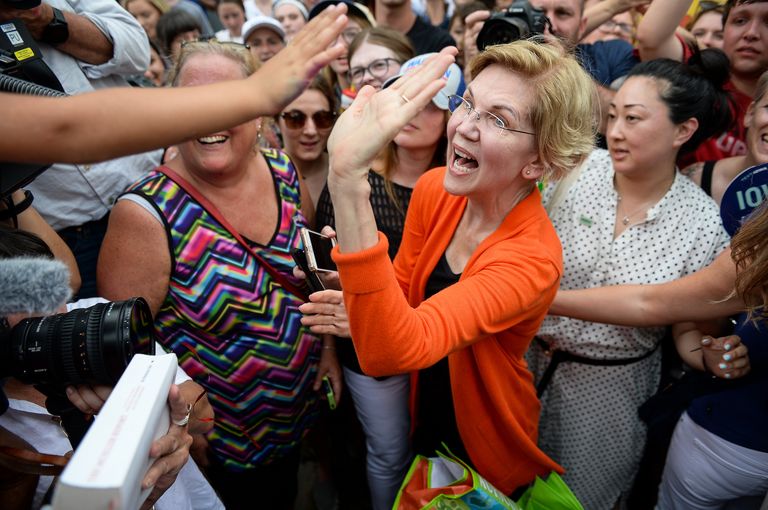
Here she is at the state fair, talking to a crowd along one of the wide boulevards, the people who couldn’t find spots in the huge crowd that waited in stifling heat to hear her at the Des Moines Register‘s candidate soapbox out front, the way Bruce Springsteen turns around to play to the crowd sitting behind the stage. Here she is backstage at some event or another, greeting Senator Kamala Harris like an old college pal, a signifying moment between two powerful women who already share one of the iconic pictures of this campaign. She spends as much time talking to kids as she does to their parents, and she works the crowd like someone born to work the crowds at state fairs.

These are the outward manifestations of what her campaign has put together out here…. She draws enormous crowds and enormous ovations from those crowds. People see her and holler, unbidden, “Big Structural Change!”—the tagline for all her now-famous syllabus of plans. They chant, “Two cents!”, the amount of each dollar over $50 million she proposes to tax to finance the implementation of those plans. (This is reminiscent of the night at the 2012 Democratic National Convention in Charlotte, when the crowd chanted, “Consumer Finance Protection Bureau,” at her, which was not an easy thing to chant.) And, in the polls, she can’t be said to have had a “moment” yet, but her rise has been steady, easing fears that she might be peaking too soon. She is now a solid second to Joe Biden, and it is still only August of 2019.

But the thing that’s sold Elizabeth Warren to Iowa is primarily Elizabeth Warren. None of the candidates seems to be having as much fun as she is. The endless selfies after speeches. The pinky-swears with young girls about how what girls do is run for president. Her willingness to hold town halls anywhere. That loose-limbed, almost goofy wave with which she steps onto every stage. In a gloomy political time, with a humorless sociopathic bully in the White House, and with all the worst impulses of the national Id come out to play, Senator Professor Warren is the campaign’s happy warrior, the teacher everybody hopes they get when school starts up again in the fall. People respond to the good feeling around her campaign as much as they respond to the blizzard of policy proposals that campaign has loosed upon the electorate.

She is a liberal academic who lives in Massachusetts, but she is not a Massachusetts Liberal in the easy caricature that has been so useful to the Republicans over the last 40 years. She is neither a quiet technocrat like Michael Dukakis nor a chilly WASPish icon like John Kerry. She is Oklahoma, born and bred, and it shows in the easy way she connects with audiences here. She is not Harvard. She is someone who went to two public universities before she ever got there. There is none of the distance, none of the archness, common to Ivy League academics.

And the people who come expecting a Dukakis or a Kerry come away happily surprised. And the people who come away expecting an ivory-tower Harvard lecturer leave feeling smarter, and experiencing the conquest of learning in a way they haven’t felt it since elementary school. None of this is to say what may happen when the guns really open up on her, but it is to say, for now, that Elizabeth Warren is running a campaign of hope and optimism and enthusiasm as surely as did Ronald Reagan, that ol’ Iowa radio guy, in 1980, and as surely as Barack Obama did in 2008.

Just on Saturday, she rolled out a plan to address gun violence that included an excise tax on ammunition, an idea the time for which clearly has come, as a number of the candidates have signed onto it. (Thus did a policy proposed by Chris Rock in 1999 become a mainstream Democratic position a decade later.) She talked it up during a forum on gun violence and then went to the fair, where she leaned off the back porch and asked people what they liked best about the fair.

“The food!” someone hollered.

“You!” someone else replied.

She hand-waved both of these until someone mentioned the pigs in competition across the grounds. She spent five minutes talking about them and then walked into the crowd. It took her the better part of an hour to get out of the place.

[End Quote]
warren-1565539405

The C-SPAN video below includes 10 minutes of her stump speech, 5 minutes of her answering reporters’ questions (that are hard to hear) and then another 5 minutes of her being mobbed by the crowd. Watching and listening to her, I’m convinced she will do very well in November 2020, even among millions of voters who mistakenly believed You Know Who would work for them instead of the “economic royalists”. But that’s only if we Democrats are smart enough to nominate her.

Elizabeth Warren at the Iowa State Fair

Our Next President

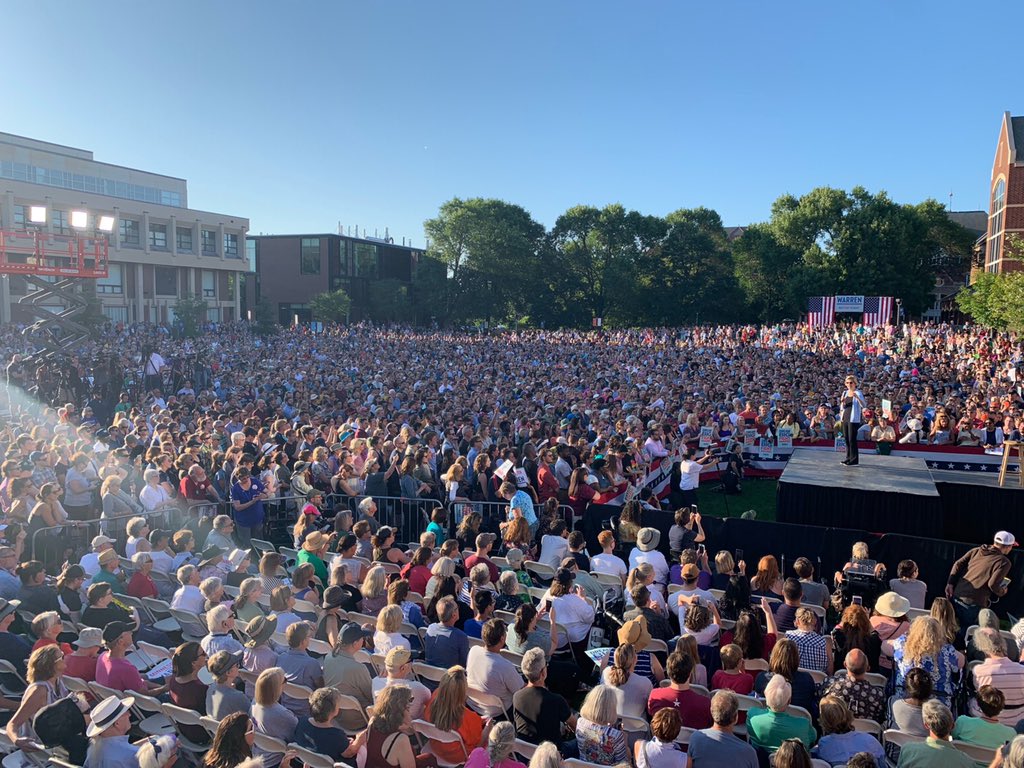
12,000 people showed up on a Monday night in Minneapolis to see Sen. Elizabeth Warren, seven months before the Minnesota primary election. After she spoke, she spent three hours taking selfies with anyone who wanted one. I think it’s time to put the “Nevertheless She Persisted” bumper stickers on the cars.

ECXxnl_W4AUNAhK

Correction:  It was at Macalester College in St. Paul, the other Twin City. Still very impressive, of course.

Irrationality: A History of the Dark Side of Reason by Justin E. H. Smith

Smith teaches philosophy at the University of Paris. This book is more of a survey than a history. He has chapters on irrationality as it relates to logic, nature, dreams, art, myth, pseudoscience, humor, the internet and death. He occasionally discusses the fact that the American president is a dangerous buffoon. (Or, as a New York Times columnist put it so well: “The most powerful country in the world is being run by a sundowning demagogue whose oceanic ignorance is matched only by his gargantuan ego”. Or, as a Washington Post columnist concluded: “If he can’t argue that he has delivered prosperity, all that remains is the single most repugnant human being to ever sit in the Oval Office, befouling everything he touches”. But back to the book.)

Smith argues that the difference between rationality and irrationality often depends on one’s perspective. For example, is it rational or irrational to concern ourselves so much with the future when we’re all going to die anyway? It depends on what our goals are. His principal thesis is that “irrationality is as potentially harmful as it is humanly ineradicable, and that efforts to eradicate it are themselves supremely irrational” [287].

It’s an interesting book, but I’d say the first part of that last sentence didn’t need to be proved (irrationality is harmful, both actually and potentially, and will never be eliminated) — and that Smith fails to prove the second part (that efforts to eliminate irrationality are supremely irrational).

This is from his chapter on death and one of the best passages in the book:

… what lifted the soldier out of his foxhole was not his faculty of reason, but rather something deeper, something we share with the animals, which the Greeks called “thumos” and which is sometimes translated as “spiritedness”. It is a faculty that moves the body without any need for deliberation. It is like something that propels us when we are driven by desire, when we dive into a mosh pit or into bed with someone we don’t quite trust. It is something to which we are more prone when we are drunk, or enraged, or enlivened by the solidarity and community of a chanting crowd.

These manifestations of irrationality, it should be clear, are, as he saying goes, beyond good and evil. Life would be unlivable if they were suppressed entirely. But to what precise extent should they be tolerated or, perhaps, encouraged? It will do no good to say flatly that they should be tolerated “in a reasonable balance” or “in moderation”. For the ideal of moderation is one that is derived from reason, and it is manifestly unfair to allow reason to determine what share it should itself have in human life in a competition between it and unreason. So if we can neither eliminate unreason, nor decide on a precise amount of it that will be ideal for human thriving, we will probably just have to accept that this will always remain a matter of contention, that human beings will always be failing or declining to act on the basis of rational calculation of expected outcomes, and that onlookers, critics and gossipers will always disagree as to whether their actions are worthy of blame or praise.

The speeder and the duelist and the others seem guilty of no failure to correctly infer from what they already know, in order to make decisions that maximize their own interests. Rather, in these cases, there is a rejection of the conception of life that it must be a maximization of one’s own long-term interests in order to be a life worth living [263-264].

Eviction vs. Conviction

We hear a lot about criminal justice in America and how it adversely affects the lives of black men in particular. A similar story should be told about housing in America and how it adversely affects the lives of black women. Lots of black men get convicted. Lots of black women get evicted.

Katha Pollitt’s 2016 review of “Evicted”, by Matthew Desmond, in The Guardian:

What if the dominant discourse on poverty is just wrong? What if the problem isn’t that poor people have bad morals – that they’re lazy and impulsive and irresponsible and have no family values – or that they lack the skills and smarts to fit in with our shiny 21st-century economy? What if the problem is that poverty is profitable? These are the questions at the heart of Evicted, Matthew Desmond’s extraordinary ethnographic study of tenants in low-income housing in the deindustrialised middle-sized city of Milwaukee, Wisconsin.

You might not think that there is a lot of money to be extracted from a dilapidated trailer park or a black neighbourhood of “sagging duplexes, fading murals, 24-hour daycares”. But you would be wrong. Tobin Charney makes $400,000 a year out of his 131 trailers, some of which are little better than hovels. Sherrena Tarver, a former schoolteacher who is one of the only black female landlords in the city, makes enough in rents on her numerous properties – some presentable, others squalid – to holiday in Jamaica and attend conferences on real estate.

Desmond follows the intertwined fortunes of eight families and a host of minor characters. Arleen Belle and Doreen Hinkston are black mothers clinging to the edge of low-wage employment; Crystal and Trisha are fragile young black women whose upbringing was violent and chaotic; Lamar is a genial black father of two who lost both his legs to frostbite when he passed out on crack in an abandoned house; Scott is a white male nurse who lost his licence when he stole opioids from his patients; Larraine, also white, is a slightly brain-damaged sweet soul. It is sometimes a little hard to keep up with the storylines as they weave in and out of the text, but no matter. What is important is that Desmond takes people who are usually seen as worthless – there is even a trailer-dweller nicknamed Heroin Susie – and shows us their full humanity, how hard they struggle to retain their dignity, humour and kindness in conditions that continually drag them down.

The main condition holding them back, Desmond argues, is rent. The standard measure is that your rent should be no more than 30% of your income, but for poor people it can be 70% or more. After he paid Sherrena his $550 rent out of his welfare cheque, Lamar had only $2.19 a day for the month. When he is forced to repay a welfare cheque he has been sent in error and falls behind on rent, he sells his food stamps for half their face value and volunteers to paint an upstairs apartment, but it is not enough. People such as Lamar live in chronic debt to their landlord, who can therefore oust them easily whenever it is convenient – if they demand repairs, for example, like Doreen, or if a better tenant comes along. Sherrena liked renting to the clients of a for-profit agency that handles – for a fee – the finances of people on disability payments who can’t manage on their own. Money from government programmes intended to help the poor – welfare, disability benefits, the earned-income tax credit – go straight into the landlord’s pocket and, ironically, fuel rising housing costs. Public housing and housing vouchers are scarce. Three in four who qualify for housing assistance get nothing.

Even in the Great Depression, evictions used to be rare. Now, each year, hundreds of thousands, perhaps millions, of renters are put out on the street. Even a paid-up tenant can be easily evicted. Arleen loses one apartment when her son Jori throws a snowball at a passing car and the enraged driver kicks in the front door, and another when the police come after Jori when he kicks a teacher and runs home. Any kind of trouble that brings the police can lead to eviction, which means women can lose their homes if they call 911 when their man beats them up. Think about that the next time someone asks why women don’t call the cops on violent partners.

As Desmond shows, the main victims of eviction are women. Why? They are paid less than men for doing the same job. They are less able to make deals with their landlord, who is almost always a man, to work off part of their rent with manual labour. The main reason, though, is that women are raising children as single mothers. They not only have all the costs and burdens of childrearing, they need bigger apartments – which, since landlords dislike renting to families with young children, are harder to find and a lot harder to keep. Other sociologists – Kathryn Edin, for example – have found that single mothers often get help under the table from their children’s fathers, but Arleen, Doreen and Doreen’s adult daughter Patrice get mostly trouble from men, who are variously abusive, addicted, vanished or in prison. In one of the book’s many small sad moments, Arleen claims she receives child support in order to seem more stable and respectable to a prospective landlord. In fact, she gets nothing.

Desmond lays out the crucial role housing plays in creating and reinforcing white privilege. In Milwaukee, one of the most segregated cities in the US, all black people suffer from housing discrimination and all white people benefit at least a little from the racial dividend – a landlord who will rent to them but not to black people, for instance, or offer them a nicer apartment. Black people have the worst housing in the worst neighbourhoods – the great fear of the trailer-park people, who are all white, is that they will end up on the black side of town. Eviction hits black women hardest of all, and the bleak benches of housing courts, which deal with disputes between landlords and tenants, are full of black women and their children: “If incarceration had come to define the lives of men from impoverished black neighbourhoods, eviction was shaping the lives of women. Poor black men were locked up. Poor black women were locked out.”

An evicted woman watches as a removal company moves her property out of her rented apartment on to the pavement.
An evicted woman watches as employees of a storage company remove her belongings to place them on the pavement in front of her rented apartment. Photograph: Sally Ryan/Zuma Press/Corbis

What are the social costs of eviction? It puts incredible stress on families. It prevents people from saving the comparatively small sums that would let them stabilise their situation. They are always starting over from scratch, losing their possessions in the chaos of removal, or putting them in storage and losing them when they can’t pay the fees. An eviction on your record makes the next apartment harder to get. Eviction damages children, who are always changing schools, giving up friends and toys and pets – and living with the exhaustion and depression of their parents. We watch Jori go from a sweet, protective older brother to an angry, sullen boy subject to violent outbursts who is falling way behind in school.

Eviction makes it hard to keep up with the many appointments required by the courts and the byzantine welfare system: several characters have their benefits cut because notices are sent to the wrong address. Eviction destroys communities: when people move frequently, they don’t form the social bonds and pride in place that encourage them to care for their block and look out for their neighbours. “With Doreen’s eviction, Thirty-Second Street lost a steadying presence – someone who loved and invested in the neighbourhood, who contributed to making the block safer – but Wright Street didn’t gain one.”

“There is an enormous amount of pain and poverty in this rich land,” Desmond writes in his conclusion. That is easy to say, and many books by journalists and academics have done so. By examining one city through the microscopic lens of housing, however, he shows us how the system that produces that pain and poverty was created and is maintained. I can’t remember when an ethnographic study so deepened my understanding of American life.to all and safeguarding our independence.

It’s Not Everything But It’s Definitely Something

Today, the Judiciary Committee of the House of Representatives, the committee that had Robert Mueller testify this week, asked a federal court to turn over all of the grand jury material related to Mueller’s investigation of the president. From the committee’s petition:

Special Counsel Robert S. Mueller III’s Report on the Investigation Into Russian Interference in the 2016 Presidential Election (the Mueller Report) provided Members of Congress with substantial evidence that the President of the United States repeatedly attempted to undermine and derail a criminal investigation of the utmost importance to the nation. That investigation sought to uncover Russia’s actions to interfere with the integrity of an American presidential election. Russia engaged in these acts in order to benefit then-candidate Donald J. Trump. President Trump repeatedly denied Russia’s actions and fired the director of the Federal Bureau of Investigation (FBI), resulting in the appointment of Mr. Mueller as Special Counsel.

The Mueller Report describes detailed evidence that President Trump then sought to terminate Special Counsel Mueller and to interfere with his investigation. Because Department of Justice policies will not allow prosecution of a sitting President, the United States House of Representatives is the only institution of the Federal Government that can now hold President Trump accountable for these actions. To do so, the House must have access to all the relevant facts and consider whether to exercise its full Article I powers, including a constitutional power of the utmost gravity—approval of articles of impeachment.

Hooray!

Listening to members of the committee at their press conference today, I got the strong impression that the House Democrats are finally, finally, opening an impeachment inquiry. One of them called their actions today an “escalation”. But they denied that their only purpose is to decide whether to impeach the president. They said they might recommend something else (legislation? censure?). For that reason, and because a number of Democrats, including Speaker of the House Nancy Pelosi, are nervous about impeachment (for no good reason), the committee isn’t calling their investigation an “impeachment inquiry”. But that’s what it amounts to.

In fact, attorney Joshua Matz argues in The Washington Post that the Judiciary Committee’s investigation of the president has been an impeachment inquiry all along:

It is settled law that House committees can obtain grand jury materials as part of impeachment investigations. So the legal dispute will probably center on whether such an inquiry is underway.

The Constitution itself does not use phrases like “impeachment investigation” or “impeachment proceedings.” This has led some to mistakenly assume that the House is disregarding its impeachment power because it has not yet held a floor vote … expressly instructing the Judiciary Committee to deliberate on such articles.

But to those who specialize in these matters, that all-or-nothing vision of the impeachment power is mistaken. The Constitution’s text and structure — supported by judicial precedent and prior practice — show that impeachment is a process, not a single vote. And that process virtually always begins with an impeachment investigation in the judiciary committee, which is already occurring….

Mr. Matz then describes several cases in which the Judiciary Committee has already cited their authority to impeach the president. For example, on June 6th, when the Attorney General was charged with contempt of Congress, the committee said it wanted an unredacted Mueller report because it was deciding whether “to approve articles of impeachment with respect to the President or any other Administration official”. Twice more in June, the committee repeated that it required information in order to decide “whether to recommend ‘articles of impeachment'” for the president.

While these events unfolded at the committee level, the House approved H. Res. 430 [on June 11th], a resolution stating that the committee “has any and all necessary authority under Article I of the Constitution” to seek key grand jury material and compel … testimony. Given that Article I enumerates the “legislative Powers,” including the “sole Power of impeachment,” the message wasn’t subtle. And it was bolstered by a report accompanying H. Res. 430, which cites the Judiciary Committee’s contempt referral for [the Attorney General] as an example of using “all necessary authority under Article I” — adding that the committee is investigating “whether to recommend articles of impeachment with respect to the President or any other administration official.”

None of these references to impeachment received much publicity at the time. But Mr. Matz says they show that the Judiciary Committee has been investigating the grounds for impeachment at least since June. He also says there is only one conclusion:

The committee is engaged in impeachment proceedings and is entitled to access the grand jury material that it has requested.

In addition, four members of the committee published a brief article for The Atlantic today that says they will broaden their investigations to include “conflicts of interest and financial misconduct”, of which there is plenty to investigate.

So the I-word is finally out in the open. Does this mean the Judiciary Committee will move ahead forcefully and efficiently and that their investigation into Trump’s malfeasance will receive the appropriate level of media attention? That isn’t clear yet, but the fact that they’re no longer avoiding the term “impeachment” almost makes one giddy. From a year ago: