There Is No “Congress”

It is true that the Constitution of the United States of America created a legislature. Its principal function is to make laws. It comprises the legislative branch of the federal government, the other two branches being the executive and the judicial.

The authors of the Constitution called this legislative branch “Congress”. They also divided this “Congress” into two parts.

Article I, Section 1:

All legislative Powers herein granted shall be vested in a Congress of the United States, which shall consist of a Senate and House of Representatives.

When a law or a change to a law is proposed, the Senate and the House of Representatives must both endorse the proposal in order for it to become official, i.e. “the law of the land”. (The Executive branch, embodied by a “President”, also gets to participate in the process. Sometimes the Judicial branch does too.)

So far, so good.

The Constitution nowhere mentions political parties, but it only took a few years for a “two-party system” to develop.

The Founding Fathers did not originally intend for American politics to be partisan. . . .  Alexander Hamilton and James Madison . . . wrote specifically about the dangers of domestic political factions. In addition, the first president, George Washington, was not a member of any political party . . . Furthermore, he hoped that political parties would not be formed, fearing conflict and stagnation . . .

Nevertheless, the beginnings of the American two-party system merged from his immediate circle of advisers. Hamilton and Madison . . .  ended up being the core leaders in this emerging party system. It was the split camps of Federalists, given rise with Hamilton as a leader, and Democratic-Republicans, with Madison and Thomas Jefferson at the helm . . . that created the environment in which partisanship, once distasteful, came to being [Wikipedia].

How does the two-party system affect Congress? If the majority in both the Senate and the House belong to the same party, it doesn’t make that much difference. If, say, the Racoon Party has the majority in both houses, there is general agreement on which laws to adopt (since senators serve for six years and representatives only serve for two, the members of the two houses sometimes have different priorities even when they belong to the same party).

But what if the Racoons are the majority in the Senate and the Otters are the majority in the House? Or the other way around? It is more difficult for the two majorities to agree on what the country’s laws should be. Sometimes it’s almost impossible.

Since 1857, when the Republicans joined the Democrats as one of America’s two major parties, there have been eighty-two sessions of Congress. By my count, the same party has controlled both houses of Congress sixty-six times, leaving sixteen sessions in which Congress has been divided. We are living through one of those sixteen sessions now, since the Democrats control the House and the Republicans control the Senate.

As we would expect, with two different parties in charge, things are not going well.

For example, the Democrat-led House agreed on legislation in May, almost three months ago, in order to deal with the suffering and disruption caused by Covid-19. Among other things, House Bill 6800 (unfortunately called “The Heroes Act”) would extend the $600 weekly increase in unemployment insurance, make another round of direct payments (up to $6,000 for a family), provide $25 billion to the U.S. Postal Service and increase aid to state and local governments.

The Republican-led Senate has not taken a vote on the House’s bill. Nor has the Senate proposed its own version of legislation to address the same issues (which would then be subject to negotiation with the House). The result is that the $600 increase in unemployment insurance agreed to earlier this year has lapsed. A moratorium on housing evictions is also ending.

So the country is in quite a pickle.

Now here’s what motivated me to express myself today. It’s a headline in The Washington Post.

Congress deeply unpopular again as gridlock on coronavirus relief has real-life consequences

Here’s one from USA Today.

Congress leaves town without a coronavirus stimulus deal, allowing $600 unemployment benefit to end

Here’s a classic example of the problem from an experienced New York Times reporter:

A conservative Republican House member profanely accosts a Democratic congresswoman as she strides up the Capitol steps to do her job during multiple national calamities.

With expanded jobless benefits supporting tens of millions of fearful Americans about to expire and a pandemic raging, Senate Republicans and the [Republican] White House cannot agree among themselves about how to respond, let alone begin to bargain with Democrats.

In a private party session, arch-conservative Republicans ambush their top female leader and demand her ouster over political and policy differences.

And that’s just the past few days.

By nearly any measure, Congress is a toxic mess . . .

Jonathan Chait is a columnist for New York Magazine. He referred to the problem twice in the past month:

If I could change one thing about political coverage, it would be the practice of attributing actions by one party to “Congress” [June 27].

The single worst practice in political journalism is attributing decisions by one party to “Congress” [July 26].

I’d make it “actions or inaction by one party”, but he made a very good point.

My suggestion is that when two different parties are in charge of Congress, people who write about politics for a living should make an effort to specify which party in which house is doing (or not doing) something. That would help readers understand where the dysfunction usually lies (hint: it’s not the Democratic side).

Since my suggesting this will have no effect, I’ll alternatively suggest that when we readers see references to Congress in times like this, we keep in mind that Congress has two parts and that one of those parts (same hint) is totally screwed up.

In fact, in times like this, “Congress” doesn’t really exist.
Another Stalwart Republican Breaks Ranks

Law professor Steven Calibresi is a leading Republican. He is a co-founder of the right-wing Federalist Society. He voted for this president and opposed his impeachment. However, the maniac’s latest pronouncement was too much even for Calibresi:

. . . I am frankly appalled by the president’s recent tweet seeking to postpone the November election. Until recently, I had taken as political hyperbole the Democrats’ assertion that President Txxxx is a fascist. But this latest tweet is fascistic and is itself grounds for the president’s immediate impeachment again by the House of Representatives and his removal from office by the Senate.

Here is what President Txxxx tweeted:

With Universal Mail-In Voting (not Absentee Voting, which is good), 2020 will be the most INACCURATE & FRAUDULENT Election in history. It will be a great embarrassment to the USA. Delay the Election until people can properly, securely and safely vote???

The nation has faced grave challenges before, just as it does today with the spread of the coronavirus. But it has never canceled or delayed a presidential election. Not in 1864, when President Abraham Lincoln was expected to lose and the South looked as if it might defeat the North. Not in 1932 in the depths of the Great Depression. Not in 1944 during World War II.

So we certainly should not even consider canceling this fall’s election because of the president’s concern about mail-in voting, which is likely to increase because of fears about Covid-19. It is up to each of the 50 states whether to allow universal mail-in voting and Article II of the Constitution explicitly gives the states total power over the selection of presidential electors.

Election Day was fixed by a federal law passed in 1845, and the Constitution itself in the 20th Amendment specifies that the newly elected Congress meet at noon on Jan. 3, 2021, and that the terms of the president and vice president end at noon on Jan. 20, 2021. If no newly elected president is available, the speaker of the House of Representatives becomes acting president.

President Txxxx needs to be told by every Republican in Congress that he cannot postpone the federal election. Doing so would be illegal, unconstitutional and without precedent in American history. Anyone who says otherwise should never be elected to Congress again.

Unquote.

It was announced this morning that the country’s Gross Domestic Product went down by 9.5% in the second quarter, the largest drop ever recorded. We’re on track to easily pass 200,000 coronavirus deaths by November.

No wonder the president is nervous. Today he tried to make the idea of a delayed election sound plausible:

You’re sending out hundreds of millions of universal mail-in ballots. Hundreds of millions,” Mr. Txxxx said. “Where are they going? Who are they being sent to?”

Given current circumstances, Txxxx probably feels like hundreds of millions of angry voters are bearing down on him. But America only has around 150 million registered voters. They’re the only people who might possibly receive a mail-in ballot. They’re the only people whose mail-in ballot would be accepted by election officials. So at most there are only 150 million or so angry voters bearing down on him. 

Hey, Mr. President, not to worry!

Note: The Republican leaders of the Senate and House agreed today that the election will be held in November. Someone orange isn’t going to be happy.

“Casino: Love and Honor in Las Vegas” by Nicholas Pileggi

A more accurate subtitle would have been “Crime and Dysfunction in Las Vegas”.

Martin Scorsese’s 1995 movie Casino starred Robert De Niro, Sharon Stone and Joe Pesci. It wasn’t as good as some of his others. This is the book the movie was based on. It tells the true story of Frank “Lefty” Rosenthal, a successful gambler and handicapper, who ran a handful of Las Vegas casinos in the 1970s (he was played very crisply by De Niro). Rosenthal was given his job in Las Vegas by the Mafia, otherwise known as the Outfit, the Organization or the Mob. He married a former showgirl and prostitute named Geri, who had a lot of problems (she was played by Sharon Stone), and had a childhood friend, Tony, who grew up to be a vicious mobster (Joe Pesci, of course).

In 1982, somebody planted a bomb in Rosenthal’s car. He survived and soon after left town, living quietly in California and Florida for another 30 years. His wife (by then his ex-wife) and his childhood friend weren’t that lucky. Geri was only 46 when she died of an overdose on a street in Hollywood. Rosenthal’s friend Tony was beaten to death and buried in a cornfield by some of his colleagues, possibly because he had an affair with Geri and was suspected of putting the bomb in his friend’s car. The crime bosses in Chicago and Kansas City didn’t like the fact that Tony had made trouble in Las Vegas. They preferred things to be quiet so they could continue stealing millions of dollars from the place (with Lefty Rosenthal’s help).

I kept reading the book even though it was tiresome at times. A lot of it is direct quotation from the people involved. They are what you might call “colorful”. I suppose that’s why stories about mobsters, factual or fictional, are popular. Although they’re very bad people who lie a lot and exaggerate their exploits, their lives are made to seem dangerous and exciting. And they can be funny guys, like the character Joe Pesci played in one of Scorsese’s better movies (“I’m funny how, I mean funny like I’m a clown, I amuse you? I make you laugh, I’m here to . . . amuse you?”).

A Republican Confesses

The Republican Party has been rotten since the days of Richard Nixon and Ronald Reagan. Some of the less crazy Republicans are now acknowledging the party’s downward trajectory. This apology was written by a political consultant, Stuart Stevens, for The New York Times (I’ve removed some historical and self-serving parts):

I spent decades working to elect Republicans, including Mr. Romney and four other presidential candidates, and I am here to bear reluctant witness that Mr. Txxxx didn’t hijack the Republican Party. He is the logical conclusion of what the party became over the past 50 or so years, a natural product of the seeds of race-baiting, self-deception and anger that now dominate it. Hold Dxxxx Txxxx up to a mirror and that bulging, scowling orange face is today’s Republican Party.

I saw the warning signs but ignored them and chose to believe what I wanted to believe: The party wasn’t just a white grievance party; there was still a big tent; the others guys were worse. Many of us in the party saw this dark side and told ourselves it was a recessive gene. We were wrong. It turned out to be the dominant gene.

What is most telling is that the Republican Party actively embraced, supported, defended and now enthusiastically identifies with a man who eagerly exploits the nation’s racial tensions. In our system, political parties should serve a circuit breaker function. The Republican Party never pulled the switch. . . .

There is a collective blame to be shared by those of us who have created the modern Republican Party that has so egregiously betrayed the principles it claimed to represent. My j’accuse is against us all, not a few individuals who were the most egregious.

How did this happen? How do you abandon deeply held beliefs about character, personal responsibility, foreign policy and the national debt in a matter of months? You don’t. The obvious answer is those beliefs weren’t deeply held. What others and I thought were bedrock values turned out to be mere marketing slogans easily replaced. I feel like the guy working for Bernie Madoff who thought they were actually beating the market.

Mr. Txxxx has served a useful purpose by exposing the deep flaws of a major American political party. Like a heavy truck driven over a bridge on the edge of failure, he has made it impossible to ignore the long-developing fault lines of the Republican Party. A party rooted in decency and values does not embrace the anger that Mr. Txxxx peddles as patriotism.

This collapse of a major political party as a moral governing force is unlike anything we have seen in modern American politics. The closest parallel is the demise of the Communist Party in the Soviet Union, when the dissonance between what the party said it stood for and what citizens actually experienced was so great that it was unsustainable.

This election should signal a day of reckoning for the party and all who claim it as a political identity. Will it? I’ve given up hope that there are any lines of decency or normalcy that once crossed would move Republican leaders to act as if they took their oath of office more seriously than their allegiance to party. Only fear will motivate the party to change — the cold fear only defeat can bring.

That defeat is looming. Will it bring desperately needed change to the Republican Party? I’d like to say I’m hopeful. But that would be a lie and there have been too many lies for too long.

Poor Donald

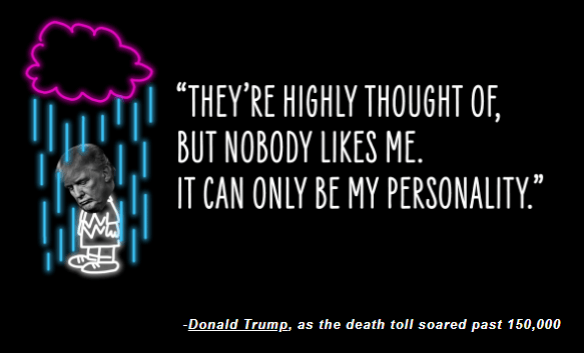
Yesterday, the president compared his approval rating to the approval ratings of two government experts, Dr. Anthony Fauci and  Dr. Deborah Birx. The moment was captured in the “What a Day” newsletter published by Crooked Media:

Untitled

We have more than 150,000 dead, millions have lost their jobs and we are pitied or mocked by the rest of the world, yet Donald isn’t popular. Life can be so unfair.