This Chart Is Hard To Believe

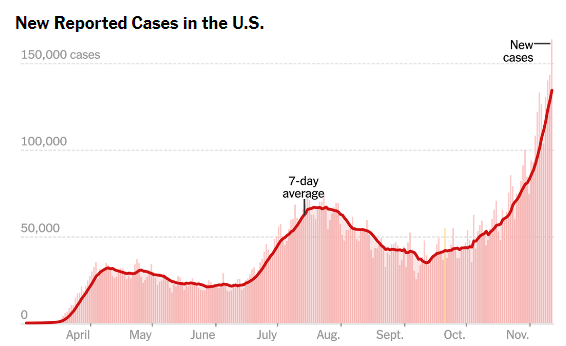
I knew the virus is spiking but didn’t realize it’s this bad. The top story in the news has been the election and its weird aftermath. The death rate is lower. We’re doing more testing. But this chart is still very surprising. Yesterday, the US reported 163,000 new cases, compared to 32,000 on April 8th (the day I left the hospital). COVID-19 killed almost 1,200 people yesterday. That number will go up. (The chart is from The New York Times.)

Untitled

Minority Rule in America

The Electoral College system was established under Article II and Amendment 12 of the U.S. Constitution more than 200 years ago. What it means is that Americans vote for president indirectly. We see a candidate’s name on the November ballot, but we’re actually voting for a group of electors who will pick the winner in December. From Jamelle Bouie of The New York Times:

Under the Constitution, states can allocate electors — meaning electoral votes — in “such Manner as the Legislature thereof may direct.” Beginning after the Civil War, every state in the union has used direct popular election to choose electors. The modern process is straightforward. After the vote, election officials certify results and prepare “certificates of ascertainment” that establish credentials for each elector. There are multiple copies, and the governor signs each one. The electors meet, record their votes, and those votes and certificates . . . are sent to state and federal officials, including the vice president, who will preside when Congress counts electoral votes early next year. 

Under the theory of legislative supremacy over elections, however, . . . state legislatures could possibly circumvent governors and election officials to create different slates of electors to send to Congress, forcing a choice between the people’s electors and those of the legislature. If a state submits conflicting electoral votes, the House and Senate may choose which ones to accept or reject.

It has to be said that there is almost no chance of this happening . . .

[Note: I’d say there’s zero chance of it happening in enough states to change the result of the election. However: ] 

We are living through a period in which, for reasons of geographic polarization in particular, the Republican Party holds a powerful advantage in the Senate and the Electoral College, and a smaller one in the House of Representatives. Twice in 20 years they’ve won the White House without a majority of votes. A few shifts here and there, and Txxxx might have won a second term while losing by a popular vote margin nearly twice as large as the one he lost by in 2016.

The Republican Party, in other words, can win unified control of Washington without winning a majority of the vote or appealing to most Americans. Aware of this advantage, Republicans have embraced it. They’ve pinned their political hopes on our counter-majoritarian institutions, elevated minority government into a positive good (rather than a regrettable flaw of our system) and attacked the very idea that we should aspire to equality in representation. “Democracy isn’t the objective; liberty, peace, and prosperity are,” Senator Mike Lee of Utah tweeted last month. “We want the human condition to flourish. Rank democracy can thwart that.”

“Rank democracy.” Perhaps Lee, one of the leading intellectual lights of the Republican Party, is alone in his contempt for political equality between citizens. But I doubt it. And a Republican Party that holds that view is one that will do anything to win power, even if it breaks democracy. It’s a Republican Party that will suppress voters rather than persuade them, degrade an office rather than allow the opposition to wield it and create districts so slanted as to make it almost impossible for voters to remove them from office.

For that Republican Party, the Electoral College is a loaded gun, waiting to be fired. We’ll disarm and disassemble it as soon as possible, if we value this democracy of ours.

Unquote.

The good news is that there is an effort underway to practically eliminate the Electoral College. From NBC News:

[By approving Proposition 113 last week,] Colorado voters have decided to join a growing list of states that hope to decide a president by popular vote, the latest move in a national chess match over the way the United States elects its presidents.

Called the National Popular Vote Interstate Compact, the agreement calls for states to award their electoral votes to the winner of the national popular vote, once enough states join the agreement.

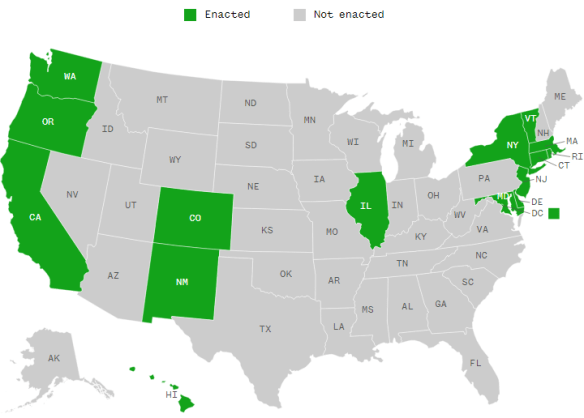
So far, 15 states and the District of Columbia have approved the pact, covering 196 electoral votes of the required 270 to win the presidency.

That 270 matters: The states that have approved legislation to join the compact agreed it would not take effect until the 270 threshold is reached. Once it does, those states will have the power to use their Electoral College votes to elect a winner, according to the popular vote. This uses the Electoral College to effectively phase out the Electoral College . . . 

Unquote.

These are the states that have enacted the Interstate Compact. Will enough voters, legislatures or governors one day agree to elect presidents by majority rule? It’s not a sure thing, but it’s more feasible than eliminating the Electoral College by amending the Constitution.

Untitled

Could This Be a More Sensible Timeline? (Quantum Mechanics Edition)

This post has nothing to do with politics.

One of the big mysteries or surprises in quantum physics is “non-locality”. This is the apparent fact that two particles can be “entangled”, such that even though they’re a billion miles apart, when something happens to one, something automatically happens to the other. The particles are far away in spacetime, but it’s as if they’re somehow right next to each other, possibly in some “deeper” reality. If that’s true, it’s pretty damn cool. 

From Quanta Magazine:

In a series of breakthrough papers, theoretical physicists have come tantalizingly close to resolving the black hole information paradox that has entranced and bedeviled them for nearly 50 years. Information, they now say with confidence, does escape a black hole. If you jump into one, you will not be gone for good. Particle by particle, the information needed to reconstitute your body will reemerge. Most physicists have long assumed it would; that was the upshot of string theory, their leading candidate for a unified theory of nature. But the new calculations, though inspired by string theory, stand on their own, with nary a string in sight. Information gets out through the workings of gravity itself — just ordinary gravity with a single layer of quantum effects. . . .

What it all means is being intensely debated in Zoom calls and webinars. The work is highly mathematical and has a Rube Goldberg quality to it, stringing together one calculational trick after another in a way that is hard to interpret. Wormholes, the holographic principle, emergent space-time, quantum entanglement, quantum computers: Nearly every concept in fundamental physics these days makes an appearance, making the subject both captivating and confounding.

And not everyone is convinced. . . .

But almost everyone appears to agree on one thing. In some way or other, space-time itself seems to fall apart at a black hole, implying that space-time is not the root level of reality, but an emergent structure from something deeper. Although Einstein conceived of gravity as the geometry of space-time, his theory also entails the dissolution of space-time, which is ultimately why information can escape its gravitational prison. . . .

The researchers drew on a concept that Richard Feynman had developed in the 1940s. Known as the path integral, it is the mathematical expression of a core quantum mechanical principle: Anything that can happen does happen. In quantum physics, a particle going from point A to point B takes all possible paths, which are combined in a weighted sum. The highest-weighted path is generally the one you’d expect from ordinary classical physics, but not always. If the weights change, the particle can abruptly lurch from one path to another, undergoing a transition that would be impossible in old-fashioned physics.

The path integral works so well for particle motion that theorists in the ’50s proposed it as a quantum theory of gravity. That meant replacing a single space-time geometry with a mélange of possible shapes. To us, space-time appears to have a single well-defined shape — near Earth, it is curved just enough that objects tend to orbit the center of our planet, for example. But in quantum gravity, other shapes, including much curvier ones, are latent, and they can make an appearance under the right circumstances. . . .

For [Stephen Hawking], space-time might knot itself into doughnut- or pretzel-like shapes. The extra connectivity creates tunnels, or “wormholes,” between otherwise far-flung places and moments. These come in different types.

Spatial wormholes are like the portals beloved of science-fiction writers, linking one star system to another. So-called space-time wormholes are little universes that bud off our own and reunite with it sometime later. Astronomers have never seen either type, but general relativity permits these structures, and the theory has a good track record of making seemingly bizarre predictions, such as black holes and gravitational waves, that are later vindicated. Not everyone agreed with Hawking that these exotic shapes belong in the mix, but the researchers doing the new analyses of black holes adopted the idea provisionally. . . .

Theorists in the West Coast group imagined sending [radiation escaping from a black hole] into a quantum computer. After all, a computer simulation is itself a physical system; a quantum simulation, in particular, is not altogether different from what it is simulating. So the physicists imagined collecting all the radiation, feeding it into a massive quantum computer, and running a full simulation of the black hole.

And that led to a remarkable twist in the story. Because the radiation is highly entangled with the black hole it came from, the quantum computer, too, becomes highly entangled with the hole. Within the simulation, the entanglement translates into a geometric link between the simulated black hole and the original. Put simply, the two are connected by a wormhole. “There’s the physical black hole and then there’s the simulated one in the quantum computer, and there can be a replica wormhole connecting those,” said Douglas Stanford, . . . a member of the West Coast team. This idea is an example of a proposal by [Juan Martin] Maldacena and Leonard Susskind  . . . in 2013 that quantum entanglement can be thought of as a wormhole. The wormhole, in turn, provides a secret tunnel through which information can escape the interior [of the black hole] . . .

Theorists have been intensely debating how literally to take all these wormholes. The wormholes are so deeply buried in the equations that their connection to reality seems tenuous, yet they do have tangible consequences. . . .

But rather than think of the wormholes as actual portals sitting out there in the universe, [some physicists] speculate that they are a sign of new, nonlocal physics. By connecting two distant locations, wormholes allow occurrences at one place to affect a distant place directly, without a particle, force or other influence having to cross the intervening distance — making this an instance of what physicists call nonlocality. “They seem to suggest that you have nonlocal effects that come in” [one physicist] said. In the black hole calculations, the island and radiation are one system seen in two places, which amounts to a failure of the concept of “place.” “We’ve always known that some kind of nonlocal effects have to be involved in gravity, and this is one of them . . . Things you thought were independent are not really independent.”

At first glance, this is very surprising. Einstein constructed general relativity with the express purpose of eliminating nonlocality from physics. Gravity does not reach out across space instantly. It has to propagate from one place to another at finite speed, like any other interaction in nature. But over the decades it has dawned on physicists that the symmetries on which relativity is based create a new breed of nonlocal effects. . . 

All this reinforces many physicists’ hunch that space-time is not the root level of nature, but instead emerges from some underlying mechanism that is not spatial or temporal. . . 

Skepticism is warranted if for no other reason than because the recent work is complicated and raw. It will take time for physicists to digest it and either find a fatal flaw in the arguments or become convinced that they work. . . .

Unquote.

So it looks like the universe is making more sense. Maybe we’ve entered a more sensible timeline, in which physics is less paradoxical and the president behaves like an adult politician/human being!

Why the Polls Were Wrong

It’s not good news. From Vox:

What the hell happened with the polls this year?

Yes, the polls correctly predicted that Joe Biden would win the presidency. But they got all kinds of details, and a number of Senate races, badly wrong . . .

To try to make sense of the massive failure of polling this year, I reached out to the smartest polling guy I know: David Shor, an independent data analyst who’s a veteran of the Obama presidential campaigns who formerly operated a massive web-based survey at Civis Analytics before leaving earlier this year. . . . Shor’s been trying to sell me, and basically anyone else who’ll listen, on a particular theory of what went wrong in polling that year, and what he thinks went wrong with polling in 2018 and 2020, too.

The theory is that the kind of people who answer polls are systematically different from the kind of people who refuse to answer polls — and that this has recently begun biasing the polls in a systematic way.

This challenges a core premise of polling, which is that you can use the responses of poll takers to infer the views of the population at large — and that if there are differences between poll takers and non-poll takers, they can be statistically “controlled” for by weighting according to race, education, gender, and so forth. . . . If these two groups do differ systematically, that means the results are biased.

The assumption that poll respondents and non-respondents are basically similar, once properly weighted, used to be roughly right — and then, starting in 2016, it became very, very wrong [note: of course, 2016 was when Txxxx began poisoning the political process]. People who don’t answer polls, Shor argues, tend to have low levels of trust in other people more generally. These low-trust folks used to vote similarly to everyone else. But as of 2016, they don’t: they tend to vote for Republicans.

Now, in 2020, Shor argues that the differences between poll respondents and non-respondents have gotten larger still. In part due to Covid-19 stir-craziness, Democrats, and particularly highly civically engaged Democrats who donate to and volunteer for campaigns, have become likelier to answer polls. It’s something to do when we’re all bored, and it feels civically useful. This biased the polls, Shor argues, in deep ways that even the best polls (including his own) struggled to account for.

Liberal Democrats answered more polls, so the polls overrepresented liberal Democrats and their views (even after weighting), and thus the polls gave Biden and Senate Democrats inflated odds of winning. . . .

Dylan Matthews

So, David: What the hell happened with the polls this year?

David Shor

So the basic story is that, particularly after Covid-19, Democrats got extremely excited and had very high rates of engagement. They were donating at higher rates, etc., and this translated to them also taking surveys, because they were locked at home and didn’t have anything else to do. There’s some pretty clear evidence that that’s nearly all of it: It was partisan non-response. Democrats just started taking a bunch of surveys [when they were called by pollsters, while Republicans did not].. . .

Dylan Matthews

You mentioned social trust. Walk me through your basic theory about how people who agree to take surveys have higher levels of social trust, and how that has biased the polls in recent years.

David Shor

For three cycles in a row, there’s been this consistent pattern of pollsters overestimating Democratic support in some states and underestimating support in other states. This has been pretty consistent. It happened in 2018. It happened in 2020. And the reason that’s happening is because the way that [pollsters] are doing polling right now just doesn’t work. . . .

Fundamentally, every “high-quality public pollster” does random digit dialing. They call a bunch of random numbers, roughly 1 percent of people pick up the phone, and then they ask stuff like education, and age, and race, and gender, sometimes household size. And then they weight it up to the census, because the census says how many adults do all of those things. That works if people who answer surveys are the same as people who don’t, once you control for age and race and gender and all this other stuff.

But it turns out that people who answer surveys are really weird. They’re considerably more politically engaged than normal. . . . [They] have much higher agreeableness [a measure of how cooperative and warm people are], which makes sense, if you think about literally what’s happening.

They also have higher levels of social trust. . . . It’s a pretty massive gap. [Sociologist] Robert Putnam actually did some research on this, but people who don’t trust people and don’t trust institutions are way less likely to answer phone surveys. Unsurprising! This has always been true. It just used to not matter.

It used to be that once you control for age and race and gender and education, that people who trusted their neighbors basically voted the same as people who didn’t trust their neighbors. But then, starting in 2016, suddenly that shifted. . . . These low-trust people still vote, even if they’re not answering these phone surveys.

Dylan Matthews

So that’s 2016. Same story in 2018 and 2020?

David Shor

The same biases happened again in 2018, which people didn’t notice because Democrats won anyway. What’s different about this cycle is that in 2016 and 2018, the national polls were basically right. This time, we’ll see when all the ballots get counted, but the national polls were pretty wrong. If you look at why, I think the answer is related, which is that people who answer phone surveys are considerably more politically engaged than the overall population. . . .

Normally that doesn’t matter, because political engagement is actually not super correlated with partisanship. That is normally true, and if it wasn’t, polling would totally break. In 2020, they broke. There were very, very high levels of political engagement by liberals during Covid. You can see in the data it really happened around March. Democrats’ public Senate polling started surging in March. Liberals were cooped up, because of Covid, and so they started answering surveys more and being more engaged.

This gets to something that’s really scary about polling, which is that polling is fundamentally built on this assumption that people who answer surveys are the same as people who don’t, once you condition on enough things. . . . But these things that we’re trying to measure are constantly changing. And so you can have a method that worked in past cycles suddenly break. . . .

There used to be a world where polling involved calling people, applying classical statistical adjustments, and putting most of the emphasis on interpretation. Now you need voter files and proprietary first-party data and teams of machine learning engineers. It’s become a much harder problem.

Dylan Matthews

. . . Pollsters need to get way more sophisticated in their quantitative methods to overcome the biases that wrecked the polls this year. Am I understanding that right?

David Shor

. . . A lot of people think that the reason why polls were wrong was because of “shy Txxxx voters.” You talk to someone, they say they’re undecided, or they say they’re gonna vote for Biden, but it wasn’t real. Then, maybe if you had a focus group, they’d say, “I’m voting for Biden, but I don’t know.” And then your ethnographer could read the uncertainty and decide, “Okay, this isn’t really a firm Biden voter.” That kind of thing is very trendy as an explanation.

But it’s not why the polls were wrong. It just isn’t. People tell the truth when you ask them who they’re voting for. They really do, on average. The reason why the polls are wrong is because the people who were answering these surveys were the wrong people. If you do your ethnographic research, if you try to recruit these focus groups, you’re going to have the same biases. They recruit focus groups by calling people! Survey takers are weird. People in focus groups are even weirder. Qualitative research doesn’t solve the problem of one group of people being really, really excited to share their opinions, while another group isn’t. As long as that bias exists, it’ll percolate down to whatever you do.

Unquote.

I think what this means is that even if you correct for the low number of Republicans who answer polls, you’re still in trouble, because you’re still polling the kind of Republicans who answer polls (the relatively nice ones). Your sample of Republican voters doesn’t represent Republicans who vote.

This does not bode well for the two Senate races in Georgia. Polls show the Democrats are a few points behind. When the run-off elections occur in January, the polls will probably be wrong again, unless the pollsters have quickly figured out how to solve this problem.
Truth and the American Way

From Thomas Friedman of The New York Times. He leaves out a big issue:

You remember the old joke? Moses comes down from Mount Sinai and tells the children of Israel: “Children, I have good news and bad news. The good news is that I bargained him down to 10. The bad news is that adultery is still in.”

Well, I’ve got bad news and worse news: We’re now down to nine.

Yes, this was a historic four years — even one of the Ten Commandments got erased. Lying has been normalized at a scale we’ve never seen before. . . .

I am not sure how we reverse it, but we’d better — and fast.

People who do not share truths can’t defeat a pandemic, can’t defend the Constitution and can’t turn the page after a bad leader. The war for truth is now the war to preserve our democracy.

It is impossible to maintain a free society when leaders and news purveyors feel at liberty to spread lies without sanction. Without truth there is no agreed-upon path forward, and without trust there is no way to go down that path together.

But our hole now is so deep, because the only commandment President Txxxx did believe in was the Eleventh: “Thou shalt not get caught.”

Lately, though, Txxxx and many around him stopped believing even in that — they don’t seem to care about being caught.

They know, as the saying goes, that their lies are already halfway around the world before the truth has laced up its shoes. That’s all they care about. Just pollute the world with falsehoods and then no one will know what is true. Then you’re home free.

The truth binds you, and Txxxx never wanted to be bound — not in what he could ask of the president of Ukraine or say about the coronavirus or about the integrity of our election.

And it nearly worked. Txxxx proved over five years that you could lie multiple times a day — multiple times a minute — and not just win election but almost win re-election.

We have to ensure that the likes of him never again appear in American politics.

Because Txxxx not only liberated himself from truth, he liberated others to tell their lies or spread his — and reap the benefits. His party’s elders did not care, as long as he kept the base energized and voting red. Fox News didn’t care, as long as he kept its viewers glued to the channel and its ratings high. Major social networks only barely cared, as long he kept their users online and their numbers growing. Many of his voters — even evangelicals — did not care, as long as he appointed anti-abortion judges. They are “pro-life,” but not always pro-truth. . . .

Israeli Bedouin expert Clinton Bailey tells the story about a Bedouin chief who discovered one day that his favorite turkey had been stolen. He called his sons together and told them: “Boys, we are in great danger now. My turkey’s been stolen. Find my turkey.” His boys just laughed and said, “Father, what do you need that turkey for?” and they ignored him.

Then a few weeks later his camel was stolen. And the chief told his sons, “Find my turkey.” A few weeks later the chief’s horse was stolen. His sons shrugged, and the chief repeated, “Find my turkey.”

Finally, a few weeks later his daughter was abducted, at which point he gathered his sons and declared: “It’s all because of the turkey! When they saw that they could take my turkey, we lost everything.”

And do you know what our turkey was? Birtherism.

When Txxxx was allowed to spread the “birther” lie for years — that Barack Obama, who was born in Hawaii, was actually born in Kenya and was therefore ineligible to be president — he realized he could get away with anything.

Sure, Txxxx eventually gave that one up, but once he saw how easily he could steal our turkey — the truth — he just kept doing it, until he stole the soul of the Republican Party.

And, had he been re-elected, he would have stolen the soul of this nation.

He and his collaborators are now making one last bid to use the Big Lie to destroy our democracy by delegitimizing one of its greatest moments ever — when a record number of citizens came out to vote, and their votes were legitimately counted, amid a deadly and growing pandemic.

It is so corrupt what Txxxx and his allies are doing, so dangerous to our constitutional system, but you weep even more for how many of their followers have bought into it.

“Lies don’t work unless they’re believed, and nearly half the American public has proved remarkably gullible,” my former . . . colleague David K. Shipler, who served in our Moscow bureau during the Cold War, said to me. “I think of each of us as having our own alarm — and it’s as if half of their batteries have died. Lots of Txxxx’s lies, and his retweets of conspiracy fabrications, are obviously absurd. Why have so many people believed them? I’m not sure it’s fully understood.”

That is why it’s vital that every reputable news organization — especially television, Facebook and Twitter — adopt what I call the Txxxx Rule. If any official utters an obvious falsehood or fact-free allegation, the interview should be immediately terminated, just as many networks did with Txxxx’s lie-infested, postelection, news conference last week. If critics scream “censorship,” just shout back “truth.”

This must become the new normal. Politicians need to be terrified every time they go on TV that the plug will be pulled on them if they lie.

At the same time, we need to require every K-12 school in America to include digital civics — how to determine and crosscheck if something you read on the internet is true — in their curriculum. You should not be able to graduate without it.

We need to restore the stigma to lying and liars before it is too late. We need to hunt for truth, fight for truth and mercilessly discredit the forces of disinformation. It is the freedom battle of our generation.

Unquote.

It’s not very surprising, but a crucial issue Mr. Friedman left out is the tendency of reality-based journalists, including those who work for the nation’s best newspapers, to strive for impartiality and balance even when dealing with liars, and to report lies as if they are simply controversial opinions.Â