“The Drunken Silenus: On Gods, Goats, and the Cracks in Reality” by Morgan Meis

This is a strange little book. It begins with the author explaining that he was living in Antwerp, in Belgium, because his wife was working on a project there. He had nothing in particular to do, but after realizing that the 17th century, Flemish painter Peter Paul Rubens had once lived in Antwerp, he decided to write a book about Rubens. It’s not a biography of Rubens though. It’s a series of brief meditations on the art of painting, ancient history, Greek mythology, Greek tragedy, hundreds of years of European history, especially Europe’s wars, and Rubens’s family, in particular the affair that Rubens’s father Jan had with Anne of Saxony, who was William of Orange’s wife, and how William of Orange and Rubens’s mother Maria reacted to the affair. There’s a lot about Friedrich Nietzsche, too. And other things.

The book’s central thread goes something like this. Silenus was a minor god in Greek mythology with a gift for prophecy. He was the very wise tutor and companion of Dionysus, the much more important god of the grape-harvest, wine, fertility, vegetation, insanity, ritual madness, religious ecstasy, festivity and theater. Silenus is best-known for something he once told King Midas (who was apparently a real person, but couldn’t turn anything into gold). Midas asked Silenus what is the most desirable thing for a human being. Silenus told him the best thing is not to have been born.  But if you have been born, the best thing is to die quickly.

Peter Paul Rubens’s father Jan was the legal advisor to Anne of Saxony. They had an affair, the affair was discovered and Anne’s husband William threw Jan in jail. Jan eventually got out, was forgiven by his wife Marie, but died a broken man. Their son Peter Paul grew up to become the most influential artist of the “Flemish Baroque” tradition. 

Around 1616, Rubens painted “The Drunken Silenus”. It shows Silenus stumbling along, surrounded by some of Dionysus’s retinue, which included nymphs and satyrs.

27mythol

A couple years later, Rubens painted “Two Satyrs”, two more of Dionysus’s pals.

Peter_Paul_Rubens_-_Two_Satyrs_-_WGA20303

A lot of history went by. Millions died during the Thirty Years War. Hapsburgs and Bourbons went at it. The nations of Europe slowly assumed their current positions.

Then, in 1872, the German philosopher Friedrich Nietzsche published The Birth of Tragedy from the Spirit of Music. Wikipedia says:

Nietzsche found in classical Athenian tragedy an art form that transcended the pessimism and nihilism of a fundamentally meaningless world. The Greek spectators, by looking into the abyss of human suffering and affirming it, passionately and joyously affirmed the meaning of their own existence. . . .

. . . Nietzsche discusses the history of the tragic form and introduces an intellectual dichotomy between the Dionysian and the Apollonian (very loosely: reality as disordered  . . . versus reality as ordered). Nietzsche claims life always involves a struggle between these two elements, each battling for control over the existence of humanity.

Which brings us back to Silenus and Dionysus, the nymphs and satyrs, especially the satyrs. And goats. The author of The Drunken Silenus thinks Nietzsche valued the wild and crazy Dionysian approach to life more than the calm and collected Apollonian. I think the key chapter of The Drunken Silenus is “Is God a goat? What possibly could that possibly mean?” 

The way Nietzsche tells it, when Silenus finally reveals to Midas the greatest thing for man, that it is best for man never to have been born and second best for a man to die quickly, Silenus lets out a shrill laugh. Silenus laughs because in telling King Midas the best thing, he actually tells him the worst thing . . . 

Nietzsche thinks the ancient Greeks — the Greeks of the satyr plays and the songs in the forest, the Greeks who came before the classical period of Plato and the brilliant days of Greek rationalism — those Greeks were bold enough to make a health of their pessimism. . . .

The olden Greeks, the ancient Greeks, thinks Nietzsche, understood life under the principle of the goat, the young goat kicking and bucking in the woods. . . Even to ask the question of what is good or bad for a man is to lose touch with the primary intuition that God is a goat. That’s to say, God is not transcendent, imperturbable, untouchable, unknowable. God is none of those things. God, if God is the God of the world, has to have the characteristics of the goat, the randiness and unpredictability, even the stupidity of the goat. . . 

And so, the question of good and bad for man is canceled before it can be asked. It is preempted. The satyr would never think to ask that question. . . . Goats don’t ask questions like “what is the best thing for goats?” Goats just go out and express goatlieness [35-38].

Getting back to Rubens, I suppose Rubens’s father and Anne of Saxony (who was also imprisoned by her husband) were the Dionysians. Rubens’s forgiving mother Marie was the Apollonian. And Rubens himself, the great artist, was a proto-Nietzsche:

When Rubens took to painting Silenus he wasn’t grabbing randomly at the bits of ancient mythology floating around in the intellectual breeze. Rubens had a whole program of satyrs and Dionysus and Silenus. . . Rubens was being very Nietzschean here, if we can be anachronistic — literally anachronistic, since it was . . . Rubens who came first and Rubens who first painted Silenus as a central figure within this story of Dionysus.

So that’s The Drunken Silenus. You might find it interesting, but I should mention that, even though it’s a short book, it’s repetitious. The author likes to repeat himself, often in the same paragraph. It also gets tedious near the end, as he starts getting more abstract and paradoxical, suggesting that life is death, and reality is unreal, that kind of thing (I’m not quoting here). It’s the kind of book that’s hard to put down until it’s easy.
America Is Totally Screwed, Well, Maybe 90% Screwed

Margaret Sullivan, who writes an excellent column about the news media for The Washington Post, gave some stern advice to her fellow journalists this morning:

First, be bolder and more direct than ever in telling it like it is. No more pussyfooting or punch-pulling. No more of what’s been called “false equivalence” — giving equal weight to truth and lies in the name of fairness.

Can mainstream outlets, influential as they are, really go up against the counter-messaging on places like Fox News, or Steve Bannon’s podcast or fact-averse outlets like Newsmax?

This battle can’t be fought with facts alone, argues journalism scholar Nikki Usher of the University of Illinois.

The only hope, she wrote, is for mainstream journalism to appeal to passion as well as reason — “providing moral clarity along with truthful content.” Or, as NYU’s Jay Rosen recently wrote, journalism must reposition itself in the media ecosystem, to seize this moment in history to take a clear stance, in everything it does, as “pro-truth, pro-voting, anti-racist, and aggressively pro-democracy.”

In other words, the reality-based press has to unapologetically stand for something. Otherwise, it’s just a pallid alternative to the excitement of burgeoning lies. . . .

Can journalists, mired in our “how we’ve always done it” mind-set, really change their stripes to fight the war on disinformation? Can we be more clear and direct, embrace a moral purpose, help to educate news consumers? And even if we do, will it make a significant difference?

I have serious doubts about the answers to those questions. But I do know that we have to try.

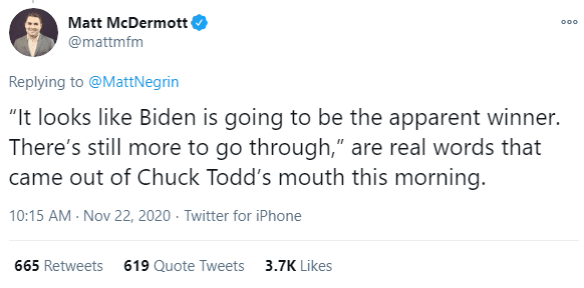
Soon thereafter, I saw the name “Chuck Todd” trending on Twitter. Todd is the host of Meet the Press, probably America’s best-known Sunday morning political talk show. He works for NBC, one of the networks Americans rely on for reality-based journalism. It was disturbing to see what he’d done this morning:

Untitled

Really? We are totally screwed if this is what passes for reality on NBC.

I couldn’t find a video where he actually expressed doubt about Biden winning, so I did a search for “Chuck Todd” and found a Meet the Press transcript for this morning’s show. Here’s that part. He’s interviewing a Republican senator from North Dakota:

CHUCK TODD:

I mean, are you really saying that the president is — you’re out there saying that the president’s not encouraging somehow any way of sort of being disorderly about this. How is that not encouraging disruption and disorderly — he’s accusing the entire system of being corrupt. Is that not undermining the democracy?

SEN. KEVIN CRAMER:

Well, first of all, what they’re claiming is that there’s a lot of evidence and they’re presenting that evidence in cases. Now, it’s up to them to present that evidence, Chuck, obviously. And we’ve yet to see a real hearing where evidence was presented. And, and they’re not obligated to present it, you know, yesterday or tomorrow, although the sooner the better from my perspective. But I’m just speaking strictly now from this “attack on democracy,” as you call it. This is, these are legal systems. This is, these are processes that are in our Constitution, in our laws, and they’re not just appropriate, but they’re really an obligation, frankly, to the millions of Americans that President Trump is a reflection of. I know, you know, a lot of people like to think that we’re the reflection of him. He’s the reflection of millions of people that want to see him fight this to the end. Now, there has to be an end, Chuck. I agree there has to be an end. I, frankly, do think it’s time to — well, it was past time to start a transition, to at least cooperate with the transition. I’d rather have a president that has more than one day to prepare, should Joe Biden, you know, end up winning this. But in the meantime, again, he’s just exercising his legal options.

CHUCK TODD:

I just want to confirm. You believe that the head of GSA [the General Services Administration], tomorrow morning at this point, ought to say, “The transition needs to begin. It looks like Joe Biden’s going to be the apparent winner. Yes, there’s more to go through.” If this is what the head of GSA said, “Yes, there’s still more to go through, but it looks like Joe Biden’s the apparent winner. Let’s allow the transition process to begin,” should that be what happens tomorrow morning?

SEN. KEVIN CRAMER:

Yes, it should happen tomorrow morning because it didn’t happen last Monday morning. I just think you have to begin that process, give the incoming administration all the time they need.

So it wasn’t as bad as people were saying. He was putting words in the mouth of the Republican jerk who runs the GSA and still hasn’t started the official transition to the new administration, two weeks after we knew who won. Maybe we aren’t totally screwed yet. 

Nevertheless, he did give a Republican politician several minutes on national TV to defend the indefensible. His audience got to hear a U.S. senator claim it’s reasonable that millions of voters want a sociopath to spread lies and undermine what’s left of our democracy. So maybe it’s only 90%.

Some good news, however: Biden now leads the maniac by more than six million votes. That margin will grow as laggard states, like New York, keep counting. He’ll end up with more than 80 million votes, the most ever for a presidential candidate. He’s won 306 electoral votes to the maniac’s 232, the same number the maniac got in 2016 (when he called it a “landslide”).

Most importantly, he made DDT (a more apt acronym than “DJT”) a one-term president. Since Franklin Roosevelt won his fourth term in 1944, only Jimmy Carter and the first George Bush have run for president as incumbents and lost (Truman and Johnson chose not to run). We know this election shouldn’t have been as close as it was, but, considering the alternative, having JRB in place of DDT counts for a lot.

Bye Bye, Bozo

From The Washington Post:

The Biden campaign has said that should [you know who] refuse to leave on Jan. 20, “the United States government is perfectly capable of escorting trespassers out of the White House” . . . 

But weren’t the Founders obsessed with the encroaching nature of tyranny [e.g. presidents who won’t go away]? Didn’t they worry constantly about a president having too much power?

Most of them did, yes, though not all. During the Constitutional Convention in 1787, Alexander Hamilton floated the idea of presidents serving for life, but when put to a vote, the proposal failed 4-6.

The power that scared many founders the most was that of commander-in-chief.

Though not necessarily tied to an election loss, ”there was a lot of discussion of the possibility that a president with control of the Army might refuse to relinquish power,” said Michael McConnell, a constitutional law professor at Stanford . . .

At the Virginia ratifying convention, Patrick Henry said, “If your American chief be a man of ambition and abilities, how easy is it for him to render himself absolute! The army is in his hands, and if he be a man of address, it will be attached to him; and it will be the subject of long meditation with him to seize the first auspicious moment to accomplish his design.”

Gouverneur Morris, who wrote the preamble to the Constitution, warned that if a president was limited to one term, he might “be unwilling to quit his exaltation … he will be in possession of the sword, a civil war will ensue, and the commander of the victorious army on which ever side, will be the despot of America.”

Perhaps most ominously, one prominent Pennsylvanian identifying himself only as “An Old Whig,” wrote about this in Anti-Federalist No. 70, and is worth quoting at length:

“Let us suppose this man to be a favorite with his army, and that they are unwilling to part with their beloved commander in chief … and we have only to suppose one thing more, that this man is without the virtue, the moderation and love of liberty which possessed the mind of our late general [Washington] – and this country will be involved at once in war and tyranny.

… We may also suppose, without trespassing upon the bounds of probability, that this man may not have the means of supporting, in private life, the dignity of his former station; that like Caesar, he may be at once ambitious and poor, and deeply involved in debt. Such a man would die a thousand deaths rather than sink from the heights of splendor and power, into obscurity and wretchedness.”

Some Founders who supported the Constitution still predicted that it wouldn’t stop a president from seizing power.

“The first man put at the helm will be a good one,” Benjamin Franklin said, referring to Washington. “Nobody knows what sort may come afterwards. The executive will be always increasing here, as elsewhere, till it ends in a monarchy.”

So why didn’t the founders plan for this particular scenario, of a president simply denying that he had lost an election? Because they couldn’t even fathom it, [according to Jeffrey Engel, the director of the Center for Presidential History at Southern Methodist University].

“They couldn’t fathom two things: a person who had become president who was so utterly lacking in classical virtue that they would deign or dare to put their own interests above the unity of the country. And the second thing is, I think they couldn’t fathom how any president who would so vividly display disdain for the unity of the country, and mock and undermine the legitimacy of American democracy, why that person [wouldn’t have] already been impeached and removed from office.”

Unquote.

But the Founders never imagined the Republican Party.

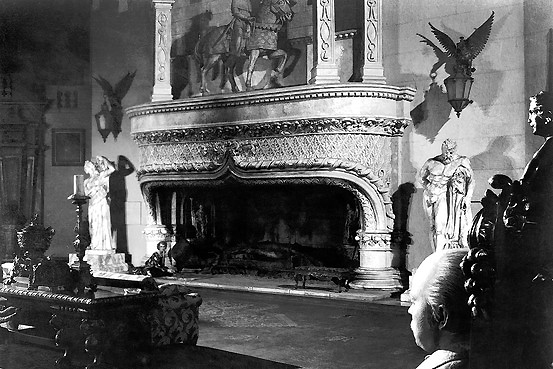
Anyway, it’s much more likely our president will have vacated the White House long before January 20th. He now spends most of his time watching TV, all alone, sulking. Next stop, Xanadu.

Kane_-_2

The Big Picture, In Case You Missed It

At the press conference from hell, via The Washington Post:

It’s very simple, according to Rudolph W. Giuliani and the rest of President Txxxx’s legal posse, but also very vast. China is in on it. Cuba is in on it. Antifa and George Soros are in on it. At least two presidents of Venezuela, one dead and one living, are in on it. Big Tech is in on it; a Web server from Germany is involved. (There’s always a server involved.) Multiple major U.S. cities are in on it, as are decent American citizens who volunteer at polling precincts. Argentina is in on it, too, sort of. Chicago Mayor Richard Daley was in on it back in 1960, when, according to [a] conspiracy theory, he stole the presidency for John F. Kennedy, thereby launching an ongoing pattern of corrupt cities stuffing or scrapping ballots. The “it” is a massive, premeditated scheme to steal the election from Dxxxx Txxxx, according to Giuliani . . 

Unquote.

But why didn’t he mention the lizard people from outer space? Rudy must be one of them.

How To Feel Smart in a Complicated World

From historian Yuval Noah Harari for The New York Times:

Conspiracy theories come in all shapes and sizes, but perhaps the most common form is the global cabal theory. A recent survey of 26,000 people in 25 countries asked respondents whether they believe there is “a single group of people who secretly control events and rule the world together.”

Thirty-seven percent of Americans replied that this is “definitely or probably true.” So did 45 percent of Italians, 55 percent of Spaniards and 78 percent of Nigerians.

Conspiracy theories, of course, weren’t invented by QAnon; they’ve been around for thousands of years. Some of them have even had a huge impact on history. Take Nazism, for example. We normally don’t think about Nazism as a conspiracy theory. Since it managed to take over an entire country and launch World War II, we usually consider Nazism an “ideology,” albeit an evil one.

But at its heart, Nazism was a global cabal theory based on this anti-Semitic lie: “A cabal of Jewish financiers secretly dominates the world and are plotting to destroy the Aryan race. They engineered the Bolshevik Revolution, run Western democracies, and control the media and the banks. Only Hitler has managed to see through all their nefarious tricks — and only he can stop them and save humanity.”

Understanding the common structure of such global cabal theories can explain both their attractiveness — and their inherent falsehood.

Global cabal theories argue that underneath the myriad events we see on the surface of the world lurks a single sinister group. The identity of this group may change: Some believe the world is secretly ruled by Freemasons, witches or Satanists; others think it’s aliens, reptilian lizard people or sundry other cliques.

But the basic structure remains the same: The group controls almost everything that happens, while simultaneously concealing this control.

Global cabal theories take particular delight in uniting opposites. Thus the Nazi conspiracy theory said that on the surface, communism and capitalism look like irreconcilable enemies, right? Wrong! That’s exactly what the Jewish cabal wants you to think! And you might think that the Bush family and the Clinton family are sworn rivals, but they’re just putting on a show — behind closed doors, they all go to the same Tupperware parties.

From these premises, a working theory of the world emerges. Events in the news are a cunningly designed smoke screen aimed at deceiving us, and the famous leaders that distract our attention are mere puppets in the hands of the real rulers.

Global cabal theories are able to attract large followings in part because they offer a single, straightforward explanation to countless complicated processes. Our lives are repeatedly rocked by wars, revolutions, crises and pandemics. But if I believe some kind of global cabal theory, I enjoy the comforting feeling that I do understand everything.

The war in Syria? I don’t need to study Middle Eastern history to comprehend what’s happening there. It’s part of the big conspiracy. The development of 5G technology? I don’t need to do any research on the physics of radio waves. It’s the conspiracy. The Covid-19 pandemic? It has nothing to do with ecosystems, bats and viruses. It’s obviously part of the conspiracy.

The skeleton key of global cabal theory unlocks all the world’s mysteries and offers me entree into an exclusive circle — the group of people who understand. It makes me smarter and wiser than the average person and even elevates me above the intellectual elite and the ruling class: professors, journalists, politicians. I see what they overlook — or what they try to conceal.

Global cabal theories suffer from the same basic flaw: They assume that history is very simple. The key premise of global cabal theories is that it is relatively easy to manipulate the world. A small group of people can understand, predict and control everything, from wars to technological revolutions to pandemics.

Particularly remarkable is this group’s ability to see 10 moves ahead on the global board game. When they release a virus somewhere, they can predict not only how it will spread through the world, but also how it will affect the global economy a year later. When they unleash a political revolution, they can control its course. When they start a war, they know how it will end.

But of course, the world is much more complicated. Consider the American invasion of Iraq, for example. In 2003, the world’s sole superpower invaded a medium-size Middle Eastern country, claiming it wanted to eliminate the country’s weapons of mass destruction and end Saddam Hussein’s regime. Some suspected that it also wouldn’t have minded the chance to gain hegemony over the region and dominate the vital Iraqi oil fields. In pursuit of its goals, the United States deployed the best army in the world and spent trillions of dollars.

Fast forward a few years, and what were the results of this tremendous effort? A complete debacle. There were no weapons of mass destruction, and the country was plunged into chaos. The big winner of the war was actually Iran, which became the dominant power in the region.

So should we conclude that George W. Bush and Donald Rumsfeld were actually undercover Iranian moles, executing a devilishly clever Iranian plot? Not at all. Instead, the conclusion is that it is incredibly difficult to predict and control human affairs.

You don’t need to invade a Middle Eastern country to learn this lesson. Whether you’ve served on a school board or local council, or merely tried to organize a surprise birthday party for your mom, you probably know how difficult it is to control humans. You make a plan, and it backfires. You try to keep something a secret, and the next day everybody is talking about it. You conspire with a trusted friend, and at the crucial moment he stabs you in the back.

Global cabal theories ask us to believe that while it is very difficult to predict and control the actions of 1,000 or even 100 humans, it is surprisingly easy to puppet master nearly eight billion.

There are, of course, many real conspiracies in the world. Individuals, corporations, organizations, churches, factions and governments are constantly hatching and pursuing various plots. But that is precisely what makes it so hard to predict and control the world in its entirety.

In the 1930s, the Soviet Union really was conspiring to ignite communist revolutions throughout the world; capitalist banks were employing all kinds of dodgy strategies; the Roosevelt administration was planning to re-engineer American society in the New Deal; and the Zionist movement pursued its plan to establish a homeland in Palestine. But these and countless other schemes often collided, and there wasn’t a single group of people running the whole show.

Today, too, you are probably the target of many conspiracies. Your co-workers may be plotting to turn the boss against you. A big pharmaceutical corporation may be bribing your doctor to give you harmful opioids. Another big corporation may be pressuring politicians to block environmental regulations and allow it to pollute the air you breathe. Some tech giant may be busy hacking your private data. A political party may be gerrymandering election districts in your state. A foreign government may be trying to foment extremism in your country. These could all be real conspiracies, but they are not part of a single global plot.

Sometimes a corporation, a political party or a dictatorship does manage to gather a significant part of all the world’s power into its hands. But when such a thing happens, it’s almost impossible to keep it hush-hush. With great power comes great publicity. . . .

Unquote.

The QAnon conspiracy theory alleges that a cabal of Satan-worshiping pedophiles is running a global child sex trafficking ring and plotting against President Txxxx, who is fighting the cabal. People who believe this are like children. It’s obvious to anyone who’s done the research that shape-shifting reptilian aliens came to Earth, took on human form and now control the world.

People are so ignorant. It’s really pathetic.