Civility and Low Expectations

Back during the Cold War years, my father and I would sometimes argue about politics. If I criticized our government for doing something secretive or anti-democratic, he would point out that the Soviet Union and China (then usually called “Red China”) weren’t held to the same standards. I couldn’t deny what he said, but I still believed our government should do better than their Cold War competition.

Michelle Goldberg’s column in The New York Times yesterday reminded me of those arguments between me and my Republican father. It’s called “Nobody Expects Civility From Republicans”:

Perhaps you remember the terrible ordeal suffered by the White House press secretary Sarah Huckabee Sanders at the Red Hen in 2018. She was awaiting her entree at the Virginia farm-to-table restaurant when the co-owner, appalled by Sanders’s defense of Dxxxx Txxxx’s administration, asked her to leave. This happened three days after the homeland security secretary at the time, Kirstjen Nielsen, was yelled at for the administration’s family separation policy as she tried to dine at a Mexican restaurant in Washington.

These two insults launched a thousand thumb-suckers about civility. More than one conservative writer warned liberals that the refusal to let Txxxx officials eat in peace could lead to Txxxx’s re-election. “The political question of the moment,” opined Daniel Henninger in The Wall Street Journal, is this: ‘Can the Democratic Party control its left?’”

Somehow, though, few are asking the same question of Republicans as Txxxx devotees terrorize election workers and state officials over the president’s relentless lies about voter fraud. Michigan’s secretary of state, Jocelyn Benson, described her family’s experience this past weekend: “As my 4-year-old son and I were finishing up decorating the house for Christmas on Saturday night, and he was about to sit down and to watch ‘How the Grinch Stole Christmas,’ dozens of armed individuals stood outside my home shouting obscenities and chanting into bullhorns in the dark of night.”

So far, what happened to Benson doesn’t appear to be turning into a big cultural moment. There’s no frisson of the new about it; it’s pretty routine for Txxxxists to threaten and intimidate people who work in both public health and election administration.

The radically different way the media treats boundary-pushing on the left and on the right is about more than hypocrisy or double standards. It is, rather, an outgrowth of the crisis of democracy that shields the Republican Party from popular rebuke. There’s no point asking if the G.O.P. can control its right. It has no reason to.

Democrats have just won the popular vote in the seventh out of the last eight presidential elections. In the aftermath, analysts have overwhelmingly focused on what Democrats, not Republicans, must do to broaden their appeal. Partly, this stems from knee-jerk assumptions about the authenticity of the so-called heartland. But it’s also just math — only one of our political parties needs to win an overwhelming national majority in order to govern.

Republican extremism tends to become a major story only when there are clear electoral consequences for it. Pat Buchanan’s demagogic culture war speech at the 1992 Republican National Convention was seen, at the time, as shocking, and elite Republicans later believed it helped George H.W. Bush lose the election. Twenty years later, after Mitt Romney’s defeat in 2012, Republicans undertook an “autopsy” and went public with the results of focus groups calling the party “scary,” “narrow-minded” and “out of touch.” There were always zealots in the modern Republican Party, but there were also forces interested in quarantining them.

After that autopsy, Reince Priebus, then the Republican Party chairman, called for a more “inclusive” G.O.P., saying, “Finding common ground with voters will be a top priority.”

Txxxx would prove that wasn’t necessary. In 2016, he got a smaller percentage of the popular vote than Romney did four years earlier, but still won the Electoral College. And while widespread revulsion toward Txxxx was a problem for him this November, down-ticket Republicans performed far better than almost anyone expected.

As a result, the effect of right-wing fanaticism on mainstream public opinion has become a non-issue. It doesn’t matter if Biden voters don’t like paranoid militants, many of them armed, menacing civil servants. The structure of our politics — gerrymandering in the House and the rural bias in the Senate — buffers Republicans from centrist backlash.

One thing would change this dynamic overnight: a Democratic victory in the Georgia Senate runoffs on Jan. 5. Republicans might learn that there’s a price for aligning themselves with a president trying to thwart the will of the electorate. . . .  Txxxxism might come to be seen as an electoral albatross, and Republicans would have an incentive to rejoin the reality everyone else operates in.

But unless and until that happens, few will be able to muster much surprise when Republicans condone the most outrageous right-wing thuggery, because few will expect anything else.

The uproar over shunning [Sarah] Sanders was an outgrowth of an old liberal quandary — how a tolerant society should treat those who conspire against tolerance. The people screaming outside Benson’s house raise an entirely different question, about how long our society can endure absent any overlapping values or common truths. . . .

Unquote.

I hoped that Democratic gains in Congress and state legislatures in this year’s election would yield various electoral reforms and help restore majority rule in this country. I even thought a Democratic wave might convince a few in the other party to join the real world and tone down their thuggery. But Biden trouncing his opponent didn’t translate into losses for the president’s supporters. That means they have no motive to reform. They don’t even see a reason to admit Biden won.

Now I’m hoping the Democrats will reverse history and make gains in the 2022 midterm election, although a president’s party almost always loses seats. That could happen if President Biden gets credit for addressing the pandemic and its consequences. The incumbent president’s party did well in 1934 when Roosevelt was addressing the Great Depression and in 2002 when Bush responded to 9/11.  

We Need All the Help We Can Get

Have the U.S. and Israeli governments been contacted by beings from other worlds? This article is from The Jerusalem Post, a heretofore reputable newspaper:

According to retired Israeli general and current professor Haim Eshed, the answer is yes, but this has been kept a secret because “humanity isn’t ready” [no surprise there].

Speaking in an interview to Yediot Aharonot, Eshed – who served as the head of Israel’s space security program for nearly 30 years and is a three-time recipient of the Israel Security Award – explained that Israel and the US have both been dealing with aliens for years.

And this by no means refers to immigrants, with Eshed clarifying the existence of a “Galactic Federation.”

The 87-year-old former space security chief gave further descriptions about exactly what sort of agreements have been made between the aliens and the US, which ostensibly have been made because they wish to research and understand “the fabric of the universe.” This cooperation includes a secret underground base on Mars, where there are American and alien representatives.

. . . It is unclear how long this sort of relationship, if any, has been going on between the US and its reported extraterrestrial allies.

Eshed insists that [President Txxxx] is aware of them, and that he was “on the verge” of disclosing their existence. However, the Galactic Federation reportedly stopped him from doing so [presumably it was a cash deal], saying they wished to prevent mass hysteria since they felt humanity needed to “evolve and reach a stage where we will… understand what space and spaceships are,” Yediot Aharonot reported.

As for why he’s chosen to reveal this information now, Eshed explained that the timing was simply due to how much the academic landscape has changed, and how respected he is in academia.

“If I had come up with what I’m saying today five years ago, I would have been hospitalized,” he explained to Yediot.

He added that “today, they’re already talking differently. I have nothing to lose. I’ve received my degrees and awards; I am respected in universities abroad, where the trend is also changing.”

Eshed provided more information in his newest book, The Universe Beyond the Horizon – Conversations with Professor Haim Eshed, along with other details such as how aliens have prevented nuclear apocalypses and “when we can jump in and visit the Men in Black.” The book is available now for NIS 98 [around $30] . . .

The Jerusalem Post was unable to reach out to this supposed Galactic Federation for comment.

Unquote.

It sounds like an 87-year-old professor is aiming to sell a few books, but I for one welcome our new galactic overlords.

download

Klaatu barada nikto.

“An Empire on the Edge: How Britain Came to Fight America” by Nick Bunker

Like most Americans, my knowledge of the Revolutionary War is spotty. The Stamp Act, the Boston Tea Party, one if by land, two if by sea. The minutemen. Lexington and Concord. The “shot heard round the world”. Bunker Hill. The Declaration of Independence, Valley Forge, Washington crossing the Delaware. Later we got the Constitution.

71saQEWKtcL._AC_SX522_

I didn’t realize the Revolutionary War lasted eight years. The Civil War only lasted four, but it’s sucked up most of the historical oxygen, along with World War 2. I did know that Washington was going to New Jersey when he crossed the Delaware River and that the Continental Army had terrible winters at Jockey Hollow, south of Morristown, even a winter that was worse than Valley Forge’s.

Reading An Empire on the Edge was helpful, therefore. The book covers events leading up to the war in great detail, sometimes in more detail than I needed. The author begins with the state of the American colonies after the French and Indian War (known elsewhere as the Seven Years War) and concludes with the British government having finally decided it’s necessary to use force to put down the rebellion in Massachusetts in 1775.

What really surprised me was the highly complicated, years-long series of events in both America and Great Britain that preceded the exchange of gunfire at Lexington and Concord in 1775. If there is one event that marked the beginning of the conflict, it was the Stamp Act, parliament’s attempt to tax the colonies by requiring printed materials to be produced on embossed paper made in London. That means there were ten years of escalating tensions, with the Americans resisting parliament’s efforts to make laws for the colonies and the British government convinced that parliament had the authority to do so. There were acts of violence on both sides, but mainly there was a lot of discussion: speeches, newspaper articles, pamphlets, meetings and personal diplomacy. All that talk eventually led parliament to declare Massachusetts in open rebellion and initiate a military response.

The author emphasizes throughout that, even so, the British government paid as little attention as possible to what was happening in the colonies. The government’s representatives in the colonies did a poor job informing London, while London was usually much more interested in events far from America. He sees the basic problem, however, as the inability of British aristocrats to understand the American point of view:

The crisis that led to the revolution in America had many causes, and ranking high among them was the narrowness of vision that afflicted [British prime minister Lord North] and his colleagues. . . . They found the rebels in America unthinkable. Nothing in rural Oxfordshire could prepare Lord North for an encounter, at a distance of three thousand miles, with men like . . . Ethan Allen of Vermont. For radicals like . . . Allen, the tenant was the equal of his landlord or even his moral superior; they would never pay a tithe to please a vicar or doff their hat in the street as he walked by . . . 

Perhaps the deepest divide of all was the one that separated Lord North from John Hancock. In the eyes of the king and his ministers, a Bostonian so wealthy had a duty to defend the status quo. . . .At best the man was deeply ungrateful, while at worse he was a traitor. . . 

A man with origins like those of Frederick North could never understand an enemy of Hancock’s kind. Nor could he be creative in response to the challenge that the colonies threw down. The very qualities George III liked best about him — his devotion to his church, to his king and to the landed gentry — were precisely those that rendered North incapable of governing America. . . . [368-69].

The war had been long in the making, the product of an empire and a system deeply flawed, the work of ignorance and prejudices and of men well-meaning but the prisoners of ideas that were obsolete and empty. “You cannot force a form of government upon a people”, the Duke of Richmond had said in the House of Lords . . . but although the radical duke would be proved right, it would take long years of fighting before the nation could admit that this was so [365]. 

It was never going to be as easy for Great Britain to rule over its American colonies the way it did over a country like India. The Americans believed they should be accorded the same rights as proper Englishmen. However, I came away from An Empire on the Edge feeling some sympathy for the British. I’m an American, but the Americans of the 1770s seem to have been a cantankerous lot, too ready to see looming tyranny.

Not much has changed in 250 years. 

Let This Sink In

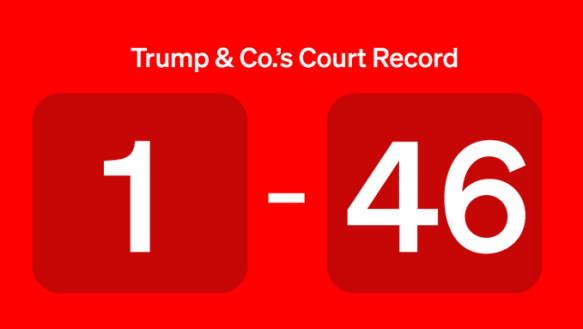
The president and members of his political party continue to file frivolous lawsuits attacking the results of the election, despite an overwhelming series of losses.

EobohfBU0AAAytD

From The New York Times:

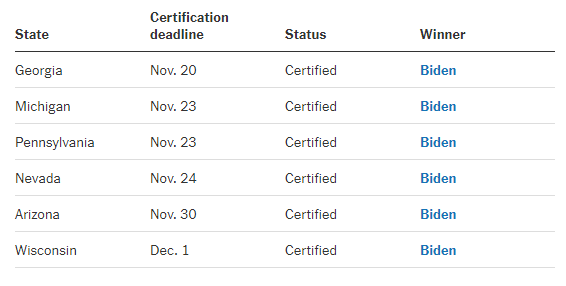
The . . . campaign’s unsuccessful strategy was to try to delay the certification processes in the key battleground states that President-elect Joseph R. Biden Jr. won. As of Monday, Nov. 30, all of those states had certified their results.

Untitled

From Wired:

On December 14, Electoral College members will formally cast their votes based on their states’ certified results, resolving any possible ambiguity that Biden is the president-elect.

“It’s [officially] over on December 14,” says Elaine Kamarck, director of the Brookings Institute’s Center for Effective Public Management . . . . “We forget that the electors are actual people, but they go to their state capitals and sign their ballots. Then the US Senate opens them, reads them out, and does the count on January 6, but there’s nothing else the Senate can do. Once they’re signed on the 14th and are on their way to Washington, that’s the end of the game.”

From The Washington Post:

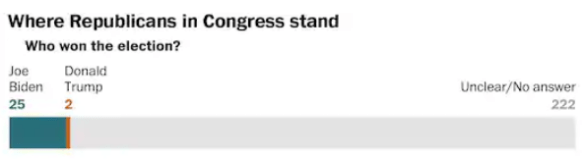
Just 25 [out of 249] congressional Republicans acknowledge Joe Biden’s win over President Txxxx a month after the former vice president’s clear victory of more than 7 million votes nationally and a convincing electoral-vote margin that exactly matched Txxxx’s 2016 tally.

Two Republicans consider Txxxx the winner despite all evidence showing otherwise. And another 222 GOP members of the House and Senate — nearly 90 percent of all Republicans serving in Congress — will simply not say who won the election.

Those are the findings of a Washington Post survey of all 249 Republicans in the House and Senate . . . 

The results demonstrate the fear that most Republicans have of the outgoing president and his grip on the party, despite his new status as just the third incumbent to lose reelection in the last 80 years. More than 70 percent of Republican lawmakers did not acknowledge The Post’s questions as of Friday evening. . . .

Of the 14 House Republicans who recognize the true winner, six are retiring from politics at the end of this month . . . 

Untitled

When Joe Biden is inaugurated as our 47th president on January 20th, the Orange Menace will still have ten tiny fingers and a Twitter account.

What Comes Next for the Creep

New York Magazine interviewed Michael Cohen. He used to be Txxxx’s “bagman and consigliere”, a job that earned him a three-year prison sentence. They wanted to talk about the president’s “ongoing election meltdown”:

Is there a strategy behind the tantrum Txxxx has been throwing since November 3? 
It’s all a shameless con job. He sees his claims of fraud as driving up donations — there’s nothing behind it beyond greed. Txxxx is using the moment to raise money. The number is actually shockingly large, over $150 million, a majority of it from small-dollar donations. This money is not going to his Election Defense Fund; it’s to keep him relevant in the GOP and launch his media brand. It’s all about money and power, and you need one to get the other.

Does he really believe massive election fraud took place?
There is that part of him that cannot accept losing. In his mind, the only way Biden could have won is through fraud. He has convinced himself of a narrative and is being fed back what he wants to hear from sycophants. The only one of these scumbags who truly believes this crap is Sidney Powell, but she is legitimately insane.

What’s next?
The money he’s raising is going toward the Save America PAC, which will be the base from which he establishes an entire parallel system of government. I call it the Republic of MAGAstan, and its capital will be in Florida at Mar-a-Lago. He’s also going to have his own 24/7 media platform with Txxxx TV, which will be an unholy alliance between Newsmax, OANN, and whoever he can drag from the swamp looking for relevance. He’ll continue to suck from the veins of his MAGA faithful while chipping away at the Biden presidency, casting doubt on the legitimacy of the election. All of this is in service of a Txxxx 2024 run for president and his return to power. . . .

Yesterday the New York Times reported that Txxxx has been discussing pardoning his three oldest children as well as Jared Kushner and Rudy Giuliani over concerns that the Biden administration may seek retribution against them. Do you think he’ll issue those pardons?
If Dxxxx Txxxx believed the pardons would be a slam-dunk benefit to him, he would already have signed off. Unfortunately for him, he is painfully aware that there are negative repercussions to such an action that could place him, his children, and his company in significant legal trouble. It is why he is proceeding cautiously. [Note: For instance, it’s suggested that you need to say what crimes a person committed as part of giving them a pardon.]

The idea that he’s concerned about “retribution” is what’s known as deflection. Dxxxx Txxxx knows that he, his children, and Kushner have all violated the law. And it’s not about retribution; it’s about an investigation that would most certainly lead to a conviction. He’s doing an act in advance of what he knows is coming down the pipeline. He’s already laying the groundwork for the premise of why he believes he must pardon his family: not because of their own dirty deeds but because of retribution. It’s all about distraction and deflection.

In your book, Disloyal, you tell a fascinating story about the socialite Patricia Kluge and how Txxxx slyly leveraged his way into acquiring her $100 million estate by exploiting her weaknesses. You wrote that Txxxx “was constantly calculating and assessing how to take maximum advantage of every situation.” I wonder if, while most people see the lame-duck period as a time to pack up and go, he sees it as a valuable opportunity to create discomfort that he can then trade for something valuable.
Of course he does. Life is a zero-sum game to Dxxxx Txxxx. Every moment is a moment to dominate and win. Where some would see a lame-duck presidency, Txxxx views an opportunity to leverage power by granting pardons, raising money, and setting himself up for the future.

You also wrote, “If something didn’t work out for Txxxx to his satisfaction, he dropped the whole project instantaneously, or at least after he’d wallowed in his outrage and anger.” You don’t think this will apply to his political career?
I don’t think he views himself as being done with politics. It will be fascinating to follow his second act through the political wilderness of Mar-a-Lago, where he’ll undoubtedly try to rewrite history and claim his four years were a miracle of prosperity and success. He’s going to have this massive Twitter following and his own media network to keep himself relevant. If he stays out of prison, he will continue to be a dangerous force in GOP politics until the day he dies.

Do you think he will be criminally prosecuted, and if so, by whom and for what?
I believe he will be indicted, along with his sons, by (New York District Attorney) Cy Vance as part of the widening probe into criminality and fraud at the Txxxx Organization. The bill is coming due, and it’s going to be nasty. . . .

As someone who knows him really well, is there something you see him doing in the next two months that will surprise everyone but you?
The only thing surprising he could do at this moment would be to go away and quietly lead his life with dignity and respect. Otherwise, we are stuck with this monster. . . .

Unquote.

We are probably stuck with him, but we don’t have to give him all the attention he craves. I hope the people who cover “the news” will give him the attention he deserves, in other words, much, much less than what they’ve given him the past five years.