This Isn’t What We Need, But Nature Isn’t Asking Us

As Omicron declines around much of the world, scientists are watching a new variant that’s even more contagious. So far, they don’t think it will have much effect on countries like the US that have already passed their Omicron peak. But this development reminded me of a recent book: Rob Dunn’s A Natural History of the Future: What the Laws of Biology Tell Us about the Destiny of the Human Species. From a NY Times review:

Levees surround us. Yes, some hold back rivers that strain against their embankments. But others hold back diseases, which are ready to saturate and overwhelm the fragile walls of antibiotics we’ve erected. And sometimes levees fail. The metaphor extends beyond epidemiology. Nature ceaselessly advances, trespasses, embarrasses our every effort to keep it at bay, and ultimately bursts through. Its rivers will not be contained.

In A Natural History of the Future, the ecologist Rob Dunn sketches an arresting vision of this relentless natural world — a world that is in equal measures creative, unguided and extravagant. Fog a tree with pesticides and watch new beetle species tumble from the canopy by the hundreds, a “riot of unnamed life.” Chlorinate your water and, though you might wipe out most parasites, you’ll soon bedew your shower head with chlorine-resistant mycobacteria. Make a world fit for bedbugs, then try to kill them with chemicals, and you’ll end up — not in a world without bedbugs, but one in which they’ve “evolved resistance to half a dozen different pesticides.”

Life is not a passive force on the planet, and much as we might presume to sit in judgment of Creation — even sorting species by their economic value to us — we live on nature’s terms. The sooner we recognize this, Dunn argues, the better.

Brannen2-superJumbo

As humans retreat into more and more sanitized spaces, and our homes become spotless, Febrezed bunkers of sterility, we’ll increasingly find that we’ve not only failed to eradicate our microbial opponents, we’ve actually helped create new, more virulent forms of them.

Enter the terrifying “megaplate” experiment, carried out by researchers at Harvard. In it, E. coli is made to grow across what is essentially a giant petri dish, one partitioned into sections laced with increasingly lethal doses of antibiotics. In the final stage of the megaplate, the bacteria meet a concentration of antibiotics many thousands of times higher than that which can kill your garden-variety E. coli. Even so, at the rate of “one mutation per billion divisions,” the bug evolves, casually crossing the entire plate, even the almost impossibly lethal barrier at the end, slipping through the antibiotic revetments as surely as water through a crumbling dike. And in only 10 days.

“I show it in talks,” Dunn writes of a video of the experiment. “It makes people quiet. It is what Kant called the horrifying sublime.”

The experiment can be run again, and again it will take about 10 days. What goes for E. coli scales up to agricultural pests, only temporarily inconvenienced by new pesticides until they evolve around them. While ecology is sometimes regarded as one of the squishier sciences, these kinds of eventualities begin to point to something like a set of laws underlying it all. These laws — though lacking the bedrock status of the laws of physics — can sometimes be nearly as predictive. If we want to know what’s coming, then, we would be well advised to familiarize ourselves with them, Dunn argues. To that end, his book functions as a helpful crash course in ecology and, as the title implies, an augur of sorts.

The law of the niche, for instance, predicts that many hapless species will fail to track their habitats on our warming world and will go extinct (think snails marooned on quickly shrinking islands). Others, however, will be cast about the face of the earth as their climate niche expands, and will flourish. Most concerning, perhaps, Aedes is coming. Just as epidemiologists warned for years that a pandemic was not merely possible but inevitable, ecologists now warn us of the looming mosquito heyday as we warp the climate. Key to this warning is the choice of modal verb: It’s not that these tropical pests “could” establish themselves in much of the Southern United States if we’re not careful, but rather that they “will.” And they will carry with them “some complex mix of the dengue virus and the yellow fever virus, but also the viruses that cause chikungunya, Zika fever and Mayaro.”

While it might not surprise us to read that mosquitoes have a niche that affects their distribution on the planet, it might be more difficult to recognize that we humans do as well. We are animals after all, and can be studied as such by ecologists. Even with the spread of air-conditioning, and all the creature comforts afforded by burning fossil fuels by the gigaton, we still mostly inhabit the same shockingly narrow band of the globe that we have for millennia. But as we push the climate beyond the norms of the past three million years we will hit the hard limits of physiology. And as the familiar rhythms of the seasons grow more syncopated and strange, some swath of our range will be increasingly foreclosed, to God knows what geopolitical effect. Many of us will have to move.

Along this unsettling journey into the future, the mood is leavened here and there by oddities, which Dunn dusts off like the docent of a strange natural history museum. We learn that the Taung child, one of the earliest hominins known to science, was eaten by eagles. We learn that the yeasts that make beer come from the bodies of wasps. That when humans spread out into new landmasses our “face mites diverged.” The impression all this arcana leaves with the reader is that we live in a much weirder, more disorienting world than we tend to appreciate.

We simplify this chaos, this riot of life, at our peril. We hoist plants from their natural context, consign them to vast monocultures, then act surprised when the rest of nature conspires to tear them down. We panic when bees fail to submit to the rote demands of industrial agriculture. But if simplifying nature is the cause of so many modern ills, then Dunn’s policy prescription, conversely, comes down to one simple dictum: Diversify. Diversify the microbes in your intestines, the crops in your fields, the plants in your watershed, the research in your grant proposals. Recruit the forests to filter your water. Let a trillion microbial flowers bloom.

This strategy works because nature is cleverer than us. The science historian George Dyson once described evolution itself as a kind of computational process that solves problems like how to swim, and how to fly. But the new problems we’ve given it to solve are ill considered, and the solutions it produces often undesirable. We dare life to overtop the levees of pesticides, herbicides, antibiotics; to overrun the concrete outcrops of cities, insinuate itself in the cracks of human society and pick the locks of our immune system. If we wipe out charismatic megafauna, of the sort that graces the brochures of conservation nonprofits, fine, nature seems to say, a florescence of rats and crows it is. Want to live in modular outcrops of steel, glass and cement, fed by rivers of pavement spanning thousands of miles? Very well, this will be a migration corridor for mice, pigeons and disease. They represent life too, after all, and the planet gives not a whit if it’s inhabited by lions or cockroaches. There are now beetles that consume only grains, mosquitoes that live only in the London metro. “Evolution creates,” Dunn writes, “and acts of creation are never complete.”

Dunn’s account leaves an overwhelming impression of fecundity, growth, adaptation. But this isn’t a naïvely rosy vision of the future like some contrarian tracts on the resilience of nature in the Anthropocene. From a human perspective this will be an impoverished world, and many of Dunn’s warnings are concrete and sobering. . . .  The rivers are rising.
I’m Glad They Agree

If you express an opinion and somebody disagrees, they’ve given you an opportunity to change your mind. If the other person’s opinion is better than yours, you’ve learned something. That’s a positive outcome. There can also be a positive outcome if the other person agrees with you. It makes you feel good (although if you were wrong to begin with, agreement will just make the situation worse). 

I had two instances today where somebody agreed with me. This made me feel good (I’m going with the assumption that I wasn’t wrong to begin with).

First, the philosopher Justin E. H. Smith criticized the idea that we may be living in a computer simulation, in response to David Chalmers’s book Reality + (my contribution, not as elegant and with a lot fewer words, was “Reality, the Virtual Kind and the Unlikely Kind”):

According to Chalmers’s construal of the “it-from-bit” hypothesis, to be digital is in itself no grounds for being excluded from reality, and what we think of as physical objects may be both real and digital. One is in fact free to accept the first conjunct, and reject the latter, even though they are presented as practically equivalent. I myself am prepared to accept that a couch in VR [virtual reality] is a real couch — more precisely, a real digital couch, or at least that it may be real or reified in consequence of the way I relate to it. But this does not compel me to accept that the couch on which I am currently sitting is digital.

There is a persistent conflation of these two points throughout discussions of the so-called “simulation argument”, which Chalmers treats in several of his works but which is most strongly associated with the name of Nick Bostrom, who in 2003 published an influential article entitled “Are You Living in a Computer Simulation?” … Here I just want to point out one significant feature of it that occurs early in the introduction and that the author seems to hope the reader will pass over smoothly without getting hung up on the problems it potentially opens up. Consciousness, Bostrom maintains, might arise among simulated people if, first of all, “the simulations were sufficiently fine-grained”, and, second of all, “a certain quite widely accepted position in the philosophy of mind is correct.”

What is this widely accepted position, you ask? … It is, namely, the view, which Bostrom calls “substrate-independence”, that “mental states can supervene on any of a broad class of physical substrates. Provided a system implements the right sort of computational structures and processes, it can be associated with conscious experiences.” Arguments for functionalism or computationalism have been given in the literature, Bostrom notes, and “while it is not entirely uncontroversial, we shall here take it as a given.”

It is of course possible that conscious experiences may be realized in a silicon substrate or in a complex arrangement of string and toilet-paper rolls, just as they may be realized in brains. But do we have any evidence that the arrangements that we have come up with for the machine-processing of information are in principle the kind of arrangements that, as they become more and more complex or fine-grained, cross over into conscious experience? In fact, there is very good reason to think that the appearance of consciousness in some evolved biological systems is the result of a very different sort of developmental history than anything we have seen so far since the dawn of artificial intelligence in the mid-twentieth century….

Unquote.

Second, Michael Tomasky of The New Republic responded to the Republican National Committee’s characterization of what happened on January 6, 2021, as “legitimate political discourse”:

It’s now official: The Republican Party is no longer a political party in any known American sense. Honestly, it hasn’t been for a quite some time, but with last week’s resolution condemning Liz Cheney and Adam Kinzinger, the party made it official. We don’t always grasp the historic importance of events in real time, but rest assured that future historians, assuming the United States remains enough of a democracy to have honest ones, will point to Friday, February 4 as a pivotal day in the party’s war on democracy….

The money quote in this episode is the line in the resolution that condemns Cheney and Kinzinger for “participating in a Democrat-led persecution of ordinary citizens engaged in legitimate political discourse.” This is right out of 1984. When The New York Times reported that this meant that the RNC was referring to the January 6 insurrection as “legitimate political discourse,” RNC gauleiter Ronna McDaniel howled that of course she has condemned violence, and the legit discourse business referred to other stuff.

What other stuff, it’s hard to say. The text of the resolution didn’t leave room to interpretation. And the select committee on January 6 is not exactly investigating Republicans across the country who are, say, protesting mask mandates. In fact, it’s not investigating any kind of “discourse.” It’s looking specifically at actions by people on and around the date of the infamous riot….

The truth here is obvious: The party is talking out of both sides of its mouth. The obvious intent with that sentence is to minimize and legitimize what happened on January 6…. And now that T____ himself has said he may pardon everyone charged with January 6–related crimes, it was clear that McDaniel saw her job as aiding [him] in that project: If it’s the official party line that the insurrection was legitimate, then there’s nothing outrageous about pardons.

The Anti-Defamation League recently released a report finding that more than 100 Republican candidates on various ballots in 2022 have explicitly embraced extremism or violence … This is not some aberration that time will correct. It is a storm that will continue to gather strength, because it’s where the action and the money are, and no one in the GOP is opposing it—except the two people who were just essentially read out of the party….

The Republican Party … has become an appendage of T____ dedicated to doing his will and smiting his enemies. I had to laugh at the part of the resolution that denounced Joe Biden for his alleged pursuit of “socialism”…..

The Republican Party is further down the road to fascism than the Democrats are to socialism. And when, by the way, might Democrats start saying that? What are you waiting for, people? How much deeper does this crisis have to get before you start telling the American people the truth about what the GOP has become? It’s time to say it and to put Republicans on the defensive….We are at a moment of historical reckoning…. But Americans won’t know it, Democrats, unless you tell them.

Unquote. 

In other words: “When Do We All Get To Say They’re Fascists?”

It Looks Like Evolution Doesn’t Work the Way We Thought!

In five words: mutations are not always random. This is according to a study reported by the University of California, Davis:

A simple roadside weed may hold the key to understanding and predicting DNA mutation, according to new research from UC Davis, and the Max Planck Institute for Developmental Biology in Germany.

The findings, published today in the journal Nature, radically change our understanding of evolution and could one day help researchers breed better crops or even help humans fight cancer.

Mutations occur when DNA is damaged and left unrepaired, creating a new variation. The scientists wanted to know if mutation was purely random or something deeper. What they found was unexpected.

“We always thought of mutation as basically random across the genome,” said Grey Monroe, an assistant professor in the UC Davis Department of Plant Sciences … “It turns out that mutation is very non-random and it’s non-random in a way that benefits the plant. It’s a totally new way of thinking about mutation.”

Researchers spent three years sequencing the DNA of hundreds of Arabidopsis thaliana, or thale cress, a small, flowering weed considered the “lab rat among plants” because of its relatively small genome comprising around 120 million base pairs. Humans, by comparison, have roughly 3 billion base pairs. 

“It’s a model organism for genetics,” Monroe said.

Work began at Max Planck Institute where researchers grew specimens in a protected lab environment, which allowed plants with defects that may not have survived in nature be able to survive in a controlled space.

Sequencing of those hundreds of Arabidopsis thaliana plants revealed more than 1 million mutations. Within those mutations a nonrandom pattern was revealed, counter to what was expected.

“At first glance, what we found seemed to contradict established theory that initial mutations are entirely random and that only natural selection determines which mutations are observed in organisms,” said Detlef Weigel, scientific director at Max Planck Institute . . . 

Instead of randomness they found patches of the genome with low mutation rates. In those patches, they were surprised to discover an over-representation of essential genes, such as those involved in cell growth and gene expression.

“These are the really important regions of the genome,” Monroe said. “The areas that are the most biologically important are the ones being protected from mutation.”

The areas are also sensitive to the harmful effects of new mutations. “DNA damage repair seems therefore to be particularly effective in these regions,” Weigel added.

The scientists found that the way DNA was wrapped around different types of proteins was a good predictor of whether a gene would mutate or not. “It means we can predict which genes are more likely to mutate than others and it gives us a good idea of what’s going on,” Weigel said. 

The findings add a surprising twist to Charles Darwin’s theory of evolution by natural selection because it reveals that the plant has evolved to protect its genes from mutation to ensure survival.  

“The plant has evolved a way to protect its most important places from mutation,” Weigel said. “This is exciting because we could even use these discoveries to think about how to protect human genes from mutation [including mutations that cause disease like cancer].

“Our discoveries yield a more complete account of the forces driving patterns of natural variation; they should inspire new avenues of theoretical and practical research on the role of mutation in evolution,” the paper concludes.

Unquote.

Nevertheless, random mutations do occur and presumably led to some mutations not being random, i.e. the plant above evolved via random mutation to protect itself with mutations that aren’t.

Maybe We’re Not Headed for Civil War or Dissolving the Union

A Columbia University sociologist, Musa el-Gharbi, says we shouldn’t trust poll results that claim to show millions and millions of Republicans are crazy (although lots are):

According to a number of polls and surveys, significant majorities of Republican-aligned voters seem to believe the big lie that T____ was the rightful winner of the 2020 US presidential election and, consequently, the Biden administration is illegitimate.

Taking these data at face value, a growing chorus insists that we’re living in a “post-truth” era, where members of one political party, the Republican party, can no longer tell facts from falsehood. As a result of the Republican party becoming unmoored from reality, the narratives typically continue, America is drifting headlong into a fascist takeover or a civil war.

Fortunately for all of us, these dire predictions are almost certainly overblown. We are not living in a “post-truth” world. We are not on the brink of a civil war. The perception that we are is almost purely an artifact of people taking poll and survey data at face value despite overwhelming evidence that we probably shouldn’t.

For instance, in the wake of the 2016 election, T____ claimed to have had higher turnout at his inauguration than Barack Obama did. Subsequent polls and surveys presented people with pictures of Obama and T____’s inauguration crowds and asked which was bigger. Republicans consistently identified the visibly smaller (T____) crowd as being larger than the other. A narrative quickly emerged that T____ supporters literally couldn’t identify the correct answer; they were so brainwashed that they actually believed that the obviously smaller crowd was, in fact, larger.

Of course, a far more obvious and empirically plausible explanation is that respondents knew perfectly well what the correct answer was. However, they also had a sense of how that answer would be used in the media (“Even T____’s supporters don’t believe his nonsense!”), so they simply declined to give pollsters the response they seemed to be looking for.

As a matter of fact, respondents regularly troll researchers in polling and surveys – especially when they are asked whether or not they subscribe to absurd or fringe beliefs . . . [“well, the world is flat, isn’t it?”].

However, many academics and pundits do not seem to be in on the joke. Instead, post-2016, a consensus quickly emerged from credulous readings of polls and surveys that America is facing an epidemic of “fake news”, which was leading people to believe things that were obviously false, and to vote for unsavory political candidates. Some of the initial studies on this topic were blatantly prejudicial in their design; other widely shared studies were ultimately retracted.

As more reliable data began to emerge, it turned out that, contrary to the initial hysteria, “fake news” stories were viewed by a relatively small number of voters, and infrequently at that. Most of those served pro-T____ or anti-Clinton “fake news” by social media sites already seemed firmly committed to voting for T____, or intractably resolved against voting for Clinton (which is why the algorithms served them this niche content to begin with). That is, “fake news” is unlikely to have changed many, if any, votes. It is not a plausible explanation for the 2016 electoral outcome nor T____’s support more broadly.

Even people who share “fake news” stories typically never read (or even click on) them. That is, people are not sharing the content because they read the stories, grew convinced of their factual accuracy, and are genuinely trying to inform others. Instead, people typically share these stories based on their headlines, for a whole host of social reasons, while recognizing them to be of questionable accuracy see here, here, here, here and here for more on this).

It should not be surprising, then, that correcting misinformation seems to have virtually no effect on political preferences or voting behavior; misperceptions are generally not driving political alignments to begin with – nor are they driving political polarization.

Contrary to narratives that have grown especially ubiquitous in recent years, Americans are actually not very far apart in terms of most empirical facts. We do not live in separate realities. Instead, people begin to polarize on their public positions on factual matters only after those issues have become politicized. And even then, polarized answers on polls and surveys often fail to reflect participants’ genuine views. Indeed, when respondents are provided with incentives to answer questions accurately (instead of engaging in partisan cheerleading), the difference between Democrats and Republicans on factual matters often collapses.

In other cases, apparent disagreements about factual matters often turn out to be, at bottom, debates about how various facts are framed and interpreted, or disputes about the policies that are held to flow from the facts. That is, even in cases of genuine disagreement, there is typically less dispute about the facts themselves than about what the facts mean – morally or practically speaking.

All said, measuring misperceptions is a fraught enterprise – even when it comes to banal and politically uncontested facts. Attempting to draw inferences about “incorrect” views on matters tied political, moral and/or identity struggles is a far more complicated endeavor. These are not data that lend themselves to being taken at face value.

Similar realities hold for the data that purportedly show we’re on the brink of a new civil war.

There is strong evidence that many of the surveys and polls indicating support for, or openness towards, political violence hugely overstate actual levels of support in the American public. Likewise, data that purport to show high levels of partisan vitriol may be misleading.

In general, behaviors are often a stronger indicator than attitudinal data for understanding how sincere or committed people are to a cause or idea. The number of people who are willing to rhetorically endorse some extraordinary belief tends to be much, much higher than the subset who meaningfully behave as if that claim is true. The number of people who profess commitment to some cause tends to be much, much higher than the share who are willing to make sacrifices or life adjustments in order to advance that cause.

The big lie is no exception. Both the low levels of turnout and the relatively low levels of violence are extraordinary if we take the polls and surveys at face value.

Event organizers were expecting, “hundreds of thousands, if not millions” to take part in the January 6 uprising. This would be reasonable to expect in a world where tens of millions of Americans literally believed that an apparently high-stakes election was stolen out from under them. Even if just 1% of those who purportedly believe in the big lie had bothered to show up, the demonstrations would have been hundreds of thousands strong. Instead, they only mustered 2,500 participants . . . 

The lack of casualties was also striking, even when one considers injuries and indirect fatalities. After all, the former president also enjoyed strong support among people who are armed and formally trained in combat, such as active duty and veteran military and law enforcement. A large number of other T____ supporters participate in militias, or are private gun owners.

Yet most January 6 participants did not bring firearms, and those who were armed did not discharge their weapons – not even in the heat of the violence that broke out. . . . 

In a world where 74 million voted for T____, and more than two-thirds of these (i.e. more than 50 million people, roughly one out of every five adults in the US) actually believed that the other party had illegally seized power and now plan to use that power to harm people like themselves, the events of January 6 would likely have played out much, much differently.

Indeed, had even the 2,500 people who assembled on the Capitol arrived armed to the hilt, with a plan to seize power by force, committed to violence as “needed” to achieve their goals – things would have gone much, much differently.

Instead, most participants showed up expecting T____ would provide them with definitive evidence for his claims of electoral malfeasance, and then unveil some master plan to take the country back. This didn’t happen. . . . 

There was an even small number . . . who showed up to the Capitol with a clear intent to forcibly overturn the election – who equipped themselves for violence, researched the congressional proceedings and the layout of the building, developed and executed a plan, etc. These are behaviors consistent with a sincere belief in the big lie, and a strong commitment to doing something “about” it. . . . 

Of course, even tiny numbers of genuine extremists like these can be extremely destabilizing under the right circumstances. Had Oath Keepers breached the Capitol instead of being repelled (even as Q-Shaman, Confederate Flag Guy et al wandered the building aimlessly) … January 6 could have played out much differently.

Nonetheless, there is a huge difference in talking about identifying and disrupting small numbers of highly committed individuals willing to engage in revolutionary political violence versus tens of millions of Americans genuinely believing the election was fraudulent and being open to violence as a means of rectifying the situation. Those are very different problems. Orders of magnitude different.

The good news is that the second problem, the tens-of-millions-of-Americans problem, is not real. It is an artifact of politicized polling design and survey responses, followed by overly credulous interpretations of those results by academics and pundits who are committed to a narrative that half the electorate is evil, ignorant, stupid, deranged and otherwise dangerous [well, they did vote for a person who has no redeeming qualities and are poised to do it again — that doesn’t imply being smart or well-informed].

In fact, rather than January 6 serving as a prelude to a civil war, the US saw lower levels of death from political violence in 2021 than in any other year since the turn of the century. . . . This is not an outcome that seems consistent with large and growing shares of the population supposedly leaning towards settling the culture wars with bullets instead of ballots. This turn of events does not seem consistent with the notion that tens of millions of Americans – including large numbers of military, law enforcement and militia members – literally believe the presidency was stolen, elections can no longer be trusted, and the fate of the country is on the line. . . . 

In truth, most Republican voters likely don’t believe in the big lie. But many would nonetheless profess to believe it in polls and surveys – just as they’d support politicians who make similar professions (according to one estimate, Republican candidates who embrace the big lie enjoy a 6 percentage point electoral boost as compared to Republicans who publicly affirm the 2020 electoral results).

Within contemporary rightwing circles, a rhetorical embrace of the big lie is perceived as an act of defiance against prevailing elites. It is recognized as a surefire means to “trigger” people on the other team. A demonstrated willingness to endure blowback (from Democrats, media, academics, social media companies, et al.) for publicly striking this “defiant” position is interpreted as evidence of solidarity with, and commitment to, “the people” instead of special interests; it’s taken as a sign that one is not beholden to “the Establishment” and its rules. That is, the big lie seems to be more about social posturing than making sincere truth claims.

For many reasons, this situation is also far from ideal. But it’s a very different (and much smaller) problem than partisans actually inhabiting different epistemic worlds and lurching towards a civil war. Glass half full.

Unquote.

This view is consistent with one of mine: if millions and millions truly believed abortion is murder, there would be a lot more resistance, including armed resistance, to abortion (despite the Supreme Court’s Roe v. Wade decision). Talk is often cheap.

Virus Update

First, the bad news:

The United States surpassed its record for covid-19 hospitalizations on Tuesday, with no end in sight to skyrocketing case loads, falling staff levels and the struggles of a medical system trying to provide care amid an unprecedented surge of the coronavirus.

Tuesday’s total of 145,982 people in U.S. hospitals with covid-19 . . . passed the record of 142,273 set on Jan. 14, 2021, during the previous peak of the pandemic in this country.

But the highly transmissible omicron variant threatens to obliterate that benchmark. If models of omicron’s spread prove accurate — even the researchers who produce them admit forecasts are difficult during a pandemic — current numbers may seem small in just a few weeks. Disease modelers are predicting total hospitalizations in the 275,000 to 300,000 range when the peak is reached, probably later this month.

As of Monday, Colorado, Oregon, Louisiana, Maryland and Virginia had declared public health emergencies or authorized crisis standards of care, which allow hospitals and ambulances to restrict treatment when they cannot meet demand [The Washington Post].

In the U.S., 840,000 confirmed deaths and 1,700 every day (almost all of whom are unvaccinated). However:

Scientists are seeing signals that COVID-19′s alarming omicron wave may have peaked in Britain and is about to do the same in the U.S., at which point cases may start dropping off dramatically.

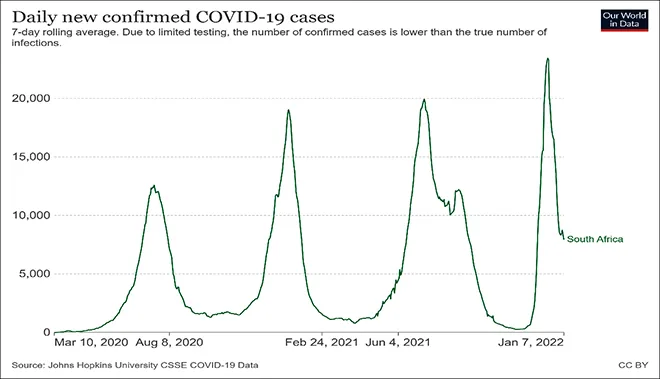
The reason: The variant has proved so wildly contagious that it may already be running out of people to infect, just a month and a half after it was first detected in South Africa.

At the same time, experts warn that much is still uncertain about how the next phase of the pandemic might unfold. . . . And weeks or months of misery still lie ahead for patients and overwhelmed hospitals even if the drop-off comes to pass.

“There are still a lot of people who will get infected as we descend the slope on the backside,” said Lauren Ancel Meyers, director of the University of Texas COVID-19 Modeling Consortium, which predicts that reported cases will peak within the week.

The University of Washington’s own highly influential model projects that the number of daily reported cases in the U.S. will crest at 1.2 million by Jan. 19 and will then fall sharply “simply because everybody who could be infected will be infected,” according to Mokdad [ABC News].

What’s happened in South Africa, with omicron as the latest spike: 

Finally, a note from France [The Washington Post]:

In an interview with France’s Le Parisien newspaper, [French President Emmanuel] Macron shared his thoughts about France’s unvaccinated population. He did not mince his words. “The unvaccinated, I really want to piss them off,” Macron said. “And so, we’re going to continue doing so until the end. That’s the strategy.”

The English translation hardly does the comment justice. In French, the verb he used is “emmerder,” which means, quite literally, to cover in excrement. The ire is difficult to translate, but in French it is crystal clear.

Actually, it’s quite easy to translate using the verb form of a different four-letter word — followed by “on them”.