I’m OK, But I’ve Got My Doubts About You

“Sapient” means “wise or knowing”. That’s why Carl Linnaeus, the father of modern taxonomy, called our species “Homo sapiens“. In fact, we’re all members of the sub-species “Homo sapiens sapiens“. We must be really smart (given the competition).

On a less optimistic note, however, studies show that our species suffers from various cognitive impairments. For example, there is “motivated reasoning”: our emotions often affect the conclusions we reach. The existence of the “backfire effect” is especially counter-intuitive: when our deepest beliefs are confronted by contrary evidence, our deepest beliefs can become even stronger. It’s a cognitive defense mechanism frequently on display at family gatherings and in the House of Representatives.

Once we accept the widespread irrationality of Homo sapiens sapiens, it’s much easier to understand why certain politicians say such crazy things. They aren’t necessarily lying. Too often, they actually believe what they’re saying.

Yesterday, Republican Senator Ted Cruz of Texas criticized the agreement to end the shutdown and raise the debt ceiling: “Unfortunately, once again, it appears the Washington establishment is refusing to listen to the American people”. The Senator may really believe that most of America was enjoying the shutdown and looking forward to the government running out of money. Public opinion polls indicating that most of us weren’t happy about it at all must be non-existent or seriously flawed.

Somehow it’s comforting to know that our political opponents aren’t lying bastards. They’re merely irrational, like so many of our species.

Fortunately, this doesn’t mean that all of us are equally irrational. Some people are more in need of cognitive defense mechanisms because they feel more threatened by what’s going on in the world. If you strongly prefer how things were back in the 19th century, when we didn’t have things like an income tax or child labor laws, you’ll have a lot of mental defending to do. Having that black guy in the White House clearly bothers a lot of people, who conclude that he must be the Antichrist or at least working for Al Qaeda. The Affordable Care Act scares the hell out of some people who think the government is becoming too powerful, so they hold on to the idea that death panels will soon be deciding who should live or die.

Of course, you might point out that many of us feel threatened by the radical Republicans among us. So maybe we are being irrational about them?

That’s possible, but it’s not what the evidence shows. Those people really are crazy! It’s just that their behavior is more common than some of us (the optimists among us?) would like to think.

For more on the backfire effect and whether journalists can do anything about it, here’s an article in the Columbia Journalism Review:

http://www.cjr.org/behind_the_news/the_backfire_effect.php?page=all

Getting to the Bottom of Things Physics-Wise

One of the things that made physicist Richard Feynman famous was his invention of the Feynman diagram. Feynman diagrams provide a method for understanding the interactions between sub-atomic particles. Here, for example, is a diagram that represents the collision of an electron and a positron, resulting in the creation of two photons:

640px-Feynman_EP_Annihilation.svg

Using Feynman diagrams to describe certain interactions turns out to be extremely challenging, however. The collision of two gluons, resulting in the creation of four less energetic gluons, requires 220 diagrams. Some calculations based on this methodology cannot be done without the aid of a powerful computer, since they require thousands, millions and even billions of mathematical terms.

Over the years, various physicists and mathematicians have found ways to simplify these calculations. Recently, in fact, physicists have discovered a new geometrical object, the use of which simplifies the calculations to an amazing degree. They call the new structure an “amplituhedron”:

Interactions that were previously calculated with mathematical formulas thousands of terms long can now be described by computing the volume of the corresponding jewel-like “amplituhedron,” which yields an equivalent one-term expression.

“The degree of efficiency is mind-boggling,” said Jacob Bourjaily, … one of the researchers who developed the new idea. “You can easily do, on paper, computations that weren’t feasible even with a computer before.”

For example, calculating the volume of the amplituhedron in this diagram, which represents the interaction of 8 gluons, provides the same result as 500 pages of algebra based on Feynman diagrams:

amplituhedron-drawing_web

I learned about this latest development in an article called “A Jewel at the Heart of Physics”, which can be found here:

https://www.simonsfoundation.org/quanta/20130917-a-jewel-at-the-heart-of-quantum-physics/

The article suggests that the discovery of the amplituhedron might one day lead to major consequences for our understanding of the universe: “a theory of quantum gravity that would seamlessly connect the large- and small-scale pictures of the universe”:

Attempts thus far to incorporate gravity into the laws of physics at the quantum scale have run up against nonsensical infinities and deep paradoxes. …The amplituhedron is not built out of space-time and probabilities; these properties merely arise as consequences of the jewel’s geometry. The usual picture of space and time, and particles moving around in them, is a construct.

If two methods give the same results, the simpler method is clearly preferable from a pragmatic point of view. In fact, it’s likely in such a case that the simpler method better reflects the way the universe works. Perhaps the simplicity of this new method indicates that fundamental reality is simpler than previously believed:

Beyond making calculations easier or possibly leading the way to quantum gravity, the discovery of the amplituhedron could cause an even more profound shift, [physicist Nima] Arkani-Hamed said. That is, giving up space and time as fundamental constituents of nature and figuring out how the Big Bang and cosmological evolution of the universe arose out of pure geometry.

“In a sense, we would see that change arises from the structure of the object,” he said. “But it’s not from the object changing. The object is basically timeless.”

None of this means that there are tiny amplituhedrons underlying the universe, floating around outside space and time (whatever that would mean). It’s not even clear (to me anyway) what “pure geometry” is, since the geometry of an object, whether real or imagined, usually refers to its spatial characteristics.

Nevertheless, this latest labor-saving device may help physicists get closer to the bottom of things, assuming there is a bottom to get to.

What Made the Big Bang Bang?

Physicists believe our universe began with a “Big Bang” about 14 billion years ago. The evidence suggests that the universe was infinitely hot and infinitely dense before it rapidly expanded, resulting in the still-expanding universe of which we are a tiny part.

But the physicists don’t know why the Big Bang occurred or what, if anything, existed before it. Maybe an earlier universe collapsed upon itself and then bounced back in a tremendous explosion. Maybe our universe resulted from some kind of random quantum fluctuation — or from a really cool experiment carried out by a kid with blue skin and 12 eyes.

Another hypothesis, of course, is that God kicked off the Big Bang. I wouldn’t bet on that, but you never know (although you might get to know if you ever join the choir invisible).

It’s also been suggested by some physicists that a black hole in another universe may have had something to do with the beginning of ours. The latest theory along those lines is that a star in a universe with four spatial dimensions (not our familiar three) ended its life as a supernova, creating a 4-D black hole at its core and simultaneously ejecting some debris out into 4-D space. Our universe could be a 3-D sliver of this 4-D cosmic debris. Or something like that.

Something immediately struck me when I read an article about this latest theory. It wasn’t the plausibility of the theory, which I’m almost completely unqualified to judge. It was the sudden feeling that we’ve now figured out why the Big Bang occurred. And no god had anything to do with it! It’s just the cosmos and us after all!

If I were religious, this momentary reaction might be understandable. But I’m not. So why did the idea that there’s no god out there pulling strings make me feel suddenly lonely? I guess it’s hard to escape your upbringing, no matter how old you get. And all that space out there can make a person feel a little bit alone, even on a planet with 7 billion people and 3 billion internet users.

Of course, God could have created that other universe that gave rise to ours, or the even earlier universe that gave rise to that one, or the one that came before that other one, and so on and so on, but somehow it’s just not the same once universes start giving birth to new ones all by themselves. 

http://www.nature.com/news/did-a-hyper-black-hole-spawn-the-universe-1.13743

Good News Is Breaking Out All Over

It often seems like the world is going to hell. But clearly there is good news too, like what might be happening with the chemical weapons in Syria.

Here’s another piece of good news: medical researchers are getting closer to understanding the mutations that result in people getting cancer. As the article below says, we already know that smoking causes mutations leading to lung cancer and ultraviolet light causes mutations that cause skin cancer. Now scientists are beginning to figure out which mutations lead to other kinds of cancer: 

Out of the 30 cancer types, 25 had signatures [or patterns] arising from age-related mutational processes. Another signature, caused by defects in repairing DNA due to mutations in the breast cancer susceptibility genes BRCA1 and 2, was found in breast, ovarian and pancreatic cancers.

One of the interesting findings mentioned in the article is that a certain family of enzymes is linked to more than half of the cancer types studied:

These enzymes, known as APOBECs, can be activated in response to viral infections. It may be that the resulting signatures [that cause cancer] are collateral damage on the human genome caused by the enzymes’ actions to protect cells from viruses.

When I was growing up, my mother wouldn’t say the word “cancer”. It was like “Voldemort”, a word that must not be spoken. As our knowledge grows, “cancer” should eventually become as rare as the world “polio” is today.

http://www.sanger.ac.uk/about/press/2013/130814.html

In completely unrelated and less important news, the Japanese are now accepting the fact that a foreigner will break the single season home record of their great national hero, Sadaharu Oh. During his career in Japanese baseball, Oh hit 863 home runs, 149 more than Babe Ruth hit in America. As the New York Times explains:

A few foreign players in Japan’s top league have threatened to surpass Oh’s hallowed mark of home runs in a single season, 55. And each time, opposing pitchers refused to throw pitches anywhere near the strike zone in a blatant effort to protect Oh’s record.

Yesterday, Wladimir Balentien, a native of Curacao, playing for the Tokyo Yakult Swallows, tied Oh’s record of 55 home runs in a season. He has 21 games left and opposing pitchers are throwing pitches he can hit.

So the people of Japan have taken another step toward welcoming the participation of foreigners in Japanese society. Good news is breaking out all over.

http://www.nytimes.com/2013/09/06/sports/baseball/deference-to-a-revered-record-by-sadaharu-oh-in-japan-is-going-going.html

Getting Down to the Truly Nitty Gritty

I live near one of the research centers that used to be known as Bell Labs, the place where scientists found evidence of the Big Bang; invented the transistor and the laser; and developed the UNIX operating system and C programming language. A friend once suggested that I try to get a job there, since they would always need janitors.

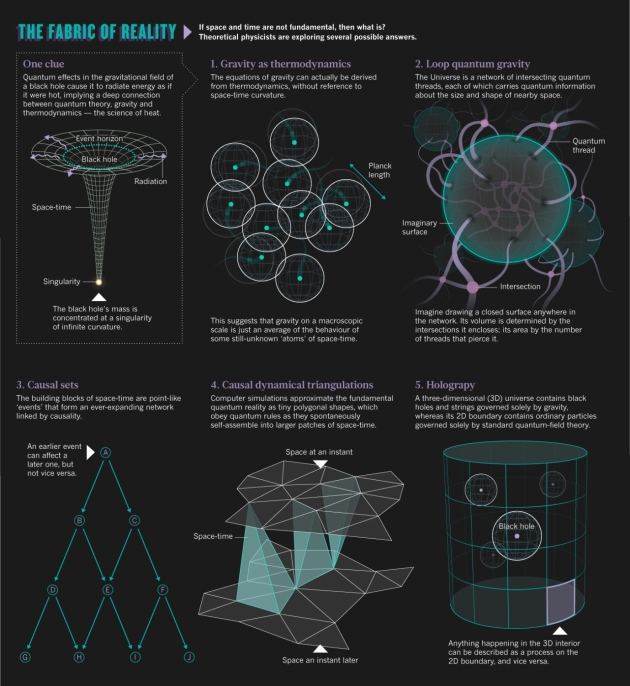
Nevertheless, even with my weak qualifications, I enjoy reading about theoretical physics. I didn’t understand much of the article below, but it’s good to know that physicists are trying to understand where space and time come from. You might think space and time are fundamental, but there appears to be more to the story.

If you follow the link to the article, you can click on this diagram and make it bigger (spatially, not temporally).

quantum-gravity-nature-online

http://www.nature.com/news/theoretical-physics-the-origins-of-space-and-time-1.13613