How One Insurrectionist Got There

#CapitolSiegeReligion is a Twitter hashtag that refers to the intersection between the attack on the Capitol and religious beliefs. Peter Manseau is a curator of religious history at the Smithsonian and has been writing about it. Yesterday, he shared the story behind one of the insurrectionist’s actions. Facebook had a major role:

One month later, there’s still a part of #CapitolSiegeReligion I think needs more attention. Some religious media & evangelical leaders no doubt share a measure of the blame. But we can’t lose sight of the fact that the attack was the result of thousands of individual choices… To understand those choices I’ve been reading FBI charges, looking for mention of religious motives. That’s how I found Mike Sparks [of Elizabethtown, Kentucky], accused of being the first to enter the Capitol through a broken window. After the attack he declared Trump would remain president “in Jesus name”.

The day charges against him were announced, I had a look at Sparks’ Facebook page, which has now gone dark. What I saw there was fascinating: a record of one man’s transformation into an unlikely insurgent. A single chronicle of radicalization that may shed light on others.

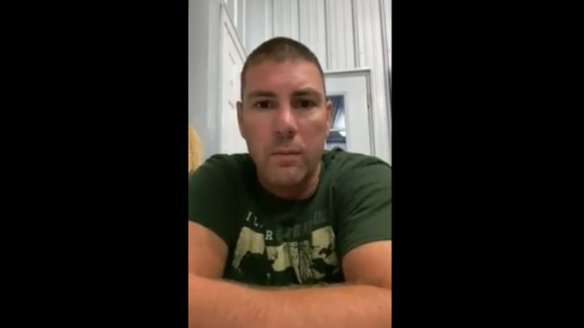
Sparks was of course taken in by all the election lies. But what we need to understand is that his transformation started long before that. Last summer he posted a long video testimonial wrestling with a new anger he feared was rising in him & clearly naming its source: Facebook.
EtixzhrWgAQr43_

“I consider myself a devout Christian,” he said, but he knew he hadn’t been sharing “godly things” on Facebook. “I’ve even said I’d shoot that person in the head, I’d shoot this person in the head… I’m not showing the love of Christ.” Friends began to worry; many unfriended him.

As he saw it, the problem for him began with Black Lives Matter. Images of protests across the country had pushed him over the edge. Framed by conservative media on Facebook, those images convinced him the time for spiritual war was at hand. “It’s good versus evil now,” he said.

It wasn’t just the images, it was that they felt inescapable. The same platform his family used to share photos was now driving him mad. “Facebook is where they’re feeding this anger and hatred,” he said. “They’ll find out what you are for or against & they’re gonna feed anger.”

Social media in Sparks’ description is a tormentor: an active, personified force that may do some good, but mostly means you harm. Facebook became for him the site of a clash with himself, relentlessly giving him dire warnings of threats posed to his family and his country.

“I’ve noticed that my phone has been in my hand more than my Bible,” Sparks confessed. “I’ve been locked in on my Facebook watching all this stuff play out and I get angrier and angrier.” He apologized & promised to do better, wondering if he should quit social media altogether.

“I’m not going to let my anger overtake me anymore,” he said. “I’m going to get in the word of God like I should be doing anyway, and get back to the me that smiles more. Because I got wrapped up. I got wrapped up in Facebook.”

In the end, he did not quit Facebook. His posts about BLM soon gave way to posts about the election and his refusal to accept the results. When Trump himself posted “JANUARY SIXTH, SEE YOU IN DC!”, Sparks shared it to his page, adding “I’ll be there.”

EtiuYlpWgAEKPQx

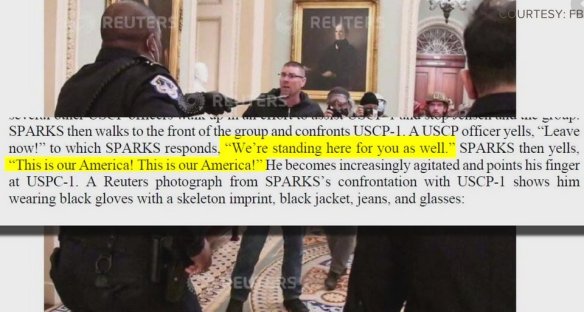
According to the FBI, not only was Sparks there, he took part in one of the day’s most notorious incidents: when rioters chased Capitol Police Officer Eugene Goodman.
EtkbnihWgAA5jHS

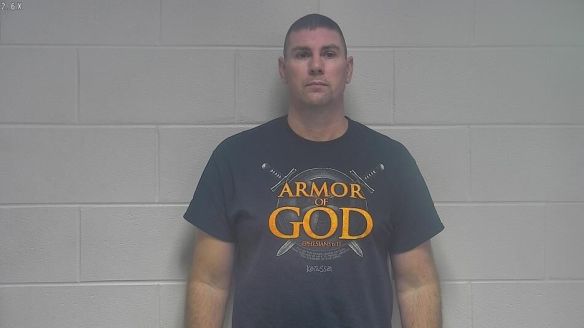
At Sparks’ arrest, he wore a t-shirt citing Ephesians 6:11: “Put on the full armor of God so that you can take your stand against the devil’s schemes.” It’s worth asking how much being “wrapped up in Facebook” led him see the Capitol attack in those terms.
600752d1ef76a.image

Elizabethtown man charged in connection with Capitol riot arrested. Michael Sparks is in federal custody at the Oldham County Detention.

Understanding January 6 on an individual level is not easy. Yet it’s an important part of making sense of the problem we face: Trump is gone, but how many angry men are still staring at their phones, wondering when the battle raging inside them will break out into the world?
A Great Opportunity for the Democrats

Having fifty votes in the Senate and the Vice President gives the Democrats a chance to make real progress and seriously damage the radical right. From Greg Sargent of The Washington Post:

In the early morning hours on Friday, Senate Democrats passed a measure laying the groundwork to move President Biden’s big economic rescue package via the reconciliation process, by a simple majority. Republicans are already thundering with outrage.

The move does indeed pose a serious challenge to Republicans. But it’s one that runs deeper than merely moving toward passing this one package without them. It also suggests a reset in dealing with GOP bad-faith tactics across the board — and even the beginnings of a response to the . . . ideology loosely described as “Trumpism.”

First, the new move suggests a growing recognition that the conventional understanding of how “bipartisanship” works has things exactly backward — and that Republicans have manipulated the public debate on this topic for far too long.

For instance, Sen. Mitch McConnell (R-Ky.) is already denouncing this move. The minority leader railed that Democrats have “set the table to ram through their $1.9 trillion rough draft,” adding: “notwithstanding all the talk about bipartisan unity, Democrats are plowing ahead.”

McConnell’s underlying claim is that Democrats should allow their plan to be subject to a supermajority requirement via the filibuster [of 60 Yes votes] to facilitate bipartisanship. The idea is this: If a partisan majority [in this case, the 50 Democrats plus the Vice President] can’t pass things by itself, it must reach out for bipartisan support [from at least ten Republicans] . . .

This is a scam. The reality is the other way around: In McConnell’s hands, the filibuster has actually made bipartisanship less likely.

By preventing a partisan majority from passing things, McConnell has created the conditions for withholding the support necessary to enact them, for the instrumental purpose of casting Democratic presidents (such as Barack Obama) as failed conciliators.

This has worked as follows: GOP senators have withheld support regardless of the concessions made to win them over, because they calculate the president’s party will take the political hit for failing to make bipartisan deals.

The paradox here is that using reconciliation — moving to pass something by a simple majority — actually could bolster the conditions for good-faith bipartisanship. GOP senators who might be gettable will no longer have a built-in incentive to oppose a particular bill. It’s likely passing anyway, so the lure of helping [their own] party by opposing it — because the Democratic president will get blamed for failure — isn’t nearly as strong.

Under those conditions, Biden actually would have an opening to negotiate with Republicans in the quest for bipartisan support. In the conditions McConnell wants, the incentives for moderate GOP senators point in the other direction.

Whether Biden actually will end up negotiating down to win a few Republicans is an open question. But the point is, in McConnell’s cynical scenario, this would be nothing but a fool’s errand, because it would be far less likely to work.

McConnell’s other basic idea — that a supermajority requirement protects the minority — is also nonsense. Adam Gurri makes a key distinction between protecting the rights of the minority party and protecting those of minorities of voters. The latter are protected by many other veto points in the system. Protecting the minority party’s rights by subjecting all Senate business to a supermajority requirement is only about facilitating its ability to obstruct.

Senior Democrats have begun to articulate the idea that the true way to revitalize faith in government — and in democracy — is by successfully delivering on big-ticket items. Achieving bipartisan cooperation for its own sake will do far less to address deep civic division and disillusionment than robust and effective action on behalf of the common good.

The Biden plan now will be written by Congress. But the new move lays the groundwork for passage of a package that could spend as much as $1.9 trillion. . . .

In an interesting column, David Brooks suggests that such large-scale spending could begin to accomplish “social repair.” We should spend far more than what’s merely needed to fill the “output gap.” We should spend to address the deep inequalities and injustices revealed by the pandemic and longer-term structural ills such as flat wages and regional stagnation. Undershooting here, Brooks notes, carries far greater moral and civic risks than overshooting.

I’d go further: Such an approach also contains the seeds of a broader answer to Trumpist populism. Success in using robust government action to charge up the recovery and get the coronavirus under control — including sinking medical resources into rural America — could clear political space for Biden to restore humanity to our immigration system and sanity to our international climate efforts.

Spending effectively toward the common good might begin to defang destructive zero-sum nationalist appeals. That could pave the way for a “new synthesis” that combines bolder progressive economics with a refusal to backpedal on issues that Democrats have long seen as politically perilous in the face of right-wing populist demagoguery. Biden’s ambitious actions so far on immigration and climate suggest just this understanding of the moment.

All this might sound overly optimistic. And there are countless ways Democrats can screw this all up. But the early returns suggest they are constructively breaking with old ways of thinking. And that could portend a serious long-term challenge to the Trumpified [Grotesque Old Party].

Unquote.

Senate Democrats can change the Senate rules whenever they want. They just need the courage to do so (and the cooperation of their least progressive members).

The “And” Defense Doesn’t Work

I’m trying to say less about our former president and his minions — including the entire Republican Party — now that they have a lesser role in our lives, but a correction to the previous post is in order. Therein I considered the argument that a president cannot be impeached after leaving office because of the way the Constitution is worded. Two law professors explain why this is clearly wrong (I apologize for not noticing what they point out):

. . . Some have argued that the constitutional clause providing that “Judgment in Cases of Impeachment shall not extend further than to removal from Office, and disqualification to hold and enjoy any Office of honor, Trust, or Profit under the United States” implies that any consequence of conviction must consist of both removal and disqualification from future office — which could happen only in the case of sitting officers.

That is not what the clause says. It says the judgment may not “extend further” than these two sanctions. It does not say that both sanctions must be imposed in every case. Indeed, most convictions over the years involved only one, removal from office.

Clearly, if punishment cannot extend beyond X and Y, it means that X and Y are both allowed, but nothing else is. The Senate can’t add punishment Z to the mix, but they can apply either X or Y or the two together.

In this particular president’s case, it means that, although it’s too late to remove him from office, he can be barred from a future government position. Unfortunately, however, he can’t be forced to shave his head and wear a dunce cap.

Despite the above, Republican senators will still argue that he’s beyond punishment. They fear the former president’s radical supporters. But it’s good to understand why they’re wrong about the Constitution.

(Note: I still say we need to add “andor” to English, so we can easily say “this andor that”, while leaving “and” to mean “both” and “or” to mean “either this or that, but not both”.)

It’s Time To Fix English Again

The House impeachment managers have submitted an 80-page “trial memorandum” explaining why the former president should be convicted in the Senate and disqualified from ever occupying a federal office again. It describes the ex-president’s lies regarding who won the election and his encouragement of the mob that attacked the Capitol. It also explains why it makes perfect sense from a legal, historical and practical perspective for the Senate to convict impeached officials even though they have left office.

In response, the creep’s lawyers have submitted a 14-page response that’s too stupid to discuss (although it will give most Republican senators an excuse to vote against conviction). 

Anyway, here’s a specific issue I want to discuss. It’s a grammatical problem with the U.S. Constitution. This is the troublesome passage:

The Senate shall have the sole Power to try all Impeachments. . . . Judgment in Cases of Impeachment shall not extend further than to removal from Office, and disqualification to hold and enjoy any Office of honor, Trust or Profit under the United States . . . 

Since you can’t remove somebody from office after they’ve left office, there seems to be a problem here. The former president’s lawyers (who are unlikely to ever receive a dime from their client) put it this way:

Since the 45th President is no longer “President,” the clause ‘shall be removed from Office on Impeachment for…’ is impossible for the Senate to accomplish, and thus the current proceeding before the Senate is void ab initio [“from the beginning”] as a legal nullity that runs patently contrary to the plain language of the Constitution.

So, although other officials have been convicted by the Senate after they’ve left office, and barring someone from holding office again used to be the main reason for impeaching somebody, as opposed to removing them from office, and almost all experts on the Constitution say it’s totally fine to convict somebody after they’ve left office, and presidents could commit all kinds of High Crimes and Misdemeanors near the end of their term if you couldn’t convict them after they left the White House, the “plain language” of the Constitution does include that three-letter word “and”.

If only James Madison, George Washington and their colleagues had used the phrase “and/or” instead of “and”! Judgment against an official would extend to removal “and/or” disqualification. There wouldn’t be any room for confusion. The Constitution’s meaning would have been perfectly clear.

Unfortunately, nobody at the Constitutional Convention was familiar with the phrase. The first known use of “and/or” occurred in 1853, sixty-four years after the Constitution was written. 

Alternatively, the framers could have used “or” instead of “and”, giving us “removal or disqualification”. But then some lawyer would have claimed that an official can’t be removed from office and disqualified at the same time. They’d argue that the Senate would have to choose between the two options, either one or the other (understanding “or” in this case as the “exclusive or”, meaning one or the other, not both). 

In the near future, we’ll learn how all this plays out in the Senate. Nobody seems to think 17 Republican senators will agree to convict the demagogue, and without 50 Democrats and 17 Republicans voting “Yes”, he will escape judgment again.

Going forward, however, I have a suggestion. We English speakers need to adopt a single term for what’s called the “inclusive or”, i.e. the meaning of “or” that implies “this or that or both this and that”. It’s rather amazing that it took hundreds of years for somebody to invent “and/or” to do the job. But since it’s not a word — unlike hyphens, a slash isn’t ordinarily used to combine other words — we need a new word to take on this function. Perhaps unsurprisingly, I suggest “andor” without a slash. “Andor” sounds the same as “and/or” and after a while it wouldn’t look weird.

This isn’t the first time I’ve argued for a change like this. Four and a half years ago, I pointed out that we should change the way we use quotation marks. I won’t go into the details again (you can review my argument at length here), but instead of writing sentences like these:

He said “Go away.”

I can spell “cat.” 

We should write them like this:

He said “Go away”.

“I can spell “cat”.

The quotation mark should go in front of the period, not after!

So far, my quotation mark suggestion hasn’t exactly taken the world by storm. Maybe I was simply ahead of my time. At any rate, please do consider adopting my suggestion from today andor my suggestion from 2016. (See how incredibly easy that is?)

A Few Pertinent Items

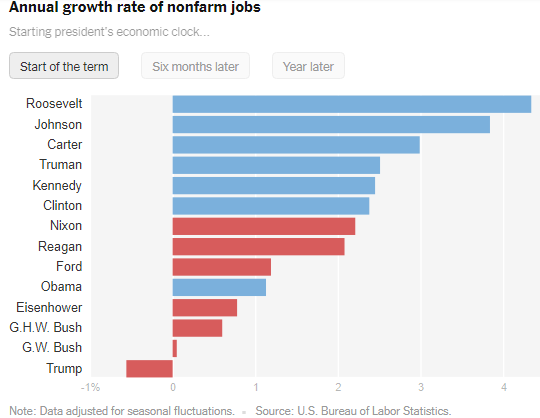
From: The Economy Does Much Better Under Democrats. Why? – The New York Times

“A president has only limited control over the economy. And yet there has been a stark pattern in the United States for nearly a century. The economy has grown significantly faster under Democratic presidents than Republican ones.”

“It’s true about almost any major indicator: gross domestic product, employment, incomes, productivity, even stock prices. It’s true if you examine only the precise period when a president is in office, or instead assume that a president’s policies affect the economy only after a lag and don’t start his economic clock until months after he takes office. The gap “holds almost regardless of how you define success,” two economics professors at Princeton, Alan Blinder and Mark Watson, write. They describe it as ‘startlingly large’.”

Untitled

” . . . if the causes are not fully clear, the pattern is. The American economy has performed much better under Democratic administrations than Republican ones, over both the last few decades and the last century.” 

From: AOC isn’t going to forget about the insurrection and move on – The Washington Post

“Alexandria Ocasio-Cortez says she was told that trauma victims should ‘tell their stories’ as a part of their healing. And that is what she did Monday night . . . The New York congresswoman initiated a live stream on Instagram and . . . recounted what had happened to her during the violent invasion of the U.S. Capitol on Jan. 6.’

“She talked about flattening herself behind her bathroom door as someone entered her office, screaming, ‘Where is she? Where is she?’ It turned out to be a police officer, but until she learned that, ‘I thought I was going to die’.”

“She talked about eventually escaping to the office of Rep. Katie Porter (Calif.), where the two Democratic congresswomen rifled through staffers’ gym bags, searching for sneakers they could change into in case they needed to jump out a window or run. . . .” 

“Ocasio-Cortez, her voice wavering, revealed during the live stream that she was a survivor of sexual assault, something she said many people did not know, because there were only so many times she’d wanted to tell that story. But she was mentioning it now, she said, because of its relevance to the attack at the Capitol.”

“Almost immediately after Jan. 6, she said, people began implying . . . that reconciliation depended on ‘moving on’. Those words, she said, were the tactics of ‘an abuser’.”

“She compared it to a sexual harasser telling his victim that the quickest path to normalcy would be her forgiving him. Or to parents telling the child they once abused that the mistreatment had happened in the past. . . .”

“There needs to be accountability, she said, because forgiveness does not happen when a perpetrator wants to move on. It happens when a victim is ready. . . .”

From: It’s Marjorie Taylor Greene’s Party Now – The New York Times

“Some decent Republicans imagine they’re in a battle for their party’s soul. Representative Adam Kinzinger, who . . . voted to impeach Txxxx, recently started a PAC devoted to fighting the forces that led . . . the Capitol rampage. “The time has come to choose what kind of party we will be,” he said in an introductory video. The thing is, Republicans already have chosen.

Just look at the party’s state affiliates. On Jan. 4, the Arizona G.O.P. retweeted a “Stop the Steal” activist who’d pronounced himself willing to “give my life” to overturn the election. Said the party’s official account: “He is. Are you?” An Arizona lawmaker has since introduced a bill that would let the Legislature, controlled by Republicans, override the presidential vote of the state’s increasingly Democratic citizenry. The Oregon Republican Party approved a resolution suggesting that the Capitol siege was a “false flag” attack. The Texas Republican Party has adopted the QAnon slogan “We are the storm” as its motto, though it insists there’s no connection. . . . 

[QAnon supporter Marjorie Taylor Greene] is not the outlier in this party. Kinzinger is.

“American conservatism — particularly its evangelical strain — has fostered derangement in its ranks for decades, insisting that no source of information outside its own self-reinforcing ideological bubble is trustworthy.”

“If you’re steeped in creationism and believe that elites are lying to you about the origins of life on earth, it’s not a stretch to believe they’re lying to you about a life-threatening virus. If what you know of history is the revisionist version of the Christian right, in which God deeded America to the faithful, then pluralism will feel like the theft of your birthright. If you believe that the last Democratic president was illegitimate, as Trump and other birthers claimed, then it’s not hard to believe that dark forces would foist another unconstitutional leader on the country.”

“There was a moment, after the Capitol riot, when it seemed as if a critical mass of the Republican Party was recoiling at what it had created. But the moment passed, because it would have required the party’s putative leaders to defy too many of their followers.”

From: More than two-thirds of Americans side with Biden on COVID relief — and most support the rest of his agenda – Yahoo News/YouGov Poll

“When asked about the 20 policies that define President Biden’s agenda, more Americans support than oppose all 20 of them, according to a new Yahoo News/YouGov poll.”

“The margins are decisive. The majority of Biden’s proposals garner at least twice as much support as opposition. Nearly half are favored by more than 60 percent of Americans.”