A Power Grab or Healing a Wound?

The U.S. government established the Dakota Territory in 1861. It consisted of what’s now South Dakota and North Dakota, as well as parts of Montana and Wyoming. As the population grew, there was a campaign to make the territory a state. That happened in 1889. But there was a wrinkle. In order to give the Republican Party more representation in Congress, the territory was divided into two states.

Today, the 1.6 million residents of North and South Dakota have four senators and two representatives. If Dakota had been made a single state, it would be the fourth largest state by area and have two senators and one representative, just like Alaska, Delaware, Montana, Vermont and Wyoming.

There are 3.2 million U.S. citizens in Puerto Rico, twice as many as live in North and South Dakota, but they have zero senators and zero representatives.

Washington, DC, only has 700,000 residents, but that’s more than Vermont and Wyoming and almost as many as Alaska. Just like Puerto Rico, the Americans who live in Washington, DC, have zero senators and zero representatives. 

From The Guardian:

One of the most powerful prosecutions [at the impeachment trial] came from Stacey Plaskett of the US Virgin Islands, the first delegate from an American territory to hold the position of impeachment manager. Yet Plaskett’s status meant that she was unable to vote for impeachment because she has no vote on the floor of the House of Representatives. The US Virgin Islands has no representation at all in the Senate. Its residents cannot even vote for president.

The anomaly illuminates America’s long unaddressed colonial history that leaves five territories floating in constitutional limbo, their residents – most of them people of color – effectively treated as second-class citizens.

But with the impetus of last summer’s protests against racial injustice, and the election of a Democratic president, one of those territories – Puerto Rico – is aiming to become the 51st state of the union. A parallel effort by Washington, District of Columbia, is also closer than ever to its similar goal.

‘It is incredibly important to take a step back and look at who actually has real representation in democracy,” said Stasha Rhodes, campaign manager of 51 for 51, an organization pushing for DC statehood. “If you think about all the players that you mentioned, they all have a common thread: [most] are people of color. Does America have a true democracy if so many people of color are standing outside looking in and are not able to fully participate?”

There are five inhabited US territories: American Samoa, Guam, the Northern Mariana Islands, Puerto Rico and the US Virgin Islands. Apart from American Samoa, people born in the territories are US citizens and pay federal taxes such as Medicare and social security, though not federal tax on locally sourced income. Each territory sends a delegate to the House who can debate legislation and sit on committees but is not able to actually vote.

Puerto Rico was a Spanish colony until 1898 when it fell under US control as part of the terms that ended the Spanish-American war. In 1917 the Jones Act granted Puerto Ricans US citizenship and in 1952 it became a commonwealth of the US – but still without voting rights in American presidential elections.

Over the past half-century Puerto Rico has held six non-binding referendums on its status and last November voted 52%-47% in favor of statehood, a cause boosted by grievance over the federal government’s inadequate response to Hurricane Maria in 2017. . . . 

George Laws Garcia, executive director of the Puerto Rico Statehood Council, said: “You have a bunch of unelected individuals making decisions on behalf of the people of Puerto Rico over the desires and ideas and perspectives of the local elected officials, which I think is basically blatant colonialism.

“We had Hurricane Maria and the earthquakes and now Covid and, in all these instances when Puerto Rico needs federal resources, federal support, federal action, we don’t have the capacity to hold elected officials in Washington accountable for what they do because they don’t ever get any votes from Puerto Rico, and that includes the president as well as members of Congress”. . . .

Almost all of Puerto Rico’s residents are Hispanic while nearly half of DC’s are Black. . . . 
Its 700,000-plus residents pay more per capita in federal income taxes than any state. They gained the right to vote in presidential elections in 1961 but still lack a voting member in the House or a voice in the Senate.

The movement for DC statehood is bigger and better organized than ever before. Last June the House passed a bill that approved it, the first time a chamber of Congress had advanced a DC statehood measure. . . .

Rhodes of 51 for 51 said: “Our most celebrated civil rights leaders were fighting for access to democracy. If you think about John Lewis and Martin Luther King, they were all fighting for access to voting and access to representation and so here in 2021 we’re still fighting in Washington DC for equal representation and a clear chance at participation in democracy” . . .
[After] the insurrection at the US Capitol on 6 January. Nancy Pelosi, the House speaker, told reporters earlier this month: “If the District of Columbia could operate as a state, [what] any governor can do is to call out the national guard without getting the permission of the federal government. It shouldn’t have to happen that way”. . . .

Meagan Hatcher-Mays, director of democracy policy for the grassroots movement Indivisible, said: “It’s an issue of basic fairness”. . . . 

LaTosha Brown, co-founder of Black Voters Matter, said: “At the end of the day, you have states from Utah to Montana to others that have gained statehood early on with less question, with less critique than DC and Puerto Rico. It is a fundamental democratic flaw and it reeks of hypocrisy. The only reason why it is a debate or even a question is because of who makes up the majority of both of those places”. . . .

Donna Brazile, a former interim chair of the Democratic National Committee, said: “This is about making America a more perfect union. It’s the oldest constitutional democracy in the world and yet some of its citizens do not have all the full voting rights because of where they reside. If we’re going to end racial injustice in America and talk about a new beginning for the country, we can’t sidestep old issues.”

Unquote.

Of course, Congressional Republicans are opposed to statehood for Puerto Rico and DC. The Senate Minority Leader called the idea a “power grab”, simply a way to add Democrats to Congress (see “Dakota Territory, history of”). 

Except it’s not that simple at all. Our fellow Americans deserve representation in Congress. That’s the principal justification for adding two more states to the union. It’s not as clear what to do for the 376,000 Americans who live in Guam, the Northern Marianas, American Samoa and the Virgin Islands, but Puerto Rico and DC aren’t difficult cases.

Overcoming right-wing opposition (aka voter suppression) by abolishing or seriously reforming the Senate filibuster in order to give Puerto Rico and Washington, DC, full voting rights would give the voters who live there the same power as the other 330 million Americans. It would fix a longstanding problem. It would heal a constitutional wound. As a side effect, it would also add balance to the US Senate, where fifty Republicans today represent 43% of the population and fifty Democrats represent 57%.
Texans in the Cold: A Few Completely Random Thoughts

Houston is the “energy capital of the world.” It is home to 4,600 energy-related firms, according to the Greater Houston Partnership. We have the expertise in our own backyard to ensure energy reliability for the state. However, Texas’s leaders have chosen to prioritize profit over people. When there are no regulations requiring power plants to winterize, and the generous tax abatements they receive don’t have those requirements, it creates an incentive not to do so for once-in-a-decade storms. The added cost of preparing a plant for extreme weather would cause the price of electricity provided to be higher, thus making the responsible plant operator unable to compete in a market where these costs are often skipped. — Heather Golden, “Failing Government, Freezing Texans”, The Bulwark

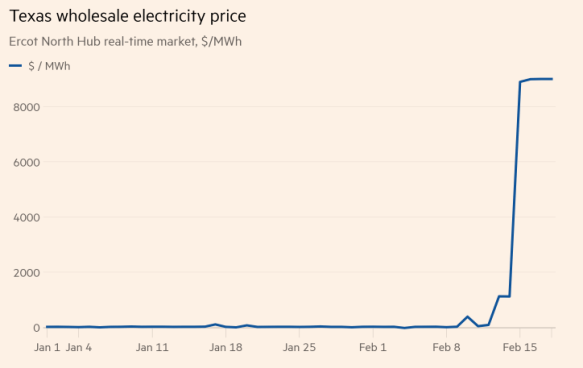
When a deep freeze shut down half the power generation capacity in Texas this week, the wholesale price of electricity exploded 10,000 per cent, with the financial consequences now being felt all the way from individual households to huge European energy companies. Astronomical bills face customers who opted for floating-rate contracts tied to wholesale prices in the state’s freewheeling electric market.

The wholesale power price was at the maximum allowable $9,000 a megawatt hour for five days from last Sunday. For a household, that translates to a $9 a kilowatt-hour electricity rate, compared with a typical cost of 12 cents.

EuqxyxkXYAA6ix6

In Burleson, a suburb of Fort Worth, Valerie Williams has been charged more than $6,000 by her electricity retailer Griddy to power her 1,400 sq ft home over the past few days. As the storm approached, Griddy told its customers to switch to more typical fixed-rate plans from other providers, but not everyone did, since there was little indication of just how extreme prices would become.

Griddy was charging her credit card multiple times a day, Williams said. She struggled to find a new provider during the crisis before finally identifying one that would switch her service on Friday. “I’m guessing it will be close to $7,000 by the time we get moved,” she said of her bill. . . .

On Friday, the city council in Denton, Texas, met to approve emergency borrowing to cover $300m the city-owned utility would pay Ercot this week — more than quadruple its purchases in full-year 2020. — “Freeze Sends Prices Soaring: Grid Operator Ercot Requires Billions in Payments”, Financial Times

The idea behind Texas energy policy was that a deregulated market didn’t require any oversight to protect the system from crisis, because profit-maximizing utilities would build in robust excess capacity to take advantage of possible price spikes. But they didn’t, even though the price spike has been incredible. — Paul Krugman

Yes, there are numerous places where Smith deplores the impact of government, and specifically the effects of intrusive regulation on trade . . . . But overall the view of Smith as anti-government seriously mistakes him. . . .He was quite clear that markets — and indeed society as a whole — are generally sustained by trust and confidence, and that for these and other things they rely on external institutions, notably of law and government, for their viability. By contrast, if merchants are left entirely to their own devices, the result is corrosive. He robustly asserts that “People of the same trade seldom meet together, even for merriment and diversion, but the conversation ends in a conspiracy against the public, or in some contrivance to raise prices”. No one who has read Smith closely can rationally believe he is an out-and-out free-marketeer. — Jesse Norman, Adam Smith: Father of Economics

The divide in our politics isn’t between proponents of big vs. small government. It’s between those trying to use government to help people and those who just want to troll the other side. When we elect responsible people, we end pandemics. When we don’t, people freeze to death. — Rep. Tom Malinowski (D-NJ)

American Politics Today: A Case Study

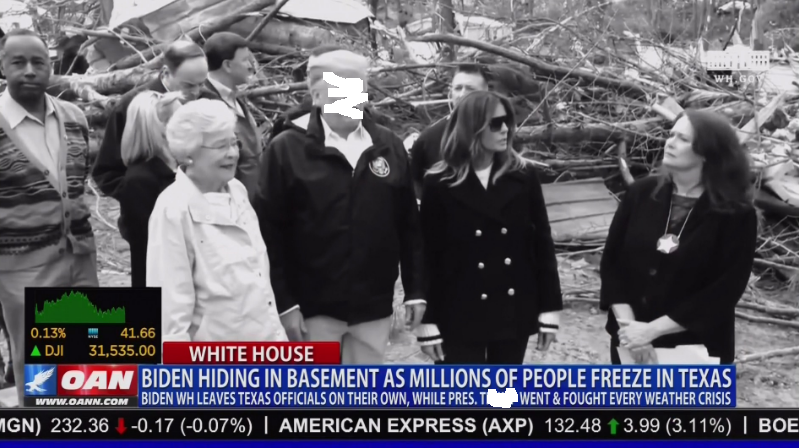
One America News Network (OAN, not OANN) is where you go for “news” when you think Fox has become way too liberal. Somebody posted this screenshot today:

Untitled

Yes, we all remember how the former president “went and fought every weather crisis”, like that time after Hurricane Maria when he personally launched paper towels — or was it toilet paper? — to a roomful of Puerto Ricans and then decided to delay millions of dollars in financial aid.

So why is that cowardly weakling Joe Biden “hiding in his basement”? Biden may have immediately declared a state of emergency in Texas and authorized the federal government to send generators and other supplies, and and he may have spoken to Gov. Abbott yesterday:

President Joseph R. Biden, Jr. spoke this evening with Texas Governor Greg Abbott about the severe winter weather situation facing central and southern parts of the United States, including Texas. [He] conveyed his support to the people of Texas [and] reiterated that the federal government will continue to work hand-in-hand with state and local authorities in Texas to bring relief and address the critical needs of the families affected. He also shared his intentions to instruct additional federal agencies to look into any immediate steps that could be taken to support Texans at this time. The President also expressed that his administration was at the ready should the State of Texas or any other impacted region need additional federal disaster support or assistance as severe storms move across the US.

But what has Biden done for Texas lately? Damn liberals.

Meanwhile, Paul Krugman of The New York Times tells what occurred after the disaster struck:

For a while, the politics surrounding the power outages that have spread across Texas looked fairly normal. True, the state’s leaders pursued reckless policies that set the stage for catastrophe, then tried to evade responsibility. But while their behavior was reprehensible, it was reprehensible in ways we’ve seen many times over the years.

However, that changed around a day after the severity of the disaster became apparent. Republican politicians and right-wing media, not content with run-of-the-mill blame-shifting, coalesced around a malicious falsehood instead — the claim that wind and solar power caused the collapse of the Texas power grid, and that radical environmentalists are somehow responsible for the fact that millions of people were freezing in the dark, even though conservative Republicans have run the state for a generation.

This wasn’t normal political malfeasance. It’s the energy-policy equivalent of claiming that the Jan. 6 insurrection was a false-flag Antifa operation — raw denial of reality, not just to escape accountability, but to demonize one’s opponents. . . . 

Like many states, Texas has a partly deregulated electricity market, but deregulation has gone further there than elsewhere. In particular, unlike other states, Texas chose not to provide power companies with incentives to install reserve capacity to deal with possible emergencies. This made power cheaper in normal times, but left the system vulnerable when things went wrong.

Texas authorities also ignored warnings about the risks associated with extreme cold. After a 2011 cold snap left millions of Texans in the dark, the Federal Energy Regulatory Commission urged the state to winterize its power plants with insulation, heat pipes and other measures. But Texas, which has deliberately cut its power grid off from the rest of the country precisely to exempt itself from federal regulation, only partially implemented the recommendations.

And the deep freeze came.

While Texas’s Republican governor was blaming wind power, other state officials admitted that power plants and pipelines that deliver natural gas were the main source of the problem. (Besides which, wind turbines operate in places like Norway and Greenland all winter without breaking down.)

The Washington Post describes what actually happened this week:

Wind accounts for just 10 percent of the power in Texas generated during the winter. And the loss of power to the grid caused by shutdowns of thermal power plants, primarily those relying on natural gas, dwarfed the dent caused by frozen wind turbines, by a factor of five or six.

As the cold hit, demand for electricity soared past the mark that ERCOT [the Electric Reliability Council of Texas] had figured would be the maximum needed. But at a moment when the world is awash in surplus natural gas, much of it from Texas wells, the state’s power-generating operators were unable to turn that gas into electricity to meet that demand.

In the single-digit temperatures, pipelines froze up because there was some moisture in the gas. Pumps slowed. Diesel engines to power the pumps refused to start. One power plant after another went offline. Even a reactor at one of the state’s two nuclear plants went dark, hobbled by frozen equipment.

Krugman (who knows the answer) asks, therefore, “Why, then, the all-out effort to falsely place the blame on wind power?”

The incentives are obvious. Attacking wind power is a way for both elected officials and free-market ideologues to dodge responsibility for botched deregulation; it’s a way to please fossil fuel interests, which give the vast bulk of their political contributions to Republicans; and since progressives tend to favor renewable energy, it’s a way to own the libs. And it all dovetails with climate change denial.

But why do they think they can get away with such an obvious lie? The answer, surely, is that those peddling the lie know that they’re operating in a post-truth political landscape. When two-thirds of Republicans believe that Antifa was involved in the assault on the Capitol, selling the base a bogus narrative about the Texas electricity disaster is practically child’s play.

Greg Sargent of the Post concludes:

No doubt many Republicans expressing outrage at the failures producing this disaster — and calling for accountability and reform — are sincere in their intentions, though we’ll see how long those demands persist.

But it’s painfully obvious that in an important larger sense, many aspects of their reaction to the Texas calamity do indeed demonstrate the future they want.

It’s a future in which the default response to large public problems will be to increasingly retreat from real policy debates into an alternate information universe, while doubling down on scorched-earth distraction politics and counter-majoritarian tactics to insulate themselves from accountability. . . .

The thing is that Abbott knows renewable energy isn’t to blame. Elsewhere, he has admitted that natural gas and coal failures played a key role. Yet the lure of retreating into the Fox News universe — and spewing nonsense he knows will resonate there — is irresistible.

When a politician’s fundamental purposes in public life are to pursue power and maintain the economic and cultural status quo, it’s easy to lie with a clear conscience. As Gen. Sherman once said:

The lust for Power in political minds is the strongest passion of Life, and impels Ambitious Men to deeds of infamy.

In Race Relations, Altruism Isn’t Enough

Michelle Goldberg of The New York Times says it’s more productive to talk about economic self-interest:

When Heather McGhee was a 25-year-old staffer at Demos, the progressive think tank she would eventually lead, she went to Congress to present findings on shocking increases in individual and family debt.

“Few politicians in Washington knew what it was like to have bill collectors incessantly ringing their phones about balances that kept growing every month,” McGhee writes in her new book, The Sum of Us: What Racism Costs Everyone and How We Can Prosper Together.

Demos’s explanatory attempts failed. . . . For McGhee, the disaster was an education in the limits of research, which is often no match for the brute power of big money. But as she was walking down the hallway of the Russell Senate Office Building, she learned something else.

. . . She heard “the bombastic voice of a man going on about the deadbeats who had babies with multiple women and then declared bankruptcy to dodge the child support.” She doesn’t know whether the man was a Democrat or a Republican, but when she heard him she realized she and her allies might have missed something. They’d thought of debt and bankruptcy primarily as a class issue. Suddenly she understood that for some of her opponents, it was more about race. . . .

McGhee’s book is about the many ways racism has defeated efforts to create a more economically just America. Once the civil rights movement expanded America’s conception of “the public,” white America’s support for public goods collapsed. People of color have suffered the most from the resulting austerity, but it’s made life a lot worse for most white people, too. McGhee’s central metaphor is that of towns and cities that closed their public pools rather than share them with Black people, leaving everyone who couldn’t afford a private pool materially worse off. . . .

McGhee argues that it’s futile to try to address decades of disinvestment in schools, infrastructure, health care and more without talking about racial resentment.

. . . McGhee and her colleagues, she writes, discovered that if you “try to convince anyone but the most committed progressives . . . about big public solutions without addressing race, most will agree 
 right up until they hear the countermessage that does talk, even implicitly, about race.”

. . . Her work illuminates what’s always seemed to me to be a central contradiction in certain kinds of anti-racist consciousness-raising, which is that many people want more privilege rather than less. You have to have an oddly high opinion of white people to assume that most will react to learning about the advantages of whiteness by wanting to give it up.

“Communicators have to be aware of the mental frameworks of their audience,” McGhee told me. “And for white Americans, the zero-sum is a profound, both deeply embedded and constantly reinforced one.”

This doesn’t mean that the concept of white privilege isn’t useful; obviously it describes something real. . . . “However, I think at this point in our discourse — also when so many white people feel deeply unprivileged — it’s more important to talk about the world we want for everyone.”

So McGhee is trying to shift the focus from how racism benefits white people to how it costs them. Why is student debt so crushing in a country that once had excellent universities that were cheap or even free? Why is American health care such a disaster? Why is our democracy being strangled by minority rule? As the first line of McGhee’s book asks, “Why can’t we have nice things?” Racism is a huge part of the answer.

McGhee describes a “solidarity dividend” gained when people are able to transcend racism. Look at what just happened in Georgia, where the billionaire Kelly Loeffler, in an attempt to keep her Senate seat, waged a nakedly racist campaign against Raphael Warnock, who ran on sending voters $2,000 stimulus checks. He still lost most white people, but won enough to prevail. He did it by appealing to idealism, but also to self-interest.

In the fight for true multiracial democracy, counting on altruism will only get you so far.

The Late Molly Ivins on Limbaugh

Talk radio blowhard Rush Limbaugh (1951-2021) is no longer taking calls from his devoted listeners. Texas writer Molly Ivins summed up Limbaugh for Mother Jones in 1995:

One of the things that concerns a lot of Americans lately is the increase in plain old nastiness in our political discussion. It comes from a number of sources, but Rush Limbaugh is a major carrier.

I should explain that I am not without bias in this matter. I have been attacked by Rush Limbaugh on the air, an experience somewhat akin to being gummed by a newt. It doesn’t actually hurt, but it leaves you with slimy stuff on your ankle.

I have a correspondent named Irwin Wingo in Weatherford, Texas. Irwin and some of the leading men of the town are in the habit of meeting about 10 every morning at the Chat’n’Chew Cafe to drink coffee and discuss the state of the world. One of their number is a dittohead, a Limbaugh listener. He came in one day, plopped himself down, and said, “I think Rush is right: Racism in this country is dead. I don’t know what the n____s will find to gripe about now.”

I wouldn’t say that dittoheads, as a group, lack the ability to reason. It’s just that whenever I run across one, he seems to be at a low ebb in reasoning skills. Poor ol’ Bill Sarpalius, one of our dimmer Panhandle congressmen, was once trying to explain to a town hall meeting of his constituents that Limbaugh was wrong when he convinced his listeners that Bill Clinton’s tax package contained a tax increase on the middle class. (It increased taxes only on the wealthiest 2 percent of Americans.) A dittohead in the crowd rose to protest: “We don’t send you to Washington to make responsible decisions. We send you there to represent us.”

[Note: If this sounds quite familiar, a Republican official from Pennsylvania was discussing Sen. Pat Toomey, one of the Republicans who voted to convict last week, and said: “We did not send him there to vote his conscience. We did not send him there to ‘do the right thing’ or whatever”. Now back to Molly Ivins.]

The kind of humor Limbaugh uses troubles me deeply, because I have spent much of my professional life making fun of politicians. I believe it is a great American tradition and should be encouraged. . . . So what right do I have to object because Limbaugh makes fun of different pols than I do?

I object because he consistently targets dead people, little girls, and the homeless—none of whom are in a particularly good position to answer back. Satire is a weapon, and it can be quite cruel. It has historically been the weapon of powerless people aimed at the powerful. When you use satire against powerless people, as Limbaugh does, it is not only cruel, it’s profoundly vulgar. It is like kicking a cripple.

On his TV show, early in the Clinton administration, Limbaugh put up a picture of Socks, the White House cat, and asked, “Did you know there’s a White House dog?” Then he put up a picture of Chelsea Clinton, who was 13 years old at the time and as far as I know had never done any harm to anyone.

When viewers objected, he claimed, in typical Limbaugh fashion, that the gag was an accident and that without his permission some technician had put up the picture of Chelsea—which I found as disgusting as his original attempt at humor. . . .

The reason I take Rush Limbaugh seriously is not because he’s offensive or right-wing, but because he is one of the few people addressing a large group of disaffected people in this country. And despite his frequent denials, Limbaugh does indeed have a somewhat cultlike effect on his dittoheads. They can listen to him for three and a half hours a day, five days a week, on radio and television. I can assure you that [cult leader] David Koresh did not harangue the Branch Davidians so long nor so often. But that is precisely what most cult leaders do—talk to their followers hour after hour after hour.

A large segment of Limbaugh’s audience consists of white males, 18 to 34 years old, without college education. Basically, a guy I know and grew up with named Bubba.

Bubba listens to Limbaugh because Limbaugh gives him someone to blame for the fact that Bubba is getting screwed. He’s working harder, getting paid less in constant dollars and falling further and further behind. Not only is Bubba never gonna be able to buy a house, he can barely afford a trailer. Hell, he can barely afford the payments on the pickup.

And because Bubba understands he’s being shafted, even if he doesn’t know why or how or by whom, he listens to Limbaugh. Limbaugh offers him scapegoats. It’s the “feminazis.” It’s the minorities. It’s the limousine liberals. It’s all these people with all these wacky social programs to help some silly, self-proclaimed bunch of victims. Bubba feels like a victim himself—and he is—but he never got any sympathy from liberals.

Psychologists often tell us there is a great deal of displaced anger in our emotional lives—your dad wallops you, but he’s too big to hit back, so you go clobber your little brother. Displaced anger is also common in our political life. We see it in this generation of young white men without much education and very little future. . . . Unfortunately, it is Limbaugh and the Republicans who are addressing the resentments of these folks, and aiming their anger in the wrong direction.

In my state, I have not seen so much hatred in politics since the heyday of the John Birch Society in the early 1960s. Used to be you couldn’t talk politics with a conservative without his getting all red in the face, arteries standing out in his neck, wattles aquiver with indignation—just like a pissed-off turkey gobbler. And now we’re seeing the same kind of anger again.

Fairness & Accuracy in Reporting [FAIR] . . . has a sweet, gentle faith that truth will triumph in the end, and thinks it is sufficient to point out that Limbaugh is wrong. I say it’s important to point out that he’s not just wrong but that he’s ridiculous, one of the silliest people in America. . . .

It’s important to show people that there is much more wrong with Limbaugh’s thinking than just his facts. Limbaugh specializes in ad hominem arguments, which are themselves ridiculously easy to expose. Ted Kennedy says, “America needs health care reform.” Limbaugh replies, “Ted Kennedy is fat.”

Rush Limbaugh’s pathetic abuse of logic, his absurd pomposity, his relentless self-promotion, his ridiculous ego—now those, friends, are appropriate targets for satire.