The Senate Moves Slowly. You Can See What They’re Doing.

Now that Democrats hold the White House and the House of Representatives, the locus of legislative action is the Senate. Democrats were able to pass the massive American Rescue Plan because a Senate rule allowed them to do so without Republican support. But so much more could be done without the filibuster rule that usually requires 60 out of 100 senators to vote Yes.

So I’ve been paying some attention to the Senate’s proceedings. The Senate has a leisurely schedule with sessions that start late in the day, long weekends and frequent vacations. I assume senators are doing something away from the Senate chamber, because it’s frequently empty. In fact, the Senate chamber is usually lightly populated even when business is being done (that’s apparently why they don’t allow the whole chamber to be shown on TV).

Like the House, the Senate has a website. You can click on Floor Proceedings to see what they did on previous days and then click on Live Proceedings to see if they’re doing anything at the moment.

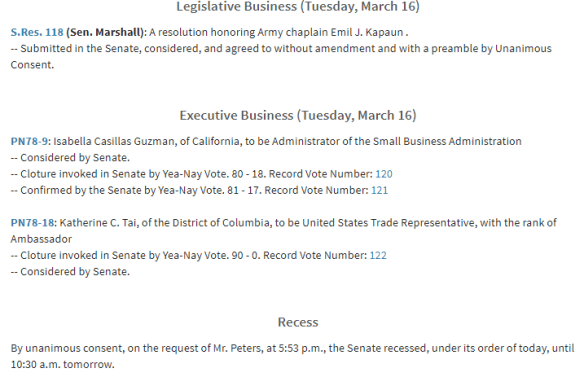
This is what the Senate accomplished on Tuesday: they honored an Army chaplain and advanced two of the president’s nominees.

Untitled

On Wednesday, they took action on two nominations again (one was from the previous day), honored the 100th anniversary of the birth of a baseball player, and approved a bill to allow the Department of Veterans Affairs to give Covid vaccines to some people not usually eligible for treatment.

On the video feed, you’ll sometimes see the Senate majority leader standing at a podium, reading from a stack of paper, uttering the same words over and over again, in order to get a few things done. The majority leader makes a motion and then the Senate’s president pro tem, who on most days is a random senator from the majority party, has a clerk read something about the motion. The president pro tem then asks for a roll call vote. The majority leader, apparently the only other senator in the room, says “aye”, the president pro tem says it appears the ayes have it, and announces that the motion is agreed to. Then they repeat the same song and dance on another motion. The Senate’s rules aren’t designed for efficiency. 

Of course, sometimes a motion is something important, so the whole Senate has to vote.  The senators come back to the chamber to tell the clerk how they’re voting. This takes quite a while, and unlike the House, the Senate doesn’t show a running total of the Yes and No votes.

In addition, senators sometimes make speeches, either regarding the motion under consideration or something else they want to talk about. You’re not allowed to see if there are any other senators present. Some of these speeches are very good. I happened to catch two excellent ones this week.

Senator Menendez, Democrat of New Jersey, made a speech condemning the stupid racist remarks of a Republican senator from Wisconsin, and Senator Warnock, Democrat of Georgia, called on the Senate to pass two bills that would reform our elections and protect voting rights (the For the People Act and the John Lewis Voting Rights Advancement Act). Both of these speeches were met with applause, but it was hard to see how many people were clapping or who they were.

I turned on the video when Menendez and Warnock were already talking, so would have missed their opening remarks, except that Vimeo has the official Senate video with the added benefit that you can scroll back to what happened earlier. Once the Senate is done for the day, both Vimeo and the Senate site make the whole day’s proceedings available. 

The Menendez and Warnock speeches are both on YouTube. Senator Menendez started by saying he took no pleasure in coming to the Senate floor to make these particular remarks, which suggested he was going to let loose on his Senate colleague. That’s what he did. Senator Warnock’s speech was his first as a senator. He pointed out that the entire Senate should support improving our democracy and helping people vote, the same way Republicans often did in the past. It’s not clear if there were any Republicans in the room when he spoke.

The Government’s Statement on the Border Issue

This morning, Homeland Security Secretary Alejandro Mayorkas released this statement about the situation at the southwest border. I tend to think it’s an improvement over the bullshit statements the government issued during the past four years:

There is understandably a great deal of attention currently focused on the southwest border.  I want to share the facts, the work that we in the Department of Homeland Security (DHS) and across the government are doing, and our plan of action. . . .

Our goal is a safe, legal, and orderly immigration system that is based on our bedrock priorities: to keep our borders secure, address the plight of children as the law requires, and enable families to be together. As noted by the President in his Executive Order, “securing our borders does not require us to ignore the humanity of those who seek to cross them.” We are both a nation of laws and a nation of immigrants.  That is one of our proudest traditions.

The Facts

We are on pace to encounter more individuals on the southwest border than we have in the last 20 years.  We are expelling most single adults and families.  We are not expelling unaccompanied children.  We are securing our border, executing the Centers for Disease Control and Prevention’s (CDC) public health authority to safeguard the American public and the migrants themselves, and protecting the children.  We have more work to do.

This is not new. We have experienced migration surges before – in 2019, 2014, and before then as well. Since April 2020, the number of encounters at the southwest border has been steadily increasing. Border Patrol Agents are working around the clock to process the flow at the border . . . To understand the situation, it is important to identify who is arriving at our southwest border and how we are following the law to manage different types of border encounters.

Single Adults

The majority of those apprehended at the southwest border are single adults who are currently being expelled under the CDC’s authority to manage the public health crisis of the COVID-19 pandemic.  Pursuant to that authority under Title 42 of the United States Code, single adults from Mexico and the Northern Triangle countries of El Salvador, Guatemala, and Honduras are swiftly expelled to Mexico.  Single adults from other countries are expelled by plane to their countries of origin if Mexico does not accept them.  There are limited exceptions to our use of the CDC’s expulsion authority.  For example, we do not expel individuals with certain acute vulnerabilities. 

The expulsion of single adults does not pose an operational challenge for the Border Patrol because of the speed and minimal processing burden of their expulsion.

Families

Families apprehended at the southwest border are also currently being expelled under the CDC’s Title 42 authority.  Families from Mexico and the Northern Triangle countries are expelled to Mexico unless Mexico does not have the capacity to receive the families.  Families from countries other than Mexico or the Northern Triangle are expelled by plane to their countries of origin.  Exceptions can be made when a family member has an acute vulnerability.

Mexico’s limited capacity has strained our resources, including in the Rio Grande Valley area of Texas.  When Mexico’s capacity is reached, we process the families and place them in immigration proceedings here in the United States.  We have partnered with community-based organizations to test the family members and quarantine them as needed under COVID-19 protocols.  In some locations, the processing of individuals who are part of a family unit has strained our border resources. . . .

Unaccompanied Children

We are encountering many unaccompanied children at our southwest border every day.  A child who is under the age of 18 and not accompanied by their parent or legal guardian is considered under the law to be an unaccompanied child.  We are encountering six- and seven-year-old children, for example, arriving at our border without an adult.  They are vulnerable children and we have ended the prior administration’s practice of expelling them.

An unaccompanied child is brought to a Border Patrol facility and processed for transfer to the Department of Health and Human Services (HHS).  Customs and Border Protection is a pass-through and is required to transfer the child to HHS within 72 hours of apprehension.  HHS holds the child for testing and quarantine, and shelters the child until the child is placed with a sponsor here in the United States. In more than 80 percent of cases, the child has a family member in the United States. In more than 40 percent of cases, that family member is a parent or legal guardian. . . .

The children then go through immigration proceedings where they are able to present a claim for relief under the law.

The Border Patrol facilities have become crowded with children and the 72-hour timeframe for the transfer of children from the Border Patrol to HHS is not always met.  HHS has not had the capacity to intake the number of unaccompanied children we have been encountering. . . .

Why the Challenge is Especially Difficult Now

Poverty, high levels of violence, and corruption in Mexico and the Northern Triangle countries have propelled migration to our southwest border for years.  The adverse conditions have continued to deteriorate.  Two damaging hurricanes that hit Honduras and swept through the region made the living conditions there even worse, causing more children and families to flee. 

The COVID-19 pandemic has made the situation more complicated.  There are restrictions and protocols that need to be followed.  The physical distancing protocol, for example, imposes space and other limitations on our facilities and operations.

The prior administration completely dismantled the asylum system.  The system was gutted, facilities were closed, and they cruelly expelled young children into the hands of traffickers.  We have had to rebuild the entire system, including the policies and procedures required to administer the asylum laws that Congress passed long ago. 

The prior administration tore down the lawful pathways that had been developed for children to come to the United States in a safe, efficient, and orderly way.  It tore down, for example, the Central American Minors program that avoided the need for children to take the dangerous journey to our southwest border.

The previous administration also cut foreign aid funding to the Northern Triangle.  No longer did we [assist] efforts in El Salvador, Guatemala, and Honduras to tackle the root causes of people fleeing their homes.

And, there were no plans to protect our front-line personnel against the COVID-19 pandemic.  There was no appropriate planning for the pandemic at all.

As difficult as the border situation is now, we are addressing it.  We have acted and we have made progress.  We have no illusions about how hard it is, and we know it will take time. . . .

Actions We Have Taken

In less than two months, Customs and Border Protection stood-up an additional facility in Donna, Texas to process unaccompanied children and families.  We deployed additional personnel to provide oversight, care, and transportation assistance for unaccompanied minors pending transfer to HHS custody.

We are standing up additional facilities in Texas and Arizona to shelter unaccompanied children and families.  We are working with Mexico to increase its capacity to receive expelled families.  We partnered with community-based organizations to test and quarantine families that Mexico has not had the capacity to receive.  We have developed a framework for partnering with local mayors and public health officials to pay for 100% of the expense for testing, isolation, and quarantine for migrants.  ICE has also developed additional facilities to provide testing, local transportation, immigration document assistance, orientation, travel coordination in the interior, and mechanisms to support oversight of the migrant families who are not expelled.

Working with Mexico and international organizations, we built a system in which migrants who were forced to remain in Mexico and denied a chance to seek protection under the previous administration can now use a virtual platform – using their phones – to register.  They do not need to take the dangerous journey to the border.  The individuals are tested, processed, and transported to a port of entry safely and out of the hands of traffickers.  We succeeded in processing the individuals who were in the Matamoros camp in Mexico.  This is the roadmap going forward for a system that is safe, orderly, and fair.

To protect our own workforce, we launched Operation Vaccinate Our Workforce (VOW) in late January.   At the beginning of this administration, less than 2 percent of our frontline personnel were vaccinated.  Now more than 25 percent of our frontline personnel have been vaccinated.

We directed the Federal Emergency Management Agency (FEMA) to assist HHS in developing the capacity to meet the surge of unaccompanied children.  FEMA already established one new facility for HHS to shelter 700 children.  They have identified and are currently adding additional facilities.  We are working with HHS to more efficiently identify and screen sponsors for children.  In two days, we recruited more than 560 DHS volunteers to support HHS in our collective efforts to address the needs of the unaccompanied children.

We are restarting and expanding the Central American Minors program.  It creates a lawful pathway for children to come to the United States without having to take the dangerous journey. Under this expansion, children will be processed in their home countries and brought to the United States in a safe and orderly way.

In addition, DHS and HHS terminated a 2018 agreement that had a chilling effect on potential sponsors – typically a parent or close relative – from coming forward to care for an unaccompanied child placed in an HHS shelter. In its place, DHS and HHS signed a new Memorandum of Agreement that promotes the safe and timely transfer of children. . . .

The Path Forward

We are creating joint processing centers so that children can be placed in HHS care immediately after Border Patrol encounters them.  We are also identifying and equipping additional facilities for HHS to shelter unaccompanied children until they are placed with family or sponsors.  These are short-term solutions to address the surge of unaccompanied children.

Longer term, we are working with Mexico and international organizations to expand our new virtual platform so that unaccompanied children can access it without having to take the dangerous journey to our border. . . .

We are developing additional legal and safe pathways for children and others to reach the United States.  While we are building a formal refugee program throughout the region, we are working with Mexico, the Northern Triangle countries, and international organizations to establish processing centers in those countries so that individuals can be screened through them and brought to the United States if they qualify for relief under our humanitarian laws and other authorities. 

For years, the asylum system has been badly in need of reengineering.  In addition to improving the process by which unaccompanied children are placed with family or sponsors, we will be issuing a new regulation shortly and taking other measures to implement the long-needed systemic reforms.  We will shorten from years to months the time it takes to adjudicate an asylum claim while ensuring procedural safeguards and enhancing access to counsel.

President Biden laid out a vision of a “multi-pronged approach toward managing migration throughout North and Central America that reflects the Nation’s highest values.” To that end, we are working with the Departments of Health and Human Services, Justice, and State in an all-of-government effort to not only address the current situation at our southwest border, but to institute longer-term solutions to irregular migration from countries in our hemisphere that are suffering worsening conditions. . . .

Conclusion

The situation we are currently facing at the southwest border is a difficult one.  We are tackling it.  We are keeping our borders secure, enforcing our laws, and staying true to our values and principles. . . .

I came to this country as an infant, brought by parents who understood the hope and promise of America.  Today, young children are arriving at our border with that same hope.  We can do this.
Border Crisis or Big Problem Being Addressed?

People in the media love a new “crisis”, even if the old crisis was worse. From Greg Sargent of The Washington Post:

Republicans are convinced that attacking President Biden’s border policies will win them the midterms. House Minority Leader Kevin McCarthy has gleefully labeled the situation there “Biden’s border crisis.”

In this, Republicans are benefiting from a media debate that has gone off the rails.
There’s a huge hole in this attack, but it’s rarely described clearly in news reports and commentary. You can read endless headlines warning of a “crisis.” But even if that’s so, a crisis relative to what, exactly?

What’s missing is a serious comparison with the pre-Biden status quo. It’s as if the current situation exists in a vacuum: Before there was no crisis, and now there’s a crisis.

That’s absurd. The situation under the former president was substantially worse from a humanitarian and a pragmatic governing perspective: worse for the migrants, worse for the rule of law and worse for our country.

It’s true that child and teenage migrants are overwhelming our facilities.

Because they can’t get released alone, they must be held at Border Patrol facilities for 72 hours before getting transferred to the Office of Refugee Resettlement, which places them with relatives or guardians. The ORR facilities are jammed, backlogging border facilities.

This is a terrible situation. But it’s happening in large part because Biden is undoing a policy that should be undone.

Due to covid-19, the previous administration turned away most asylum seekers — without hearings — under a legal provision allowing a temporary block on noncitizens from entering, in order to protect public health.

Biden is no longer applying this provision to unaccompanied children and teenagers (while keeping it for adults), helping fuel child backlogs. But that’s a move in the right direction, both from a humanitarian and rule-of-law perspective.

Coronavirus will be tamed before long, and we have a legal obligation to allow migrants to exercise their right to seek asylum. [The public health] provision is not for controlling migrant flows outside a genuine public health rationale. If anything, expelling adults abuses it.

So continuing to use this tool is not a tenable long-term solution to the humanitarian problem, and it’s not in keeping with the rule of law. That requires letting in the kids, and we will have to allow more adults to apply for asylum. The question is how we manage it.

Republicans claim we’re seeing a breakdown in enforcement, and that this, combined with Biden’s promise to reverse the former guy’s policies, is causing the migrant spikes.

Yes, we’re seeing a spike: There were over 100,000 detentions at the border in February.

But right now, the border is in large part closed: Many adult asylum seekers are getting turned away with zero due process. The decision to lift the public health restriction for children and teens [does not mean a law isn’t being enforced. It means] the administration is no longer incorrectly applying the law to children and teens . . .

On the second claim, these spikes in migrations occur for complex reasons rooted in Central American conditions. Indeed, . . . there was a huge spike in 2019, amid the former guy’s draconian policies.

Expectations of a policy reversal might play some role in spurring people to attempt to apply for asylum. But all this really means is that [the former guy] was denying them that legal right, and Biden [won’t].

[The former guy’s] “solutions” were designed to prevent people from applying for asylum at all. His “Remain in Mexico” policy — which forced thousands back into Mexico to await hearings — was the centerpiece of this.

But that was a humanitarian catastrophe. Many were exposed to violence and even kidnapping, or stranded in horrific refugee camp conditions for months.

“[That] created a much worse humanitarian and legal crisis than what we’re seeing now,” Dan Restrepo, a national security official under former president Barack Obama, told me. “It failed to meet our legal obligations and relegated tens of thousands to dangerous and inhumane conditions in Mexico.”

That was only a “solution” if you believe cruelty and fear should be used to deter people from applying for asylum. That’s the real Republican position: that those are legitimate tools to ensure that as few people apply and qualify for asylum as possible.

But continuing that approach would be worse than the present in humanitarian and rule-of-law terms: Conditions spurring migrations will continue, and it would renege on our obligations under U.S. and international law.

The question is whether Biden can make the asylum system function better.

Homeland Security Secretary Alejandro Mayorkas just released a new statement outlining what this should look like: investing in Central American countries and creating new pathways for people to apply from afar, so they don’t come to the border; speeding up processing, so asylum claimants aren’t left in the interior and kids get transferred to guardians faster; and increasing capacity and ensuring more humane treatment at [Refugee Resettlement] facilities in the interim. . . .

The real way to hold Biden accountable is to judge whether he meets those promises.
Yes, these problems are hard to solve. But that’s the point: What’s hard is actually trying to solve them. Calling this a “crisis” outside that context is absurd: It was a crisis before, too. What’s different is that Biden is attempting to tackle this crisis in a far better way than [his predecessor] did.

Martin, Malcolm and America

From Brandon Terry’s long review of The Sword and the Shield: The Revolutionary Lives of Malcolm X and Martin Luther King Jr. by Peniel Joseph:

. . . The extent to which King’s vision of justice exceeded the horizons of American nationalism is still perhaps the least appreciated element of his public philosophy.

For those used to seeing King situated in a progressive story of American liberalism, it can be surprising to learn that as early as the 1950s, he considered Black freedom struggles to be part of the wave of anti-imperialist revolt in Africa and Asia. “The determination of Negro Americans to win freedom from every form of oppression,” he proclaimed, “springs from the same profound longing for freedom that motivates oppressed peoples all over the world.” He strongly identified with anticolonial liberation movements, meeting veterans of Gandhi’s satyagraha movement in India in 1959 and traveling to Ghana for Kwame Nkrumah’s inauguration in 1960. Like many leftist figures navigating cold war politics, however, King’s criticisms of American foreign policy could often seem restrained, couched in the obligatory tropes of anticommunism or paeans to pacifism.

It was Vietnam that served as the inflection point for King’s radicalization on matters of global justice, but Joseph helps underscore Malcolm’s underappreciated influence on this shift. Malcolm was a prescient critic of the war from the outset, eviscerating its premises with a moral clarity that eluded most commentators, who were gaslighted by lies that US troops were acting as noncombatant “advisers” in Southeast Asia. “You’re not supposed to be so blind with patriotism that you can’t face reality,” Malcolm warned, charging that the war was a “criminal” act made palatable by racism and deception.

Malcolm’s antiwar critique and denunciation of the draft as “the most hypocritical governmental half-truth that has ever been invented since the world was the world” found its most important supporters among the student organizers in the Student Nonviolent Coordinating Committee (SNCC), the first civil rights group to dissent from the war and the draft. How, Malcolm asked, could one accept being drafted to fight on behalf of a supposed democracy, only to return home concerned about how you “can get a right to register and vote without being murdered”?

King, whose political ties to Lyndon Johnson and mainstream liberals made him more tentative in speaking out against the war, became openly critical of the administration after young activists pressed him on the hypocrisy of preaching nonviolence at home while remaining quiet about militarism abroad. Against the private advice and public chastisement of some of his closest advisers, he denounced both the war and the systemic injustices revealed or intensified by the effort to fight it. The war, he charged, represented a threat to free speech and legitimate dissent, and it bred cynicism concerning both the use of violence and the rights of nonwhite peoples for self-rule. Further, he charged the war effort with the “cruel manipulation of the poor,” lamenting its unethical waste of vital resources as well as how it sent

the black young men who had been crippled by our society…8,000 miles away to guarantee liberties in Southeast Asia which they had not found in Southwest Georgia and East Harlem.

In our era of perpetual warfare, with its boomerang effects on domestic liberties and civic trust, such insights remain unheeded.

The questions both men were converging on concerned the worth of citizenship in a society riven by economic domination, racial hierarchy, and belligerent militarism: What, if any, allegiance or sacrifice could such a society demand? The ideal of “radical black citizenship,” which Joseph most closely associates with King, contends that full, equal citizenship for African-Americans requires not just the formal recognition of equal rights but also the fair value of those rights. This means not only the ability to act on them as any other citizen might, but also the inability of a privileged class of citizens to unjustly enrich themselves at the expense of the least powerful.

In Why We Can’t Wait (1964), for example, King wrote that “Negroes must not only have the right to go into any establishment open to the public, but they must also be absorbed into our economic system in such a manner that they can afford to exercise that right.” As Joseph reminds us, his conception of civic equality extended to things like “a good job, living wage, decent housing, quality education, health care, and nourishment.” Or as King put it in 1967, true freedom in an affluent society cannot mean the “freedom to hunger, freedom to the winds and rains of heaven, freedom without roofs to cover [our] heads.”

. . . King’s view of the world that he hoped mass protest would bring into being went far beyond Malcolm’s populist appeals to the “downtrodden masses” left behind by civil rights legislation. For King, equal civic standing, at least in an ostensible democracy, also means that each of us participates in decision-making, determining the contours of our common life together through deliberation. Indeed, one of his principal arguments concerning the evil of segregation was its assault on freedom. Segregation, King said, imposes undue “restraint on my deliberation as to what I shall do, where I shall live, how much I shall earn, the kind of tasks I shall pursue.” Segregation destroys the vital human capacity to authentically “deliberate, decide, and respond” by imposing restrictions on when and where we may enter.

If democratic citizenship is to be free and equal, it must uproot habits, power arrangements, and resource distributions that leave us subject to the arbitrary impositions of others in the most vital domains of life. As Joseph notes, such demands extended to capitalism itself and partly explain King’s skepticism toward its basis in “cut-throat competition and selfish ambition.” In 1967, for instance, he wrote that “if democracy is to have breadth of meaning,” we must overcome the “contemporary tendency in our society” to “compress our abundance into the overfed mouths of the middle and upper classes until they gag with superfluity.”

. . . Malcolm’s criticisms of so-called integrationism never adequately grappled with the leftist tenor of King’s views, which could be better described as “reconstructionist” rather than “integrationist.” For King, authentic integration was “meaningless without the mutual sharing of power.” Kingian integration would involve the widespread redistribution of assets and real democratic participation in economic and political decision-making instead of allowing municipal borders, the dictates of private profit, and existing measures of “merit” to unfairly disadvantage the life chances of so many Americans.

Not 1930s Germany, But 1820s Britain

Prof. Corey Robin, author of The Reactionary Mind, doesn’t see our former president as a political strongman, the harbinger of an American brand of fascism. He sees the Republican Party using the Constitution to hold the line against the majority’s desire for progress, and therefore truly conservative. From The New Yorker:

. . . Fascism called the young to the cause of novelty and creation. Today’s right is nothing like that. It is an artifact of the world’s most ancient and extant legal order, holding on to the Constitution, and the institutions it authorizes, for dear life. . . .

. . . Seeking to counter their waning position, the Republican Party and the conservative movement have come to depend upon three pillars of counter-majoritarian rule: the Senate, the Electoral College, and the Supreme Court. These institutions are not authoritarian or fascist—indeed, they are eminently constitutional—but they are antidemocratic. They are also mainstays of the right. In a remarkable statement, now forgotten, issued three days before January 6th, seven conservative members of the House warned their colleagues that [Republican] presidential candidates have

depended on the electoral college for nearly all presidential victories in the last generation. If we perpetuate the notion that Congress may disregard certified electoral votes—based solely on its own assessment that one or more states mishandled the presidential election—we will be delegitimizing the very system that led [our party] to victory in 2016, and that could provide the only path to victory in 2024.

The current moment is less reminiscent of the last days of Weimar than of Britain in the years before the Reform Act of 1832. With a scheme of representation dating back to the twelfth century, Parliament was the playground of grandees from rural and sparsely populated regions of the South. Growing cities in the Midlands and the North had no representation at all.

Standing atop this “aristocracy of mere locality,” in the words of the historian and Whig politician Thomas Macaulay, were the Tories. For six decades, virtually without interruption, they leveraged this Senate-like system of rotten boroughs to keep the Whigs out of power, enabling an increasingly isolated group of aristocrats and gentry to maintain their privileges. While “the natural growth of society went on” among the middle classes and in the cities, Macaulay said, “the artificial polity continued unchanged.”

Other features of this system will sound familiar. Polling places were few and far between; one of the leading items on the reform agenda was to increase their number. Electoral laws were so byzantine, and generated results so murky, that an army of well-paid lawyers was on the payroll for years, sorting out the returns and arguing over their validity. The “artificial polity” kept politics frozen in time, discouraging both parties from taking up vital economic questions of the day, and preventing new social forces and the partisan realignment that was eventually to come . . .