Video from Las Vegas local news: “Radar confirms UFO swarm around Navy warship”. They say the Navy says it’s legitimate.
Category Archives: Politics
It Can Happen Here
Earlier today, I quoted part of an interview with political scientist David Faris regarding Republican efforts to do make America safe for minority rule. The Washington Monthly’s blog also has a brief article by him. It’s called “The Republican Assault on Democracy Is Worse Than You Think” (note: besides changing the name of the orange-skinned creature to “X”, I’m changing all references to the “GOP” to “GQP” to reflect the party’s mass descent into the conspiratorial abyss):
Despite the palpable relief of Joe Biden’s election, American democracy is experiencing an ongoing crisis. With Republicans likely to end the Democratic hold on the House next year with an aggressive gerrymander, GQP-led states enacting voter suppression laws and Republicans laying the groundwork for a more successful version of [President X’s] post-hoc effort to steal the 2020 election, the threat to democracy is clear and present.
That widely felt, crisis-like sense of urgency is why the Democratic House passed the For the People Act, which among many other things would end gerrymandering and make it easier for adults to vote, and then made history by forwarding a D.C. statehood bill to the Senate, which would rectify a longstanding injustice and help keep Mitch McConnell, a Republican from Kentucky, the leader of the minority rather than the majority.
Unfortunately, a handful of Democratic senators led by and possibly limited to Joe Manchin, of West Virginia, and Kyrsten Sinema, of Arizona, may unwittingly usher in a long era of de facto authoritarianism by blocking the reforms needed to preserve democracy. Both insist that they won’t abolish the filibuster, which is the gateway drug to doing anything at all.
Consequently, Democrats must avert both the looming carnage in the midterm elections as well as a post-election putsch in 2024. There’s really only three things they can do, and none of them will be easy, but it’s worth considering because the alternatives are worse.
First, Biden and Harris could win re-election by a margin beyond dispute. The 2020 election was extremely close. A small shift in votes across three battleground states could have thrown the election to [X] despite Biden’s significant margin in the national popular vote. A more substantial Biden win in the critical states might ensure that [GQP] coup plotters won’t be able to pull off an electoral vote heist.
Barring that, it is critical that Democrats cling to one branch of Congress in both 2022 and 2024. The [GQP] gambit to object to electoral votes and throw the election into the House failed in large part because they needed a majority in both chambers to toss out the electoral votes from a particular state. While a majority of Republican senators never signed on to this malevolent project, the guess here is that this can mostly be attributed to the futility of the effort. If Republicans had the votes, many of the senators who refused to object would almost certainly have come around if they believed that the maneuver could have secured another term for [X].
Democrats must also win gubernatorial (and secretary of state) races in Pennsylvania, Michigan, Wisconsin, Georgia, Arizona, and others. Another factor in the coup is that Democrats controlled the election machinery in the Midwest battlegrounds, and Republican officials in Arizona and Georgia, to their credit, refused to play their part in [X’s] plot. We may not be so lucky in 2024.
It is hard to overstate how unlikely it is that even one of these three things might happen if Democrats can’t muster the votes to pass democracy reform.
They don’t call them midterm losses for nothing. The president’s party has taken a beating in nearly every post-WWII midterm election, losing an average of 26 seats in the House and four in the Senate. The out-party’s voters are extra motivated to deliver a rebuke to the president’s party, while the president’s party gets complacent. To make matters worse, in the absence of mandatory non-partisan redistricting, Republicans are going to add a significant number of safe or Republican-leaning seats to the House, making their path to a majority even easier.
In the Senate, Majority Leader Chuck Schumer, of New York, must hold onto precious seats in what will be tough races in Georgia (Raphael Warnock), Arizona (Mark Kelly), Nevada (Catherine Cortez-Masto), and New Hampshire (Maggie Hassan). Democrats have only three realistic pickup opportunities in Wisconsin, Pennsylvania and North Carolina, maybe Florida. That math is not great.
As for those governor races, Democrats again begin the cycle struggling against history’s headwinds. The president’s party has lost governorships in 16 of the last 19 midterms. In just one midterm since WWII (1986) has the party in power increased its gubernatorial numbers. . . .
If Democrats lose both chambers of Congress, cough up multiple governorships, and the 2024 election is another squeaker, we know the playbook. [GQP] governors will certify Republican electors no matter what the voters want, and Republican congressional majorities will try to deliver the presidency to their party’s candidate. State legislatures, which used to pick senators, will supplant secretaries of state where Republicans detect any wobbling. Wherever it goes from there is anyone’s guess, but democracy as we know it will be gone. . . .
That means figuring out how to get Manchin and Sinema to nuke, or at the very least curtail, the filibuster should consume every waking minute of Chuck Schumer’s life. The alternative is to either hope for a series of electoral miracles or watch helplessly as an authoritarian mob ushers in the catastrophe. We may never get another chance to fix this peacefully.
More Good News, Bad News
There’s good news about the economy, which means good news about people’s lives. From Paul Krugman:
At the beginning of this year, the United States was still very much in the depths of the pandemic. Daily deaths were higher than ever, with Covid-19 taking more than 3,500 lives in the country every day. Parts of the economy that depend on close physical contact were largely frozen. . . .
Then came an extraordinarily successful vaccination campaign. Deaths have plunged more than 85 percent and are still dropping. As fear recedes, the economy is surging, in what may end up being the fastest recovery ever. . . .
Why would anyone imagine us able to achieve that kind of sudden acceleration without leaving a few skid marks, and maybe even burning some rubber?
So yes, sawmill operators, who expected a longer slump, got caught short, leading to sky-high lumber prices. Rental car companies, which sold off a large part of their fleets last year, are now scrambling to buy vehicles again, helping to send used-car prices soaring. And so on.
What about those reports of labor shortages? Some of this is what always happens after a period of high unemployment: Businesses grow accustomed to having job applicants lined up at their doors, and get cranky when the buyers’ market ends. . . .
Mainly, however, we’re just seeing the problems you’d expect when the economy tries to roar ahead from a standing start, which means that we’re calling on suppliers to ramp up production incredibly fast and expecting employers to quickly attract a large number of new workers. These problems are real, but they’ll mostly resolve themselves in a few months.
So what do these probably temporary problems say about the longer term, and in particular about President Biden’s economic plans? That’s easy: nothing. Politicians gonna politician, and Biden’s opponents are seizing on every negative bit of news as proof that his entire agenda is doomed. But none of it should be taken seriously. . . . None of this tells you anything at all about how much we should worry about overheating, let alone how much more we should be spending on infrastructure and family support (answer: a lot) or how we should pay for these initiatives (answer: tax corporations and the rich).
. . . There is some bad news out there, but most of it is a temporary byproduct of extraordinary good news: The virus is losing, and the economy is winning.
Or more succinctly, from the White House:
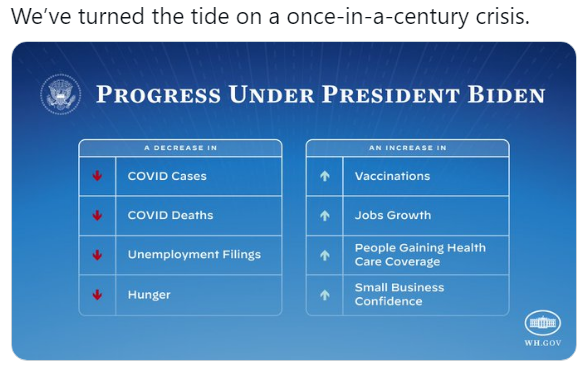
On the other hand — and it’s a giant hand with about twelve dangerous fingers — one side is trying to rig the game even more than it already is. This is part of an interview from Vox:
Sean Illing
You were urging Democrats in 2018 to pass the sorts of reforms that are still on the table today, like packing the courts or granting statehood to DC and Puerto Rico. Are we beyond that now?
David Faris (political scientist and author of It’s Time to Fight Dirty)
What needs to be done has gotten more complex. The structural problems are even worse than I anticipated. I also didn’t fully anticipate the unapologetically authoritarian turn in Republican politics. But the fixes are still there. You have to abolish the filibuster in the Senate, you have to mandate national nonpartisan redistricting, you have to make voting easier, and you have to outlaw some of these Republican voter suppression tactics.
Sean Illing
I’ve had conversations with some Democrats and when these ideas about nuking the filibuster or court-packing or granting statehood to DC and Puerto Rico come up, the argument is often that it’s a nonstarter because [senators] Joe Manchin or Kyrsten Sinema simply won’t do it. What’s wrong with that thinking?
David Faris
Certainly the laws that you can pass are contingent on getting the most moderate member of your caucus on board. . . .
Where Manchin seems to be very far away from what House Democrats want to do is on the democracy reform stuff. It’s maddening because nothing that Manchin wants to do policy-wise can get done without abolishing the filibuster. Democrats are not going to have a majority after next year if they don’t do some of these things now. So it’s a mistake to assume Manchin can’t be moved. That’s the job of leadership. That’s Joe Biden’s job. That’s Chuck Schumer’s job.
Sean Illing
Let’s just say that Manchin and Kyrsten Sinema, for whatever reason, refuse to respond to the realities of the moment — then what?
David Faris
It’s bleak. I don’t know what else to say.
Democrats have to get extremely lucky next year. They either need to luck into the most favorable environment for the president’s party that we haven’t ever had for a midterm election or … I don’t know. There’s not much else they can do. None of these democracy reforms can get through on a reconciliation bill. If Democrats don’t pass nonpartisan redistricting, they’re going to be fighting at a huge disadvantage in the House. That’s the ballgame.
Progressive activists are going to pour a billion dollars into the Florida Senate race and then [Marco] Rubio is going to win by 10 points. So if they don’t act, it’s very simple. The Democrats will have to fight on this extremely unfair playing field against a newly radicalized Republican Party that is going to pull out all the stops in terms of voter suppression to win these elections, on top of the situation where they’re making other changes to state laws that could allow them to mess around with results in other ways, like what we’re seeing in Georgia now.
There’s a very circular structure to this kind of proto-authoritarianism. You have anti-democratic practices at the state level that produce minority Republican governments that pass anti-democratic laws that end up in front of courts that are appointed by a minoritarian president and approved by a minoritarian Senate that will then rule to uphold these anti-democratic practices at the state level.
And so there is no path to beating some of these laws through the courts. The Supreme Court has already said it’s not going to touch gerrymandering. And so there’s nothing left except Congress using its constitutional authority under the elections clause to do some regulation to the elections. I just don’t see another way.
Sean Illing
It feels like we’re sleepwalking into a real crisis here, but it’s hard to convey the urgency because it’s not dramatic and it’s happening in slow motion and so much of life feels so normal. And yet our democratic system is losing any semblance of legitimacy and down that road is a range of possibilities no one wants to seriously consider. …
David Faris
When people think of democracy dying, they think of some very dramatic event like Trump riding down Pennsylvania Avenue in a tank or something. That’s not the reality here.
Take the scenario where Republicans don’t have to steal the 2024 election. They just use their built-in advantages in which Biden wins the popular vote by three points but still loses the Electoral College. Democrats win the House vote but lose the House. Democrats win the Senate vote, but they lose the Senate.
That’s a situation where the citizens of the country fundamentally don’t have control of the agenda and they don’t have the ability to change the leadership. Those are two core features of democracy, and without them, you’re living in competitive authoritarianism. People are going to wake up the next day and go to work, and take care of their kids, and live their lives, and democracy will be gone. . . .
Bad News and Possible Good News
The bad news isn’t actually news, but it’s good news that more people are finally admitting how bad it is. From Charles Pierce of Esquire:
Call me the Wet Blanket of the Gods, but I despair of ever making common cause with people who volunteer to live in Bedlam. From IPSOS:
. . . 56% of Republicans believe the election was rigged or the result of illegal voting, and 53% think [X] is the actual President, not Joe Biden.
There is no longer any reason to try to “understand” these people. Nor should there be any compunction about doing whatever we can to read them out of American politics, because they clearly have opted out on their own. They should be considered anathema, as should the entire Republican Party and the modern conservative movement that animates it.
Anything that can be done without including them should be done for the good—to say nothing of the sanity—of the country. Raw political power should be used to push through whatever of this administration’s policy priorities can be passed without any Republican help whatsoever. Majoritarianism should be invoked without mercy, and by whatever legitimate means necessary, and the window of opportunity to do that is closing fast.
It doesn’t matter if 53 percent of them say they believe the former president* is still the president* because they actually believe it, or they say it because it makes them one of The Elect. The effect on democracy is the same. They are poison in the bloodstream. And they’re proud of it.
Only 30% of Republicans feel confident that absentee or mail-in ballots were accurately counted . . . As a result, 87% of Republicans believe it is important that the government place new limits on voting to protect elections from fraud. Finally, 63% percent of Republicans think [X] should run for President again in 2024 . . .
This is beyond the beyond. There is no compromise with this. There is no common ground. There is no deal to be struck. Millions of our fellow citizens are lost in rebellion against reality, and the only solution for the common good is to isolate them from decision-making and hope enough of them find their way back to make the country governable again. I’m not optimistic.
Unquote.
Today it was announced that the Manhattan district attorney has convened a grand jury to look at possible criminal behavior by the former president, his associates or his company. It’s unlikely the grand jury will indict anybody soon, but it’s a good development. Maybe he’ll have to run for president from jail.
And some observers think it’s becoming more likely the Senate filibuster’s stranglehold on progress will be loosened. From David Atkins of Washington Monthly:
The pressure to end the filibuster is getting strong enough you can feel all way from Arizona to West Virginia. But this time the impetus isn’t coming from outside activists or anti-gerrymandering and vote suppression reformers: it’s coming from inexorable forces within Congress itself.
A series of crucial votes looms in the near future, and it’s not clear that the internal calculus of Republican senators in the [X] era can permit a compromise with Democrats. Even less can Democrats permit an entire year and a half of legislative stalemate that not only threatens to derail democracy but would functionally disable the basic functions of government.
The immediate triggers for all this are 1) the imperiled January 6th Commission; 2) the debt ceiling fight; and 3) rising awareness that if nothing is done to curtail it, Republicans will simply rig elections in their favor and even refuse to certify their defeat even if they do lose their own rigged game. . . .
The hostility of Senate Republicans toward accepting even the basic premises of a bipartisan commission to examine the January 6th insurrection on the Capitol has pulled a wet blanket over the hopes of optimists seeking to avoid partisan entrenchment. It is possible that Republicans are simply using hardball negotiating tactics and will eventually . . . strike an agreement. But it’s unlikely. . . .
Democrats, meanwhile, cannot afford not to investigate it. It was the most damaging assault on the foundations of American democracy since the Civil War, and members of Congress themselves were just minutes from potentially being murdered by the right-wing mob. Pressure will mount considerably to push the Democratic senators still defending the filibuster (most notably Arizona Senator Kyrsten Sinema and West Virginia Senator Joe Manchin) to change their stance if Republicans refuse to come to the table . . .
But an even bigger battle looms ahead of the commission. As Dave Dayen notes at The American Prospect, Republicans in Congress are even likelier than they were in the Obama Administration to hold the government hostage over the debt limit–thereby threatening the full faith and credit of the United States Treasury. Democrats, for their part, are far less inclined to lend credibility to conservative crocodile tears about deficits or hamstring their own ability to help people or craft policy. . . .
Ryan Grim is confident enough in this trajectory to predict that this is how the filibuster goes down. Grim believes that the debt ceiling will be the cue to enter Act II of Adam Jentleson’s speculative timeline for the end of the filibuster in his book Kill Switch: the flash point that will turn Manchin’s and Sinema’s Mom-and-apple-pie defenses of the filibuster into regretful reforms. There is good reason believe this analysis is correct. . . .
A Real Friend Tells You When You’re Committing a War Crime
John Oliver brilliantly describes the terribly unbalanced situation in Israel and Gaza and our government’s failure to respond or even admit what’s happening.
They say whoever mentions the Nazis first automatically loses the argument. However:
Germany took property from Jews and gave it to Gentiles. Israel is taking property from Palestinians and giving it to Israelis.
When resistance fighters killed a German soldier, the Germans retaliated by killing a disproportionate number of civilians. When members of Hamas fire rockets and kill Israelis, Israel retaliates by killing a disproportionate number of Palestinians, mostly civilians.
It’s time for the US to put real pressure on Israel to end its brutal treatment of the Palestinians. In particular, we need to stop subsidizing Israel’s powerful military. From NBC News:
For decades, billions of dollars in American military aid to Israel has been justified as necessary to help an underdog nation stave off an array of powerful foes threatening its survival. . . .
But as Israel now demonstrates its ability to inflict a lopsided death count on the Palestinians, it’s time to acknowledge that this depiction of Israel no longer has any basis in reality. Instead, U.S. aid merely polishes the armor of a regional Goliath in its contests with David.
Right now, the U.S. provides $3.8 billion to Israel annually — equivalent to 20 percent of Israel’s defense budget and nearly three-fifths of U.S. foreign military financing globally.
Meanwhile, Congress oftens adds more on top of the annual $3.8 billion commitment. For instance, though the Iron Dome was developed by Israel, its improvement and deployment have received $1.6 billion in U.S. funding in addition to the yearly allocation.
After years of this largesse, combined with its own improved military capabilities, Israel isn’t about to run out of weaponry without U.S. funding; in fact, Israel now exports many of the arms it produces. At this point, U.S. military aid is essentially underwriting a regional heavyweight that sells so many weapons abroad it’s ranked as the eighth-largest arms exporter on the planet. . . .
It’s just that giving so much aid to Israel is clearly unnecessary given its current posture. Today Israel can defend itself just fine and acquire whatever American weapons it needs without an annual check from Uncle Sam. And it’s not like the allowance from Washington necessarily secures Israeli compliance with U.S. policies and objectives.
Indeed, U.S. aid to Israel has proven ineffectual in leveraging genuine cooperation with recent peace initiatives. Rather, the opposite dynamic prevails, as the allegedly corrupt but evidently unsinkable Netanyahu himself overtly intervenes in U.S. domestic politics. He punishes American politicians critical of Israel or supportive of the nuclear deal with Iran, while backing those such as [the previous president] willing to write Israel a blank check.
Repeated U.S. attempts to rein in Israeli settlements in Palestinian areas have been met with defiance. Requests for Israel to make concessions to Palestinians at the bargaining table have been shrugged off. Growing criticism by American groups over Israeli human rights violations and anti-democratic policies have done little to change Israeli behavior.
 Whereof One Can Speak 🇺🇦
You must be logged in to post a comment.