Whereof One Can Speak 🇺🇦

Nothing special, one post at a time since 2012

Conning the Suckers

You may not have thought much about it, but the facts that sperm prefer a pleasantly cool environment and a guy’s testicles are outside the body are related. Maybe Fox News blowhard Tucker Carlson hasn’t thought about it at all, or maybe he’s trying to stop members of his audience from reproducing. He’s currently promoting the benefits of “testicle tanning” on the theory that warming one’s scrotum will make men more “manly”, not kill sperm.

Untitled

If you need to know more, New York Magazine has the story.

I mention this because someone recently linked to a long article from 2012 called “The Long Con: Mail Order Conservatism”. It describes the modern Republican Party as a snake oil operation where candidates, policies, miracle cures and get rich quick schemes are all sold in the very same way to the very same gullible people. The author was surprised to find out thatonce he gave a few dollars to a right-wing politician or subscribed to a right-wing publication, he was inundated with advertisements on how to make thousands of dollars with hardly any effort or how to stay healthy taking pills the medical establishment and  pharmaceutical industry simply won’t tell you about.

The article is 6,000 words long, so I don’t insist you read it. But here’s an excerpt:

. . . the redeemer, the hero who tells you the tale, can see the innermost details of the most baleful conspiracies. Trust him. Send him your money. Surrender your will—and the monster shall be banished for good.

This method highlights the fundamental workings of all grassroots conservative political appeals, be they spurious claims of Barack Obama’s Islamic devotion, the supposed explosion of taxpayer-supported welfare fraud, or the proliferation of weapons of mass destruction in Iraq.

And, in an intersection that is utterly crucial, this same theology of fear is how a certain sort of commercial appeal—a snake-oil-selling one—works as well. This is where the retail political lying practiced by Romney links up with the universe in which 23-cent miracle cures exist just out of reach, thanks to the conspiracy of some powerful cabal—a cabal that, wouldn’t you know it in these late-model hustles, perfectly resembles the ur-villain of the conservative mind: liberals.

In this respect, it’s not really useful, or possible, to specify a break point where the money game ends and the ideological one begins. They are two facets of the same coin—where the con selling 23-cent miracle cures for heart disease inches inexorably into the one selling miniscule marginal tax rates as the miracle cure for the nation itself. The proof is in the pitches—the come-ons in which the ideological and the transactional share the exact same vocabulary, moral claims, and cast of heroes and villains.

It’s not often pointed out, but the same people who are open to fantastic miracle cures are open to fantastic miracle politics. In both cases, there are blatant lies on one side and remarkable credulity on the other.

Crazy Times with a Dose of Humor

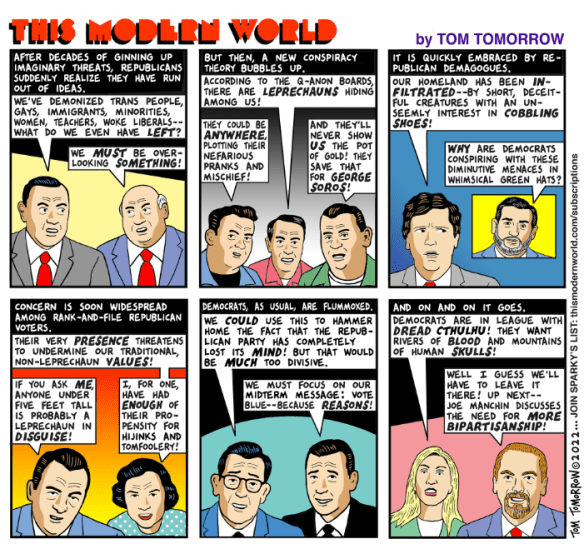
It continues to be a noteworthy phenomenon: how the Right ignores real threats (e.g. the climate crisis) while publicizing imaginary ones (e.g. Critical Race Theory). Words fail me, but Tom Tomorrow devoted his last two comic strips to this lunacy. 

Untitled

Untitled

This Modern World has a website. If you’d like to give a bit of support to Tom Tomorrow and receive each week’s cartoon (with additional commentary) by special email delivery, you can sign up here.

Russia Ain’t the Soviet Union Anymore

Two European academics who have studied Russia’s culture and politics explain why the war in Ukraine is much more than a response to NATO. They also explain why segments from the most extreme Fox News programs are replayed on Russian TV:

In recent weeks, many analysts — especially those trying to find a logical justification for the Russian war in Ukraine — have argued that the Kremlin was reacting to a perceived threat from NATO encroachment and the Western alliance’s push into Russia’s sphere of influence.

While that may be so, such explanations miss an important point. . . . 

Gay parades and cancel culture

In his sermon approximately two weeks into the war, on March 6, the patriarch of the Russian Orthodox Church justified the invasion of Ukraine as necessary to defend Orthodox Christians against Western values and gay pride parades. On March 24, during a meeting with young artists, Russian President Vladimir Putin complained about cancel culture, arguing that much the way J.K. Rowling was criticized for her opposition to transgender rights, the West was now “trying to cancel a whole 1,000-year culture, our people … Russian writers and books are now canceled.”

Russia presents itself as being at the forefront of the global culture wars, leading the resistance to liberal values. Russian anti-Westernism has religious implications: According to its own narrative, Russia is guarding true Christian faith, as embodied in the Eastern Orthodox church, from Western attempts to distort it, whether through Marxism in the 20th century or liberalism in the 21st.

Ukraine plays an important role in this story. It is depicted as part of the “Russian world,” the cradle of Russian civilization, which for many centuries was centered not around Moscow but around Kyiv, capital of today’s Ukraine. Ukraine’s choice to orient itself toward the West and reconcile a Slavic Orthodox identity with liberal democratic values is thus dangerous to this Russian vision of itself.

Global Christian Right

The arguments about gender freedoms and cancel culture that we hear today from Patriarch Kirill and Putin are nothing genuinely Russian. They derive from a global Christian right ideology, which Russian conservatives learned about in the 1990s.

Right after the end of the Cold War, Christian right activists, especially from the United States, flocked into Russia; among them were Focus on the Family, CoMission and the World Congress of Families. From the 1990s onward, Russian conservatives have argued that the frustrations of their society falling apart result from painful liberal socioeconomic reforms. Their argument combines elements of a late-Soviet conservative social ethos, Russian Orthodox traditionalism and huge transnational influences.

Today’s Russian discourse on traditional values is a hybrid of Christian right ideas from the global culture wars and nostalgia about Russia’s great Soviet and even greater imperial and Orthodox Christian past.

The whimsical West

This type of Russian cultural conservatism was marginal until around 2010, when it started to migrate to the center of Russian political life — decisively so during Putin’s third term as president. For Putin, the traditional values discourse was a good pretext for political repression — exemplified in the treatment of the Pussy Riot women — and a shield against rising opposition, which demanded more freedoms.

Traditional values and the defense of Christianity were a suitable foundation for the new Russian foreign policy mission: becoming the leader of those countries and actors that were not, were no longer or had never wanted to be “liberal.”

In the process of “learning” the global culture wars, Russian conservatives not only defined their national identity in relation to a global Christian conservatism, but also acquired a precise vision of the West as spiritually hollow and failing. Christian conservatives flocking to Russia conveyed an image of the West that was torn, weak and doomed, because it no longer had children, no longer had values, and did not even distinguish between men and women. As a result, many Christian conservatives from the United States and Europe  looked to Russia with hope.

Christian conservatives’ image of a failing and doomed West began to dominate views of Russian conservative elites during the late 2000s. But Russian elites saw their Western conservative partners as part of that failing West: they too were weak and pitiful heralds of a West in decline.

Russian triumphalism

This account of the West helped give birth to a new Russian triumphalism. Russian media filled with TV shows and “documentaries” on “Gayropa” and “Sodom.” These shows conjured up a caricature of weak “gayish” Western males and women who lost their femininity by competing with men in spheres where they could achieve nothing serious.

Russian media frequently stressed the oddity that many Western democracies nominated women as defense ministers, as if that was the ultimate proof that the West has lost its ability to defend itself. In this collective image of a weak West, Russia depicted itself (to the inside and outside) as the country of strength, the bulwark of traditional families: with strong men, fertile women and children properly guarded against subversive homosexual propaganda.

Russian triumphalism

This image is without any empirical foundation, but that was not important. It resulted in an internal perception of Russia as world messiah and a force preventing the world from sliding into the chaos of evil, with a special mission of saving the world from liberal depravities. The Patriarch’s March 6 sermon expressed precisely that worldview.

Fascinated by this flattering vision of Russia, elites, it seems, overestimated Russia’s strength and underestimated Ukraine’s. The Kremlin also appears to have underestimated the strength and unity of the collective West, which appears not as corrupted and not as weak as Russia imagined. Pointedly, J. K. Rowling, whom Putin mentioned as a victim of Western cancel culture, refused his characterization and accused Putin of killing civilians instead.

Unquote.

Everybody should keep in mind that 21st century Russia isn’t the 20th century Soviet Union. There are no communists in power now. Putin is yet another neo-fascist authoritarian, the kind that rules over Hungary, Brazil, India, Turkey, the Philippines and elsewhere. That’s why our former president and other Republicans admire Putin and those like him. The days when being an anti-Communist meant being anti-Russia are long gone.

Down, Down, Down We Go, Politically Speaking

Considering that this is 2022, not 1952, it was quite a surprise the first time I read that a Republican politician called some innocuous Democrat a “communist”. But crazy talk is no longer out of the ordinary for one of our major political parties. Ed Kilgore of New York Magazine was surprised too:

The day after the 2020 vice-presidential debate between Mike Pence and Kamala Harris, then-President D____ T____ did something that is hard to do: He actually shocked me with intemperate language, in this case referring to Harris as a “monster” and a “communist.” The “monster” business didn’t surprise me, actually, given T____’s long history of personal insults to women. But “communist?” Seriously? I hadn’t heard a Republican call a Democrat a commie since the high tide of McCarthyism — and even back then, the rare slur was associated with specific (if lunatic) allegations of subservience to an international Marxist-Leninist conspiracy operating out of Moscow. Sure, for a generation, Republicans have been imprecisely calling Democrats “socialists,” though no more than a handful of Donkey Party members answer to that appellation, . . . but “communist” is actually pretty precise . . . 

It’s not just T____ throwing the term around. One of his favorite Republican acolytes, Congresswoman Marjorie Taylor Greene of Georgia, calls Democrats — all of them, not just some of them — communists all the time (most recently in her speech to a white-nationalist group, in which she referred to “Democrats, who are the Communist Party of the United States of America”). When Republicans lost two Senate seats and control of the upper chamber in Greene’s home state in January 2021, South Dakota governor Kristi Noem called the winning Democratic candidates communists. And another Republican member of Congress, Senator Tommy Tuberville of Alabama, betrayed a lack of understanding of communism just last month in explaining that the Russians were invading Ukraine because, as a communist, Vladimir Putin “couldn’t feed his people” and needed Ukraine’s farmland [note: Russia’s authoritarian leader, a fascist kleptocrat, doesn’t even belong to the Communist Party, although some Russians still do].

But amazingly ridiculous accusations are now a sign of the times in Republican circles (even though journalists still refer to Republicans as “conservatives”). From Thomas Zimmer and The Guardian:

Ever since entering Congress, Marjorie Taylor Greene has been making headlines . . . The latest escalation came last week, when she smeared her Republican colleagues in the Senate, Lisa Murkowski, Susan Collins and Mitt Romney, as “pro-pedophile” after they voted to confirm Ketanji Brown Jackson to the US supreme court; Democrats, she added, “are the party of pedophiles.”

. . . The fact that Greene’s antics are so clearly designed to keep herself in the spotlight has prompted calls for the media and commentators to stop paying attention to her rather than be complicit in the amplification of far-right propaganda. And if what’s on display here were just the extremist behavior of a fringe figure, it would indeed be best to simply ignore her. This, however, isn’t just Greene’s extremism – it is increasingly that of the Republican party itself. Greene and the many provocateurs like her are not just rightwing trolls, but elected officials in good standing with their party. Ignoring them won’t work, nor will making fun of them: These people are in positions of influence, fully intent on using their power.

In any (small-d) democratic party, Greene’s extremism should be disqualifying. In today’s Republican party, she’s not being expelled, she’s being elevated. Greene is undoubtedly one of the rightwing stars in the country, and that’s not just a media phenomenon. Republican candidates crave her endorsement. . . . 

Greene’s rise is indicative of a more openly militant form of white Christian nationalism inserting itself firmly at the center of Republican politics. “America First” candidates like Greene are representing the Republican party all over the country. In Arizona, for instance, state senator Wendy Rogers proudly declared herself to “stand with Jesus, Robert E Lee, and the Cleveland Indians” back in December – all of them supposedly “canceled” by “satanic communists”. .. .  In Georgia, gubernatorial candidate Kandiss Taylor runs on a platform of “Jesus, Guns, and Babies” and openly advocates for the establishment of a Christian theocracy.

The Republican party doesn’t just tolerate such extremists in an attempt to appease the fringe – this isn’t simply a matter of acquiescence out of convenience or cowardice. What we really need to grapple with is the fact that this sort of radicalism is widely seen as justified on the right. The exact language someone like Greene uses might be slightly crasser than what some conservatives are comfortable with, and some Republicans might disagree with specific aspects of the public image she projects. But it’s obviously not enough for them to break with her, or with any of the Christian nationalist extremists in their ranks.

If anything, most of what Greene is saying actually aligns with the general thrust of conservative politics. Republicans are currently all in on smearing anyone who disagrees with their assault on LGBTQ rights [or supports sex education in schools] as “groomers” and declaring any progressive social position adjacent to pedophilia. And it’s really hard to tell the difference between Greene’s propaganda and what much of the reactionary intellectual sphere has been producing. Rod Dreher, for instance, one of the Religious Right’s best-known exponents, has called the Democrats the “party of groomers” and “the party of child mutilators and kidnappers” . . . 

That’s precisely the key to understanding why so many Republicans are willing to embrace political extremism. Greene’s central message is fully in line with what has become dogma on the right: that Democrats are a radical, “Un-American” threat, and have to be stopped by whatever means. Everyone suspected of holding liberal or progressive positions is a “fellow traveler with the radical left,” as senator Ted Cruz put it; as part of the “militant left,” Democrats need to be treated as the “the enemy within,” according to senator Rick Scott; and Florida governor Ron DeSantis declared that Stacey Abrams winning the Georgia gubernatorial election would be akin to a foreign adversary taking over and lead to a “cold war” between the two neighboring states.

. . . Greene’s pedophilia accusations . . .  adhere to the higher truth of conservative politics: that Democrats are a fundamental threat to the country, to its moral foundations, its very survival. “How much more can America take before our civilization begins to collapse?” Greene asked last week. There aren’t many conservatives left who disagree with her assessment. That’s how they are giving themselves permission to embrace whatever radical measures are deemed necessary to defeat this “Un-American” enemy.

Once you have convinced yourself you are fighting a noble war against a bunch of pedophiles hellbent on destroying the nation, there are no more lines you’re not justified to cross. Greene and her fellow extremists are perceived to be useful shock troops in an existential struggle for the survival of “real” America. The right isn’t getting distracted by debates over whether Greene’s militant extremism or Mitch McConnell’s extreme cynicism are the right approach to preventing multiracial pluralism. They are united in the quest to entrench white reactionary rule.

I fear that . . .  we might have become a bit numb to how extreme and dangerous these developments are. Let’s not be lulled into a false sense of security by the clownishness, the ridiculousness of it all. Some of history’s most successful authoritarians were considered goons and buffoons by their contemporaries – until they became goons and buffoons in power.

What we are witnessing is one party rapidly abandoning and actively assaulting the foundations of democratic political culture. Every “Western” society has always harbored some far-right extremists like Greene. But the fact that the Republican party embraces and elevates people like her constitutes an acute danger to democracy.

Unquote.

Yet, if you believe the polls, Americans who are willing and able to vote are going to put these right-wing bastards in charge of Congress next year. Two years later, if given the chance, they’d put the treasonous conman who can only handle short sentences back in the White House. This is America in 2022, not 1952.

Radical Judges Running Wild

It’s only getting worse at the Supreme Court now that six of the nine justices are Republicans. A University of Texas law professor explains:

Last week the Supreme Court, by a 5-to-4 vote, put back into effect a T___ administration regulation that [makes it harder for] states to [protect rivers and streams from being polluted]. The unsigned, unexplained order in Louisiana v. American Rivers came as part of a highly technical dispute over the scope of the Clean Water Act — and leaves for another day whether the regulation is a valid interpretation of that Nixon-era statute.

But the temporary decision cannot be ignored, especially because of the brief but blistering dissenting opinion written by Justice Elena Kagan. It’s not the first time that liberal justices have called out most of the court’s conservative [no, radical] justices for their increasingly frequent use of the so-called shadow docket — unsigned, unexplained orders like the one last week. But it was significant for being the first time that [Republican] Chief Justice John Roberts joined her (and Justices Stephen Breyer and Sonia Sotomayor) in doing so.

With the striking public stance, the chief justice illustrated how concerns about the procedural shortcuts the other [right-wing] justices are taking . . . . He also made clear what many have long suspected: The Roberts court is over.

The term “shadow docket” was introduced by the University of Chicago law professor Will Baude in 2015 to describe the more obscure part of the Supreme Court’s work — the thousands of unsigned and usually unexplained orders that the justices issue each year to manage their docket. Those orders are in contrast to the merits docket, the 60 to 70 cases each year that go through rounds of briefing and oral argument before being resolved in long, signed opinions for the court.

Owing to its inscrutability, the shadow docket has historically received much less public attention or scrutiny. Most shadow docket orders are anodyne — matters as routine as refusing to take up an appeal or giving a party more time to file a brief.

But far more than ever before, the court is using procedural orders on applications for emergency relief while appeals work their way through the courts to resolve disputes affecting the lives of millions of Americans — whether in blocking a rule from the Occupational Safety and Health Administration on a vaccination mandate for large employers, refusing to block Texas’ ban on most abortions after six weeks or putting back into effect congressional district maps that two Alabama lower courts struck down as violating the Voting Rights Act.

Time and again, the [Republican] justices are ordering lower courts to treat these decisions as precedents — even when, as in last week’s ruling, the order includes no analysis to apply to other cases, which often makes the precedent difficult for lower courts to apply.

Unsurprisingly, these rulings have provoked increasingly strident dissents from the court’s liberal justices. Last September, when the justices refused, by a 5-to-4 vote, to halt the patently unconstitutional Texas abortion law, Justice Kagan criticized the majority not just for the substance of its ruling but also for what that ruling said about the shadow docket. She wrote, “The majority’s decision is emblematic of too much of this court’s shadow-docket decision making — which every day becomes more unreasoned, inconsistent and impossible to defend.”

Last week, by freezing a district court injunction despite a lack of evidence that it was harming the complaining states, the majority once again defied the requirements for the very emergency relief they granted. Justice Kagan wrote that that renders the court’s “emergency docket not for emergencies at all” but rather “only another place for merits determinations — except made without full briefing and argument.” In other words, the principal justification for shadow docket orders — the need to intervene early in litigation to prevent a party from suffering irreversible harm while the appeal unfolded — was nowhere to be found.

Chief Justice Roberts voted with Justices Breyer, Sotomayor and Kagan in dissenting from six previous shadow docket rulings. But the Clean Water Act dispute was the first time he joined in the procedural criticism that the other conservatives were not just using the shadow docket but abusing it. . . .  By publicly endorsing the charge that the conservative justices are short-circuiting ordinary procedures to reach their desired results without sufficient explanation, Chief Justice Roberts provided a powerful counter to defenders of the court’s behavior, [such as hard-right] Justice Samuel Alito. . . . 

What is especially telling about Chief Justice Roberts’s dissents in these shadow docket cases is that, unlike Justices Breyer, Sotomayor and Kagan, he’s often been sympathetic to the results. In February’s Alabama redistricting ruling, for instance, Chief Justice Roberts agreed that the court should reconsider the interpretation of the Voting Rights Act under which Alabama’s maps had been struck down; he just believed that any change in that interpretation had to come through the merits docket, not the shadow docket.

At least on the shadow docket, though, that’s no longer up to him. Instead, the court’s destiny increasingly appears to be controlled by Justices Brett Kavanaugh and Amy Coney Barrett. She implored an audience at the Ronald Reagan Presidential Library just last week to “read the opinion” before jumping to any conclusions about whether the justices are acting more like politicians than judges. Two days later, she joined the majority’s unsigned, unexplained order in the Clean Water Act case, in which there was no opinion to read. Justice Kavanaugh, too, [is] troubled by criticism of the court’s behavior, [not] the behavior itself . . . . 

The court’s credibility [is wearing out]. The justices have long insisted — as Justices Sandra Day O’Connor, Anthony Kennedy and David Souter [all nominated by Republican presidents] put it in 1992 — that “the court’s legitimacy depends on making legally principled decisions under circumstances in which their principled character is sufficiently plausible to be accepted by the nation.” The proliferation of principle-free decisions affecting more and more Americans — and with a clear, troubling tendency of favoring Republicans over Democrats — calls that legitimacy into increasingly serious question.

It’s understandable, then, why Chief Justice Roberts would finally speak out. . . .  If even his objections can’t persuade the other [Republicans] to stop abusing the shadow docket, then that may signal the willingness of the court’s [radical right] majority to go even further in the future and to use the shadow docket to resolve even more significant and contentious constitutional questions.