Our Former President Invites an Odious Comparison

You’ve probably heard that the first person to mention Hitler or the Nazis automatically loses the argument. That’s not true, of course, but it does suggest that Hitler or Nazi comparisons shouldn’t be made lightly. (This adage is different from Godwin’s Law, which says “As an online discussion continues, the probability of a reference or comparison to Hitler or Nazis approaches 1”.

Yet, these days, with America’s right wing becoming ever more extreme, it’s natural to wonder how far they’ll go. Journalist Brian Beutler names a few names:

We see all around us people clothed in immense power whom we know, to a practical certainty, would have been enthusiastic allies to George Wallace or Jefferson Davis or even Adolf Hitler, and we see many, many more who would quite evidently have made their peace with segregation, or slavery, or genocide as an acceptable moral compromise for maintaining their wealth or social sway. 

It’s a testament to the durable temptation of wickedness—to the fact that “Never Again!” without constant vigilance is a chant of delusion. But it’s also prima facie evidence that we remain insufficiently vigilant, or that a large subset of liberals is in denial about the totalitarian temptation washing over the right. The people would side with us overwhelmingly if they understood the stakes this way, but all too frequently we won’t even tell them. 

Anybody who’s paid to write or speak for a big corporation like The New York Times or a smaller one like the Corporation for Public Broadcasting needs to come across as fair and balanced. That’s a big problem if the subject they’re writing or speaking about, American politics, is no longer balanced at all. What words are appropriate when there is news like this, in this case reported by the Times:

[The former president] and his allies are planning a sweeping expansion of presidential power over the machinery of government if voters return him to the White House in 2025, reshaping the structure of the executive branch to concentrate far greater authority directly in his hands.

Their plans to centralize more power in the Oval Office stretch far beyond the former president’s recent remarks that he would order a criminal investigation into his political rival, President Biden, signaling his intent to end the post-Watergate norm of Justice Department independence from White House political control.

[He] and his associates have a broader goal: to alter the balance of power by increasing the president’s authority over every part of the federal government that now operates, by either law or tradition, with any measure of independence from political interference by the White House, according to a review of his campaign policy proposals and interviews with people close to him.

[He] intends to bring independent agencies — like the Federal Communications Commission, which makes and enforces rules for television and internet companies, and the Federal Trade Commission, which enforces various antitrust and other consumer protection rules against businesses — under direct presidential control.

He wants to revive the practice of “impounding” funds, refusing to spend money Congress has appropriated for programs a president doesn’t like — a tactic that lawmakers banned under President Richard Nixon.

He intends to strip employment protections from tens of thousands of career civil servants, making it easier to replace them if they are deemed obstacles to his agenda. And he plans to scour the intelligence agencies, the State Department and the defense bureaucracies to remove officials he has vilified as “the sick political class that hates our country.”.

[He] and his advisers are making no secret of their intentions — proclaiming them in rallies and on his campaign website, describing them in white papers and openly discussing them….

“What we’re trying to do is identify the pockets of independence and seize them,” said Russell T. Vought, who ran the Office of Management and Budget [for the former president].

The Times reporters don’t draw the obvious conclusion. In response to the Times article, Ryan Cooper of the American Prospect does:

Donald Trump is plotting to make himself dictator. His plan it to make the federal government his plaything, and many Republican elites are behind him.

When Vladimir Putin came to power in Russia in 1999, he did not become dictator overnight. It took him many years to crush independent media, make the oligarch class dependent on him, and suppress organized political opposition… That process of power consolidation has accelerated since the invasion of Ukraine, as the former “hybrid regime” with some tacit limited freedoms has become a full-blown autocracy.

Trump is openly planning something similar, should he win the 2024 election…. Given [his] history, it’s clear that should he become president again, he will try to set up a dictatorship….

When [he] first came to power, he had little idea of how the federal government worked or even what he wanted to do with it, much less how to bend it to his will….

Eventually, [he] figured out how to get what he wanted. The answer was not to conform his acts to the existing system, but to break it. By issuing hundreds of executive orders, threatening those who stood in his way, and above all installing cronies throughout the executive branch and the judiciary, he could break through the procedures and norms that had constrained previous presidents (which turned out to be a lot more feeble than many assumed).

By 2020, Presidential Personnel Office head John McEntee was running a plan to install Trump stooges throughout the federal bureaucracy even over the objections of Trump’s own Cabinet members.

This process culminated in the attempted putsch on January 6, 2021, which as usual was poorly planned and led, yet got alarmingly close to success nonetheless. For the first time in American history, a fascist mob sacked the national legislature and disrupted the process of transferring power—all under the direction of the losing president, who was trying to cling to power through violence….

The Times report is characteristically stuffy about what is going on here. Yet the reporters got enough [of his] cronies on the record to make the stakes abundantly clear. The plan is called Project 2025—a transition project … with the explicit purpose of making the entire government beholden to [the president’s] every whim…. The only way to satisfy his craving for limitless money and power, and to inflict ruthless vengeance against his enemies, is to turn the presidency into a dictatorship.

[He] won’t necessarily succeed, even if he does win the election—it is unwise for a would-be autocrat to cultivate deep unpopularity among the armed forces, just for starters—but that is what he’s determined to do.

The Hitler of 1943? No. The Hitler of 1933? The evidence is clear.
Ending Military Aid to Israel Shouldn’t Be “Unmentionable”

A New York Times columnist, Nicholas Kristof, feared the reaction when he questioned the military aid we give to Israel, although he makes totally valid points (“Lots of folks will disagree with my column today”). I’ve edited out parts of his column where he goes wishy-washy:

Israel is in the headlines, evoking tumultuous debate. Yet one topic remains largely unmentionable, so let me gingerly raise it: Is it time to think about phasing out American aid for Israel down the road?

This is not about whacking Israel. But does it really make sense for the United States to provide the enormous sum of $3.8 billion annually to another wealthy country?

… Today, Israel has legitimate security concerns but is not in peril of being invaded by the armies of its neighbors, and it is richer per capita than Japan and some European countries. One sign of changed times: Almost a quarter of Israel’s arms exports last year went to Arab states.

The $3.8 billion in annual assistance to Israel is more than 10 times as much as the U.S. sends to the far more populous nation of Niger, one of the poorest countries in the world and one under attack by jihadis. In countries like Niger, that sum could save hundreds of thousands of lives a year, or here in the United States, it could help pay for desperately needed early childhood programs.

Aid to Israel is now almost exclusively military assistance that can be used only to buy American weaponry. In reality, it’s not so much aid to Israel as it is a backdoor subsidy to American military contractors, which is one reason some Israelis are cool to it.

“Israel should give up on the American aid,” Yossi Beilin, a former Israeli minister of justice, told me. He has argued that the money can be used more effectively elsewhere.

Daniel Kurtzer, a former American ambassador to Israel, agreed.

“Israel’s economy is strong enough that it does not need aid; security assistance distorts Israel’s economy and creates a false sense of dependency,” Kurtzer said in an email. “Aid provides the U.S. with no leverage or influence over Israeli decisions to use force; because we sit by quietly while Israel pursues policies we oppose, we are seen as ‘enablers’ of Israel’s occupation.”

“And U.S. aid provides a multibillion-dollar cushion that allows Israel to avoid hard choices of where to spend its own money and thus allows Israel to spend more money on policies we oppose, such as settlements.”

At some point when running for president in the last election, Bernie Sanders, Pete Buttigieg and Elizabeth Warren all suggested conditioning aid to Israel….. [but were apparently concerned about the negative reaction if they called for eliminating it].

It’s not just liberals. “Cut the stranglehold of aid,” Jacob Siegel and Liel Leibovitz argued recently in Tablet magazine, saying that the aid benefited America and its arms manufacturers while undercutting Israeli companies….

Martin Indyk, who twice served as America’s ambassador to Israel, also favored new security agreements and said that it’s time to have this discussion about ending aid.

“Israel can afford it, and it would be healthier for the relationship if Israel stood on its own two feet,” he told me.

The issue is politically sensitive, of course. Just a couple of years ago, more than 325 members of the House of Representatives signed a letter opposing any drop in aid to Israel.

“There’s a serious conversation that should be had ahead of this next memorandum of understanding about how best to use $40 billion in U.S. tax dollars,” said Jeremy Ben-Ami, the president of J Street, an advocacy group. “Yet instead of a serious national security discussion, you’re likely to get a toxic mix of partisan brawling and political pandering.”

… We’d all benefit by finding the maturity to discuss the unmentionable.

Unquote.

The most recommended comments on the Times site all said we should stop giving money to the Israeli government. But, as so often is the case, our politicians haven’t caught up with reality.

Where We Live Matches How We Vote

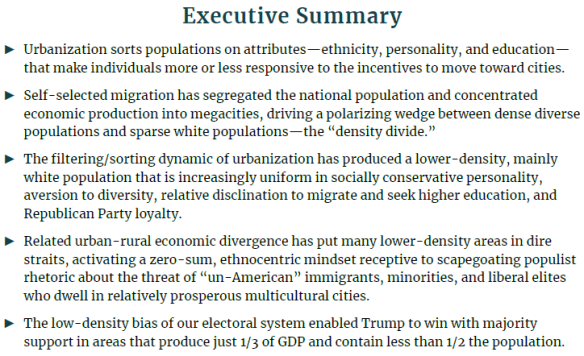
To understand the disheartening state of American politics, we need to consider the growth of cities and suburbs and the related decline of rural areas. That’s the conclusion of a 79-page report issued a few years ago by Will Wilkinson of the Niskanen Center. It’s called “The Density Divide: Urbanization, Polarization and Populist Backlash”. Here the author summarizes his findings: 

I weave recent research in political science, economics, psychology and more into an account of political polarization and the rise of populist nationalism as a surprising and overlooked side-effect of urbanization.

I claim that we’ve failed to fully grasp that urbanization is a relentless, glacial social force that transforms entire societies and, in the process, generates cultural and political polarization by segregating populations along the lines of the traits that make individuals more or less responsive to the incentives that draw people to the city. I explore three such traits — ethnicity, ideology-correlated aspects of personality, and level of educational achievement — and their intricate web of relationships.

The upshot is that, over the course of millions of moves over many decades, high density areas have become economically thriving multicultural havens while whiter, lower density places are facing stagnation and decline as their populations have become increasingly uniform in terms of socially conservative personality, aversion to diversity, and lower levels of education. This self-segregation of the population, I argue, created the polarized economic and cultural conditions that led to populist backlash.

Because the story of urbanization just is the story of a strengthening relationship between density, human capital and economic productivity, it’s also the story of relative small town and rural decline. The same process that has filtered better-educated, more temperamentally liberal whites out of lower density places has left those places with less vibrant economies, but also with more place-bound, ethnocentric populations.

It’s no shock that leavers leave and stayers stay. What’s surprising is that, if you’re white (and if you’re not, you’re almost certainly urban), the personality traits that make you more or less inclined to leave or stay — that make you more or less magnetized to the rising attractive force of the city — also predict how socially conservative or liberal you’ll tend to be, and which political party you’ll tend to support.

So the pull of urbanization has segregated us geographically on those traits, and it has done it so thoroughly that Democratic vote share now rises, and Republican vote share drops, in a remarkably linear fashion as population density rises. The relationship between density and party affiliation is, with few exceptions, similar everywhere — in “red states” and “blue states,” in sprawling metro regions and bucolic small towns — and majorities tend to flip at the density typical of a big city’s outer suburbs. I call this partisan polarization on population density the “density divide.”

When populations segregate geographically on traits relevant to ideology and party affiliation, political polarization is sure to follow. The increasing concentration of the economy in big cities, which is both a cause and effect of urbanization, amplifies this polarization. Rising prosperity reliably produces a liberalizing, tolerant, positive-sum mood. Material insecurity, in contrast, tends to elicit a grim, zero-sum, us-or-them mindset.

Because the sunshine of prosperity has become increasingly focused on urban populations, lower density white populations — which, thanks to the sorting logic of urbanization, are already more conservative and ethnocentric — have been left with objectively darkening prospects and a mounting sense of anxiety that is, at once, economic and ethno-cultural.

This combination of conditions created a political opportunity [our former president] managed to exploit. Because urbanization is reshaping societies everywhere around the world, it has created similar conditions, and similarly illiberal strongman leaders, in other countries as well. If we’re going to be able to do anything about the acrimony of polarization and the peril of ethno-nationalist populism, we’re going to have to get the story straight. This cross-disciplinary account of the social and psychological forces behind the density divide is my preliminary attempt to put us, finally, on the right track.

Untitled

Unquote.

The growth of cities and suburbs tends to make American politics more progressive, but a constitution ratified in 1789 that favors small states doesn’t make it easy.

It’s Dangerous to Criticize Israel

Israel is one of the sacred cows of American politics. Thou shalt not speak ill of Israel. A Democratic politician made a questionable statement this week. Reaction was swift and, according to Michelle Goldberg of The New York Times, “hysterical”:

Last weekend, Representative Pramila Jayapal, a Washington Democrat who is chair of the Congressional Progressive Caucus, made a significant political error. She called Israel a “racist state,” instead of simply a state that has racist leaders who treat many of the people under their authority as second-class citizens or worse on account of their ethnic and religious background.

Her rhetorical misstep generated international headlines and rebukes from Democrats and Republicans alike, demonstrating that, no matter how far Israel veers from liberal democratic norms, when it comes to American politics, it’s still protected by a thick lattice of taboos.

Jayapal’s gaffe occurred at Netroots Nation, a progressive conference held in Chicago, where pro-Palestinian activists interrupted a panel she was on…. Seeking to placate the demonstrators, Jayapal agreed that Israel is a “racist state” — one of their key contentions — and said that the “Palestinian people deserve self-determination and autonomy, that the dream of a two-state solution is slipping away from us.”

Almost as soon as she got off the stage, Jayapal told me on Monday, she realized she shouldn’t have used the phrase “racist state.” Sure enough, she was soon deluged by criticism not just from the right, but from some in her own party.

One group of centrist Democratic lawmakers circulated a draft of a letter blasting her words as “unacceptable” and saying that efforts to “delegitimize and demonize” Israel are “dangerous and antisemitic.” House Democratic leaders declared that “Israel is not a racist state” in a statement of their own….. On Sunday, Jayapal offered an apology and a clarification, saying, “I do not believe the idea of Israel as a nation is racist,” even though there are “extreme racists” enacting “outright racist policies” in Prime Minister Benjamin Netanyahu’s government.

Jayapal’s clarification was wise: It’s good to be as precise as possible when discussing an issue as fraught and complex as the conflict between Israelis and Palestinians. Her words at Netroots Nation could have been interpreted as ideological opposition to Zionism, which does not reflect Jayapal’s views; like most Democrats, she wants to see a Jewish state alongside a Palestinian one. Nevertheless, the ferocity of the backlash was striking, suggesting a brittle political denial about Israel’s increasingly authoritarian, jingoistic turn.

It’s telling that Democratic House leaders referred in their statement to Israel’s 1948 Declaration of Independence, which pledges that Israel will “uphold the full social and political equality of all its citizens, without distinction of race, creed or sex.” We can argue about whether that promise was ever compatible with a political project that, in creating a national home for one oppressed and stateless people, made refugees of another. What’s important today, however, is that Israel’s leadership no longer even appears to aspire to this founding ideal.

“Israel is not a state of all its citizens,” Netanyahu wrote in 2019. “According to the basic nationality law we passed, Israel is the nation state of the Jewish people — and only it.” He was referring to a 2018 law, which, among other things, downgraded the official status of Arabic, the language of about a fifth of Israel’s population.

Today, there are nearly equal numbers of Jews and Palestinian Arabs living in Israel and the occupied territories. For Palestinians living under occupation, there is no pretense of equal rights: They are subject to regular land seizures and home demolitions and constant restrictions on their freedom of movement. But even Palestinian citizens of Israel face legal as well as social discrimination. Israel’s Palestinian citizens, for example, cannot obtain citizenship for spouses who are from the West Bank or Gaza, dooming thousands of couples to live separately.

Israel’s security minister, Itamar Ben-Gvir, a disciple of the fanatically anti-Arab rabbi Meir Kahane, was once convicted of inciting racism and supporting terrorism. He used to have a photograph of Baruch Goldstein, a settler who massacred 29 Muslim worshipers in 1994, hanging in his living room. Israel’s government is considering creating a security militia under his control.

Of course, a state’s leaders and policies can be bigoted without the state itself being irredeemable. That’s basically Jayapal’s stance, which is why she’s not an anti-Zionist. But the rush to condemn her offhand remarks is not about encouraging linguistic rigor. It’s about raising the political price of speaking about Israel forthrightly. If you believe in liberal ideals, Netanyahu’s government is very hard to defend. It’s easier for Israel’s most stalwart boosters to harp on a critic’s slight misstatement — especially when denunciation of Israel is likely to ramp up ahead of the address by Israel’s president, Isaac Herzog, to Congress on Wednesday, which several progressive lawmakers are refusing to attend.

Israel’s most die-hard backers, Jayapal told me, are “feeling that they’ve lost credibility because the Netanyahu government’s policies are so racist, and they want to silence any discussion of any criticism.” She’s right. If Israel’s champions are truly worried about the fallout from accusations of racism, they might act to make them seem less credible.

Two Very Different Presidents, Two Very Different Paths

Like so many others, the historian Kruse Kruse now has a Substack newsletter. In this edition, he sheds light on a famous speech from 43 years ago that attempted to make America better but failed.

Today [July 15th] marks the anniversary of [President] Jimmy Carter’s deeply unpopular “Malaise speech,” which actually was not deeply unpopular and actually never used the word “malaise.”

In the late 1970s, the United States was reeling from crises on several fronts, ranging from economic “stagflation” (a new term coined to describe the previously unimaginable mix of high inflation and high unemployment) to an energy crisis sparked by the one-two punch of Middle Eastern oil embargoes and OPEC’s price hikes.

In early July, President Carter scrapped plans for an address on the energy crisis, deciding that he needed to dig deeper to diagnose what was ailing America. The president assembled a cast of political figures and public intellectuals for ten days of free-ranging discussion and frank deliberation at Camp David. The conversations covered a great deal of ground, but the president focused in on what became the actual title of his misremembered speech: the country’s “Crisis of Confidence.”

On July 15, 1979, Carter delivered the speech in a nationally televised address.

Pairing the Camp David conversations with feedback he’d gotten from “other Americans, men and women like you,” Carter rattled off a series of seemingly disconnected comments that, taken together, spoke to the dissatisfaction, distrust and discontent of the American people. “The erosion of our confidence in the future,” he warned, “is threatening to destroy the social and the political fabric of America.”

Carter offered a clear-eyed vision of how, and why, Americans had come to doubt their government and, as a result, to doubt themselves too:

We were sure that ours was a nation of the ballot, not the bullet, until the murders of John Kennedy and Robert Kennedy and Martin Luther King, Jr. We were taught that our armies were always invincible and our causes were always just, only to suffer the agony of Vietnam. We respected the Presidency as a place of honor until the shock of Watergate.

We remember when the phrase “sound as a dollar” was an expression of absolute dependability, until ten years of inflation began to shrink our dollar and our savings. We believed that our nation’s resources were limitless until 1973 when we had to face a growing dependence on foreign oil.

As he well understood, the general dissatisfaction and distrust in government had been a main reason for Carter’s own election. While presidential candidates had long campaigned on a rĂ©sumĂ© thick with political roles and posts in Washington D.C., Carter leveraged his identity as “an outsider” — in a move others would quickly copy — who bore no responsibility for creating these crises and who could therefore have a better shot at fixing them.

But two and a half years into his presidency, Carter was “Washington” and these problems were now his own. Still, he tried to ally himself with unhappy Americans: “You don’t like it, and neither do I. What can we do?”

The president offered a blunt assessment:

We are at a turning point in our history. There are two paths to choose. One is a path I’ve warned about tonight, the path that leads to fragmentation and self-interest. Down that road lies a mistaken idea of freedom, the right to grasp for ourselves some advantage over others. That path would be one of constant conflict between narrow interests ending in chaos and immobility. It is a certain route to failure.

All the traditions of our past, all the lessons of our heritage, all the promises of our future point to another path — the path of common purpose and the restoration of American values. That path leads to true freedom for our nation and ourselves. We can take the first steps down that path as we begin to solve our energy problem.

Energy will be the immediate test of our ability to unite this nation, and it can also be the standard around which we rally. On the battlefield of energy we can win for our nation a new confidence, and we can seize control again of our common destiny.

Carter then laid out a detailed plan for common action on the energy crisis, one that called for reducing oil imports, diverting resources to alternative fuels, imposing stark conservation efforts and rationing gasoline.

There were, as one might expect, calls for government programs — a version of the War Production Board of World War II that would focus on energy, a plan for greater investments in public transportation, a tax on windfall profits to fund it all, etc. — but the emphasis was on the private, voluntary action of the American people. President Carter was confident they would rise to the challenge. “With God’s help and for the sake of our nation, it is time for us to join hands in America,” he urged in closing. “Let us commit ourselves together to a rebirth of the American spirit. Working together with our common faith we cannot fail.”

Despite later memories of the speech as a disaster, it was actually a tremendous success. News coverage was generally positive, with political leaders heaping praise on the president for his mixture of blunt talk and bold faith.

Most notably, President Carter’s approval rating, which had been an abysmal 26% before the speech, shot up to 37% after the speech, an impressive 11-point bump that seemed to many to signal a turnaround in his political fortunes.

But that good luck was short-lived. As he moved from words to deeds, Carter made some serious missteps, most significantly securing formal offers of resignation from his entire Cabinet and several senior White House aides…. Carter meant this to be a sign of how serious his administration was taking the crisis, but most Americans saw it [as] a sign of chaos and confusion. The good will of the speech was quickly wiped away, and as additional problems arrived, like the Iran hostage crisis, Carter only found himself discredited again.

Meanwhile, an alternative vision — the first path of “self-interest” that the pious Carter had dismissed — was advanced by former California Governor Ronald Reagan as he secured the Republican nomination and challenged the incumbent president. Like Carter’s critics on both the left and right, Reagan ignored much of what Carter had actually said and instead latched onto a word the longtime Democratic operative Clark Clifford had casually tossed out to reporters in describing the speech: America’s sense of “malaise.”

“That is really the question before us tonight,” Reagan said the evening before the 1980 election. “For the first time in our memory many Americans are asking: does history still have a place for America, for her people, for her great ideals? There are some who answer no; that our energy is spent, our days of greatness at an end, that a great national malaise is upon us.”

Carter had offered a blunt assessment of the country’s problems but expressed a sharp faith in Americans’ ability to come together and conquer them, but in Reagan’s hands the underlying optimism of that message was spun into nihilistic pessimism. “I find no national malaise,” Reagan said. “I find nothing wrong with the American people.”

Carter called on the American people to join together in common cause and to make personal sacrifices for the sake of the nation. Reagan dismissed all that as needless pessimism and confirmed their complacency….

Seeking to echo FDR’s famous first inaugural address, Carter had bluntly addressed the nation’s “crisis of confidence” but expressed his faith that, with a little hard work and personal sacrifice, Americans could pull themselves out of their problem. There was, in effect, nothing to fear but fear itself.

In sharp contrast, Reagan simply insisted there was nothing to fear, nothing to sacrifice, nothing to work together to do — except show Jimmy Carter the door.

It’s not surprising which message ultimately resonated with voters, between the challenge of self-sacrifice and the comfort of self-interest.

And it’s not surprising that political leaders, from both parties, took notice.