They Give Themselves Permission

Right-wingers love to claim the left is trying to “destroy America”. Joe Biden, a long-time politician who isn’t a radical in any way whatsoever, is accused of the same. (They also sometimes call him a “communist” — at least they know enough about communism to know they’re against it.)

David Roberts, who operates a newsletter/podcast about clean energy and politics called Volts, explains what they’re doing:

In his book The School for Dictators, Ignazio Silone famously called fascism “a counter-revolution against a revolution that never took place”. There is much wisdom there.

A core feature of reactionary (I’ll use that term rather than “fascist” because people love to pointlessly debate semantics) movements is an inversion of power. They cast the weak as looming threats and status-quo powers as the trembling victims.

This is a familiar move … in every reactionary movement. You see it in the US when they talk about gay or trans people imposing themselves on everyone, forcing their lifestyle down our throats. Or when they talk about how white people face more racism.

Or, on a grander scale, when they talk about how social justice warriors have taken over every institution in the the US, ruthlessly imposing their woke worldview.

It’s self-evidently ridiculous, but why do they do it so consistently?

The point is to justify their own escalating violence and lawlessness. They hate difference, they hate the status quo being challenged, they hate the existence of Others in their midst, so they need to convince one another that it’s ok to cast off norms and let the violence [or criminality or immorality] out.

This is why the only mode of moral argumentation you ever see from a reactionary is whataboutism. The point of “they did it first” (for whatever “it,” censorship or voter fraud or whatever) is not that “it” is bad and no one should do it, but that it’s ok for us to do it too.

It’s not even really a moral argument. It’s just a permission structure — they did it, so we can’t be held accountable for doing it too.

So when they create this mythology about Democratic voter fraud, the point is not “voter fraud is bad,” the point is, “it’s ok for us to do it too” [which explains why the people found to have voted twice or somewhere they don’t live are almost always Republicans].

The long-running narrative about left bias in the media is not about “bias is bad”, it’s about, “it’s ok for us to make full-on propaganda”. The point about violent rioting urban lefties is not “violence is bad”, it’s “it’s ok for us to be violent”.

The clichĂ© goes “every conservative accusation is a confession,” and that’s kind of true, but it’s more accurate to say every accusation is permission — permission for the right to do in reality what it has worked itself up to believe the left is doing.

Oh I forgot to mention the classic example we’re living through: endlessly accusing the left of censorship to justify banning books and rewriting history.

It’s all a counter-revolution against a revolution that never took place — a way of defending and reinforcing status quo hierarchies by exaggerating the power and efficacy of the marginalized and vulnerable, the outsiders trying to reform the status quo in an egalitarian direction.

I was thinking about this the other day listening to the @IfBooksPod episode on Jonah Goldberg’s “Liberal Fascism”. Goldberg desperately wanted to be taken seriously as an intellectual, but literally the only thing he could think to do is the World Biggest What About. It’s “we’re rubber, you’re glue” puffed up to hundreds of pages. It’s just how their brains work. It’s never “people should be good”. It’s always, “you can’t call us shitty because you’re shitty too”.

And that is the most primal and formative feature of reactionary psychology: the belief that everyone is selfish, everyone is out for themselves, it’s a zero-sum world in which tribes compete for dominance, and all the progressive talk about universalist values is just a clever con.

They have to believe that. Their worldview has no room for people of good will trying earnestly to do good for humanity. They need for all the Others they hate to be sinister and powerful and right on the verge of taking over and destroying everything.

They need it because it gives them permission to indulge their base instincts. “We have to do this violence/censorship/lawbreaking, it’s the only way to stop the gays/immigrants/professors from destroying our way of life”. Every time it’s the same.

A friend reminded me that I forgot the most perfect example for this thread: all the “Flight 93 election” stuff! If you’re not familiar, this is the right-wing idea that US culture has been hijacked by the left and is headed for some grim end, so anything the right does to regain control is justified, even if it crashes the plane. The danger from the left is so severe, so immediate, that even blowing everything up is better than the alternative. Again, the point is always to create that permission structure.

“You prosecute us for real crimes, we’ll prosecute you for fake crimes!” Sigh.

Unquote.

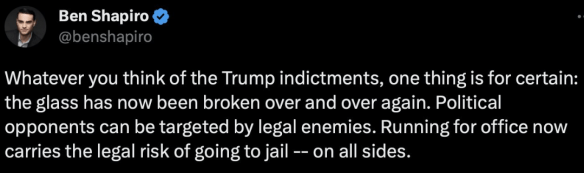
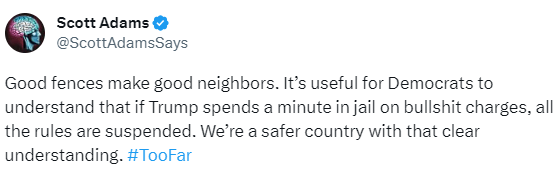
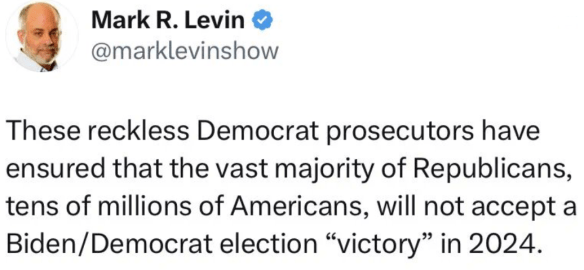
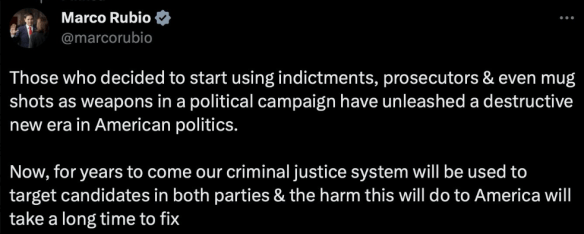
Mr. Roberts then provides a few recent examples of this phenomenon:

Untitled

Untitled

Untitled

Untitled

In case you haven’t heard, some of the worst House Republicans are pushing to impeach Biden. On what grounds? They don’t know yet, but there must be something, either real or imaginary.

This Is Not Normal. They Are Not Serious People.

Wednesday night’s Republican “debate” should have convinced journalists to tell the truth about how dangerous and divorced from reality Republicans have become. They’re no longer “conservative” in any way and shouldn’t be treated like a normal political party.

Ben Rhodes, an author and former Obama official, captured the flavor of the event:

… A stage full of people acted like a bunch of kids trying to get admitted to some fascist costume party. Kill people at the border! Prohibit women from any agency over their bodies! Side with Putin! Etc. Etc.

Six of the eight prospective presidents (!!!) said they would support their party’s 2024 nominee even if he’s a convicted felon, even if one of his crimes was trying to overthrow the government.

But coverage of the 2024 presidential election is looking a lot like what we were fed in 2016 and 2020. The New York Times, for example, published this on Thursday: “Our Writers Pick the Winners, Losers and ‘the Star of the Evening’ From the First Republican Debate”. Ten of their well-paid opinion writers ranked the night’s performers on a scale of 0 to 10.

Politics as sports or entertainment.

Margaret Sullivan, the Public Editor at the Times before the management decided they didn’t like the idea of a Times employee being allowed to criticize the paper in public, wrote about Wednesday night for The Guardian. Her principal focus was on a rising star in MAGA World:

He thinks the climate crisis is a hoax, supports Vladimir Putin’s aggression in Ukraine and would gladly pardon D____ T____ on day 1 of his would-be presidency. A wealthy biotech entrepreneur, the 38-year-old has never before run for public office.

Despite all of this (or maybe because of it), this week’s Republican debate became a national coming-out party for Vivek Ramaswamy.

Suddenly, this inexperienced and dangerous showoff is almost a household name.

Many in the Republican base ate up his showmanship and blatant fanboying of their hero, [the individual now charged with 91 felonies]. In CNN’s post-debate focus group of Republican voters in Iowa, for example, Ramaswamy got the most favorable response.

… Many in the mainstream media declared him victorious. The Washington Post put him up high in its “winners” column, trailing only behind [the individual facing four criminal trials], who wasn’t even there. (Choosing not to enter this particular clown car showed some uncharacteristic good sense on the former president’s part.)

The New York Times analyzed the situation under a glowing headline “How Vivek Ramaswamy Broke Through: Big Swings With a Smile”, with emphasis on his style: “unchecked confidence and insults”.

For this millennial tech bro, his performance on the Fox News stage in Milwaukee couldn’t have gone much better.

As a glimpse of America’s future, it couldn’t have gone much worse….

Certainly, Ramaswamy has the essentials covered. No, not foreign policy chops or a background in public service, but a mocking aversion to social justice and equality….

His night in the spotlight, and its aftermath, shows that neither Republican voters nor many in the mainstream media have learned much since [the leader of the cult] came down the elevator in 2015 and proceeded to wreak havoc on the country.

In case there was any doubt, now we know: they will always fall for the attention-seeking, the policy-unencumbered, the candidate quickest with a demeaning insult. That’s a “winner”, apparently.

And it’s all too familiar.

“Ramaswamy is like T____ in the larva stage, molting toward the full MAGA wingspan but not quite there yet,” wrote Frank Bruni in his New York Times newsletter. “His narcissism, though, is fully evolved.”

Not everyone in the media, of course, was buying it. Charlie Sykes, editor in chief of the right-leaning Bulwark, was blunt, calling Ramaswamy “facile, clownish, shallow, shameless, pandering”, but, then again, “exactly what Republican voters crave these days”.

Given that the Republican party – still firmly in the grip of a twice-impeached con man – has lost its mind, this craving makes a certain amount of sense.

But it makes the endless media normalization even more cringe-inducing. Shouldn’t mainstream journalists be able to step back a tiny bit, providing critical distance rather than the same old tricks?

How can there be “winners” in yet another milestone on the way to fascism?

Section 3 of the 14th Amendment Should Matter

No person shall … hold any office, civil or military, under the United States … who, having previously taken an oath … to support the Constitution of the United States, shall have engaged in insurrection or rebellion against the same, or given aid or comfort to the enemies thereof. 

The 14th Amendment was ratified in 1868. Section 3 was designed to stop anyone who had rebelled against the United States from ever having a role in the government again. It’s not commonly applied (we don’t have that many insurrections or rebellions), but it’s still in the Constitution. The New York Times reports that legal experts are paying attention:

Two prominent conservative law professors have concluded that [the Orange Menace] is ineligible to be president under a provision of the Constitution that bars people who have engaged in an insurrection from holding government office. The professors are active members of the Federalist Society, the conservative legal group, and proponents of originalism, the method of interpretation that seeks to determine the Constitution’s original meaning.

“Originalism” is bullshit, but others have reached the same conclusion, including a University of Virginia professor and Citizens for Responsibility and Ethics in Washington (CREW). What’s interesting about these two professors is that they would ordinarily be expected to bend over backwards to support the Orange Menace, like so many other Federalist Society members have done.

The Times article suggests the likelihood of lawsuits:

The scope and depth of the article may encourage and undergird lawsuits from other candidates and ordinary voters arguing that the Constitution makes him ineligible for office.

“There are many ways that this could become a lawsuit presenting a vital constitutional issue that potentially the Supreme Court would want to hear and decide,” [one of the authors] said.

Of course, the Supreme Court deciding that the 14th Amendment applies to the former president would require two of the Court’s right-wing, so-called “originalist” Justices to accept the Constitution’s plain language, not something they’re used to doing.

Nevertheless, here’s the authors’ summary of the article:

Section Three of the Fourteenth Amendment forbids holding office by former office holders who then participate in insurrection or rebellion. Because of a range of misperceptions and mistaken assumptions, Section Three’s full legal consequences have not been appreciated or enforced. This article corrects those mistakes by setting forth the full sweep and force of Section Three.

First, Section Three remains an enforceable part of the Constitution, not limited to the Civil War, and not effectively repealed by nineteenth century amnesty legislation.

Second, Section Three is self-executing, operating as an immediate disqualification from office, without the need for additional action by Congress. It can and should be enforced by every official, state or federal, who judges qualifications.

Third, to the extent of any conflict with prior constitutional rules, Section Three repeals, supersedes, or simply satisfies them. This includes the rules against bills of attainder or ex post facto laws, the Due Process Clause, and even the free speech principles of the First Amendment.

Fourth, Section Three covers a broad range of conduct against the authority of the constitutional order, including many instances of indirect participation or support as “aid or comfort.”

[Section Three] covers a broad range of former offices, including the Presidency. And in particular, it disqualifies [the former president], and potentially many others, because of their participation in the attempted overthrow of the 2020 presidential election.

“A Mystery for the Ages”

In under 3 minutes, Tennessee comedian Trae Crowder explains the overriding reality confronting the Republican Party and the party’s response.

The History Behind the Crisis

Homegrown: Timothy McVeigh and the Rise of Right-Wing Extremism is the latest book by the lawyer and author Jeffrey Toobin. The New York Review of Books has a long review by Sean Wilentz, a Yale history professor, that provides historical context for our current political crisis. The following 1,800 words are most of the review. I think they (or the whole review) are worth reading:

Ronald Reagan’s pronouncement, in his first inaugural address in 1981, that “government is not the solution to our problem, government is the problem” marked a signal moment in what has become the most successful political counterrevolution in modern American history. Having won a smashing electoral victory, Reagan acted as if he were the latter-day inverse of his long-ago political hero, Franklin Delano Roosevelt. Summoning the American people to “a rendezvous with destiny”—a line he had shamelessly filched from FDR in the 1964 speech on behalf of Barry Goldwater’s presidential campaign that established him as the Republican right wing’s future leader—and pretending that the stubborn stagflation of the 1970s was a crisis of the same magnitude as the Great Depression, Reagan channeled Roosevelt’s optimistic rhetoric to attack the instrument of Roosevelt’s great reforms: the federal government.

He aimed, above all, to revive the laissez-faire economic and social policies that the Depression had discredited, that Roosevelt had supplanted, and that even Richard Nixon had repudiated when he declared himself a Keynesian. But Reagan’s antigovernment politics and policies went much further than rolling back the New Deal.

Reagan’s Republican Party of 1981 was very different from Herbert Hoover’s of 1933: it had become the refuge of millions of formerly Democratic white conservative voters in the Solid South who resisted the civil rights reforms of the 1960s. Accordingly, behind his cheerful veneer Reagan made sure that he tapped into the fierce resentments of federal authority, dating back to the Civil War and Reconstruction, that fueled that resistance. Before they were done, the Reagan Republicans had absorbed into their coalition an array of aggrieved Americans, including quasi-theocratic white Christian nationalists, the gun-manufacturing lobby, antiabortion militants, and antigay crusaders.

The antigovernment fervor that grips the nation today is the long-term product of the right wing that Reagan called to arms (literally, in the case of the National Rifle Association) forty-odd years ago. It was his attorney general Edwin Meese, in tandem with the newly formed Federalist Society, who started packing the federal judiciary with the conservative judges who have gutted federal protections for voting rights, abortion rights, and more, while inventing, with fake history presented as “originalism,” an individual’s Second Amendment right to own and carry military-grade armaments. It was the Reagan administration that eliminated the FCC’s fairness doctrine, which mandated that broadcasters provide balanced coverage of controversial public issues, paving the way for right-wing talk radio inciters like Rush Limbaugh and G. Gordon Liddy and, on cable TV, Rupert Murdoch’s Fox News to amplify antigovernment paranoia.

The Reagan White House also harbored the former Nixon aide Pat Buchanan as its communications director. Buchanan’s politics were rooted in the 1930s America First isolationism of Charles A. Lindbergh and the diatribes of the right-wing “radio priest” Father Charles Coughlin, with their eccentric fixations on imaginary Jewish internationalist cabals. In the waning days of Reagan’s presidency, Buchanan remarked that “the greatest vacuum in American politics is to the right of Ronald Reagan.” He tried to fill that vacuum himself, nearly defeating President George H.W. Bush in the 1992 New Hampshire primary with his “pitchfork brigades.” His convention speech later that year laid out the culture wars to come. Then he followed up with another bid for the Republican nomination in 1996 and an independent campaign in 2000.

All those efforts failed, but their stark themes of isolationism, lost national greatness, immigrant invasion, and racial fear provided a template for T____’s MAGA campaign a quarter-century later. “American carnage” was the favored far-right image at least two decades before T____.

Meanwhile, a step away from Buchanan—how distant a step has long been subject to debate—an assortment of antisemitic and white nationalist organizations remained on the political fringes during the Reagan period. The fringiest may have been the neo-Nazi National Alliance, founded in 1974 by William Luther Pierce, the author of the widely read novel The Turner Diaries, a lurid description of—and in some respects a blueprint for—a white supremacist revolution. The conspiracy-mongering Liberty Lobby, founded in 1958 by Willis Carto, claimed in the early 1990s a membership of 20,000, supplemented by 90,000 subscribers to its weekly newspaper, The Spotlight. In 1968 the Liberty Lobby supported the segregationist hero Governor George Wallace for president. Twenty years later the splinter Populist Party, which Carto helped to organize, nominated the former grand wizard of the Ku Klux Klan David Duke. In both 1992 and 1996 The Spotlight backed Buchanan.

A major turning point in the Republican Party’s rightward radicalization and its fitful convergence with the evolving conspiratorial and white supremacist netherworld—populated today by groups like the Proud Boys, the Oath Keepers, and QAnon—came during the fall and winter of 1994, culminating in the spring of 1995. Much to the shock of Republicans who assumed that Reagan had created a national coalition that would last for decades, a Democrat, Bill Clinton, won the presidency in 1992.

Republican strategists shifted their attention to Congress, and in November 1994, led by the firebrand Newt Gingrich of Georgia, the party captured the majority in the House of Representatives for the first time in forty years. Rewarded with the speakership, Gingrich dominated the news cycle with slash-and-burn denunciations of “sick,” “corrupt,” “anti-flag” Democrats. Advised by the political consultant Frank Luntz, he adopted his poll-tested vocabulary of demonization, published in a private memo entitled “Language: A Key Mechanism of Control”: “anti-child,” “decay,” “welfare,” “traitors.”

Limbaugh, Liddy, and smaller-fry right-wing radio [hosts] added their own blend of conspiracy mongering and personal abuse. The prolonged and fatal siege in 1993 involving an armed religious sect, the Branch Davidians, and federal law enforcement in Waco, Texas, became a cause cĂ©lĂšbre on both sides of the increasingly blurry border between the GOP hard right and the paramilitary extremists. “Go for a head shot,” the ex–Watergate plotter Liddy shouted into his radio microphone, instructing listeners on how to kill federal firearms officials. “The second violent American revolution,” Limbaugh declared around the same time, “is just about—I got my fingers about a quarter of an inch apart—is just about that far away.”

Out of this toxic mix of cultism and grifting came Timothy McVeigh, a young, decorated army veteran, subscriber to The Spotlight, gun show enthusiast, and avid fan of Limbaugh’s. He had developed a burning hatred of Bill and Hillary Clinton and studied The Turner Diaries like a field manual. In April 1995, on the second anniversary of the end of the Waco siege, McVeigh parked a Ryder rental truck crammed with barrels of fertilizer explosive, flicked his Bic lighter to fire a five-minute fuse, and blew up the Alfred P. Murrah Federal Building in Oklahoma City, killing 168 people, 19 of them children….


 Not long after high school, McVeigh obtained—via the National Rifle Association’s magazine, American Hunter—a mail-order copy of The Turner Diaries, which offered him a worldview that he never relinquished. From this book, written at the furthest reaches of antigovernment paranoia, he eventually extracted the basic instructions on how to touch off, with a spectacular act of terror, a white supremacist revolution that would overthrow the federal government…..


 He would later tell his lawyers [that reading The Spotlight] pretty much summed up “my world/my culture
the stuff I identify with
stuff I know and live.” Around the same time, McVeigh began listening to Limbaugh, who was just coming into his own as a best-selling author, television performer, and talk radio megastar…. He became an ardent fan.


 Buchanan rounded out McVeigh’s political thinking, above and beyond—but by no means in contradiction to—the crude racism of The Turner Diaries. From Buchanan, McVeigh learned of the menacing New World Order (NWO), purportedly a project of shadowy, powerful, internationalist elites to topple the America created by the Founding Fathers and replace it with a single omnipotent world government run exclusively by and for themselves. From Buchanan, he learned that a new revolutionary resistance could defeat the NWO much as the patriots of 1776 had defeated the British. And from Buchanan, perhaps most important of all, he learned that, just as the redcoats had once tried to strip the patriots of their arsenals, so the nefarious globalists and their liberal minions were out to shred the Founders’ Second Amendment and seize the guns of a God-fearing citizenry….

The author then recounts how passage of the ban on assault weapons during the Clinton administration (which Republicans allowed to lapse in 2004, despite its success in limiting the number of mass shootings) was “the last straw” for McVeigh.


 The plot that led to the bombing began on September 13, 1994, the date that Clinton signed the assault weapons bill.

The links [between the politics of the mid-1990s and those of our own times are vivid: in the assurance that sinister “globalist” forces are either about to take control of the country or already have; in 
 “the belief in the value and power of violence”; in an obsession with gun ownership that reduces the entire Constitution to a twisted version of the Second Amendment; in a crackpot narrative of American history that turns liberalism into tyranny on the supposed authority of Thomas Jefferson….

The largest difference between now and then … is frightening. Whereas McVeigh … found a kind of community in right-wing periodicals, talk radio call-ins, and far-flung gun shows, the Internet and social media have at once vastly enlarged that community and tightened its connections, with billions of unfiltered rants and orders and falsehoods flashing through the ether….

But while it warns about the present danger, Homegrown also illuminates and bids us to reckon with the larger history of what happened in 1995. Not only do today’s distempers date back well before T____ or the Tea Party; they originated well before the inflamed mid-1990s, taking their modern form during the presidency of Ronald Reagan, who encouraged them with his denunciations of the federal government as a malevolent force.

And there is an even longer history behind that. The great revolutions in American history—from the nation’s founding through Emancipation, Reconstruction, the Progressive Era, and the New Deal—have been predicated on the idea, inscribed in the Constitution, that it is the nation, the more perfect Union striven for in 1787, that is best equipped to secure the common good and the general welfare.

Counterrevolutionaries in their various forms—nullifiers, Confederates, so-called Redeemers overthrowing Reconstruction, anti–New Deal Liberty Leaguers—have fought that idea, never more successfully than in the long counterrevolution begun under Reagan. Though resisted and even halted from time to time, that reaction, steadily radicalized, has now turned a substantial number of Americans against their own government, and they are ready and willing to use violence for their retribution. In the process, large and influential elements of the party of Abraham Lincoln—a party that fought against one such counterrevolution—have become captive to that subversive rage.