Whereof One Can Speak 🇺🇦

Nothing special, one post at a time since 2012

Two Major Democracies At Risk

Two articles in the New York Times opinion section dealt with creeping authoritarianism in the world oldest democracy and the world’s largest. First, from Thomas Edsall’s column about the oldest:

Herbert Kitschelt, a political scientist at Duke, noted in an email that the United States stands apart from most other developed nations in ways that may make this country especially vulnerable in the universe of democratic states to authoritarian appeals and democratic backsliding:

There are two unique American afflictions on which T___ could thrive and that are not shared by any other advanced Western … country: the legacy of slavery and racism and the presence of fundamentalist evangelicalism, magnifying racial and class divisions. There is no social organization in America that is as segregated as churches.

In this context, Kitschelt wrote,

a critical element of T____ist support is trying to establish in all of the United States a geographical generalization of what prevailed in the American South until the 1960s civil rights movement: a white evangelical oligarchy with repression — jail time, physical violence and death — inflicted on those who will not succumb to this oligarchy. It’s a form of clerofascism [i.e. clerical fascism]. A declining minority — defined in economic and religious terms — is fighting tooth and nail to assert its supremacy.

Underlying the racial motivations, in Kitschelt’s view, are

changes in political economy and family structure, strongly related also to a decline of religion and religiosity. Religions, for the most part, are ideological codifications of traditional paternalist family kinship structures. Postindustrial libertarianism and intellectualism oppose those paternalisms. This explains why right-wing populists around the world draw on religion as their ultimate ideological defense, even if their religious doctrines are seemingly different: T____(white Protestant evangelicalism and Catholic ultramontanism [which emphasizes supreme papal authority], Putin (Orthodoxy), Modi (Hinduism), Erdogan (Islam), Xi (Confucianism).

Unquote.

India is the world’s largest democracy, with four times the population of the U.S. The other Times article described its more established slide into religious fascism. This is by an Indian journalist, Debasish Roy Chowdhury:

Prime Minister Narendra Modi stood last month atop India’s nearly completed new Parliament building, built to mark the country’s 75 years of independence, and pulled a lever. A sprawling red curtain fell back to reveal the structure’s crowning statue. Many across India gasped.

The 21-foot-tall bronze figure — four lions seated with their backs to one another, facing outward — is of India’s revered national symbol. The beasts are normally depicted as regal and restrained, but these looked different: Their fangs bared, they seemed angry, aggressive.

Untitled

To Mr. Modi’s critics, the refashioned image atop the Parliament building— a project that was rammed through without debate or public consultation — reflects the snarling “New India” he is creating.

In his eight years in power, Mr. Modi’s Bharatiya Janata Party government has profaned Indian democracy, espousing an intolerant Hindu supremacist majoritarianism over the ideals of secularism, pluralism, religious tolerance and equal citizenship upon which the country was founded after gaining independence on Aug. 15, 1947.

Drawing comparisons to Nazi Germany, the regime uses co-opted government machinery, disinformation and intimidation by partisan mobs to silence critics while dehumanizing the large Muslim minority, fanning social division and violence. Civil liberties are systematically violated.

India, the world’s largest democracy, is where the global battle between liberalism and tyranny is being lost….

Laws and rights are applied unevenly. Muslims can now be arrested for praying in public, while Hindu pilgrims are congratulated by state officials. The state celebrates the Hindu religion, while protests are orchestrated against Muslim customs like the wearing of the hijab and the call to prayer. Hindu vigilante groups attack Muslims and their businesses.

A high-ranking B.J.P. leader called Muslim refugees from Bangladesh “termites” eating away the country’s resources. Emboldened by state support, Hindu extremists now openly threaten the genocide and rape of Muslims, while the government arrests journalists who call out acts of hate. On Aug. 15, Independence Day, the government released 11 convicts serving life sentences for gang-raping a Muslim woman and murdering 14 members of her family during the 2002 Gujarat pogrom that occurred on Modi’s watch…..

At 75, after decades of institutional abuse, India’s democracy is too frail to withstand a strongman taking a sledgehammer to its weak foundations. Mr. Modi calls the Parliament building a “temple of democracy.” But the institution’s new premises in New Delhi are instead a monument to the demi-democracy he is building — a hollowed-out facade that exists to legitimize authoritarian rule.
Almost Anyone Can Be a U.S. Senator (There May Be New Evidence Pretty Soon)

The Constitution has three requirements to be a member of the U.S. Senate. You have to be at least 30 years old, have been a U.S. citizen for at least 9 years, and — by the time of the election — live in the state you will represent (so it’s perfectly fine if you live in New Jersey but, for some vague reason, are running for the Senate in Pennsylvania). Competence and interest in the job aren’t required.

Paul Waldman of The Washington Post asks what it means that a well-known, former football player (who meets the three qualifications) is running for the Senate in Georgia:

In the race for U.S. Senate in Georgia, Republican nominee Herschel Walker is forcing people to ask: Just how clueless is too clueless to serve in Congress? And what would it mean if our national legislature was filled with people like Walker?

The former football star’s campaign has been a series of howlers and head-scratchers, the latest of which is his argument against the recently passed Inflation Reduction Act: “They continue to try to fool you that they are helping you out. But they’re not … Because a lot of money it’s going to trees … Don’t we have enough trees around here?”

The possibility that Georgians are fed up with all their trees notwithstanding, no one says that Walker is the first office-seeker to lack even the most rudimentary understanding of policy or the issues he would confront. And there is in fact some money in the IRA to promote trees, including urban “heat islands” where a lack of shade trees increases temperatures.

But Walker’s comments on policy have been particularly colorful, including his thoughts on China hurting our environment by taking “our good air” and his proposal to address school shootings with “a department that can look at young men that’s looking at women that’s looking at social media.” Then there’s his recent debunking of evolution: “If that is true, why are there still apes? Think about it.”

Senate Minority Leader Mitch McConnell (R-Ky.) recently predicted his party might not win control of the chamber, saying “candidate quality has a lot to do with the outcome” of these races. No one doubted that Walker was one of the candidates he had in mind.

Yet Walker is hardly the only one; since so much rides on former president T____’s endorsement in Republican primaries and the most important qualification for winning that endorsement is an embrace of his conspiracy theories about the 2020 election, from coast to coast we’ve seen the party’s nominations won by crackpots and halfwits, perhaps more than ever before.

What would it mean if a bunch of these people actually won?

The greatest danger lies in executive positions such as governor and secretary of state, where they would have the power to steal elections and create all kinds of other disasters. But it’s not immediately clear that a Republican-controlled Congress dominated by the party’s worst and dimmest would be appreciably different from one led by its best and brightest, or at the very least its marginally clever.

There are multiple ways to be a terrible legislator, and being a dolt is only one of them. For instance, until 2021, Georgia was represented in the Senate by Republican David Perdue, who in his six years in the chamber wrote just a few bills that became law, including one to create a parking lot at the National Zoo and another renaming a post office. Georgians were left to wonder what, if anything, Perdue was actually doing in Washington, and when given the chance they tossed him out.

Perdue wasn’t too dumb to legislate; the job just didn’t seem to grab his interest. The truth is that while it doesn’t hurt to be smart if you’re a senator, you don’t have to be. You can let other people write the laws, and just have your party’s leadership or the hosts on Fox News tell you which way to vote when the time comes.

Today’s Republican Party also contains a cadre of extremely smart politicians educated at the most prestigious universities, people such as Sens. Ted Cruz of Texas (Princeton undergrad, Harvard Law School), Tom Cotton of Arkansas (Harvard undergrad and law school) and Josh Hawley of Missouri (Stanford undergrad, Yale Law School), who spend most of their time trying to Own the Libs, because they see that as the path to success in their party.

Which may be the smart thing to do if you’re a Republican who wants to run for president. And it shows the problem: When there are few incentives to do the hard work of legislating to address complex policy challenges, even the smart people see advantage in pretending to be stupid.

There’s a critical imbalance here as well: As members of the party that believes in government, Democrats know their supporters expect them to produce results, and as we’ve seen this year, that takes a lot of doing. Some may be better at it than others, but all are expected to demonstrate their commitment to the process.

Liberal voters also tend to value intellect in a way conservative voters just don’t. They may not always choose the smartest person (if they did, Sen. Elizabeth Warren would have been their 2020 presidential nominee). But they’re far less likely to fall for a politician telling them that all their problems can be solved by nurturing their resentment of supposedly snooty “elites.”

So the truth is that while Walker would probably displace Ron Johnson (R-Wis.) as the widely acknowledged dopiest member of the Senate if he were elected, that’s not why he’s such a threat. It’s not even Walker’s extraordinary record of telling easily disprovable lies. It’s the fact that if he wins it could mean Congress being in control of a party that elevates people like him.

The problem isn’t Walker, it’s that the Republican Party is dominated by politicians who in one way or another resemble him. His party doesn’t just tolerate ignorance and dishonesty, it often seems to want nothing more….

Unquote.

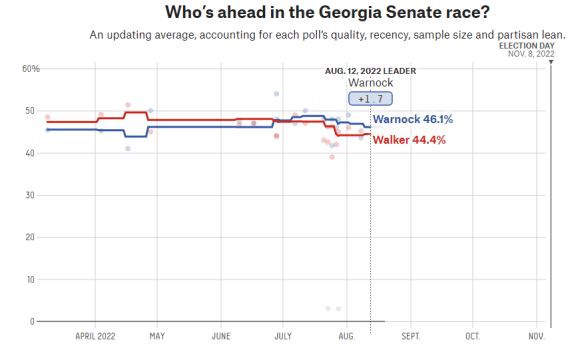
According to the FiveThirtyEight site, Georgia opinion polls say the incumbent, Democratic Sen. Raphael Warnock (a longtime Baptist minister and political activist with a PhD in theology, who has never threatened his wife with a gun, hasn’t lied about how many children he has and has never played football for the University of Georgia), has a small lead over Herschel Walker, after trailing in the Spring.

Untitled

The Supreme Court Has Never Been a Level Playing Field

The Constitution deserves less respect. So does the Supreme Court. After reviewing the Court’s history as an impediment to progress, Ian Millhiser of Vox argues that “the judiciary is structurally biased in favor of conservatives:

The Court was the midwife of Jim Crow, the right hand of union busters, the dead hand of the Confederacy, and now is one of the chief architects of America’s democratic decline….

Decisions like Dobbs, which commandeer the bodies of millions of Americans — or decisions dismantling the Voting Rights Act — are entirely consistent with the Court’s history as defender of traditional hierarchies. [Justice Samuel] Alito is not an outlier in the Court’s history. He is quite representative of the justices who came before him.

In offering this critique of the Supreme Court, I will acknowledge that the Court’s history has not been an unbroken string of reactionary decisions dashing the hopes of liberalism. The Court’s marriage equality decision in Obergefell v. Hodges (2015), for example, was a real victory for liberals.

But the Court’s ability to spearhead progressive change that does not, like marriage equality, enjoy broad popular support is quite limited. The seminal work warning of the heavy constraints on the Court’s ability to effect such change is Gerald Rosenberg’s The Hollow Hope, which argues that “courts lack the tools to develop policies and implement decisions [in favor of] significant social reform,” at least when those reforms aren’t also supported by elected officials.

This constraint on the judiciary’s ability to effect progressive change was most apparent in the aftermath of perhaps the Court’s most celebrated decision: Brown v. Board of Education (1954).

Brown triggered “massive resistance” from white supremacists, especially in the Deep South. As Harvard legal historian Michael Klarman has documented, five years after Brown, only 40 of North Carolina’s 300,000 Black students attended an integrated school. Six years after Brown, only 42 of Nashville’s 12,000 Black students were integrated. A decade after Brown, only one in 85 African American students in the South attended an integrated school.

The courts simply lacked the institutional capacity to implement a school desegregation decision that Southern states were determined to resist. Among other things, when a school district refused to integrate, the only way to obtain a court order mandating desegregation was for a Black family to file a lawsuit against it. But terrorist groups like the Ku Klux Klan used the very real threat of violence to ensure few lawsuits were filed.

No one dared to file such a lawsuit seeking to integrate a Mississippi grade school, for example, until 1963.

Much of the South did not really begin to integrate until Congress passed the Civil Rights Act of 1964, which allowed the Justice Department to sue segregated schools, and which allowed federal officials to withhold funding from schools that refused to integrate. Within two years after this act became law, the number of Southern Black students attending integrated schools increased fivefold. By 1973, 90 percent of these students were desegregated.

Rosenberg’s most depressing conclusion is that, while liberal judges are severely constrained in their ability to effect progressive change, reactionary judges have tremendous ability to hold back such change. “Studies of the role of the courts in the late nineteenth and early twentieth centuries,” Rosenberg writes, “ show that courts can effectively block significant social reform.”

And, while such reactionary decisions may eventually fall if there is a sustained political effort to overrule them, this process can take a very long time. Dagenhart [a decision that overruled Congress and allowed products made by child labor to cross statelines] was decided in 1918. The Court did not overrule it, and thus permit Congress to ban child labor, until 1941.

There are several structural reasons courts are a stronger ally for conservative movements than they are for progressive ones. For starters, in most constitutional cases courts only have the power to strike down a law — that is, to destroy an edifice that the legislature has built. The Supreme Court could repeal Obamacare, but it couldn’t have created the Affordable Care Act’s complex array of government-run marketplaces, subsidies, and mandates.

Litigation, in other words, is a far more potent tool in the hands of an anti-governmental movement than it is in the hands of one seeking to build a more robust regulatory and welfare state. It’s hard to cure poverty when your only tool is a bomb.

So, to summarize my argument, the judiciary, for reasons laid out by Rosenberg and others, structurally favors conservatives. People who want to dismantle government programs can accomplish far more, when they control the courts, than people who want to build up those programs. And, as the Court’s history shows, when conservatives do control the Court, they use their power to devastating effect.

This alone is a reason for liberals, small-d democrats, large-D Democrats, and marginalized groups more broadly, to take a more critical eye to the courts. And the judiciary’s structural conservatism is augmented by the fact that, in the United States, institutions like the Electoral College and Senate malapportionment give Republicans a huge leg up in the battle for control of the judiciary.

Simply put, the Supreme Court has not served the American people well. It’s time to start treating it that way.

Unquote.

A similar point can be made regarding the US Senate. Senators who want to leave everything as it is can use the filibuster to kill legislation much more easily than Senators can use it to pass legislation.  

How Democracy May Survive the Constitution

Among our democracy’s enemies, foreign or domestic, is a document ratified in 1789: the United States Constitution. The power the Constitution gives to the states, its provisions that favor minority rule, and the difficulty of amending it may allow the Republican Party to institute authoritarian, one-party rule, all the while claiming to respect “the supreme law of the land”. 

Two law professors, Ryan Doerfler and Samuel Moyn, argue that it’s time to do something about our broken Constitution: 

When liberals lose in the Supreme Court — as they increasingly have over the past half-century — they usually say that the justices got the Constitution wrong. But struggling over the Constitution has proved a dead end. The real need is not to reclaim the Constitution, as many would have it, but instead to reclaim America from constitutionalism.

The idea of constitutionalism is that there needs to be some higher law that is more difficult to change than the rest of the legal order. Having a constitution is about setting more sacrosanct rules than the ones the legislature can pass day to day. Our Constitution’s guarantee of two senators to each state is an example. And ever since the American founders were forced to add a Bill of Rights to get their handiwork passed, national constitutions have been associated with some set of basic freedoms and values that transient majorities might otherwise trample.

But constitutions — especially the broken one we have now — inevitably orient us to the past and misdirect the present into a dispute over what people agreed on once upon a time, not on what the present and future demand for and from those who live now. This aids the right, which insists on sticking with what it claims to be the original meaning of the past.

Arming for war over the Constitution concedes in advance that the left must translate its politics into something consistent with the past. But liberals have been attempting to reclaim the Constitution for 50 years — with agonizingly little to show for it. It’s time for them to radically alter the basic rules of the game.

In making calls to regain ownership of our founding charter, progressives have disagreed about strategy and tactics more than about this crucial goal. Proposals to increase the number of justices, strip the Supreme Court’s jurisdiction to invalidate federal law or otherwise soften the blow of judicial review frequently come together with the assurance that the problem is not the Constitution; only the Supreme Court’s hijacking of it is. And even when progressives concede that the Constitution is at the root of our situation, typically the call is for some new constitutionalism.

Since the Supreme Court began to drift right in the 1970s, liberals have proposed better ways of reading the Constitution. [Meanwhile,] the conservative Federalist Society engaged in a successful attempt to remake constitutional law by brainstorming ideas, creating networks of potential judges and eventually helping to guide the selection of President D____ T____’s nominees…. With the death of Ruth Bader Ginsburg, the consolidation of right-wing control of constitutional law and the overturning of Roe and other disasters this term — the damage has only worsened.

One reason for these woeful outcomes is that our current Constitution is inadequate, which is why it serves reactionaries so well. Starting with a text that is famously undemocratic, progressives are forced to navigate hard-wired features, like the Electoral College and the Senate, designed as impediments to redistributive change while drawing on much vaguer and more malleable resources like commitments to due process and equal protection — resources that a conservative Supreme Court has used over the years to invalidate things like abortion rights and child labor laws and might use in the coming term to prohibit affirmative action.

Sometimes reclaiming the Constitution is presented as a much-needed step toward empowering the people and their elected representatives. In a new book, the law professors Joseph Fishkin and William Forbath urge progressives to stop treating constitutional law as an “autonomous” domain, “separate from politics.” In contrast with earlier efforts among liberals, which, as Jedediah Purdy put it in a 2018 Times guest essay, put forward a “vivid picture of what judges should do with the power of the courts,” such exercises in progressive constitutionalism call on Congress and other nonjudicial actors to claim some amount of authority to interpret the Constitution for themselves

It is a breath of fresh air to witness progressives offering bold new proposals to reform courts and shift power to elected officials. But even such proposals raise the question: Why justify our politics by the Constitution or by calls for some renovated constitutional tradition? It has exacted a terrible price in distortion and distraction to transform our national life into a contest over reinterpreting our founding charter consistently with what majorities believe now.

No matter how openly political it may purport to be, reclaiming the Constitution remains a kind of anti-politics. It requires the substitution of claims about the best reading of some centuries-old text or about promises said to be already in our traditions for direct arguments about what fairness or justice demands.

It’s difficult to find a constitutional basis for abortion or labor unions in a document written by largely affluent men more than two centuries ago. It would be far better if liberal legislators could simply make a case for abortion and labor rights on their own merits without having to bother with the Constitution.

By leaving democracy hostage to constraints that are harder to change than the rest of the legal order, constitutionalism of any sort demands extraordinary consensus for meaningful progress. It conditions democracy in which majority rule always must matter most on surviving vetoes from powerful minorities that invoke the constitutional past to obstruct a new future.

After failing to get the Constitution interpreted in an egalitarian way for so long, the way to seek real freedom will be to use procedures consistent with popular rule. It will not be easy, but a new way of fighting within American democracy must start with a more open politics of altering our fundamental law, perhaps in the first place by making the Constitution more amendable than it is now.

In a second stage, though, Americans could learn simply to do politics through ordinary statute rather than staging constant wars over who controls the heavy weaponry of constitutional law from the past. If legislatures just passed rules and protected values majorities believe in, the distinction between “higher law” and everyday politics effectively disappears.

One way to get to this more democratic world is to pack the Union with new states. Doing so would allow Americans to then use the formal amendment process to alter the basic rules of the politics and break the false deadlock that the Constitution imposes through the Electoral College and Senate on the country, in which substantial majorities are foiled on issue after issue.

More aggressively, Congress could simply pass a Congress Act, reorganizing our legislature in ways that are more fairly representative of where people actually live and vote, and perhaps even reducing the Senate to a mere “council of revision” (a term Jamelle Bouie used to describe the Canadian Senate), without the power to obstruct laws.

In so doing, Congress would be pretty openly defying the Constitution to get to a more democratic order — and for that reason would need to insulate the law from judicial review. Fundamental values like racial equality or environmental justice would be protected not by law that stands apart from politics but — as they typically are — by ordinary expressions of popular will. And the basic structure of government, like whether to elect the president by majority vote or to limit judges to fixed terms, would be decided by the present electorate, as opposed to one from some foggy past.

A politics of the American future like this would make clear our ability to engage in the constant reinvention of our society under our own power, without the illusion that the past stands in the way.

If Only We Were Nicer

3 Quarks Daily is a good place to visit for online intellectual stimulation. They publish original content on Mondays; the rest of the week they link to articles on “science, arts, philosophy, politics, literature”. Even the (moderated) comments are often worth reading. Unfortunately, somebody at 3 Quarks likes to share articles that purport to explain or address political polarization.

If you’ve visited sites like 3 Quarks or read prestigious publications like The New York Times or The Atlantic, you’ve probably run into Jonathan Haidt. He’s an American social psychologist who writes lots of articles and books like The Righteous Mind: Why Good People are Divided by Politics and Religion and The Coddling of the American Mind: How Good Intentions and Bad Ideas Are Setting Up a Generation for Failure. The 3 Quarks Daily’s search function turns up almost 60 links to things by him or that mention him (going back to 2004).

There was another one this morning: “The Polarization Spiral” by him and a co-author. The subtitle is: “How the Right’s Monomania and the Left’s Great Awokening Feed Each Other”.

The best way to read this piece — if you’re inclined — is to skip to the end and savor the conclusion:

The polarization spiral, which is fed and accelerated by social media, is making extremists on both right and left more extreme, more powerful, and more intimidating. Both sides feed off of each other. Both sides are essential for a polarization spiral. And that means that neither side can win by attacking or humiliating the other side. Such tactics only serve to energize the other side.

It’s a classic “both sides” analysis. If only those far left extremists on Twitter and Facebook would calm down, stop criticizing well-meaning people so much and in particular stop saying nasty things about right-wingers, we wouldn’t have such polarization in this country. The right wouldn’t care that America is becoming less homogeneous, less patriarchal and less Christian. They wouldn’t feel the need to make minority rule permanent or launch the occasional coup. No more gun worship or right-wing terrorism, no more teenage girls forced to give birth, no more pervasive lies, no more demonization of immigrants from “shithole” countries, no skepticism about the climate crisis. Hell, we could even have universal healthcare!

In other words, there would be much less polarization if only we were less judgmental. You can’t argue with that.