Leopardi and Yeats weren’t the only poets with opinions on the subject of political passion. The following is attributed to the American poet Robert Frost (1874-1963):
A liberal is a man too broadminded to take his own side in a quarrel.
Leopardi and Yeats weren’t the only poets with opinions on the subject of political passion. The following is attributed to the American poet Robert Frost (1874-1963):
A liberal is a man too broadminded to take his own side in a quarrel.
Giacomo Leopardi (1798-1837) was a great Italian poet. He was also one of Western civilization’s great pessimists. Below is an 1821 extract from his Zibaldone di pensieri (“Commonplace Book of Thoughts”):
The power of nature and the weakness of reason. I’ve said elsewhere that for opinions to have a real influence on people, they must take the form of passions…. One could quote endless examples to demonstrate this point. But since all opinions that aren’t, or don’t seem to be, prejudices will have only pure reason to support them, in the ordinary way of things they are completely powerless to influence people.
Religious folks (even today, and maybe more these days than ever before, in reaction to the opposition they meet) are more passionate about their religion than their other passions (to which religion is hostile); they sincerely hate people who are not religious (though they pretend not to) and would make any sacrifice to see their system triumph (actually they already do this, mortifying inclinations that are natural and contrary to religion), and they feel intense anger whenever religion is humbled or contested.
Non-religious people, on the other hand, so long as their not being religious is simply the result of a cool-headed conviction, or of doubt, don’t hate religious people and wouldn’t make sacrifices for their unbelief, etc., etc. So it is that hatred over matters of opinion is never reciprocal, except in those cases where for both sides the opinion is a prejudice, or takes that form.
There’s no war then between prejudice and reason, but only between prejudice and prejudice, or rather, only prejudice has the will to fight, not reason. The wars, hostilities and hatreds over opinions, so frequent in ancient times, right up to the present day, in fact, wars both public and private, between parties, sects, schools, orders, nations, individuals—wars which naturally made people determined enemies of anyone who held an opinion different from their own—only happened because pure reason never found any place in their opinions, they were all just prejudices, or took that form, and hence were really passions.
Poor philosophy then, that people talk so much about and place so much trust in these days. She can be sure no-one will fight for her, though her enemies will fight her with ever greater determination; and the less philosophy influences the world and reality, the greater her progress will be, I mean the more she purifies herself and distances herself from prejudice and passion. So never hope anything from philosophy or the reasonableness of this century.
About 100 years later, William Butler Yeats (1865-1939) expressed a similar thought in The Second Coming:
Turning and turning in the widening gyre
The falcon cannot hear the falconer;
Things fall apart; the centre cannot hold;
Mere anarchy is loosed upon the world,
The blood-dimmed tide is loosed, and everywhere
The ceremony of innocence is drowned;
The best lack all conviction, while the worst
Are full of passionate intensity.
In the 21st century, nobody believes in pure reason anymore. The question now is whether the more reasonable have enough passion to counteract the less reasonable. Leopardi would have been doubtful.
Note: the Leopardi quote is from a New York Review of Books blog post that is much less interesting: http://www.nybooks.com/blogs/nyrblog/2013/oct/17/headline-headaches/
“Sapient” means “wise or knowing”. That’s why Carl Linnaeus, the father of modern taxonomy, called our species “Homo sapiens“. In fact, we’re all members of the sub-species “Homo sapiens sapiens“. We must be really smart (given the competition).
On a less optimistic note, however, studies show that our species suffers from various cognitive impairments. For example, there is “motivated reasoning”: our emotions often affect the conclusions we reach. The existence of the “backfire effect” is especially counter-intuitive: when our deepest beliefs are confronted by contrary evidence, our deepest beliefs can become even stronger. It’s a cognitive defense mechanism frequently on display at family gatherings and in the House of Representatives.
Once we accept the widespread irrationality of Homo sapiens sapiens, it’s much easier to understand why certain politicians say such crazy things. They aren’t necessarily lying. Too often, they actually believe what they’re saying.
Yesterday, Republican Senator Ted Cruz of Texas criticized the agreement to end the shutdown and raise the debt ceiling: “Unfortunately, once again, it appears the Washington establishment is refusing to listen to the American people”. The Senator may really believe that most of America was enjoying the shutdown and looking forward to the government running out of money. Public opinion polls indicating that most of us weren’t happy about it at all must be non-existent or seriously flawed.
Somehow it’s comforting to know that our political opponents aren’t lying bastards. They’re merely irrational, like so many of our species.
Fortunately, this doesn’t mean that all of us are equally irrational. Some people are more in need of cognitive defense mechanisms because they feel more threatened by what’s going on in the world. If you strongly prefer how things were back in the 19th century, when we didn’t have things like an income tax or child labor laws, you’ll have a lot of mental defending to do. Having that black guy in the White House clearly bothers a lot of people, who conclude that he must be the Antichrist or at least working for Al Qaeda. The Affordable Care Act scares the hell out of some people who think the government is becoming too powerful, so they hold on to the idea that death panels will soon be deciding who should live or die.
Of course, you might point out that many of us feel threatened by the radical Republicans among us. So maybe we are being irrational about them?
That’s possible, but it’s not what the evidence shows. Those people really are crazy! It’s just that their behavior is more common than some of us (the optimists among us?) would like to think.
For more on the backfire effect and whether journalists can do anything about it, here’s an article in the Columbia Journalism Review:
http://www.cjr.org/behind_the_news/the_backfire_effect.php?page=all

(until the next time…)
Because America doesn’t look like them:
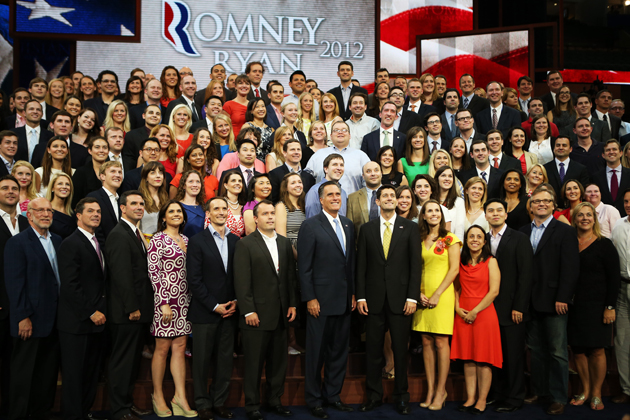
O.k., that isn’t completely fair. The Romney/Ryan campaign staff skews younger than the Republican Party as a whole:

There. Now it’s completely fair!
 Whereof One Can Speak 🇺🇦
You must be logged in to post a comment.