Whereof One Can Speak 🇺🇦

Nothing special, one post at a time since 2012

Columnists Are Deeply Concerned About the Election

I’m still avoiding “news” about Tuesday’s election, but many people who write for a living are expressing these two points:

  • Republican politicians no longer even pretend to care about morality.
  • The election will be a choice between democracy and autocracy.

They don’t need to mention that democracy may lose.

From “The New Nihilists” by Sarah Longwell for Persuasion:

These midterms are proving how deep the GOP rot runs.

The crop of Republican candidates running in the midterms has taken immorality to a whole new level. [She then cites scandalous behavior by three of their Senate candidates, Lake, Oz and Walker.]

What was the response from GOP leaders and media figures? In essence: “LOL, nothing matters”. 

It’s a baffling turn for those of us who grew up in an era where the Republican Party built its public brand around morality and character….Until a few years ago, the GOP still defended virtue rhetorically, even when it fell short and engaged in double standards….

In 2022, by contrast, the GOP ignores or perverts virtue altogether. [Their leader] has spawned hundreds of GOP candidates who ape his lies about the 2020 election, his corruption, and his combative style. Candidates of low character—like Lake, Oz, and Walker—are the rule in the GOP, rather than the exception. According to the old saying, hypocrisy is the tribute that vice pays to virtue—and Republicans have resolved their hypocrisy in favor of vice.   

From “Well, America, You Were a Good Idea While You Lasted” by Charles Pierce for Esquire:

The GOP have finally abandoned the last shreds of common decency, the rule of law and other American ideals.

It was this weekend that I finally gave up. I have watched the steady descent of American conservatism—and its primary public vehicle, the Republican Party—into the terminal depths of the prion disease it acquired when Ronald Reagan, Richard Viguerie and Jerry Falwell first fed it the monkey-brains back in the late 1970s….

I mocked it and inveighed against it. Better people than I … have spent four decades warning us what was coming unless the prion disease was kept in check….

The public episodes are now too numerous to mention…. They are beyond anyone’s reach. They are beyond logic and reason. They left democratic norms and customs far behind decades ago. They are beyond political compromise. They are beyond checks and balances, and they have drifted off into the void of a space far beyond the Constitution.

From “We Need to Be Clear About Who Pushed Us to the Breaking Point” by Jamelle Bouie for The New York Times:

The Democratic Party is, at this moment, the only viable political party with a serious commitment to free and fair elections. And in a country where power alternates between two major parties, this means American democracy is in real trouble….

It is simply the truth of the matter. If you oppose the effort to nullify Democratic election victories and create systems of minority rule (the Republican running for governor of Wisconsin said, for example, that “Republicans will never lose another election in Wisconsin after I’m elected governor”), then there’s only one real choice on the ballot….

Democrats did not make democracy a partisan issue. Republicans did. They did when they stood with Donald Trump in the wake of Jan. 6; they did when they embraced “Stop the steal” and election-denying candidates; they did when they made light of the threats against Nancy Pelosi and the assault on her husband.

There is nothing stopping Republican candidates and Republican voters and Republican leaders from pursuing their partisan and ideological goals while keeping their commitment to free and fair elections. There is nothing stopping them from rejecting antidemocracy extremists in their midst and affirming the vital principles of popular sovereignty, rule of law and political equality. There is nothing stopping them, in other words, from making a different set of choices about the kind of political party they wish to be part of.

It’s not Democrats who left the voting public with only one choice if they want to protect democracy as they know it….

Bouie adds that this kind of politics appeals to some:

When politicians and other political leaders … drop the pretense of virtue and embrace a politics of cruelty and malice, in which nothing matters but the will to power — voters act accordingly. Some may recoil, but just as many will embrace the chance to live vicariously through leaders who celebrate vice and hold virtue in contempt.

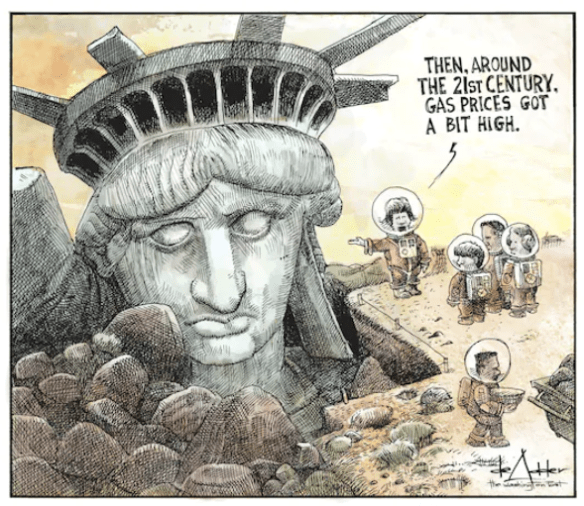
Others have other things on their mind (by Michael de Adder for The Washington Post):
Untitled

A Note to Readers

When I make a serious mistake in something I’ve written here — which happens often — and I notice it — which happens less often — I try to fix the post. But that doesn’t generate a new email for those who get posts that way. So if you see something badly wrong in an emailed post it’s may be corrected on the blog (although, as in most things, there’s no guarantee).

Thus, today, this went out:

Maybe [Biden] actually believes it’s just those extreme MAGA Republicans we have to worry about, not the 5% or so who actually respect democracy and the rule of law.

It now says:

Maybe he actually believes it’s just those extreme MAGA Republicans we have to worry about, not the average ones who are lukewarm on democracy and the rule of law.

Please pardon this interruption in your daily affairs.

President Biden Speaks to the Nation Again, but Ignores a Big Part of the Story

Last night, President Biden gave a televised speech about the right-wing attack on democracy. But he didn’t express the obvious truth that most Republican politicians are in on it. Maybe he actually believes it’s just those extreme MAGA Republicans we have to worry about, not the average ones who are lukewarm on democracy and the rule of law. Anyway, here’s most of what he said:

Just a few days ago, a little before 2:30 a.m. in the morning, a man smashed the back windows and broke into the home of the Speaker of the House of Representatives, the third-highest-ranking official in America. He carried in his backpack zip ties, duct tape, rope and a hammer.

As he told the police, he had come looking for Nancy Pelosi to take her hostage, to interrogate her, to threaten to break her kneecaps. But she wasn’t there. Her husband … was home alone. The assailant tried to take Paul hostage….

The assailant entered the home asking: “Where’s Nancy? Where’s Nancy?” Those are the very same words used by the mob when they stormed the United States Capitol on January 6th, when they broke windows, kicked in the doors, brutally attacked law enforcement, roamed the corridors hunting for officials and erected gallows….

It was an enraged mob that had been whipped up into a frenzy by a president repeating over and over again the Big Lie, that the election of 2020 had been stolen. It’s a lie that’s fueled the dangerous rise in political violence and voter intimidation over the past two years.

Even before January 6th, we saw election officials and election workers in a number of states subjected to menacing calls, physical threats, even threats to their lives…. 

This intimidation, this violence against Democrats, Republicans and nonpartisan officials just doing their jobs, are the consequence of lies told for power and profit, lies of conspiracy and malice, lies repeated over and over to generate a cycle of anger, hate, vitriol and even violence.

In this moment, we have to confront those lies with the truth. The very future of our nation depends on it. My fellow Americans, we’re facing a defining moment, an inflection point. We must with one overwhelming unified voice speak as a country and say there’s no place, no place for voter intimidation or political violence in America. Whether it’s directed at Democrats or Republicans. No place, period. No place ever.

I speak today near Capitol Hill, near the U.S. Capitol, the citadel of our democracy. I know there’s a lot at stake in these midterm elections, from our economy, to the safety of our streets, to our personal freedoms, to the future of health care and Social Security, Medicare. It’s all important. But we’ll have our differences, we’ll have our difference of opinion. And that’s what it’s supposed to be.

But there’s something else at stake, democracy itself. I’m not the only one who sees it. Recent polls have shown an overwhelming majority of Americans believe our democracy is at risk, that our democracy is under threat. They too see that democracy is on the ballot this year, and they’re deeply concerned about it. [Note: The president failed to point out that Democrats are worried about a real threat to democracy, while Republicans are worried about an imaginary one premised on the Big Lie. Voting by mail? Truckloads of counterfeit ballots?]

So today, I appeal to all Americans, regardless of party, to meet this moment of national and generational importance. We must vote knowing what’s at stake and not just the policy of the moment. Institutions that have held us together as we’ve sought a more perfect union are also at stake. We must vote knowing who we have been, what we’re at risk of becoming.

Look, my fellow Americans, the old expression, “Freedom is not free,” it requires constant vigilance. From the very beginning, nothing has been guaranteed about democracy in America. Every generation has had to defend it, protect it, preserve it, choose it. For that’s what democracy is. It’s a choice, a decision of the people, by the people and for the people. The issue couldn’t be clearer, in my view.

We the people must decide whether we will have fair and free elections, and every vote counts. We the people must decide whether we’re going to sustain a republic, where reality’s accepted, the law is obeyed and your vote is truly sacred.

We the people must decide whether the rule of law will prevail or whether we will allow the dark forces and thirst for power put ahead of the principles that have long guided us.

You know, American democracy is under attack because the defeated former president of the United States refused to accept the results of the 2020 election. If he refuses to accept the will of the people, if he refuses to accept the fact that he lost, he’s abused his power and put the loyalty to himself before loyalty to the Constitution. And he’s made a big lie an article of faith in the MAGA Republican Party, the minority of that party [Unfortunately, recent polls say up to 60% of Republicans accept the lie.]

The great irony about the 2020 election is that it’s the most attacked election in our history. And, yet, there’s no election in our history that we can be more certain of its results. Every legal challenge that could have been brought was brought. Every recount that could have been undertaken was undertaken. Every recount confirmed the results. Wherever fact or evidence had been demanded, the Big Lie has been proven to be just that, a big lie. Every single time.

Yet now extreme MAGA Republicans aim to question not only the legitimacy of past elections, but elections being held now and into the future. The extreme MAGA element of the Republican Party [is] its driving force. It’s trying to succeed where they failed in 2020, to suppress the right of voters and subvert the electoral system itself. That means denying your right to vote and deciding whether your vote even counts.

Instead of waiting until an election is over, they’re starting well before it. They’re starting now. They’ve emboldened violence and intimidation of voters and election officials. It’s estimated that there are more than 300 election deniers on the ballot all across America this year. We can’t ignore the impact this is having on our country. It’s damaging, it’s corrosive and it’s destructive.

And I want to be very clear, this is not about me, it’s about all of us…. It’s about the durability of our democracy. For democracies are more than a form of government. They’re a way of being, a way of seeing the world, a way that defines who we are, what we believe, why we do what we do. Democracy is simply that fundamental.

We must, in this moment, dig deep within ourselves and recognize that we can’t take democracy for granted any longer. With democracy on the ballot, we have to remember these first principles. Democracy means the rule of the people, not the rule of monarchs or the moneyed, but the rule of the people.

Autocracy is the opposite of democracy. It means the rule of one, one person, one interest, one ideology, one party. To state the obvious, the lives of billions of people, from antiquity till now, have been shaped by the battle between these competing forces, between the aspirations of the many and the greed and power of the few, between the people’s right for self-determination, and the self-seeking autocrat, between the dreams of a democracy and the appetites of an autocracy.

What we’re doing now is going to determine whether democracy will long endure and, in my view, it is the biggest of questions, whether the American system that prizes the individual bends toward justice and depends on the rule of law, whether that system will prevail. This is the struggle we’re now in….

There’s been anger before in America. There’s been division before in America. But we’ve never given up on the American experiment. And we can’t do that now.… We have to face this problem. We can’t turn away from it. We can’t pretend it’s just going to solve itself.

There’s an alarming rise in the number of our people in this country condoning political violence, or simply remaining silent, because silence is complicity. To the disturbing rise of voter intimidation, the pernicious tendency to excuse political violence or at least, at least trying to explain it away. We can’t allow this sentiment to grow. We must confront it head on now. It has to stop now….

Look, even as I speak here tonight, 27 million people have already cast their ballot in the midterm elections. Millions more will cast their ballots in the final days leading up to November the 9th — 8th, excuse me…. Once again we’re seeing record turnout all over the country. And that’s good. We want Americans to vote. We want every American’s voice to be heard. Now we have to move the process forward. We know that more and more ballots are cast in early voting or by mail in America. We know that many states don’t start counting those ballots till after the polls close on Nov. 8.

That means in some cases we won’t know the winner of the election for a few days — until a few days after the election. It takes time to count all legitimate ballots in a legal and orderly manner. It’s always been important for citizens in the democracy to be informed and engaged. Now it’s important for a citizen to be patient as well. That’s how this is supposed to work.

This is the first election since the events of January 6th, 2021….I wish I could say the assault on our democracy ended that day, but I cannot.

As I stand here today, there are candidates running for every level of office in America — for governor, Congress, attorney general, secretary of state — who won’t commit, that will not commit to accepting the results of the election that they’re running in. This is a path to chaos in America. It’s unprecedented. It’s unlawful, and it’s un-American.

… So I ask you to think long and hard about the moment we’re in. In a typical year, we’re not faced with questions of whether the vote we cast will preserve democracy or put us at risk. But this year we are. This year I hope you’ll make the future of our democracy an important part of your decision to vote and how you vote….You have the power, it’s your choice, it’s your decision, the fate of the nation, the fate of the soul of America lies where it always does, with the people, in your hands, in your heart, in your ballot….

Defining Populism (Briefly)

Politicians, both on the right and left, are sometimes called “populists” (although these days most of them are on the right). Being called a populist isn’t a compliment. An article from the Boston Review offers a definition of populism and explains why it would be good if there were fewer of them:

In 2016, [Jan-Werner] MĂĽller published a much-heralded study, What Is Populism? Though written before [America’s 2016 election], the book reflected the anxieties of many Europeans who already lived amongst powerful populist parties and movements and became all the more relevant in the years later….

Müller’s basic argument is that the primary feature that distinguishes populists from traditional political actors is how they claim to represent their supporters. According to this picture, traditional politicians offer policy proposals tailored to appeal to a specific set of supporters, fully aware that many within the electorate will disagree. By contrast, populists are fundamentally “anti-pluralist”: they claim to absolutely and exclusively represent the people—or at least, the only people who count.

For this to be possible, the populist must reject the heterogeneity of democratic society and instead invoke a fictitious common will. (Thus the grand statements of populist leaders like that of France’s Marine Le Pen in 2014: “The sovereign people have proclaimed that they want to take back the reins of their destiny into their hands.”) Any citizens who disagree are maligned and excluded from being part of the people. They are instead seen as immoral, corrupt, or “brainwashed” actors, propping up “the elite,” the Other in the populist us-versus-them narrative.

According to Müller, it is this logic of representation that explains the behavior of populist leaders. Their frequent use of referenda, for example, is an attempt to “ratify what the populist leader has already discerned to be the genuine popular interest.” Likewise, populists frequently reject unfavorable election results as, for them, it would be impossible for the people to genuinely select other choices.

Even though they don’t represent all voters or all the people, populists act as if they do. Some of them have delusions of grandeur (as in “I alone can fix [the system]”). Too many of them think they don’t have to obey the rules.

Would an Assassination Help?

According to news reports, someone violently assaulted Paul Pelosi, the 82-year old husband of Nancy Pelosi, the Democratic Speaker of the House (who is second in line for the presidency). Mr. Pelosi survived, but got a fractured skull and other injuries. The person arrested for the assault appears to have been seriously delusional:

The San Francisco Bay area man arrested in the attack on … Nancy Pelosi’s husband filled a blog a week before the incident with delusional thoughts, including that an invisible fairy attacked an acquaintance and sometimes appeared to him in the form of a bird, according to online writings under his name.

[He] also published hundreds of blog posts in recent months sharing memes in support of fringe commentators and far-right personalities. Many of the posts were filled with screeds against Jews, Black people, Democrats, the media and transgender people [Washington Post].

We can assume the attacker was intending to injure or assassinate Nancy Pelosi, since he apparently asked her husband “Where’s Nancy?” She wasn’t there, she was in Washington. But that’s probably why her husband was allowed to go to the bathroom, where he happened to be charging his phone. That allowed him to call 911. The 911 operator then heard conversation between Pelosi and the other man. That led the operator to alert police, who responded within a couple minutes and witnessed the assault [Politico]. I suppose, understanding that Nancy Pelosi wasn’t there, and seeing that he was about to be arrested, it seemed like a good idea to eliminate Pelosi’s husband instead.

Nancy Pelosi has been demonized for years by the Republican Party and right-wing propaganda outlets like Fox News (Vox has an historical summary). It’s not surprising that somebody who’s been told over and over that a powerful woman, in league with various dark forces, wants to destroy America decided he had to do something about it. Given the intensity of right-wing attacks on Democratic politicians in recent years, it is surprising that there haven’t been more assaults and assassination attempts.

One question this episode raises is whether the assassination of a high-level official like Nancy Pelosi or President Biden would tone down right-wing rhetoric. Could it even break the hold of the most extreme Republicans on their party? Would it be a sufficient shock to the system that some voters — possibly the so-called “moderates” who have trouble deciding which party to support — would turn away from the Republican Party?

For a time, people thought the January 6th assault on the Capitol was bad enough to make people switch sides. But it doesn’t seem to have had that effect (otherwise the polls wouldn’t be so close). For one thing, the insurrectionists walking the halls calling out to Nancy Pelosi weren’t able to find her and bludgeon her to death. They didn’t find Vice President Pence, one of their other targets, either.

The early indications are that Friday’s attempt to maim or kill the Speaker of the House by someone steeped in right-wing propaganda won’t have much of an effect. An alternate reality is already being created:

An online forum devoted to former White House adviser Stephen K. Bannon’s right-wing radio show alerted its 78,000 subscribers to “very strange new details on Paul Pelosi attack.”

Roger Stone … took to the messaging app Telegram to call the assault on House Speaker Nancy Pelosi’s husband an “alleged attack,” telling his followers that a “stench” surrounded mainstream reporting about the Friday break-in….

The skepticism didn’t stay in right-wing echo chambers but seeped also into the feeds of popular online personalities, including Twitter’s new owner, Elon Musk.

“There is a tiny possibility there might be more to this story than meets the eye,” he wrote Sunday morning, pointing his 112 million followers to a sensationalist account of the episode published by a site known for spreading right-wing misinformation. 

The rush to sow doubt about the assault on Pelosi’s husband illustrates how aggressively influential figures on the right are seeking to dissuade the public from believing facts about the violence, seizing on the event to promote conspiracy theories and provoke distrust….

These merchants of misinformation, said Carl Cameron, a former longtime Fox News political correspondent, deceive their massive audiences using rumors and lies about everything from the integrity of elections to the details of a police report. “They are creating a dystopia wherein lying and physical violence become part of our politics,” he said.

Dinesh D’Souza … aired falsehoods and innuendo in a viral Twitter thread suggesting the attack on Paul Pelosi was a form of intentional misrepresentation sometimes referred to as a “false flag”…. “The Left is going crazy because not only are we not BUYING the wacky, implausible Paul Pelosi story but we are even LAUGHING over how ridiculous it is,” he wrote early Sunday morning. “What this means is that we are no longer intimidated by their fake pieties”….

Musk [Twitter’s new owner] also appeared unconvinced by the official story… In response to a tweet from Hillary Clinton condemning the attack and claiming it resulted from “hate and deranged conspiracy theories” spread by Republican politicians, he pointed instead to a story in the Santa Monica Observer claiming without evidence that Paul Pelosi was drunk at the time of the assault and “in a dispute with a male prostitute.” Musk, who later deleted the tweet, did not respond to an email seeking comment.

The website of the Santa Monica Observer, described by fact-checkers as a low-credibility source favoring the extreme right, was offline Sunday morning. But an archived version of the story promised to explain “what really happened early Friday morning in San Francisco”. It unspooled a lurid tale about nudists and a tryst gone terribly wrong….

Apart from our personal experience, we all learn by paying attention to trusted sources of information. If your sources of information are corrupt, you get a skewed view of reality. That’s why it will take more than an attack on the Capitol or a botched assassination attempt — or something of world-historical importance like the climate crisis — to change some people’s minds.