Whereof One Can Speak 🇺🇦

Nothing special, one post at a time since 2012

An Enduring Question: What Do They See In Him?

There are answers, of course. He gives them license to be their worst selves. They actually believe he can turn back the clock to an era they’d find more comfortable. He attacks and angers their perceived enemies. He promises tax cuts (for people who don’t need them) and less government regulation (for businesses that do). Against all evidence, they think he’d do a better job on the economy than a Democrat and make other countries respect us more.

One answer that doesn’t get enough attention, perhaps because it’s especially hard to believe, is offered by New York Times columnist David French:

The more I consider the challenge posed by Christian nationalism, the more I think most observers and critics are paying too much attention to the wrong group of Christian nationalists. We mainly think of Christian nationalism as a theology or at least as a philosophy. In reality, the Christian nationalist movement that actually matters is rooted in emotion and ostensibly divine revelation, and it’s that emotional and spiritual movement that so stubbornly clings to [T]…

We should not forget the astounding finding of a HarrisX poll for The Deseret News, showing that more Republicans see [T] as a “person of faith” than see openly religious figures like Mitt Romney, Tim Scott and Mike Pence, [his] own (very evangelical) vice president, that way. It’s an utterly inexplicable result, until you understand the nature of the connection between so many Christian voters and [him]….

Arguments … are helpless in the face of prophecies, like the declarations from Christian “apostles” that [T] is God’s appointed leader, destined to save the nation from destruction. Sometimes there’s no need for a prophet to deliver the message. Instead, Christians will claim that the Holy Spirit spoke to them directly. As one longtime friend told me, “David, I was with you on opposing [T] until the Holy Spirit told me that God had appointed him to lead.”

Several weeks ago, I wrote about the “rage and joy” of MAGA America. Outsiders see the rage and hatred directed at them and miss that a key part of [T’s] appeal is the joy and fellowship that [his] supporters feel with each other. But there’s one last element that cements that bond with [T]: faith, including a burning sense of certainty that by supporting him, they are instruments of God’s divine plan.

For this reason, I’ve started answering questions about Christian nationalism by saying it’s not serious, but it’s very dangerous. It’s not a serious position to argue that this diverse, secularizing country will shed liberal democracy for Catholic or Protestant religious rule. But it’s exceedingly dangerous and destabilizing when millions of citizens believe that the fate of the church is bound up in the person they believe is the once and future president of the United States.

That’s why the … fever won’t break. That’s why even the most biblically based arguments against [him] fall on deaf ears. That’s why the very act of Christian opposition to [T] is often seen as a grave betrayal of Christ himself. In 2024, this nation will wrestle with Christian nationalism once again, but it won’t be the nationalism of ideas. It will be a nationalism rooted more in emotion and mysticism than theology. The fever may not break until the “prophecies” change, and that is a factor that is entirely out of our control.

On a brighter note, there is a certain factor that is under our control. Kate Cohen, a columnist for The Washington Post, explains. I recommend the whole article, “America Doesn’t Need More God. It Needs More Atheists”. Here are excerpts:

Studies have shown that many, many Americans don’t trust atheists. They don’t want to vote for atheists, and they don’t want their children to marry atheists. Researchers have found that even atheists presume serial killers are more likely to be atheist than not.

Given all this, it’s not hard to see why atheists often prefer to keep quiet about it. Why I kept quiet. I wanted to be liked!

But when I had children — when it hit me that I was responsible for teaching my children everything — I wanted, above all, to tell them the truth….

We need Americans who demand — as atheists do — that truth claims be tethered to fact. We need Americans who understand — as atheists do — that the future of the world is in our hands. And in this particular political moment, we need Americans to stand up to Christian nationalists who are using their growing political and judicial power to take away our rights. Atheists can do that.

Fortunately, there are a lot of atheists in the United States — probably far more than you think….

Do you know what some of those atheists call themselves? Catholics. And Protestants, Jews, Muslims and Buddhists. General Social Survey data back this up: Among religious Americans, only 64 percent are certain about the existence of God. Hidden atheists can be found not just among the “nones,” as they’re called — the religiously unaffiliated — but also in America’s churches, mosques and synagogues.

“If you added up all the nominal Christians, Jews, Muslims, Hindus, Buddhists, etc. — those who are religious in name only,” Harvard humanist chaplain Greg M. Epstein writes in “Good Without God,”“you really might get the largest denomination in the world”….

Atheists can do one thing about the country’s drift into theocracy that our religious neighbors won’t: We can tell people we don’t believe in God. The more people who do that, the more we normalize atheism in America, the easier it will be — for both politicians and the general public — to usher religion back out of our laws.

Okay, but should you say you’re an atheist even if you believe in “God” as the power of nature or something like that?

Yes. It does no one any favors — not the country, not your neighbors — to say you believe in God metaphorically when there are plenty of people out there who literally believe that God is looking down from heaven deciding which of us to cast into hell.

In fact, when certain believers wield enough political power to turn their God’s presumed preferences into law, I would say it’s dangerous to claim you believe in “God” when what you actually believe in is awe or wonder. (Your “God is love” only lends validity and power to their “God hates gays.”)

So ask yourself: Do I think a supernatural being is in charge of the universe?

If you answer “no,” you’re an atheist….

Consider that your honesty will allow others to be honest, and that your reticence encourages others to keep quiet. Consider that the longer everyone keeps quiet, the longer religion has political and cultural license to hurt people. Consider that the United States — to survive as a secular democracy — needs you now more than ever.

Sure, I can say I’m technically an agnostic since nobody can really know if a god or gods exist. Isn’t an atheist someone who explicitly believes there is no god? Merriam-Webster disagrees. According to the experts, an atheist is “a person who does not believe in the existence of a god or any gods”. Not believing makes me a non-believer. If “atheist” is good enough for Merriam-Webster, it’s good enough for me.
The Tyranny of the Minority

The authors of How Democracies Die have a new book coming out called Tyranny of the Minority. Zack Beauchamp of Vox has a review that’s worth reading in full. These are selections:

In The Odyssey, Odysseus and his crew are forced to navigate a strait bounded by two equally dangerous obstacles: Scylla, a six-headed sea serpent, and Charybdis, an underwater horror that sucks down ships through a massive whirlpool. Judging Charybdis to be a greater danger to the crew as a whole, Odysseus orders his crew to try and pass through on Scylla’s side. They make it, but six sailors are eaten in the crossing.

In their new book Tyranny of the Minority, Harvard political scientists Steven Levitsky and Daniel Ziblatt — the authors of How Democracies Die â€” argue America’s founders faced an analogous problem: navigating between two types of dictatorship that threatened to devour the new country.

The founders, per Levitsky and Ziblatt, were myopically focused on one of them: the fear of a majority-backed demagogue seizing power. As a result, they made it exceptionally difficult to pass new laws and amend the constitution. But the founders, the pair argues, lost sight of a potentially more dangerous monster on the other side of the strait: a determined minority abusing this system to impose its will on the democratic majority.

“By steering the republic so sharply away from the Scylla of majority tyranny, America’s founders left it vulnerable to the Charybdis of minority rule,” they write.

This is not a hypothetical fear. According to Levitsky and Ziblatt, today’s America is currently being sucked down the anti-democratic whirlpool.

The Republican Party, they argue, has become an anti-democratic institution, its traditional leadership cowed by Trump and a racially reactionary base. As such, it is increasingly willing to twist legal tools designed to check oppressive majorities into tools for imposing its policy preferences on an unwilling majority. The best way out of this dilemma, in their view, is radical legal constitutional reform that brings the American system more in line with other advanced democracies.

Tyranny of the Minority is an exceptionally persuasive book. I think it is almost inarguably correct about both the nature of the modern Republican Party and the ways in which it exploits America’s rickety Constitution to subvert its democracy.  I come to some similar conclusions in my own forthcoming book on democracy, The Reactionary Spirit ….

In the US, Levitsky and Ziblatt see a democracy made vulnerable by its own Constitution.

The Constitution’s framers were the first to take Enlightenment ideas about freedom and translate them to an actual political system. The only historical democratic experiences they looked at were from antiquity, in places like Athens and Rome. Classical sources repeatedly chronicled threats to democracy, even outright collapse, emanating from mob rule.

Though the founders knew that democracy was at heart about majority rule, they took the Greco-Roman experience seriously and designed a system where majorities were severely constrained. The tripartite separation of powers, bicameral legislature, indirect election of the president and senators, lifetime Supreme Court tenure, the laborious process for amending the Constitution: all of these were built, in whole or in part, as limitations on the ability of majorities to impose their will on minorities.

Some American counter-majoritarian institutions emerged not from well-intentioned design but political necessity. Leading founders like James Madison bitterly resented the basic structure of the Senate, where each state gets two seats regardless of size; Alexander Hamilton called it “preposterous” during a constitutional convention debate. It was included purely to mollify small states like Delaware and Rhode Island, who were refusing to join the Union absent sufficient protections for their interests.

Over time, the US shed some of these minoritarian trappings — senators are now directly elected, thanks to the 17th Amendment — but deepened others. In 1803’s Marbury v. Madison, the Supreme Court gave itself expansive power to strike down legislation that was not explicitly granted in the Constitution. More recently, the filibuster emerged as a de facto 60-vote requirement for passing legislation in the Senate — a practice similar to the supermajority vote that the founders explicitly rejected early on.

Levitsky and Ziblatt show that almost every other peer democracy went in the opposite direction.

The United States is “the only presidential democracy in the world in which the president is elected via an Electoral College,” “one of the few remaining democracies that retains a bicameral legislature with a powerful upper chamber,” and “the only democracy in the world with lifetime tenure for Supreme Court justices.” Moreover, they note, “the U.S. Constitution is the hardest in the world to change” — making it extremely difficult for reformers to do anything about America’s minority-empowering institutions.

These institutions allow the Republican Party to rule despite being a distinctly minority faction — one that holds extreme positions on issues like taxes and abortion, and has lost the popular vote in seven out of the last eight presidential elections.

So long as the party retains appeal among a hard core of racially resentful supporters, efficiently distributed around the country to take advantage of the Senate and Electoral College’s biases, it can remain nationally competitive. The right’s control over the Supreme Court will likely last decades, thanks to lifetime tenure, allowing it to remake American policy and institutions with impunity. The GOP’s disproportionate national power enables its cadres at the state and local level to pursue explicitly undemocratic policies for holding power, like felon disenfranchisement and extreme gerrymandering, without fear of federal intervention.

Hence the titular “tyranny of the minority”: The Republican Party, having broken with its core commitment to democracy, has now embraced a peculiarly American strategy for taking and wielding power undemocratically.

“America’s countermajoritarian institutions can manufacture authoritarian minorities into governing majorities,” they write. “Far from checking authoritarian power, our institutions have begun to augment it.”

Levitsky and Ziblatt are absolutely right that its outdated constitution makes it easier for the GOP to travel down an authoritarian path.

But “easier” doesn’t mean “necessary.” While Levitsky and Ziblatt ultimately take an institutions-first approach, seeing their reform as our way out of America’s crisis, I take a more society-first view: that America’s problems are primarily the result of deep social fissures exacerbated by outdated and poorly designed institutions. Even if the United States had a more authentically democratic institution, we’d still be riven by divides over race and identity that have unerringly produced the worst political conflicts in the country’s history.

It follows from this that institutional reforms are not enough: In addition to policies for political reform, we also need to think about ways to reduce the social demand for extreme politics. More bluntly: If widespread hostility to social change enables the Republicans’ far-right authoritarian lurch, we need to figure out ways to shift Americans’ beliefs in a more egalitarian direction.

But such a proposal should be considered in addition to Levitsky and Ziblatt’s proposals, not in replacement of them …

Unquote.

Fundamental changes to the Constitution are unlikely, but the success of Democrats in recent special elections justifies some optimism regarding 2024. The Republican tendency to overreach (e.g. by trying to legislate forced birth) is also a positive factor.

Today’s oldest voters are more conservative than the Baby Boomers who will soon replace them. Young voters are more motivated than they’ve been in years. There may come a time when there are enough sensible Democratic senators to change the Senate’s various anti-democratic procedures. Two more Democrats on the Supreme Court would make it a very different institution (the two oldest Supreme Court justices, Thomas and Alito, are especially evil Republicans).

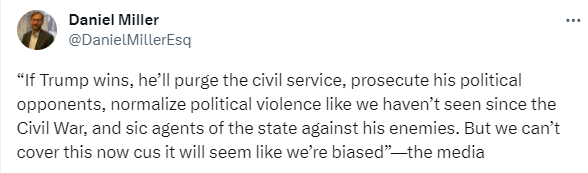
But our antiquated Constituion is a major stumbling block. So is the corporate news media:

Untitled

You Are Not the Only One Who Feels This Way

Perhaps it’s presumptuous of me to assume you have this feeling. I sure do. So does David Roberts, as he explains: 

Contemplating the latest [Orange Menace] revelations, the chaos in the US House, the bullshit hearings, the servicing of Putin … it just makes me feel genuinely crazy that anyone is voting for a Republican for anything. I barely even know how to argue. I just wanna say: LOOK AROUND.

Look at this motley collection of dimwits, apparatchiks, back-biters, liars, grifters, and narcissists. You want to be on their side? You want them in charge? I’ll never understand it. It’s crazy-making trying to pretend there’s some normal political dispute happening here.

To be a normie, news-following Democrat is basically to feel gaslit all the time, all day every day. I know pundits are supposed to affect this world-weary, seen-it-all attitude — actually having feelings is unforgivably naive — but some days it just all gets to me.

Like, we find out that [the Menace] is repulsed at the sight of a wounded soldier and instructs a general to hide the soldier away. That … should be it, right? Discussion over. Horrible person. No place in public life. Obviously. Wait. What? You say we’re just gonna roll on?!

You say House Republicans are mounting an impeachment based on nothing, purely out of revenge? OK, well, that’s that. Clearly wildly irresponsible people with no business being near the levers of power. Surely will be universally denounced. Wait. What? We’re just rolling on?

Hearings full of demonstrable lies, slandering longstanding public servants? Hostage-taking that could destroy the economy, with no coherent demands? Open corruption on the Supreme Court? Senators voting against impeachment out of fear for their safety? Just roll on.

It does something to a person, being forced to pretend that this is normal, just something else to scratch our chins about and debate on the morning shows. Just one more thing to slipstream into a both-sides template. The cognitive dissonance is corrosive.

Unquote.

While I’m here, amid all the right-wing anti-immigrant hysteria, this news might have been widely reported, but wasn’t (I wasn’t able to find the actual Census report it’s based on, but I doubt the libertarian Cato Institute made up the numbers).

  • the number of immigrants in 2022 was nearly 2 million immigrants lower than the Census Bureau’s 2017 projection for 2022;
  • over the last decade, the United States has seen the slowest growth in the immigrant share of the U.S. population since the 1960s;
  • the immigrant share is growing slowly, even while the United States faces the lowest total population growth in its history.

A Republican Admits the Terrible Truth

Mitt Romney was the Republican candidate for president in 2012. Barack Obama beat him. The election wasn’t very close. Six years later, Romney was elected to the Senate. After one term, Romney has decided not to seek re-election. The Atlantic has an excerpt from an upcoming biography of the Utah senator. Here’s what New York Times columnist Jamelle Bouie’s wrote about it in his newsletter:

Reading the recent excerpt from McKay Coppins’s forthcoming biography of Mitt Romney of Utah, I was struck by the depth of the senator’s contempt and disdain for much of the Republican Party, including many of his colleagues in the Senate.

He condemned their vanity, their venality, their cowardice. “Every time he publicly criticized [the Orange Menace], it seemed,” Coppins writes, “some Republican senator would smarmily sidle up to him in private and express solidarity.” Romney made note of the “rank cynicism” of his Republican colleagues and their almost total refusal to stand up for anything that might harm their future electoral prospects. He saved his harshest words, however, for those Republican senators who would do or say anything for political power and influence.

What bothered Romney most about [Senator Josh] Hawley and his cohort was the oily disingenuousness. “They know better!” he told me. “Josh Hawley is one of the smartest people in the Senate, if not the smartest, and Ted Cruz could give him a run for his money.” They were too smart, Romney believed, to actually think that [the loser] had won the 2020 election. Hawley and Cruz “were making a calculation,” Romney told me, “that put politics above the interests of liberal democracy and the Constitution.”

As for the latest crop of Republicans, Romney had this to say: “I don’t know that I can disrespect someone more than [Senator] J.D. Vance.”

Bouie says Romney’s words are “surprisingly harsh and unsparing for someone who is still an active participant in American political life”.

Yet they’re totally deserved. Bouie had more to say in his Times column:

“A very large portion of my party,” Senator Mitt Romney of Utah tells McKay Coppins, “really doesn’t believe in the Constitution”….

If Romney was using “the Constitution” as a rhetorical stand-in for “American democracy,” then he’s obviously right. Faced with a conflict between partisan loyalty and ideological ambition on one hand and basic principles of self-government and political equality on the other, much of the Republican Party has jettisoned any commitment to America’s democratic values in favor of narrow self-interest.

The most glaring instance of this, of course, is [the] attempt to overturn the results of the 2020 presidential election, which was backed by prominent figures in the Republican Party, humored by much of the Republican establishment and affirmed, in the wake of an insurrectionary attack on the Capitol by supporters of the former president, by a large number of House and Senate Republican lawmakers who voted to question the results.

Other examples of the Republican Party’s contempt for democratic principles include the efforts of Republican-led state legislatures to write political majorities out of legislative representation with extreme partisan gerrymanders; the efforts of those same legislatures to raise new barriers to voting in order to disadvantage their political opponents; and the embrace of exotic legal claims, like the “independent state legislature theory,” meant to justify outright power grabs.

In just the past few months, we’ve seen Tennessee Republicans expel rival lawmakers from the State Legislature for violating decorum by showing their support for an anti-gun protest on the chamber floor, Florida Republicans suspend a duly elected official from office because of a policy disagreement, Ohio Republicans try to limit the ability of Ohio voters to amend the State Constitution by majority vote, Wisconsin Republicans float the possibility that they might try to nullify the election of a State Supreme Court justice who disagrees with their agenda and Alabama Republicans fight for their wholly imaginary right to discriminate against Black voters in the state by denying them the opportunity to elect another representative to Congress.

It is very clear that given the power and the opportunity, a large portion of Republican lawmakers would turn the state against their political opponents: to disenfranchise them, to diminish their electoral influence, to limit or even neuter the ability of their representatives to exercise their political authority.

So again, to the extent that “the Constitution” stands in for “American democracy,” Romney is right to say that much of his party just doesn’t believe in it. But if Romney means the literal Constitution itself — the actual words on the page — then his assessment of his fellow Republicans isn’t as straightforward as it seems.

At times, Republicans seem fixated on the Constitution. When pushed to defend America’s democratic institutions, they respond that the Constitution established “a republic, not a democracy” [although, according to the English language, a republic is a kind of democracy]. When pushed to defend the claim that state legislatures have plenary authority over the structure of federal congressional elections and the selection of presidential electors, Republicans jump to a literal reading of the relevant parts of Article I and Article II to try to disarm critics. When asked to consider gun regulation, Republicans home in on specific words in the Second Amendment — “the right of the people to keep and bear Arms, shall not be infringed” — to dismiss calls for reform.

[The leader of the Republican Party] tried to subvert American democracy, yes, but his attempt rested on the mechanisms of the Electoral College, which is to say, relied on a fairly literal reading of the Constitution. Both he and his allies took seriously the fact that our Constitution doesn’t require anything like a majority of the people to choose a president. Attacks on representation and personal freedom — the hyper-gerrymandering of legislatures to preserve and perpetuate minority rule and the attempts to limit or restrict the bodily autonomy of women and other Americans — have operated within the lines drawn by the Constitution, unimpeded or even facilitated by its rules for structuring our political system.

Republicans, in other words, do seem to believe in the Constitution, but only insofar as it can be wielded as a weapon against American democracy — that is, the larger set of ideas, intuitions, expectations and values that shape and define political life in the United States as much as particular rules and institutions.

Because it splits sovereignty between national and subnational units, because it guarantees some political rights and not others, because it was designed in a moment of some reaction against burgeoning democratic forces, the Constitution is a surprisingly malleable document, when it comes to the shaping of American political life. At different points in time, political systems of various levels of participation and popular legitimacy (or lack thereof) have existed, comfortably, under its roof.

Part of the long fight to expand the scope of American democracy has been an ideological struggle to align the Constitution with values that the constitutional system doesn’t necessarily need to function. To give one example among many, when a Black American like George T. Downing insisted to President Andrew Johnson that “the fathers of the Revolution intended freedom for every American, that they should be protected in their rights as citizens, and be equal before the law,” he was engaged in this struggle.

Americans like to imagine that the story of the United States is the story of ever greater alignment between our Constitution and our democratic values — the “more perfect union” of the Constitution’s preamble. But the unfortunate truth, as we’re beginning to see with the authoritarian turn in the Republican Party, is that our constitutional system doesn’t necessarily need democracy, as we understand it, to actually work.

One More Answer to a Frequently Asked Question

You’ve probably never heard a discussion or seen an article about Biden voters. What makes them tick? Why do they support such a person? You have, however, heard lots of discussion and seen too many articles about the people who support the other guy. What are they thinking? What are they like? How can they support an individual who’s so obviously corrupt, egotistical, incompetent, and so on? You’ve probably asked yourself the same question.

There’s a simple explanation for why one group of voters is endlessly analyzed and the other isn’t. Biden voters aren’t mysterious to the people who run the news media. The other guy’s voters are. Weird is interesting.

Journalist Tom Nichols (who goes by @RadioFreeTom) offers an explanation I hadn’t heard before:

I wrote a whole book on why democracies become illiberal, but something about America after [the other guy’s] indictment really strikes me. Yes, MAGA world is about resentment and ignorance and displaced anger and all that. But it’s also a time that seems to me incredibly…juvenile.

[Him] hawking t-shirts with his mug shot is like some hair band selling posters of their guy getting busted for drugs or waggling his junk onstage or something. It’s beyond unserious. It’s child-like, the political version of Oppositional Defiance Disorder. And yet it’ll sell.

In the book, I argue that peace and affluence have been a big part of America’s slide: Life’s good and people don’t grasp that ghastly decisions can have disastrous effects – including on them. Because other adults make sure the nation functions even when the voters go nuts.

But maybe peace and affluence, in addition to making people bored out of their skulls, also prevents them developing into adults who make democracy possible. This is the world, as I wrote in the book, in which Huxley wins, not Orwell. (I am stealing Neil Postman’s point here.)

I suppose you could call all this *decadence*, but it’s not even gloriously decadent in that grandiose, Weimar, “Cabaret” kind of decadence. It’s just people putting on costumes and hats and being violent and then crying in front of judges when it all goes horribly wrong.

Childishness doesn’t make voters less dangerous to democracy. But even if [he] is defeated (again), this is a serious level of social dysfunction. You can’t sustain a superpower when nearly half of its citizens are mired in eternal petulant childhood.

And millions of our oldest citizens, people my age – [his] most reliable voting bloc – who should be our wisest among us, are the ones most like angry, irrational toddlers (much like [their leader] himself). This is incomprehensible to me, especially as I get older.

In another weird role-switch, these right-wingers are now like the dilettantish countercultural activists of the 60s: well-off would-be revolutionaries who really have no idea what they’re doing and merely want to act on ill-defined, self-actualizing, self-centered emotion.

Adults, however, know that there were people who came before us, and people who will come after us, and that “the moment” is not supreme. We have a civic inheritance, a trust, to hold and to protect, and then to pass on. This used to be central to the American idea. No longer.

All we can do is hope that the generations coming up can learn to embrace civic adulthood. I’m (mildly) optimistic – if we get past these next few elections. But how weird that so many adults now worship – and emulate – a choleric 77 year old toddler.