Taking Advantage of the Electoral College: Two Possibilities

I don’t know about you, but I’m still avoiding the news. 

I do know, however, as votes are still being counted, Hillary Clinton is leading her opponent. She has 60.5 million; he has 60.1 million. (And roughly 6.2 million fools voted for candidates who had no chance to win.) In fact, her margin will continue to grow, since California is still counting votes and California voters strongly support Clinton. 

In a better world, these results would mean Clinton won the election. But in this world, we didn’t hold just one election. We held 51 separate elections, one for each state and one for the District of Columbia. The winner of each of those 51 elections thereby received a certain number of “electoral votes”. 

For example, Clinton beat her opponent by more than 2.5 million votes in California. That means she will get all of California’s 55 electoral votes. But if she’d won the state by 1,000 votes instead, she’d still get all 55. With some very minor exceptions, it’s winner-take-all. This is the system our founding fathers came up with more than 200 years ago. 

Furthermore, the number of electoral votes each state receives isn’t based purely on population. California, for example, has about 38.5 million residents. Montana has 1 million. One might think that California would get 38 times as many electoral votes as Montana, but that’s not how it works. Each state (and D.C.) gets at least 3 electoral votes. So empty Montana gets 3, while not-empty California gets 55, or 18 times what Montana gets, not 38 times.

Another way of saying this is that because we elect a President in this strangely indirect way, individual votes cast in Montana are worth more than ones cast in California. 

Our founding fathers weren’t idiots, of course. The complicated system they devised was partly a way to give smaller states more representation than bigger states, because small states like Rhode Island were afraid they’d be bullied by big states like Virginia. That’s why the small states were given extra weight in choosing a President. (Why the big states weren’t equally concerned about being cheated is an interesting question.)

So, officially speaking, we won’t know who the next President will be until December 19th. That is when the various “electors” submit their ballots. 

But wait! The founding fathers didn’t completely trust the wisdom of the voters. They had more trust in the electors, who were presumed to be pillars of the community. The voters might prefer an orange-haired demagogue or TV personality as President. The electors would presumably know better. They might have the good sense to choose a former Senator and Secretary of State. They might even choose whichever candidate won the nationwide vote. The point is that there is nothing in the U.S. Constitution that requires an elector to vote for the candidate who won that elector’s state.

Now, it’s true that some states would levy a small fine on an elector who applied his or her judgment and voted for someone who didn’t win the state’s presidential election. But other states don’t even levy a fine. Electors from those states can vote for anyone with no penalty at all (except a lot of criticism from disgruntled voters back in their home state).

The ability of the presidential electors to vote for whomever they want has given rise to a petition at Change.org. It calls for the Electoral College to choose Hillary Clinton on December 19th. If she ends up with, say, 230 electors pledged to her after all the statewide ballots are counted, she would only need 40 electors to switch to her. Whoever receives 270 electoral votes become President. That’s how the system was designed to work.

I don’t expect 40 or so Republican electors to do what’s best for their country and the world, so I’m not expecting much from the petition. But I signed it anyway, as have more than a million other people. As they say, any port in a storm, especially a  world-class (pardon my French) shit storm! 

Fortunately, there is another way to eventually use the Electoral College to make America a better place. Several states have already adopted legislation that would award their electoral votes to whoever wins the nationwide “popular” vote. The legislation will take effect in those states as soon as states with a combined total of 270 electoral votes pass the legislation. After that, whichever candidate got the most votes nationwide in the next Presidential election would automatically receive at least 270 electoral votes and become President. It wouldn’t matter how states that haven’t adopted the legislation allocated their electoral votes.

The great thing about this plan, which is called the National Interstate Popular Vote Compact, is that it wouldn’t require changing the U.S. Constitution. The anti-democratic effect of the Electoral College would be eliminated without eliminating the Electoral College itself.  It’s very difficult to amend our Constitution. It’s only been done fifteen times in the last 200 years. So a plan that uses the Electoral College instead of trying to get rid of it has much to recommend it. (Of course, as long as the Electoral College exists, some electors might still go their own way.)

As of 2016, ten states and the District of Columbia have joined the Compact. Their 165 electoral votes are 61% of the 270 votes needed for it to have legal force. In addition, the necessary  legislation is pending in Michigan and Pennsylvania. If those states adopt it, we’ll have 74% of the necessary 270 votes.

As you might expect, states controlled by Republicans are less likely to join the Compact. Republicans love the fact that they’ve won two of the last five Presidential elections while losing the popular vote (The man who became President lost to his Democratic opponent, Al Gore, by 550,000 votes in 2000).  That doesn’t mean, however, that the Compact will never come into play. It just means Democrats need to take control of more state governments.

It might even be possible to get the necessary legislation passed in Republican-controlled states using public referendums or ballot questions. Most people, if asked, would probably agree that the candidate who gets the most votes should win the election. Well-financed campaigns to get the issue on the ballot in several more states might hasten the day when the person who gets the most votes will always win the election.

Of course, many Americans already believe that’s how our system of government works. Whoever gets the most votes wins. Knowledge of the Constitution isn’t our strong point. After the election we just had, I don’t know what is. 
It’s Still Called “Whereof One Can Speak”

Millions of Americans just said “fuck you” to the rest of the country and the rest of the world. They truly are deplorable.

It appears that more of us voted for someone else. We can hardly believe what our fellow citizens did.

Millions more voted for a third or fourth-party candidate in what was always a two-person race. I can’t speak for anyone foolish enough to have done that.

Millions more weren’t allowed to vote or didn’t bother to. I can’t speak for them either.

Our 228-year old Constitution has failed us once again.

I can’t think of anything else to say.

It’s Called “Whereof One Can Speak”

Millions of Americans just said “fuck you” to the rest of the country and the rest of the world. They truly are deplorable.

A few million more of us voted for someone else and can hardly believe what our fellow citizens did.

I can’t think of anything else to say.


We’re at the Brink, So We Need to Get Serious

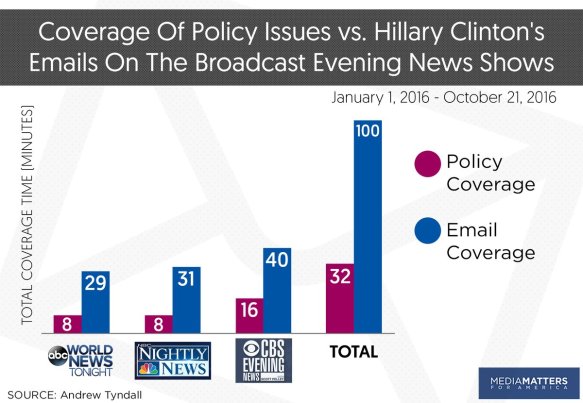
If you’re familiar with American politics and mass media, you probably won’t be surprised to hear that, between January 1st and October 24th of this year, the nightly news programs on ABC, CBS and NBC devoted three times as much coverage to Hillary Clinton’s emails than to all issues of government policy combined (from the Tyndall Report):

cwrzmtrweaacwe5

It’s safe to say this imbalance has grown even larger since October 28th. That’s when the Republican FBI Director Robert Comey sent Congress his cryptic letter regarding Anthony Weiner’s laptop. As Comey should have realized (and no doubt did), releasing that letter eleven days before the election led to an explosion of speculation and related discussion, none of which has revealed relevant facts about anything at all except that Trump and his supporters will use any excuse to paint Clinton as corrupt.

The incessant email stories on the broadcast networks and cable news and in leading newspapers has had a bizarre result. From the Gallup polling company:

We found that “email” was by far the most frequently used word when we asked Americans what they had read or heard about Clinton back in August 2015.…As [we] put it then: “When Gallup recently asked Americans to say what they recall reading or hearing about her, one word — ’email’ — drowned out everything else.”

Now we are asking Americans every day the same basic question — what they have read, seen or heard about Clinton — and once again, “email” dominates. For interviews conducted Oct. 28-31, “email” drowns out everything else, particularly anything relating to policy or substance. Indeed, the second-, third- and fourth-most-frequently used words associated with Clinton also relate to emails: “FBI,” “investigation” and “scandal.”

Believe it or not, 46% of voters in a recent poll said that Trump, the most obvious con man ever to run for the Presidency, is more trustworthy than Clinton (only 38% gave her higher marks). When people are asked to explain why they don’t trust Clinton, the most frequent response is, of course, “emails”.

As a minuscule corrective to the mountain of email nonsense that the media, Wikileaks (assisted by Russia, of course) and the FBI (officially and via politically-motivated leaks) have disseminated, here are an article and a video worth considering. You might also share them with friends, acquaintances, antagonists and random citizens before the voting ends on Tuesday.

First, Matthew Yglesias of Vox analyzes the Clinton email story with the aptly titled: “The Real Clinton Email Scandal Is That a Bullshit Story Has Dominated the Campaign”. He explains what Clinton did and shows why we shouldn’t care. An excerpt:

Clinton broke no laws according to the FBI itself. Her setup gave her no power to evade federal transparency laws beyond what anyone who has a personal email account of any kind has. Her stated explanation for her conduct is entirely believable, fits the facts perfectly, and is entirely plausible to anyone who doesn’t simply start with the assumption that she’s guilty of something.

Given [Secretary Colin] Powell’s conduct, Clinton wasn’t even breaking with an informal precedent. The very worst you can say is that, faced with an annoying government IT policy, she used her stature to find a personal workaround rather than a systemic fix that would work for everyone. To spend so much time on such a trivial matter would be absurd in a city council race, much less a presidential election. To do so in circumstances when it advances the electoral prospects of a rival who has shattered all precedents in terms of lacking transparency or basic honesty is infinitely more scandalous than anything related to the server itself.

And here is an eight-minute video uploaded today by Humanity for Hillary. It features Daveed Diggs and is called “Clinton vs. Trump on the Issues”:

Finally, a few words from Jonathan Chait of New York Magazine: 

However low my opinion of the Republican Party, it was not low enough….This is not a joke. This is one of the moments in history when the republic is at the brink.

Republican voters chose Trump. Republican donors have supported Trump. Republican politicians, even those who condemned him as a charlatan totally unfit to be President, have endorsed Trump. Others have remained silent. There are no excuses for what they’ve done. But now we have the chance to teach them a lesson. We need to vote for Democrats up and down the ballot. Only an historic, stinging defeat for the Republican Party will protect America and the world from getting this close to the brink the next time someone as dangerously abnormal as Trump wants the ability to launch nuclear missiles.

We Are Stronger Together, But Let’s Get to Work!

You’ve probably heard variations on a well-known slogan this year. Two I’ve heard are “Make America White Again” and “Make America Great for White People Again”.

It’s unlikely, however, that you’ve heard variations on Hillary Clinton’s slogan or even know what her slogan is. She never wears a silly hat that has it plastered on the front.

20160924_164301

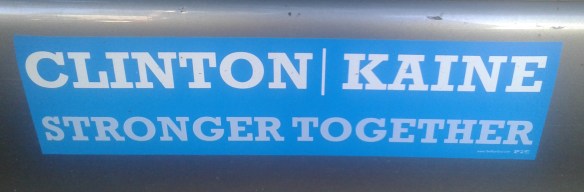
Yes, that’s it: “Stronger Together”.

I agree with the sentiment, of course, since we are stronger as a nation when we work together. But “Stronger Together” hasn’t caught on, certainly not as much as “Make America As Great As It Was For White Men In 1955”.

In fact, there were at least two articles this week that said Hillary needs a better slogan, something that would express an overarching theme, something you could put on a t-shirt or a stupid hat. The Guardian actually called their editorial “Hillary Needs a Slogan to Sum Up What She Stands For”:

Mrs. Clinton seems to have a hundred carefully costed policies but not one eye-catching slogan. She radiates a sensible incrementalism. She campaigns in prose, leaving poetry to her predecessor. This is a mistake. She needs to focus on what is driving discontent in America: an economic system that no longer defuses high levels of inequality with opportunities for all….Mrs. Clinton needs to find a resonant theme to sum up her policies: a Marshall Plan for the middle classes would not be a bad idea. Monday is her chance to show she is motivated by the common good. Mrs. Clinton should seize it.

I’m not sure many Americans could identify the Marshall Plan today, but you get their drift. A columnist for Bloomberg View contributed “Clinton Needs a Better Slogan” the very same day:

The Democratic nominee does have 40 bullet-point programs on everything from child care to mental health to the Middle East. But she has no memorable rallying cry to capture her candidacy and rationale to be president.

To test that, simply ask a bunch of Clinton supporters to summarize in a sentence or two what her candidacy is about. You usually get multiple paragraphs in response.

This is more a political than a substantive issue. Slogans are no substitute for governing policies….Still, a catchphrase can be a powerful and moving expression of a candidate’s authentic ambitions.

Yes, a simple catchphrase could finally help undecided voters make up their minds between two candidates as different as Hillary and Voldemort.

So I got to thinking. What might be better than “Stronger Together”?

First, it occurred to me that Hillary has said her primary goal as President will be to get the economy working for all of us, partly by improving the labor market in a number of ways.

Second, Hillary is known as a hard worker. Even Republican politicians agree that she has a remarkably strong work ethic. Indeed, people often suggest she works too hard and needs to lighten up (all those position papers, for example).

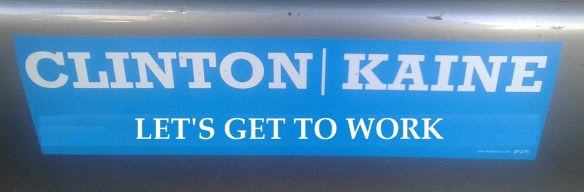
So I came up with this:

20160924_164301-newest

I like “Let’s Get To Work” for several reasons.

It summarizes Hillary’s primary goal as President, an improved economy for all of us, not just those at the economic top.

It reminds people that she’s a hard worker who has lots of ideas and the energy and temperament to get things done, even to get things done with the Republicans in Congress, as she did when she was First Lady and a Senator.

It brings to mind the backlog of work to be done in Washington, all the projects and initiatives that have gone nowhere because of Republican opposition (increased infrastructure spending, a higher minimum wage, immigration reform, criminal justice reform, etc. etc.).

For older voters, it might even evoke memories of Franklin Roosevelt’s New Deal or, more recently, the growing economy we enjoyed during Bill Clinton’s administration. And there could hardly be a more welcome promise to the unemployed and underemployed than “Let’s Get To Work”.

I believe it’s positive, inclusive and relatively specific. Plus, it sounds less like a reaction to her opponent’s campaign of bigotry and exclusion than “Stronger Together”.

Since we’re living in the era of electronic sharing, I submitted my proposed slogan to Hillary and her campaign and also sent it soaring into the Twitter-verse. I’ve also shared it with a few live human beings of my acquaintance.

Of course, I know it’s late to fully adopt a new slogan, and so far all I’ve got back from the Clinton campaign is a form letter thanking me and encouraging me to volunteer.

But hope springs eternal! Perhaps, when Hillary offers her closing remarks on Monday night before an audience of 100 million or so people (minus me), she’ll wind up her two or three minutes with a ringing call to action: 

Let’s get to work!

Hey, maybe she’ll even cite a guy from New Jersey as the source of this new, exciting summation of her candidacy. Stranger things have happened!

And if you doubt me, consider this editorial in The New York Times from tomorrow’s paper: “Hillary Clinton for President: Our endorsement is rooted in respect for her intellect, experience and courage”. The whole thing is worth reading, but here’s the last paragraph:

Through war and recession, Americans born since 9/11 have had to grow up fast, and they deserve a grown-up president. A lifetime’s commitment to solving problems in the real world qualifies Hillary Clinton for this job, and the country should put her to work.

You can thank me after the election.