Bring It On, He Said

You probably heard about a train accident in Ohio. The Washington Post said “the derailment erupted into a culture battle”, as if culture battles simply happen without any help from the people who specialize in starting them and getting them in “the news”. Josh Marshall of Talking Points Memo tells Democrats how to respond:

In recent days I’ve seen every major paper write a version of the How Did This Tragic Train Derailment Become a New Culture War story. I didn’t need to ask myself whether any of them gave the actual answer, which I think most of us know [Checks notes…They didn’t].

How is it that a train derailment caused by a major Republican-donating corporation, in a state run by a Republican governor, caused at least in part by regulations rolled back by Republican President D____ T____ … well, how exactly is that a story about Democrats not caring about people in “flyover country”? The Republican crackpot investigations complex is even now prepping to hold hearings about it.

The reality of the situation is that big corporations like Norfolk Southern spend millions in Washington for lax regulation and our railroad infrastructure is woefully aged and deficient — and not just for freight rail. Virtually every upgrade to the country’s railroad infrastructure and the quality of its rail stock pays dividends either in safety or efficiency. Republicans are simultaneously calling out corporations for not caring about ordinary Americans while carrying their anti-regulatory water on Capitol Hill. Democrats should run a freight train right through that contradiction. Only good things can come of it.

Democrats should pound on the fact at every opportunity that the T____ White House not only rolled back those regulations but T____ literally bragged about doing so on Twitter.

But that’s hardly enough. Democrats, led by the White House, should immediately bring forward expansive legislation to bring America’s railroads up to code, to not only add additional health and safety regulations but change the formulas and frameworks through which new regulations are promulgated. (They’re currently held captive by a framework of narrow cost-benefit analysis which does not take into account the true externalities and consequences of man-made disasters like these.) That legislation is the answer to every Republican’s crocodile tears about how did this happen? Why was Norfolk Southern allowed to do this? How do we prevent this from ever happening again?

You call it the Rail Safety and Corporate Accountability Act of 2023. You keep flogging it nonstop and certainly every time the East Palestine catastrophe comes up. It should be Democrats’ focus in any hearings about it. Was it terrible? Yes. Pass the Act. Should the big corporations be held accountable? Definitely. Pass the Act.

But it has to come now, not in response to more caterwauling months from now.

Does this mean the law will pass? It might. Even under a Republican House. There are actually signs of some emerging bipartisan agreement on passing new legislation. But if Republicans refuse to bring such a bill or any reasonable approximation of it to a vote let them explain why they oppose it.

Few things are more important in politics than making clear why things happen or fail to happen. That includes the policies that allow them to happen and the people who keep those policies in place. There is a rearguard chorus from the left saying that Obama should have done more than the limited regulations he advanced within current law and that Biden should have done more in his first two years to restore the regs that T____ turned back. Fair enough. All the more reason to pass the Act.

For Democrats, the policy and the politics line up exactly. They should be leaning into it. Yes, Republicans react to their own policy failures with performative pearl-clutching. Elite media buys it every time. But that’s only a conversation for people already part of the reality-based community. More importantly, being right about that doesn’t make future toxic chemical derailments any less likely. President Biden’s State of the Union address shows the rhetorical mold in which to sell it.

Introduce the legislation and push it hard. Make clear to everyone what the problem is and where everybody stands and increase the chances of actually improving things. Policy and politics line up precisely.

Where Do You Go in a Handbasket?

The excellent Tom Tomorrow indicates our possible destination.

TMW2023-02-27colorXLYour better handbaskets have wheels.

To support Mr. Tomorrow’s work and receive his weekly cartoon and newsletter, you can join Sparky’s List.

It Used To Be the Blue and the Gray; Now It’s Blue and Red

One of the most moronic members of Congress was in the news recently when she proposed a “national divorce”. Red and blue states would go their separate ways. She’d have us remain one country, but the national government would have much less authority than it does now.

American politics being what it is these days, many of us, probably most of us, have thought it would be a good idea if those other states — the crazy ones — went off and formed their own damn country. Unfortunately, this would be a very difficult thing to do.

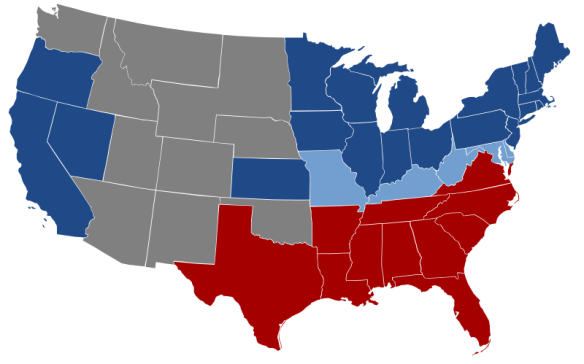
Back in 1861, the country was geographically divided between the North and South. The South  had slavery, its “peculiar institution”, and the North didn’t. But the division wasn’t that clearcut. There were five “border states” (Missouri, Kentucky, West Virginia, Maryland and Delaware, moving from west to east) that permitted slavery but didn’t secede from the Union. They’re the light blue ones below (the gray areas were relatively unsettled “territories” that hadn’t yet become states).

US_map_1864_Civil_War_divisions.svg

President Lincoln’s Emancipation Proclamation was only intended to end slavery in the eleven states that had seceded. It wasn’t until the 13th Amendment to the Constitution was ratified in 1865 that slavery was abolished everywhere. But geography made it relatively easy for the southern states to try to leave.

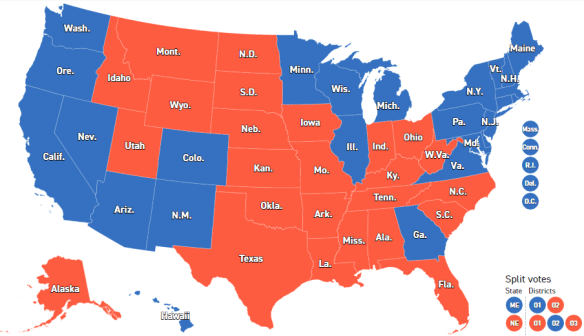
Dividing America by red and blue states is more complicated today. This map shows the results of the 2020 presidential election. The blue states voted for the Democratic winner; the red ones for the Republican loser. The red states are connected; the blue ones aren’t. And look at Georgia all by itself. (That’s where the Republican moron who proposes a national divorce was voted into Congress. Based on this election, she’d want to relocate.)

Untitled This way of portraying an election makes sense in terms of our obsolete Electoral College, since it requires each state to hold its own separate presidential election. In almost every state, a candidate gets all of that states “electoral votes” if they beat their opponent by one vote in that state’s election.
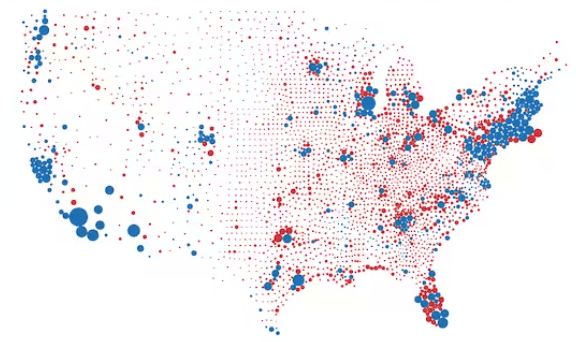
But a state-level map hides something important about American politics. After the 2004 election, the editors of a Seattle alternative paper called “The Stranger” wrote about our Urban Archipelago:

Look at our famously blue West Coast. But for the cities—Seattle, Portland, San Francisco, Los Angeles, and San Diego—the West Coast would be a deep, dark red. The same is true for other nominally blue states. Illinois is almost entirely red—Chicago turns the state blue. Michigan is almost entirely red—Detroit, Lansing, Kalamazoo turn it blue. And on and on. What tips these states into the blue column? Their urban areas do, their big, populous counties….

Liberals, progressives, and Democrats do not live in a country that stretches from the Atlantic to the Pacific, from Canada to Mexico. We live on a chain of islands. We are citizens of the Urban Archipelago, the United Cities of America. We live on islands of sanity, liberalism, and compassion—New York City, Chicago, Philadelphia, Seattle, St. Louis, Minneapolis, San Francisco, and on and on.

And we live on islands in red states too—a fact obscured by that state-by-state map. Denver and Boulder are our islands in Colorado; Austin is our island in Texas; Las Vegas is our island in Nevada; Miami and Fort Lauderdale are our islands in Florida. Citizens of the Urban Archipelago reject heartland “values” like xenophobia, sexism, racism, and homophobia, as well as the more intolerant strains of Christianity that have taken root in this country….

For Democrats, it’s the cities, stupid—not the rural areas, not the prickly, hateful “heartland,” but the sane, sensible cities—including the cities trapped in the heartland.

This map shows the 2020 election by county instead of state. The blue dots are the Urban Archipelago, the United Cities of America. (The map also shows how Biden managed to win by 7.5 million votes, unlike state-level maps that ignore how many people are in those states.)

Untitled

Of course, not everybody in Los Angeles County or Miami-Dade voted for Democrats. But on top of all its other problems, a “national divorce” by state would strand millions of Democratic city dwellers in red Republican states free to become even more reactionary and dangerous to live in.

Even though un-uniting the United States is unlikely, thinking about the possibility helps us understand our country’s political geography. According to a 2019 paper by Will Wilkinson of the Niskanen Center, it’s all about cities and population density. The title of the paper is “The Density Divide: Urbanization, Polarization and the Populist Backlash”. Here’s his summary of his findings:

We’ve failed to fully grasp that urbanization is a relentless, glacial social force that transforms entire societies and, in the process, generates cultural and political polarization by segregating populations along the lines of the traits that make individuals more or less responsive to the incentives that draw people to the city. I explore three such traits — ethnicity, ideology-correlated aspects of personality, and level of educational achievement — and their intricate web of relationships. The upshot is that, over the course of millions of moves over many decades, high density areas have become economically thriving, multicultural havens while whiter, lower density places are facing stagnation and decline as their populations have become increasingly uniform in terms of socially conservative personality, aversion to diversity, and lower levels of education. This self-segregation of the population, I argue, created the polarized economic and cultural conditions that led to populist backlash [note: and the election of You Know Who in 2016].

Because the story of urbanization just is the story of a strengthening relationship between density, human capital and economic productivity, it’s also the story of relative small town and rural decline. The same process that has filtered better-educated, more temperamentally liberal whites out of lower density places has left those places with less vibrant economies, but also with more place-bound, ethnocentric populations.

It’s no shock that leavers leave and stayers stay. What’s surprising is that, if you’re white…,  the personality traits that make you more or less inclined to leave or stay — that make you more or less magnetized to the rising attractive force of the city — also predict how socially conservative or liberal you’ll tend to be, and which political party you’ll tend to support.

So the pull of urbanization has segregated us geographically on those traits, and it has done it so thoroughly that Democratic vote share now rises, and Republican vote share drops, in a remarkably linear fashion as population density rises. The relationship between density and party affiliation is, with few exceptions, similar everywhere — in “red states” and “blue states,” in sprawling metro regions and bucolic small towns — and majorities tend to flip at the density typical of a big city’s outer suburbs. I call this partisan polarization on population density the “density divide.”

When populations segregate geographically on traits relevant to ideology and party affiliation, political polarization is sure to follow. The increasing concentration of the economy in big cities, which is both a cause and effect of urbanization, amplifies this polarization. Rising prosperity reliably produces a liberalizing, tolerant, positive-sum mood. Material insecurity, in contrast, tends to elicit a grim, zero-sum, us-or-them mindset. Because the sunshine of prosperity has become increasingly focused on urban populations, lower density white populations — which, thanks to the sorting logic of urbanization, are already more conservative and ethnocentric — have been left with objectively darkening prospects and a mounting sense of anxiety that is, at once, economic and ethno-cultural.

This combination of conditions created a political opportunity [a certain orange demagogue]  managed to exploit. Because urbanization is reshaping societies everywhere around the world, it has created similar conditions, and similarly illiberal strongman leaders, in other countries as well. If we’re going to be able to do anything about the acrimony of polarization and the peril of ethno-nationalist populism, we’re going to have to get the story straight. This cross-disciplinary account of the social and psychological forces behind the density divide is my preliminary attempt to put us, finally, on the right track.

The Rot and Greed Inside Fox “News”

Fox “News” is in the news because a lawsuit revealed what the company’s leaders think of their viewers, i.e. they prefer comforting lies to truth and if Fox doesn’t feed them enough comforting lies, they’ll change the channel and Fox won’t make as much money.

Brian Stelter explains (behind the Atlantic’s paywall):

The basic story of Fox News and the 2020 election is well understood. Fox’s relatively small news operation covered the vote count accurately; this coverage infuriated President D____ T____, the MAGA base, and Fox’s opinion stars; some viewers temporarily flipped to further-right outlets, such as Newsmax; and Fox panicked.

But thanks to Dominion Voting Systems, which is pursuing a $1.6 billion defamation lawsuit against Fox, we now know that the network’s sense of crisis was even more intense than it appeared from outside. With the case careening toward trial, a court filing [last week] revealed some of what Dominion found during the discovery process, including eye-popping messages from Sean Hannity, Tucker Carlson, and Fox’s senior management. “Getting creamed by CNN!” Fox’s owner, Rupert Murdoch, wrote to its top executive after seeing the overnight ratings on November 8. “Guess our viewers don’t want to watch it.”

He was right. Some of Fox’s top shows began broadcasting a better story, one that its viewers did want to watch: a conspiracy-laden tale about crooked Democrats stealing an election. Dominion is arguing that Fox knew full well that [the] voter-fraud allegations were bunk, but promoted the lies anyway.

Whether or not Dominion prevails in court, and many experts believe it will, the lawsuit is already forcing an ethical reckoning over Fox’s disrespect of its audience. Hour after hour, day after day, Fox stars kept signaling to viewers that T____ might still win the election not because they thought he would, but because they were worried about their ratings. And we all witnessed the consequences on January 6….

On November 12, 2020, nearly a week after Joe Biden clinched the presidency, … Hannity pretended that the outcome was still in doubt. He said the election was not fair. He cited “outstanding votes that have yet to be counted” and “more reports of dead people voting from beyond the grave.” And, crucially, he talked at length about Dominion….

The Fox News correspondent Jacqui Heinrich … had the audacity to tweet the truth. She wrote that “top election infrastructure officials”—including some in [the current] administration—had issued a statement saying “there is no evidence that any voting system deleted or lost votes, changed votes, or was in any way compromised.”

… Carlson flagged Heinrich’s tweet and told Hannity, “Please get her fired.” Why? Because her minor Twitter fact-check of an out-of-control president was exactly the sort of thing that Fox’s fan base could not stand to see.

“It needs to stop immediately, like tonight,” Carlson wrote. “It’s measurably hurting the company. The stock price is down. Not a joke.”

Hannity replied and said he had already sent the accurate and thus offending tweet to Fox News Media CEO Suzanne Scott.

“Sean texted me,” Scott wrote to two colleagues…. Scott was bothered too. She worried that reporters at other outlets would notice Heinrich’s tweet: “She has serious nerve doing this and if this gets picked up, viewers are going to be further disgusted”….

The new legal filing by Dominion is such a showstopper [because] we can read exactly what the leaders and stars of Fox News really think. This is my biggest takeaway: In the days after Biden won the election, while T____ tried to start the steal by shouting “Stop the Steal,” the most powerful people at Fox News were not concerned about [informing their audience or] the health of U.S. democracy. They were concerned about Fox’s brand and their own bottom line.

Stelter has talked to people at Fox:

A senior staffer at Fox railed against the network’s journalists and math wizards who had called Arizona for Biden, calling them “arrogant fucks”.

[A] former morning-show producer told me, “We were deathly afraid of our audience leaving, deathly afraid of pissing them off.”

A veteran staffer [said] “I feel like Fox is being held hostage by its audience”…

Sources at Fox [have] told me to think of it not as a network per se, but as a profit machine. They feared doing anything that would disrupt the machine. 

Jay Rosen, a journalism professor at New York University, also describes Fox “News” as a “machine”:

The latest filing by Dominion Voting Systems in its defamation suit against Fox nails something critics have long argued for. Fox is not a news organization. It’s something else. But what is this thing? I will try to answer that.

The Dominion suit establishes that Fox stars (like Tucker Carlson) and executives (like CEO Suzanne Scott) were fearful and enraged when some of their own people blundered into delivering a true and accurate report about the 2020 election. Think about that. When its own talent reported the facts truthfully, the result was a company crisis….

If Fox is not a news organization … and it is not “opinion” either (because the Dominion filing shows the hosts are frightened to share their real opinions) then what is it, exactly? Some common answers: It’s entertainment. It’s propaganda. No, it’s just ratings.

[It’s] the commercial arm of a political movement that has taken control of the Republican Party. The product is resentment news. Current ways to resent. Success in that market makes for political power. [It’s] a kind of machine.

By “machine” I mean to evoke both the manufacture of politicized grievance for fun and profit, and the kind of machine through which Richard Daley rose to power in mid 20th century. A machine in the sense of the Cook County Democratic Machine. Again: not a news organization.

Dominion’s filings describe a time when the audience took charge of the resentment machine. Power traded hands for a bit. Viewer backlash from a correct call in Arizona felt ruinous. Stars with shows and executives nominally in charge of Fox saw how weak their positions were.

Fox has to accept that its powers are limited. The Fox audience can veto events that in the rest of the world unquestionably occurred. You’re not a news organization if your audience’s refusal to accept what happened prevents [you from telling them] what happened.

Both the Republican Party and Murdoch’s fear-and-loathing machine know they cannot control the core audience for commercialized resentment and white nationalism, which will turn on anyone who interferes in the free exercise of its many hatreds.

We are faced with a vicious circle. There is an audience for right-wing fake news. Fox cultivates that audience by giving it fake news. That makes the audience want more fake news. So that’s what Fox gives them. We might think that Fox’s audience will shrink when they realize they’re being lied to and otherwise manipulated. But since they get their news from Fox “News”, they’ll probably never hear about it and won’t believe it if they do.

The Good News About Social Security

Democrats created Social Security in 1937 over the usual Republican opposition. People with jobs put money in while they work and take money out (usually more than they put in) when they retire. The program has been in the news lately because President Biden pointed out that at least one leading Republican had suggested Social Security and all other government programs should cease to exist every year unless the president and Congress agreed to renew them in some form or other (he seems to have backed away from that position after more people heard about it).

Since Social Security and its finances are a big deal, it helps to know the truth. Josh Marshall of Talking Points Memo explains:

Political reporters remain way behind when it comes to seeing through the flimflam of Republicans’ schemes to cut or dismantle Social Security. [Too often,] press accounts of the financing of the program [aare] trapped in Republican talking points. In X number of years, we hear again and again, Social Security will become “insolvent.”

But this isn’t true. At best, it’s a totally misleading way to describe how the federal government pays for things.

Social Security and Medicare are funded (almost entirely) by a payroll tax of approximately 15% on wage and salary income up to a statutory cap, which currently stands at $160,200. That tax is split between the employer and the employee. It funds the two programs. A couple generations ago, Congress increased the tax to build up a surplus to pay for the benefits of the Baby Boom generation. That’s the “trust fund.” Social Security “lent” that extra money to the rest of the federal government, i.e., it purchased government bonds. Eventually the Trust Fund will run out of bonds to cash in. The current estimate is that it will happen in the mid-2030s. This is when Social Security supposedly becomes “insolvent.”

But that’s a meaningless term. The federal government has to pay its promised benefits. If they can’t all be paid out of payroll taxes, the remainder can and will be paid out of general revenues. This was actually the assumption about what would eventually happen back when the program was founded almost a century ago. (Look it up.)

This doesn’t mean it’s a non-issue. It means there will be a funding gap and that’s a budgetary issue to be resolved. It’s not “insolvent.” That’s just scare talk. Now, how can the funding gap be resolved? You could just pay the remainder out of general revenue (the general tax base of income, corporate, capital gains and other taxes that are not tied to any specific program). But there’s another more straightforward approach: just rejigger the payroll tax.

You could simply raise the payroll rate. But that’s a bad idea….Payroll taxes are really regressive. You’re paying about 7.5% on the first dollar you make up to $160,200. No deductions or anything. Every dollar. Most economists would say you’re actually also paying the employer side too because that’s money that goes to the cost of employing people that would otherwise go to the employee. So there’s a good argument that low- and middle-income workers are paying a flat tax of 15% on every dollar they make. It makes no sense to raise that rate. The simpler and more equitable solution is just to raise the cap.

It gets raised every year by a calculus tied to cost of living and related measures… But I mean raise it to a higher level, beyond the annual increase. There are various ways to do this. You can just raise the number from $160k to say $200k or $250k. Or, perhaps more equitably, you could leave the cap at $160k and have it kick in again starting at $500k. That way you put most of the burden on very high income earners.

Obviously there are a limitless number of ways you can do this. The point is that there are really basic budgetary changes that solve the problem — the problem being that there is a larger share of retirees to younger workers. (Another way to help with this problem is to welcome more working-age immigrants.)

Of course, you could just start cutting benefits — as Republicans want to do. But that’s a values question more than an economics one. Who should carry the burden of this shortfall, seniors on fixed incomes or the people getting rewarded most in the current economy? Income inequality is a key part of this equation on every front, both as a matter of equity and adjusting Social Security finances and because rising income inequality has itself weakened Social Security financing. As more income has been pushed into the higher tax brackets, more income has been removed from the Social Security tax base.

The global point is that there’s no “insolvency” or “bankruptcy.” That makes the whole thing sound like some looming crisis, which it’s not.

For example, Senators Elizabeth Warren and Bernie Sanders have proposed changes that would keep Social Security fully funded for 75 years (and increase benefits).

More from Mr. Marshall:

Since we’re talking about whether Social Security survives for future generations, we should start with understanding the various ways the program’s foes propose to limit or get rid of it. Since Social Security is one of America’s most popular government programs, virtually no one says they want to get rid of Social Security…. Plans to cut it or phase it out entirely are almost all framed as ways to “improve it” or “save” it….

For years, the Republican policy of choice was converting Social Security into a 401k-like system of private accounts. This was billed as a way to avoid the program’s inevitable “bankruptcy” and make it “better”…. This is what President Bush tried and failed to do in 2004 and 2005. There’s nothing wrong with a 401k….But it’s not Social Security. [A] 401k places the risk on the individual rather than socializing the risk, which is the heart of what social insurance [like] Social Security is….

The other approach Republicans look toward is to leave the structure of the program more or less as it is and just reduce the benefits. There are three different ways benefit cuts are usually proposed…

The first is simply to increase the age of eligibility [since] people live longer than they did when the program was first created… Regardless, it’s still a cut. Fewer years of eligibility means fewer total dollars you receive. It also means needing to work longer [note: which is fine for people in Congress but not so great if you work in construction or some other physically taxing job].

The second approach is to change the formula that determines the annual increases that allow security benefits to keep up with the cost of living… There is actually some real debate about whether the current cost of living formula is the most “accurate” way to calculate cost of living and purchasing power. It’s highly, highly technical, but the technical issues are mostly beside the point… It’s still a cut from the current formula. A beneficiary in 2060 will get a smaller check than they would have with the current system…

The third broad category is what’s called “means testing”. You save money by seeing how much people really need the money when they retire. Advocates of this approach point out that Bill Gates doesn’t need his Social Security check….In practice, of course, [means testing would have] to apply to a lot more people than  Bill Gates… Otherwise you’re not saving any money….

This very broad overview leaves out a lot of detail, and not just technicalities. Social Security supports a lot of people across the age spectrum [including the disabled], not just retirees. Because my mother died when I was a child, my father (or whoever had been my legal guardian) received Social Security checks to support the costs of raising me until I turned 18….

No one is going to argue with “making Social Security better”. But it’s hard to see how cutting benefits make it better….The only way you can make the argument that cuts make Social Security “better” is if you start with the claim that it’s currently “going bankrupt.” But it’s not.

And one last thing:

Despite the fact that Republicans have been demanding cuts and a phase-out for years and despite the fact they will continue to do so after the current burst of media attention abates, they are now demanding that President Biden not say what their policy is….Indeed, what’s especially weird is how many Republicans can’t help restating their demand for cuts [such as increasing the age of eligibility and means testing] even while denying their demand for cuts….