A Few Words from Martin Luther King and Jamaal Bowman (Redux)

[Apologies for sending this again, but the video of King’s interview didn’t show up in the email that goes out to some of this blog’s vast public]

From an interview in May, 1967:

[The interview]

From Jamaal Bowman, who will now represent New York’s 16th District in Congress:

We can’t talk about the attacks against “Socialism” without talking about white backlash to demands for investment in communities of color.

Government programs, or what they call “Socialism,” is apparently fine for white people but no one else.

Was the GI Bill socialism?
Was the Works Progress Administration socialism?
Was the Homestead Act socialism?

These programs built the middle class and American wealth. But we’re letting ourselves get played by the GOP’s divide-and-conquer strategy if we don’t tell it like it is.

If we let Republicans and their billionaire friends on Fox News and corporate America divide us up, working people of all backgrounds can’t come together to fund our schools, demand millions of green jobs, and investment in ALL of our communities.

Let’s complete the work of our ancestors in this struggle.

For every step our nation takes forward on racial and economic justice, the forces of backlash will try to divide-and-conquer us all.

But we have to stay focused because I truly believe that we will win.

Em9byw-W4AEaSbr

Understanding Our Fellow Voters

I read one of those “understanding Txxxx voters” articles at Salon today (no link provided). If you can find it, you can read every word and won’t find anything concrete. The author says the Democratic Party must “start changing its approach”; “a great number of people in the country . . . simply feel unseen, and in desperation they reach out to anyone who even appears to care about them”; and “people are looking for a sense of belonging, looking to be heard, looking for professional and educational opportunity, looking to feel valued and loved”.

These are his explanations for the president getting 70 million votes. He must think the president “appears to care about” his supporters, that he sees them and loves them. If the president appears to care about them, it’s because they think “he tells it like it is”. He expresses opinions they agree with. He makes them think he’ll protect them from Spanish-speaking immigrants; Islamic terrorists; uppity black people; leftist protesters; feminist writers; Whole Foods customers (but just the liberal ones); people with advanced degrees; and the uncaring Democratic politicians who tell us to wear masks, use acronyms like LGBTQ, worry about pollution, and want to raise taxes on the rich and increase the minimum wage.

Democrats say over and over that we’re all in this together, that everyone should have an opportunity to succeed. Txxxx supporters don’t like the sound of that at all.

Here’s another view. Two professors, Brad Evans and Henry Giroux, have written an article called “American Fascism”. An excerpt:

Fascism is a mutable beast. Like society itself, it is prone to transformation. We cannot underestimate the importance of this. Since so much of our understanding of fascism is informed by history, too often we fixate on the final acts of its destruction. The destruction of life, the destruction of cities, the destruction of politics. Whilst this concern with end state fascism does allow us to emphasise how truly nihilistic and deadly its violence can become; it nevertheless works in an apologetic way insomuch as fascism cannot be named if democracy hasn’t fully been suspended or gas chambers built and people led to certain death. . . We must recognize that fascism is a process, parasitic to everyday fears, anxieties and insecurities. . . . It is adept at seducing the masses, so they desire their oppression as though it were their liberation.

We do not accept the notion that talk of a fascist politics emerging in the United States and in the rise of right-wing populist movements across the globe can and should be dismissed as a naive exaggeration or a misguided historical analogy. In the age of leaders such as Txxxx, Bolsonaro, and Erdogan, such objections feel like reckless efforts to deny the growing relevance of the term and the danger posed by a number of societies staring into the abyss of a menacing authoritarianism.

In fact, the case can be made that rather than harbor an element of truth, such criticism further normalizes the very fascism it critiques, allowing the extraordinary and implausible, if not unthinkable, to become ordinary. Under such circumstances, history is not simply being ignored or distorted, it is being erased. Not only in such cases does one run the risk of repeating the worse elements of the past, but also becoming complicitous with them.

In the current historical moment, a growing fascist politics connects the ravages of [contemporary] capitalism, . . . media perversions of truth, and authoritarian practices with fascist ideals . . . This unprecedented convergence includes: a disdain for human rights, a rampant anti-intellectualism, a populist celebration of white nationalism, the cult of leadership, the protection of corporate power, the elevation of pejorative emotion over critical insight, rampant cronyism, a disdain for dissent and intellectuals, and the “more or less explicit endorsement of violence against political enemies”.

What this new political formation suggests is that fascism and its brutalizing logics are never entirely interred in the past and that the conditions that produce its central assumptions are with us once again, ushering in a period of modern barbarity that appears to be reaching towards homicidal extremes . . . While there is no perfect fit between Txxxx and the fascist societies of Mussolini, Hitler, and Pinochet, the basic tenets of hypernationalism, racism, misogyny, rootlessness, and manipulation of the rule of law, “the essential message is the same”. Fascism is never entirely interred in the past and as Hannah Arendt reminded us in her discussions of totalitarianism, it can crystallize in different forms. It may go into remission, but it never entirely disappears.

So when another commentator says “we need to learn to say ‘yes’ to each other”, we should consider what we’re saying “yes” to.

A woman who identifies herself as a nurse in South Dakota wrote this on Twitter last night:

I have a night off from the hospital. . . I can’t help but think of the Covid patients the last few days. The ones that stick out are those who still don’t believe the virus is real. The ones who scream at you for a magic medicine and that Joe Biden is going to ruin the USA. All while gasping for breath on 100% Vapotherm. They tell you there must be another reason they are sick. They call you names and ask why you have to wear all that “stuff” because they don’t have COVID because it’s not real. Yes. This really happens. And I can’t stop thinking about it. These people really think this isn’t going to happen to them. And then they stop yelling at you when they get intubated. It’s like a fucking horror movie that never ends. 

Just say “yes”?

They Merely Want To Protect Themselves and What’s Theirs

This is by an NBC News reporter, Ben Collins, who jokes that he works the “dystopia beat”:

What people say on Facebook and in comments sections is what they actually mean. The comments section may be our id, but social media networks exclusively target our id with a nonstop barrage of fear and hatred. . . .

I did this story over the summer about two women who became minor celebrities because of viral QAnon tirades. . . . Before the pandemic, they weren’t particularly political. By the summer, they were throwing masks on the ground at Target or calling their county commissioners pedophiles who needed to be executed.

. . . During the pandemic, some people lost their jobs. Others lost their ritualized social lives, real-life brunches or bowling leagues or church. . . So with the time they used to spend at work or church or with their family, they filled it with Instagram and Facebook. Extremist movements from QAnon to anti-vaxxers had been waiting for this precise moment for years and they pounced.

Algorithms catered to our worst fears, and “otherized” anyone who didn’t look and think exactly like you to the point of literal demonization. By demonization, I mean your newsfeed was telling you that Democrats are literal, child-eating Satanists.

In turn, social media created a world you could control: Bad guys were creating the pandemic, shutting down the economy, and you had secret knowledge that could stop it. It fed you autonomy and identity . . .

It was extremely alluring to so many people, and people in power winked at it for months. [Many of us] know someone who overtly believes this stuff. Many other entertained it, or believe pieces or variations of it. They brought it to the ballot box with them.

The QAnon Karen who destroyed [a display of masks at] Target realizes she was a victim of social media brainwashing, and she’s trying to stop it. But . . . she had a multi-million person intervention on Twitter. As our parents or friends or siblings get radicalized in less public ways, there’s no one there to step in.

I’m inundated with people asking for help, saying their family members need resources for someone in their life who has recently become divorced from reality and militant because of extraordinarily comforting lies on social media.

They want to know why people aren’t taking this more seriously and why we can’t quantify these things. Well, we can’t quantify these things because social media networks don’t want people to know how bad this problem is . . .

There are so many people out there earnestly struggling right now . . . They are being fed lies for power and profit. Its no wonder they believe them. . . . We need to take their emotions as seriously as the people manipulating them have been for the last ten years.

Unquote.

Of course, there are millions of people struggling who aren’t tempted by bizarre right-wing conspiracy theories, or conspiracy theories at all. What might distinguish the people who are?

John Hibbing, a professor of political science at the University of Nebraska, published a book this year called The Securitarian Personality: What Really Motivates Txxxx’s Base. This is from the publisher’s site:

The Authoritarian Personality, . . . published by Theordor Adorno and a set of colleagues in the 1950s, was the first broad-based empirical attempt to explain why certain individuals are attracted to the authoritarian, even fascist, leaders that dominated the political scene in the 1930s and 1940s. Today, the concept has been applied to leaders ranging from Txxxx to Viktor Orban to Rodrigo Duterte. But is it really accurate to label Txxxx supporters as authoritarians?

In The Securitarian Personality, John R. Hibbing argues that an intense desire for authority is not central to those constituting Txxxx’s base. Drawing from participant observation, focus groups, and especially an original, nationwide survey of the American public that included over 1,000 ardent Txxxx supporters, Hibbing demonstrates that what Txxxx’s base really craves is actually a specific form of security.

His supporters do not strive for security in the face of all threats, such as climate change, Covid-19, and economic inequality, but rather only from those threats they perceive to be emanating from human outsiders, defined broadly to include welfare cheats, unpatriotic athletes, norm violators, non-English speakers, religious and racial minorities, and certainly people from other countries. The central objective of these “securitarians” is to strive for protection for themselves, their families, and their dominant cultural group from these embodied outsider threats.

Unquote.

The publisher could have said they strive for protection from outsider threats, real or imaginary. The point is that they feel threatened by those they view as outsiders, those who have been “otherized” (using the NBC reporter’s term). And once you view your fellow citizens as outsiders, it’s easy to mistrust everything they say and do. The standard Democratic rhetoric about us all being in this together and providing opportunity for everybody sounds like an attack to them.

Thus, we hear from an older couple who live in Mason, Texas, 50 miles east of Austin. They’re deeply concerned about immigrants and protesters, as if their isolated town with a population of 2,000 is on the frontlines of the culture wars:

Ms. Smith, 67, and her husband, Dennis, 69, tied their unequivocal support for the president — even in defeat — to larger cultural concerns.

Like Mr. Biden and his supporters, the Smiths saw this election as a battle for the country’s soul. To unify with Mr. Biden would be an admission that the battle is lost, and that the multicultural tide powering his victory will continue its ascension.

“Everything I worked for, Biden wants to give to the immigrants to help them live, when they don’t do nothing but sit on their butts,” Mr. Smith said.

“And if those protesters come here, if they go tearing up stuff, I guarantee you they won’t be in this town very long,” he added. “We’ll string them up and send them out of here . . . 

Minority Rule in America

The Electoral College system was established under Article II and Amendment 12 of the U.S. Constitution more than 200 years ago. What it means is that Americans vote for president indirectly. We see a candidate’s name on the November ballot, but we’re actually voting for a group of electors who will pick the winner in December. From Jamelle Bouie of The New York Times:

Under the Constitution, states can allocate electors — meaning electoral votes — in “such Manner as the Legislature thereof may direct.” Beginning after the Civil War, every state in the union has used direct popular election to choose electors. The modern process is straightforward. After the vote, election officials certify results and prepare “certificates of ascertainment” that establish credentials for each elector. There are multiple copies, and the governor signs each one. The electors meet, record their votes, and those votes and certificates . . . are sent to state and federal officials, including the vice president, who will preside when Congress counts electoral votes early next year. 

Under the theory of legislative supremacy over elections, however, . . . state legislatures could possibly circumvent governors and election officials to create different slates of electors to send to Congress, forcing a choice between the people’s electors and those of the legislature. If a state submits conflicting electoral votes, the House and Senate may choose which ones to accept or reject.

It has to be said that there is almost no chance of this happening . . .

[Note: I’d say there’s zero chance of it happening in enough states to change the result of the election. However: ] 

We are living through a period in which, for reasons of geographic polarization in particular, the Republican Party holds a powerful advantage in the Senate and the Electoral College, and a smaller one in the House of Representatives. Twice in 20 years they’ve won the White House without a majority of votes. A few shifts here and there, and Txxxx might have won a second term while losing by a popular vote margin nearly twice as large as the one he lost by in 2016.

The Republican Party, in other words, can win unified control of Washington without winning a majority of the vote or appealing to most Americans. Aware of this advantage, Republicans have embraced it. They’ve pinned their political hopes on our counter-majoritarian institutions, elevated minority government into a positive good (rather than a regrettable flaw of our system) and attacked the very idea that we should aspire to equality in representation. “Democracy isn’t the objective; liberty, peace, and prosperity are,” Senator Mike Lee of Utah tweeted last month. “We want the human condition to flourish. Rank democracy can thwart that.”

“Rank democracy.” Perhaps Lee, one of the leading intellectual lights of the Republican Party, is alone in his contempt for political equality between citizens. But I doubt it. And a Republican Party that holds that view is one that will do anything to win power, even if it breaks democracy. It’s a Republican Party that will suppress voters rather than persuade them, degrade an office rather than allow the opposition to wield it and create districts so slanted as to make it almost impossible for voters to remove them from office.

For that Republican Party, the Electoral College is a loaded gun, waiting to be fired. We’ll disarm and disassemble it as soon as possible, if we value this democracy of ours.

Unquote.

The good news is that there is an effort underway to practically eliminate the Electoral College. From NBC News:

[By approving Proposition 113 last week,] Colorado voters have decided to join a growing list of states that hope to decide a president by popular vote, the latest move in a national chess match over the way the United States elects its presidents.

Called the National Popular Vote Interstate Compact, the agreement calls for states to award their electoral votes to the winner of the national popular vote, once enough states join the agreement.

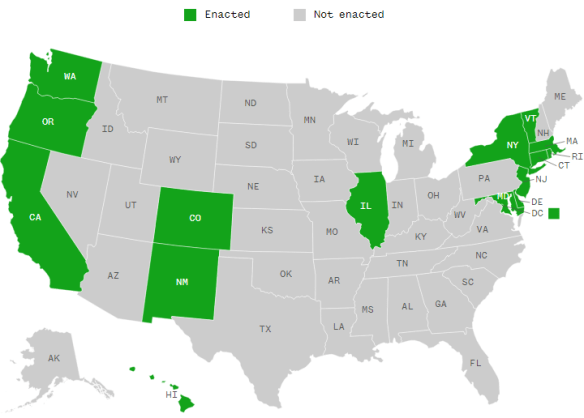
So far, 15 states and the District of Columbia have approved the pact, covering 196 electoral votes of the required 270 to win the presidency.

That 270 matters: The states that have approved legislation to join the compact agreed it would not take effect until the 270 threshold is reached. Once it does, those states will have the power to use their Electoral College votes to elect a winner, according to the popular vote. This uses the Electoral College to effectively phase out the Electoral College . . . 

Unquote.

These are the states that have enacted the Interstate Compact. Will enough voters, legislatures or governors one day agree to elect presidents by majority rule? It’s not a sure thing, but it’s more feasible than eliminating the Electoral College by amending the Constitution.

Untitled

Why the Polls Were Wrong

It’s not good news. From Vox:

What the hell happened with the polls this year?

Yes, the polls correctly predicted that Joe Biden would win the presidency. But they got all kinds of details, and a number of Senate races, badly wrong . . .

To try to make sense of the massive failure of polling this year, I reached out to the smartest polling guy I know: David Shor, an independent data analyst who’s a veteran of the Obama presidential campaigns who formerly operated a massive web-based survey at Civis Analytics before leaving earlier this year. . . . Shor’s been trying to sell me, and basically anyone else who’ll listen, on a particular theory of what went wrong in polling that year, and what he thinks went wrong with polling in 2018 and 2020, too.

The theory is that the kind of people who answer polls are systematically different from the kind of people who refuse to answer polls — and that this has recently begun biasing the polls in a systematic way.

This challenges a core premise of polling, which is that you can use the responses of poll takers to infer the views of the population at large — and that if there are differences between poll takers and non-poll takers, they can be statistically “controlled” for by weighting according to race, education, gender, and so forth. . . . If these two groups do differ systematically, that means the results are biased.

The assumption that poll respondents and non-respondents are basically similar, once properly weighted, used to be roughly right — and then, starting in 2016, it became very, very wrong [note: of course, 2016 was when Txxxx began poisoning the political process]. People who don’t answer polls, Shor argues, tend to have low levels of trust in other people more generally. These low-trust folks used to vote similarly to everyone else. But as of 2016, they don’t: they tend to vote for Republicans.

Now, in 2020, Shor argues that the differences between poll respondents and non-respondents have gotten larger still. In part due to Covid-19 stir-craziness, Democrats, and particularly highly civically engaged Democrats who donate to and volunteer for campaigns, have become likelier to answer polls. It’s something to do when we’re all bored, and it feels civically useful. This biased the polls, Shor argues, in deep ways that even the best polls (including his own) struggled to account for.

Liberal Democrats answered more polls, so the polls overrepresented liberal Democrats and their views (even after weighting), and thus the polls gave Biden and Senate Democrats inflated odds of winning. . . .

Dylan Matthews

So, David: What the hell happened with the polls this year?

David Shor

So the basic story is that, particularly after Covid-19, Democrats got extremely excited and had very high rates of engagement. They were donating at higher rates, etc., and this translated to them also taking surveys, because they were locked at home and didn’t have anything else to do. There’s some pretty clear evidence that that’s nearly all of it: It was partisan non-response. Democrats just started taking a bunch of surveys [when they were called by pollsters, while Republicans did not].. . .

Dylan Matthews

You mentioned social trust. Walk me through your basic theory about how people who agree to take surveys have higher levels of social trust, and how that has biased the polls in recent years.

David Shor

For three cycles in a row, there’s been this consistent pattern of pollsters overestimating Democratic support in some states and underestimating support in other states. This has been pretty consistent. It happened in 2018. It happened in 2020. And the reason that’s happening is because the way that [pollsters] are doing polling right now just doesn’t work. . . .

Fundamentally, every “high-quality public pollster” does random digit dialing. They call a bunch of random numbers, roughly 1 percent of people pick up the phone, and then they ask stuff like education, and age, and race, and gender, sometimes household size. And then they weight it up to the census, because the census says how many adults do all of those things. That works if people who answer surveys are the same as people who don’t, once you control for age and race and gender and all this other stuff.

But it turns out that people who answer surveys are really weird. They’re considerably more politically engaged than normal. . . . [They] have much higher agreeableness [a measure of how cooperative and warm people are], which makes sense, if you think about literally what’s happening.

They also have higher levels of social trust. . . . It’s a pretty massive gap. [Sociologist] Robert Putnam actually did some research on this, but people who don’t trust people and don’t trust institutions are way less likely to answer phone surveys. Unsurprising! This has always been true. It just used to not matter.

It used to be that once you control for age and race and gender and education, that people who trusted their neighbors basically voted the same as people who didn’t trust their neighbors. But then, starting in 2016, suddenly that shifted. . . . These low-trust people still vote, even if they’re not answering these phone surveys.

Dylan Matthews

So that’s 2016. Same story in 2018 and 2020?

David Shor

The same biases happened again in 2018, which people didn’t notice because Democrats won anyway. What’s different about this cycle is that in 2016 and 2018, the national polls were basically right. This time, we’ll see when all the ballots get counted, but the national polls were pretty wrong. If you look at why, I think the answer is related, which is that people who answer phone surveys are considerably more politically engaged than the overall population. . . .

Normally that doesn’t matter, because political engagement is actually not super correlated with partisanship. That is normally true, and if it wasn’t, polling would totally break. In 2020, they broke. There were very, very high levels of political engagement by liberals during Covid. You can see in the data it really happened around March. Democrats’ public Senate polling started surging in March. Liberals were cooped up, because of Covid, and so they started answering surveys more and being more engaged.

This gets to something that’s really scary about polling, which is that polling is fundamentally built on this assumption that people who answer surveys are the same as people who don’t, once you condition on enough things. . . . But these things that we’re trying to measure are constantly changing. And so you can have a method that worked in past cycles suddenly break. . . .

There used to be a world where polling involved calling people, applying classical statistical adjustments, and putting most of the emphasis on interpretation. Now you need voter files and proprietary first-party data and teams of machine learning engineers. It’s become a much harder problem.

Dylan Matthews

. . . Pollsters need to get way more sophisticated in their quantitative methods to overcome the biases that wrecked the polls this year. Am I understanding that right?

David Shor

. . . A lot of people think that the reason why polls were wrong was because of “shy Txxxx voters.” You talk to someone, they say they’re undecided, or they say they’re gonna vote for Biden, but it wasn’t real. Then, maybe if you had a focus group, they’d say, “I’m voting for Biden, but I don’t know.” And then your ethnographer could read the uncertainty and decide, “Okay, this isn’t really a firm Biden voter.” That kind of thing is very trendy as an explanation.

But it’s not why the polls were wrong. It just isn’t. People tell the truth when you ask them who they’re voting for. They really do, on average. The reason why the polls are wrong is because the people who were answering these surveys were the wrong people. If you do your ethnographic research, if you try to recruit these focus groups, you’re going to have the same biases. They recruit focus groups by calling people! Survey takers are weird. People in focus groups are even weirder. Qualitative research doesn’t solve the problem of one group of people being really, really excited to share their opinions, while another group isn’t. As long as that bias exists, it’ll percolate down to whatever you do.

Unquote.

I think what this means is that even if you correct for the low number of Republicans who answer polls, you’re still in trouble, because you’re still polling the kind of Republicans who answer polls (the relatively nice ones). Your sample of Republican voters doesn’t represent Republicans who vote.

This does not bode well for the two Senate races in Georgia. Polls show the Democrats are a few points behind. When the run-off elections occur in January, the polls will probably be wrong again, unless the pollsters have quickly figured out how to solve this problem.