Would It Be Inappropriate to Call It the Nut House?

Predictions that, given his warped psychology, the president will become even more erratic as he gets closer to the end of his presidency are coming true. He held a meeting at the White House yesterday. From Axios:

Senior Txxxx administration officials are increasingly alarmed that President Txxxx might unleash — and abuse — the power of government in an effort to overturn the clear result of the election.

Why it matters: These officials tell me that Txxxx is spending too much time with people they consider crackpots or conspiracy theorists and flirting with blatant abuses of power.

  • There are 32 days until President-elect Biden’s inauguration.

The big picture: Their fears include Txxxx’s interest in former national security adviser Michael Flynn’s wild talk of martial law; an idea floated of an executive order to commandeer voting machines; and the specter of Sidney Powell, the conspiracy-spewing election lawyer, obtaining governmental power and a top-level security clearance.

A senior administration official said that when Txxxx is “retweeting threats of putting politicians in jail, and spends his time talking to conspiracy nuts who openly say declaring martial law is no big deal, it’s impossible not to start getting anxious about how this ends.”

  • “People who are concerned and nervous aren’t the weak-kneed bureaucrats that we loathe,” the official added. “These are people who have endured arguably more insanity and mayhem than any administration officials in history.”

At Friday’s meeting, first reported by The New York Times, Txxxx discussed making Powell a special counsel for election fraud.

  • The ideas included commandeering voting machines, with Powell as a special counsel to inspect the machines, according to a source familiar with the meeting.
  • White House counsel Pat Cipollone and chief of staff Mark Meadows “pushed back strenuously and repeatedly against the ideas put forth by Sidney Powell,” the source said.
  • The meeting included Flynn, who was pardoned by Txxxx in November and is a celebrity with election-denying Txxxx supporters.

Unquote.

Nobody knows how unhinged the president will become in the next four weeks, but it shouldn’t surprise us if he issues orders to insert Flynn, Giuliani, Jared or Ivanka in the military chain of command. 

Small States and Minority Rule

Every four years we elect a president. Almost every four years, we discuss the Electoral College. From Jesse Wegman of The New York Times:

As the 538 members of the Electoral College gather on Monday to carry out their constitutional duty and officially elect Joe Biden as the nation’s 46th president and Kamala Harris as his vice president, we are confronted again with the jarring reminder that it could easily have gone the other way. We came within a hairbreadth of re-electing a man who finished more than seven million votes behind his opponent — and we nearly repeated the shock of 2016, when Dxxxx Txxxx took office after coming in a distant second in the balloting.

No other election in the country is run like this. But why not? That question has been nagging at me for the past few years, particularly in the weeks since Election Day, as I’ve watched with morbid fascination the ludicrous effort by Mr. Txxxx and his allies to use the Electoral College to subvert the will of the majority of American voters and overturn an election that he lost.

The obvious answer is that, for the most part, we abide by the principle of majority rule. . . . 

In the last 20 years, Republicans have been gifted the White House while losing the popular vote twice, and it came distressingly close to happening for a third time this year. 

Since 2000, we’ve had six presidential elections. The candidate who got the most votes only won four of them. This year, shifting 44,000 votes to the loser in Arizona, Georgia and Wisconsin would have resulted in a 269-269 tie in the Electoral College. That would have moved the election to the House of Representatives, where each state’s delegation gets one vote, regardless of population. Since most states have Republican-majority representation in the House — even though the House has more Democrats — DDT would have presumably been re-elected, hard as that is to imagine. 

Among the comments the Times article received, one person said the Electoral College is fine, since we’re a collection of states, the United States of America, not a collection of citizens. He said it’s only fair that we pick a president based on which states the candidates win, not how many votes they get. Besides, he added, votes in the Electoral College are “roughly” assigned by population.

I don’t agree that because we’re called the United States, we should ignore majority rule when it coms to picking a president. After all, the states we live in are supposed to be “united”. But his statement about the Electoral College being “roughly” based on population made me wonder.

How would the 2020 election have turned out if votes in the Electoral College were “precisely” assigned by population, instead of “roughly”? Today, the largest state, California, gets 55 electoral votes and the smallest state, Wyoming, gets 3. But California’s population is 68 times Wyoming’s. So if the Electoral College were precisely allocated by population, California would get 204 electoral votes, not 55. Quite a difference. The next largest state, Texas, would get 150 instead of 38.

Would that have made the result in the Electoral College much different? It was surprising to see that it wouldn’t. If you do the same precise arithmetic for all 50 states and the District of Columbia, Joe Biden receives 974 electoral votes instead of 306 and DDT gets 730 instead of 232. That looks like a big difference, but the percentages are about the same. Biden would get 57.2% of the electoral votes with the precise arithmetic and 56.9% with the rough arithmetic. It works out that way because some big states, like California and New York, went for Biden and some, like Texas and Florida, went for DDT. When you average it all out, the Electoral College result would be about the same either way.

There would be a big difference, however. Big states would be much more important in the Electoral College than small states. If California got 204 electoral votes instead of 55, it would make even less difference who won a bunch of little states like Wyoming, Vermont and Alaska. In fact, assuming precise arithmetic, the 25 largest states would get 1,423 electoral votes vs. 288 for the 25 smallest. 

What this shows is that the current Electoral College is significantly skewed to benefit smaller states. Voters in those states play a bigger role than they should, based on how few of them there are. Being precise about population wouldn’t necessarily change the winner every time, but a more accurate Electoral College would reflect where people actually live in these “united” states. It would also reflect the cultural divisions in this country, since smaller states tend to be more rural.

Unfortunately, it’s not just the Electoral College that is skewed toward smaller states. According to the Constitution, each state gets as many votes in the Electoral College as it has members of Congress. Wyoming gets three electoral votes because it has two people in the Senate and one in the House of Representatives. California gets 55 electoral votes because it has two senators and 53 representatives in the House. If seats in Congress were precisely allocated by population, California would still have two senators, but it would elect almost four times as many members of the House of Representatives as Wyoming. The ratio in the House would be California’s 202 to Wyoming’s one, not 53 to one.

If the makeup of the House of Representatives isn’t unfair enough, consider the US Senate. Each state, regardless of population, gets two senators. It was designed to give small states the same representation as big states, so each state, regardless of population, gets to elect two. Maybe that made sense when there were only 13 states and they were relatively close in population. Now we have 50 states with a very wide range of populations.

In 1790, for example, the largest state, Virginia, had 13 times as many people as the smallest, Delaware. Today, as noted above, California has 68 times more people than Wyoming. Furthermore, the 50 members of the Senate from the largest 25 states represent almost 275 million people. The 50 senators from the smallest 25 states represent 49 million.

The imbalance is made even worse by the fact that the Senate is responsible for approving nominations to the Executive Branch (including all the officials in the president’s cabinet) and the federal judiciary (including the Supreme Court), as well as approving treaties. Because of the way senators were to be chosen, the authors of the Constitution assumed that members of the Senate would be more responsible than the unruly members of the House of Representatives. That’s hardly the case today.

In addition, smaller states, which tend to more rural, tend to vote for Republicans. Of the 25 largest states, 15 voted for Biden and 10 for his opponent. Of the 25 smallest, 10 voted for Biden and 15 for the other guy. That’s why the Senate is where progressive legislation goes to die and liberal nominees fall into comas waiting to be approved.

Add this all up and it’s easy to see that a Constitution written in 1789 doesn’t work very well for a large, complicated country in 2020. The Senate is skewed to benefit smaller, more Republican states, while the House of Representatives and the Electoral College, which chooses the president, are skewed the same way, although less so. This unfairness explains why Hillary Clinton could beat her opponent by 3 million votes and lose, why Joe Biden could beat the same opponent by 7 million votes but not necessarily win, and why forward-looking legislation that would make the United States a much better place to live has so little chance of success. Maybe shifting demographics will eventually help, but in the short run, we have to assume the United States will be subject to minority rule from Washington in important ways and much too often. 
A Few More Words on This Crisis

From E. J. Dionne, Jr. of The Washington Post:

At least the Confederate secessionists acknowledged that Abraham Lincoln won the 1860 election.

The 18 Republican state attorneys general and 126 Republican House members who asked the Supreme Court to throw out the results of the 2020 election may thus be more impudent than the Civil War seditionists in whose steps they followed.

Here is a translation of what they were telling a majority of the nation’s electorate and voters in states representing 62 of President-elect Joe Biden’s 306 electoral votes:

“We don’t like the president and vice president you chose so we simply won’t accept the result of a free election. We’ll deploy lies and phony statistics to justify imposing our will on the rest of the country. The heck with democracy. But we’ll continue to enjoy the Social Security checks, the farm subsidies and all the other money that states that voted for Biden send our way.”

Their lawsuit, flatly rejected by the court on Friday night, was originally brought by Texas Attorney General Ken Paxton (who happens to be under federal investigation for bribery and abuse of office and has been under indictment for felony securities fraud charges). It was joined by 17 of his Republican colleagues and backed by almost two-thirds of House Republicans. Its claims have been described as (you can look it up) clownish, comical, farcical, frivolous, ludicrous, insane and dumb. The court used none of those words, of course, but its terse dismissal said enough.

The lawsuit was all these things, but it was also profoundly dangerous, hypocritical and revealing. We should continue to take it very seriously as a sign that not only President Txxxx but also a majority of his party would rather tear our republic apart than accept electoral defeat. We went through this once before, and it led to a civil war.

Yes, that’s the moment we should be thinking about. . . .

No matter how they dress things up, the Nullification wing of the Republican Party is obsessed with the fact that Txxxx lost key states in part because a lot of Black voters in big cities rejected him. Paxton’s initial court filing mentioned Wayne County, home of Detroit, 11 times,; Milwaukee seven; and Philadelphia six. “In Wayne County, Mr. Biden’s margin (322,925 votes) significantly exceeds his statewide lead,” the brief declared, almost as if this in itself were evidence of a crime.

The lawsuit was plain about its partisan purposes, complaining of how elections were run in “areas administered by local government under Democrat control and with populations with higher ratios of Democrat voters than other areas of Defendant States.” (Paxton lacked the grace to refer to the Democratic Party by its proper name.)

Notice something else: Those who claim to believe in “states’ rights” and “local decision-making” once again showed that their rhetoric is a bunch of hooey. This was true of the Confederates, too. Not only was slavery, not states’ rights, the cause of the Civil War, but slavery’s advocates embraced the Dred Scott decision, which, as Lincoln had argued, laid out the path to nationalizing slavery. Power and results were all that mattered.

So it is with the GOP’s Minority Rule Caucus. They believe Republican jurisdictions should be free to suppress votes. But areas under “Democrat control” must be blocked from making voting a little bit easier. . . .

So, despite the Supreme Court’s ruling, we should remain alarmed that so many Republican politicians blithely walked away from democracy and sought to undermine the very institutions they took an oath to defend.

Unquote.

Even though the Republicans won’t be able to undo the election, the majority of Americans are faced with a malignant minority that only pays lip service to the Constitution. It’s impossible to believe they will soon change their ways and behave responsibly again.

One Senator Sees the Extreme Danger

You could argue that the Southern states seceding from the union was the most serious attack on American democracy. But the slave states weren’t merely trying to change the way we govern ourselves. They were attacking the United States itself, trying to break it apart. Sen. Chris Murphy of Connecticut is correct when he says: “Right now, the most serious attempt to overthrow our democracy in the history of our of country is underway. Those who are pushing to make Dxxxx Txxxx President, no matter the outcome of the election, are engaged in a treachery against their nation.”

He spoke for 14 minutes on Friday and then later to Greg Sargent of The Washington Post.

Greg Sargent asks a good question:

How many other Democrats have you heard making this case in such stark terms?:

Yes, you regularly hear Democrats claiming that it’s time that Republicans accept that Txxxx lost. Or you hear them slamming Txxxx’s lawsuits as frivolous. Or you hear them suggesting that Republicans are spineless for not standing up to Txxxx, as if they harbor deeply held principles they’d adhere to if only Txxxx’s rage-tweets weren’t so frightening.

But you don’t often hear them saying what Murphy suggested here: that the Republican Party has morphed into a malignant and profoundly dangerous threat to the country and the long-term prospects for our democratic stability.

I followed up with Murphy to ask what prompted this speech.

“I have a very clear sense of the danger this all poses to the republic,” Murphy told me. “If this becomes at all normalized more broadly than it already is, they will steal an election two years from now or four years from now.”

“And then I’m not sure how we keep our democracy together,” Murphy continued.

. . . President-elect Joe Biden’s team — which has adopted the posture that much of what Republicans are doing is just a stunt — wants to reassure the country that the transition is proceeding smoothly, and might not want too much focus on this disruption. But that risks misleading the public about the tenuousness of the moment. . . .

. . . If large swaths of the Republican Party are morphing into a much more cancerous anti-democratic force, one that in some basic sense just isn’t functioning as an actor in a democracy, how should Democrats adapt, and communicate to the public about this? How can they compete in the information wars, given the massive media machine the GOP has at its disposal?

On another front, a much more robust agenda to broaden prosperity and combat inequality and flat wages might defuse some populist anger out there. But given that the prospects for a modest economic rescue package are dim — and given the likelihood of GOP Senate control — that seems like an uphill climb.

Murphy suggested that the starting point might be to “diagnose the problem,” which would require a real reorientation in posture.

“For much of the last four years, we thought the problem was that Republicans knew what the right thing was, but they just didn’t do it because Txxxx was so scary,” Murphy told me. “I think this moment is showing us that there are a whole lot of Republicans who believe this nonsense.”

“This isn’t just a party that’s trying to stay on the good side of an enemy of democracy,” Murphy continued. “This is a party that has a whole bunch of enemies of democracy inside its top ranks. That’s bone-chilling.”

Hatred and Delusion United

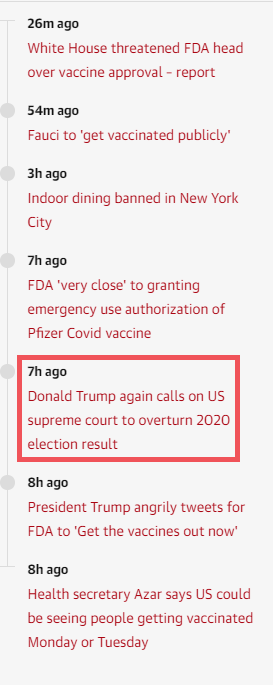
How strange it is to see this story displayed as if it’s just another bit of today’s news.

Untitled

It’s strange but not unexpected. Here are two meditations on current events from columnists for The Washington Post. First, Paul Waldman:

If you were dropped in from another country without knowing anything about the United States and surveyed our current political moment, what would you conclude about the Republican Party and the broader conservative movement it represents? As 2020 comes to an end, what is conservatism about?

After nearly four years of Dxxxx Txxxx’s presidency in which no misdeed was too vulgar or corrupt for conservatives to defend, now culminating in an outright war against democracy itself, you might be tempted to answer, “Nothing.” Though that’s not quite true, the real answer is not much more encouraging. . . .

The one thing that unites the right and drives the GOP is hatred of liberals. That hatred has consumed every policy goal, every ideological principle and even every ounce of commitment to country. . . .

When 18 Republican state attorneys general, more than half of House Republicans and multiple conservative organizations all demand that the results of a presidential election where no fraud was found be simply tossed aside so that Txxxx can be declared winner, something more profound has been revealed. . . .

Txxxx has often cited the extraordinary loyalty he has received from his party’s voters; it’s one of the few things he says that’s true. . . . When you ask the typical Txxxx supporter what they love about him, they don’t mention some substantive policy position; what they say is that he is a fighter. The petty squabbles, the insulting tweets, the deranged conspiracy theories — the things that the Never Txxxxers and most other Americans find off-putting are exactly what endears him to the Republican base.

Txxxx fights and fights, angrily, bitterly, endlessly driven forward by his hatred of the people his supporters hate. That’s what the base loves, and every other Republican knows it.

Everything about the election that just ended reinforced for conservatives that nothing is more important than hating liberals. The rhetoric of the 2020 campaign, starting with Txxxx but going all the way down the ballot, was that if Democrats were elected, then it would not be suboptimal or bad or even terrible, but the end of everything you care about. Towns and cities would burn, religion would be outlawed, America as we know it would cease to exist. These horrors were not presented as metaphors, but as the literal truth.

In the face of that potential apocalypse, who could possibly care about mundane policy goals? . . . They want to cut the capital gains tax, sure — but its importance pales next to the urgency of stopping the cataclysm that would engulf us all if Democrats were to hold power.
To be clear, there are still thoughtful conservatives out there trying to advance a coherent ideological project. But seldom have they mattered less to their movement and their party. . . .If it doesn’t Own the Libs, it doesn’t matter on the right. . . .

Second, ex-Republican Jennifer Rubin:

. . . With a new appreciation for the inexactitude of polling, it’s possible the portion of Americans who accept Biden’s victory is anywhere from 70 percent to only 50. Regardless, the answer to “How many Americans believe in a baseless conspiracy that the election was stolen?” is “Too many.”

The consequences are grave. It gives Republicans license to continue to break norms and even the law (e.g., threaten election officials). It promotes irrational, obstructionist politics and increases the divide between Americans. Biden voters, I would guess, have never been more contemptuous of Txxxx voters as they are now . . . [with good reason].

Conduct from Republican House and Senate members shows the pernicious effects of this cult of absurdity. Victimology and self-pity (We were denied a second Txxxx term!) mixed with arrogance (Only we know what really happened in those ballot-counting rooms!) do not make people amenable to compromise or empathy. Indeed, it turns seemingly capable and sane public figures into raving lunatics . . .

Expect a new norm to take root in the Republican Party that any lost election is a stolen election. Wholesale attempts to restrict voting (that make voter-ID laws look mild by comparison) and actual corruption of the election process may follow. . . .

And sadly, what we learned in the Txxxx era is that once you are ready to believe utter nonsense in one arena because Txxxx says so, you’re willing to believe — in fact, compelled to believe! — utter nonsense about a lot of things. Coronavirus is overblown. Masks are not needed.

“The Great Leader is never wrong” is the most fundamental principle of closed, authoritarian societies. When communism was crumbling in Poland, people began to put up signs that read “2 + 2 = 4,” a clever reminder that in a totalitarian state, reality is the province of the state and obedience to falsehoods is a requirement for survival.

The Republican Party, ironically the party that used to . . . scorn victim-mongering, now thrives as an institution in which people, as Txxxx said at a recent rally, think “we’re all victims” and accept Txxxx’s alternative reality. Maybe one day an American Lech Walesa will arrive in the Txxxx heartland and revive the spirit of democracy. Until then, the GOP remains the “2 + 2 = 5” party.

Unquote.

Does the hatred lead to the delusion or is it the other way around? I’d say they reinforce each other. On the other side, sure, we hate this president, but it’s not because we’re deluded about his actions. Besides, nobody hopes Democrats will raise the minimum wage or fix the climate in order to irritate Republicans. The two sides really are different, as the Texas lawsuit and its many supporters demonstrate.