A Nation-State and Its Enemies

The Spanish philosopher JosĂ© Ortega y Gasset (1883-1955) had an idea about what a nation is that’s relevant to our current predicaments. This is from Philosophy Now:

Published posthumously in 1960, Ortega’s resultant book Meditación de Europa (Meditation on Europe) discusses the nation-state, its role, and its future. After being forced from his own country by a fascist regime and witnessing two World Wars, it’s hardly surprising that the nation-state was an important topic to Ortega. He believed the issue lay partly in the fact that, whilst the nation-state generates a great deal of fanaticism, we are often incapable of providing an exact definition of one – which however Ortega had already done long ago in The Revolt of the Masses. As he said at a conference in 1951:

“I will repeat it once again: the reality which we call the State is not the spontaneous coming together of those united by ties of blood. The State begins when groups naturally divided find themselves obliged to live in common. This obligation is not violently forced upon them, but implies an impelling purpose, a common task which is set before the divided groups. Above all, the State is a plan of action and a program of collaboration. The men are called upon so that together they may do something. The State is neither consanguinity, nor linguistic unity, nor territorial unity, nor proximity of habitation. It is nothing material, inert, fixed, limited. It is pure dynamism – the will to do something in common – and thanks to this the concept of the State is bounded by no physical limits.”

Just like any enterprise, the nation-state has a set of values, insignia through which it is recognized (a flag), and a general set of customs that unite its members, creating cultural coherence amongst them. The nation-state, however, is built upon diversity, and belonging to it does not mean that sub-groups lose their individuality. Be it Catalonia in Spain or Scotland in the UK, belonging to a nation doesn’t remove their spirit as separate entities. And in the same way, all other groups which make up the members of a state do not lose their identity simply by becoming part of the nation: being Spanish doesn’t imply that you are of any particular faith, age, gender, race, and whilst it may be assumed that you speak Spanish, it is not necessarily your mother tongue. Even borders – which might seem like pretty stable definers of a nation – are the present result of centuries of conflict and negotiations. They have constantly changed throughout history, and there’s no reason to think that they won’t do so again in the future.

So instead of understanding a nation as something static, bound fast together by metaphysical connections, it should be viewed as a dynamic – something we do instead of something we are. Thanks to historical records, we have a documented account of Rome from its beginning until its fall – its lifespan, you might say. We Europeans have also witnessed the birth of our modern nation-states from the ruins of the Roman Empire, including their growth and incorporation of surrounding communities. But nation-states are also prone to shrink, fall apart, maybe even die. As a work in progress, nations are by no means eternal features that exist naturally on the face of the earth, leaving them open to whatever fate we bestow. As dynamic, ever-changing projects, nations must be open to change and to the incorporation of new groups, whose ideas could contribute to solving their problems and reaching their goals.

From Eugene Robinson for The Washington Post:

The biggest problem facing the nation now is not what to do with Txxxx, who will soon become yesterday’s news. The crisis is that more than 70 percent of Republican voters believe — falsely — that there was some kind of widespread fraud in the election. The essence of democracy is accepting both victory and loss as legitimate outcomes.

A GOP that internalizes and retains Txxxx’s conspiratorial worldview is not a political party. It is a dangerous cult. Elected officials who have cynically — or cravenly — gone along with that cult’s lies will not find it easy to reverse course.

Much more important than whether Txxxx is convicted in his coming trial is whether Republicans level with their constituents and tell them that Txxxx is lying.

If Republicans won’t — or can’t — tell the truth about the November election, they are no longer participants in our [nation-state’s] democracy. They are its enemies. 
Why Try to Get Rid of Him Now?

He is scheduled to be removed from office 13 days from now. Any attempt to strip him of his powers would require a number of Republican officeholders to agree. Given the nature of almost all Republican officeholders, it’s unlikely they would cooperate. But there are reasons to make the effort anyway.

First, it’s the right thing to do. Heinous actions should have consequences, either as retribution or as a way to limit future bad behavior.

Second, it reminds everyone that the federal government has procedures in place to deal with presidents who are unfit. Following those procedures when appropriate emphasizes their reality. It gives them weight.

Third, a failed attempt would show the public which Republican officeholders refused to do the right thing. Most of us already know who is likely to resist removing this particular unfit president, but it’s worth making their refusal public knowledge, making it clear to even more of us that they shouldn’t be given the benefit of the doubt or entrusted with responsibility in the future.

Finally, it’s possible that the attempt to punish this president would succeed. Since the president incited a riot that endangered Vice President Pence and members of his family, in addition to all the other people who were put at risk, and furthermore called Pence disloyal and weak when he failed to engineer a coup, the vice president might conceivably get a majority of the president’s cabinet members to approve the use of the 25th Amendment, making Pence the acting president until January 20th. If Democrats in the House of Representatives impeach the president again, as they seem likely to, roughly 17 of the 50 or so Republican senators, including Majority Leader McConnell, might conceivably agree to convict him and bar him from ever being president again.

This is why it’s encouraging that leading Democrats. a few Republicans and other observers have called for action against this incredibly unfit president, unlikely as it may be.

The Meaning of Philosophy Today

While listening to forty-five minutes of Brian Wilson, then 22, creating “California Girls” with a group of studio musicians (“this is real good now, take 43”), I read a series of brief philosophical articles on “Finding Meaning”:

“In this series of articles, contributors from a variety of perspectives reflect on what the philosophical life means to them. In doing so, they do not attempt just to account for what personally led them to philosophy, but what philosophy itself has become today in the wake of “the death of God,” the age of nihilism.”

I don’t think meaning exists in the world independently of us, but rather that we find some things, like particular songs, meaningful (or not). The final paragraphs of the entry written by Mark Anderson, a philosophy professor at Belmont University in Tennessee, were interesting to me, even meaningful:

Philosophy today, as far as I can tell, is mostly either scholarship or the refinement of arguments for the journals, all with an eye toward a monograph with the right academic publisher. This is to be expected when a civilization’s faith in grand Truths and meta-narratives has collapsed. What else to do but dispute the hermeneutical minutiae of other people’s ideas or tweak this or that old chestnut of an argument, especially if such activities are the route to security and prestige among one’s peers? Ahh, it’s all one big job-talk…

I exaggerate, of course, but I’ll let the hyperbole stand.

Maybe I’m saying that philosophy is dead, and that we have killed it. That authentic philosophy was asphyxiated by the philosophy profession. That’s too facile, but it’s true that there are no Platos or Nietzsches around today. Platonists and Nietzscheans, yes. Plato and Nietzsche scholars, in abundance. But where are the living philosophers, the scholar-artists, the creatively deep thinkers? The problem has consumed me for years, and for years I wanted only to become a philosopher myself. Maybe I succeeded; I used to think that I had. But these days I no longer care. Or, rather, my cares have been transformed. I have come to regard our “psychic explorations” and “ontological investigations” as so much internal chatter, our talking to ourselves about the meanings of words and the relations between and among concepts, those meanings we happen to know and those relations that happen to strike us. Hyper-intellectualized, and all too often gloomy, distractions from the real—the real with a lowercase “r”.

Plato set us going on this misguided—this imaginary, illusory search for the Real, and although Nietzsche nearly overcame it, he declined too young to reclaim his true youthfulness. I suspect that if he’d lived to follow through on his own insights, he would have come to Cratylus’s conclusion (shared in a way by Zen, though distorted by religion accretion). He would have let his Übermensch and Will to Power slip into the river of flux and float away; he would have realized that preferring his preferences to others, and wanting to argue about it, is an endless and silly game; he would have held his tongue and, if questioned, only wiggled a finger.

Or maybe not; I don’t know. Plato and Nietzsche were unusual men. Who can say what they were after? But as for me: Lin-chi remarks that when you understand that fundamentally there is nothing to seek, you have settled your affairs. I think maybe I have settled my affairs. Finally. I am done with the make-believe search, stalking the mythical minotaur of wisdom; and although I cherish the years I wandered though the psychic labyrinth, I feel liberated, and rejuvenated. Returned to the sun and the land of the living, out of the shadow of the death of God.

What? Isn’t this just another form of darkness? Isn’t this nihilism! Call it what you will. I call it ataraxia.

Unquote.

“Ataraxia” is Greek for “unperturbed” or “without mental trouble”. Wikipedia says the term was “first used in ancient Greek philosophy by Pyrrho and subsequently Epicurus and the Stoics for a lucid state of robust equanimity . . .”

Ataraxia or not, job-talk or not, Prof. Anderson is chairman of the philosophy department at Belmont University.

How Society Comes To Know Stuff

I read another of those “how could they vote for him?” articles today. As usual, the author offered an explanation that fit his own political and cultural leanings. But he cited an article that includes a nice summary of how an enlightened society should work. This is from “The Constitution of Knowledge” by Jonathan Rauch:

Some Americans believe Elvis Presley is alive. Should we send him a Social Security check? Many people believe that vaccines cause autism, or that Barack Obama was born in Africa, or that the murder rate has risen. Who should decide who is right? And who should decide who gets to decide?

This is the problem of social epistemology, which concerns itself with how societies come to some kind of public understanding about truth. It is a fundamental problem for every culture and country, and the attempts to resolve it go back at least to Plato, who concluded that a philosopher king (presumably someone like Plato himself) should rule over reality. Traditional tribal communities frequently use oracles to settle questions about reality. Religious communities use holy texts as interpreted by priests. Totalitarian states put the government in charge of objectivity.

There are many other ways to settle questions about reality. Most of them are terrible because they rely on authoritarianism, violence, or, usually, both. As the great American philosopher Charles Sanders Peirce said in 1877, “When complete agreement could not otherwise be reached, a general massacre of all who have not thought in a certain way has proved a very effective means of settling opinion in a country.”

As Peirce implied, one way to avoid a massacre would be to attain unanimity, at least on certain core issues. No wonder we hanker for consensus. . . .

But that is not quite the right answer, either. Disagreement about core issues and even core facts is inherent in human nature and essential in a free society. If unanimity on core propositions is not possible or even desirable, what is necessary to have a functional social reality? The answer is that we need an elite consensus, and hopefully also something approaching a public consensus, on the method of validating propositions. We needn’t and can’t all agree that the same things are true, but a critical mass needs to agree on what it is we do that distinguishes truth from falsehood, and more important, on who does it.

Who can be trusted to resolve questions about objective truth? The best answer turns out to be no one in particular. The greatest of human social networks was born centuries ago, in the wake of the chaos and creedal wars that raged across Europe after the invention of the printing press (the original disruptive information technology). In reaction, experimenters and philosophers began entertaining a radical idea. They removed reality-making from the authoritarian control of priests and princes and placed it in the hands of a decentralized, globe-spanning community of critical testers who hunt for each other’s errors. In other words, they outsourced objectivity to a social network. Gradually, in the scientific revolution and the Enlightenment, the network’s norms and institutions assembled themselves into a system of rules for identifying truth: a constitution of knowledge.

Though nowhere encoded in law, the constitution of knowledge has its own equivalents of checks and balances (peer review and replication), separation of powers (specialization), governing institutions (scientific societies and professional bodies), voting (citations and confirmations), and civic virtues (submit your beliefs for checking if you want to be taken seriously). The members of the community that supports and upholds the constitution of knowledge do not have to agree on facts; the whole point, indeed, is to manage their disagreements. But they do need to agree on some rules.

One rule is that any hypothesis can be floated. [Note: not any hypothesis] That’s free speech. But another rule is that a hypothesis can join reality only insofar as it persuades people after withstanding vigorous questioning and criticism. That’s social testing. Only those propositions that are broadly agreed to have withstood testing over time qualify as knowledge, and even they stand only unless and until debunked.

The community that follows these rules is defined by its values and practices, not by its borders, and it is by no means limited to scholars and scientists. It also includes journalism, the courts, law enforcement, and the intelligence community — all evidence-based professions that require competing hypotheses to be tested and justified. Its members hold themselves and each other accountable for their errors. When CNN, in 2017, fired three senior journalists for getting a story wrong, President Txxxx gloated that the “Fake News” media’s dishonesty had been exposed. (His tweet: “So they caught Fake News CNN cold, but what about NBC, CBS & ABC?”) In fact, the opposite was true: By demanding evidentiary accountability, CNN showed that, unlike Txxxx, it adheres to standards of verification.

On any given day, of course, we won’t all agree on what has or has not checked out. The speed of light is widely agreed upon, but many propositions are disputed . . .  The community that lives by the standards of verification constantly argues about itself, yet by doing so provides its members with time and space to work through their disagreements without authoritarian oversight.

The results have been spectacular, in three ways above all. First, by organizing millions of minds to tackle billions of problems, the epistemic constitution disseminates knowledge at a staggering rate. Every day, probably before breakfast, it adds more to the canon of knowledge than was accumulated in the 200,000 years of human history prior to Galileo’s time. Second, by insisting on validating truths through a decentralized, non-coercive process that forces us to convince each other with evidence and argument, it ends the practice of killing ideas by killing their proponents. What is often called the marketplace of ideas would be more accurately described as a marketplace of persuasion, because the only way to establish knowledge is to convince others you are right. Third, by placing reality under the control of no one in particular, it dethrones intellectual authoritarianism and commits liberal society foundationally to intellectual pluralism and freedom of thought.

Together, these innovations have done nothing less than transform our way of living, learning, and relating to one another.

Unquote.

Yet, according to this month’s exit polls, 92% of White Txxxx voters think climate change is not a serious problem, while 87% think the US is handling the pandemic well and wearing a mask is a personal choice, not a matter of public health.

Is there a way to share more knowledge with them? I don’t think anybody knows.

“The Drunken Silenus: On Gods, Goats, and the Cracks in Reality” by Morgan Meis

This is a strange little book. It begins with the author explaining that he was living in Antwerp, in Belgium, because his wife was working on a project there. He had nothing in particular to do, but after realizing that the 17th century, Flemish painter Peter Paul Rubens had once lived in Antwerp, he decided to write a book about Rubens. It’s not a biography of Rubens though. It’s a series of brief meditations on the art of painting, ancient history, Greek mythology, Greek tragedy, hundreds of years of European history, especially Europe’s wars, and Rubens’s family, in particular the affair that Rubens’s father Jan had with Anne of Saxony, who was William of Orange’s wife, and how William of Orange and Rubens’s mother Maria reacted to the affair. There’s a lot about Friedrich Nietzsche, too. And other things.

The book’s central thread goes something like this. Silenus was a minor god in Greek mythology with a gift for prophecy. He was the very wise tutor and companion of Dionysus, the much more important god of the grape-harvest, wine, fertility, vegetation, insanity, ritual madness, religious ecstasy, festivity and theater. Silenus is best-known for something he once told King Midas (who was apparently a real person, but couldn’t turn anything into gold). Midas asked Silenus what is the most desirable thing for a human being. Silenus told him the best thing is not to have been born.  But if you have been born, the best thing is to die quickly.

Peter Paul Rubens’s father Jan was the legal advisor to Anne of Saxony. They had an affair, the affair was discovered and Anne’s husband William threw Jan in jail. Jan eventually got out, was forgiven by his wife Marie, but died a broken man. Their son Peter Paul grew up to become the most influential artist of the “Flemish Baroque” tradition. 

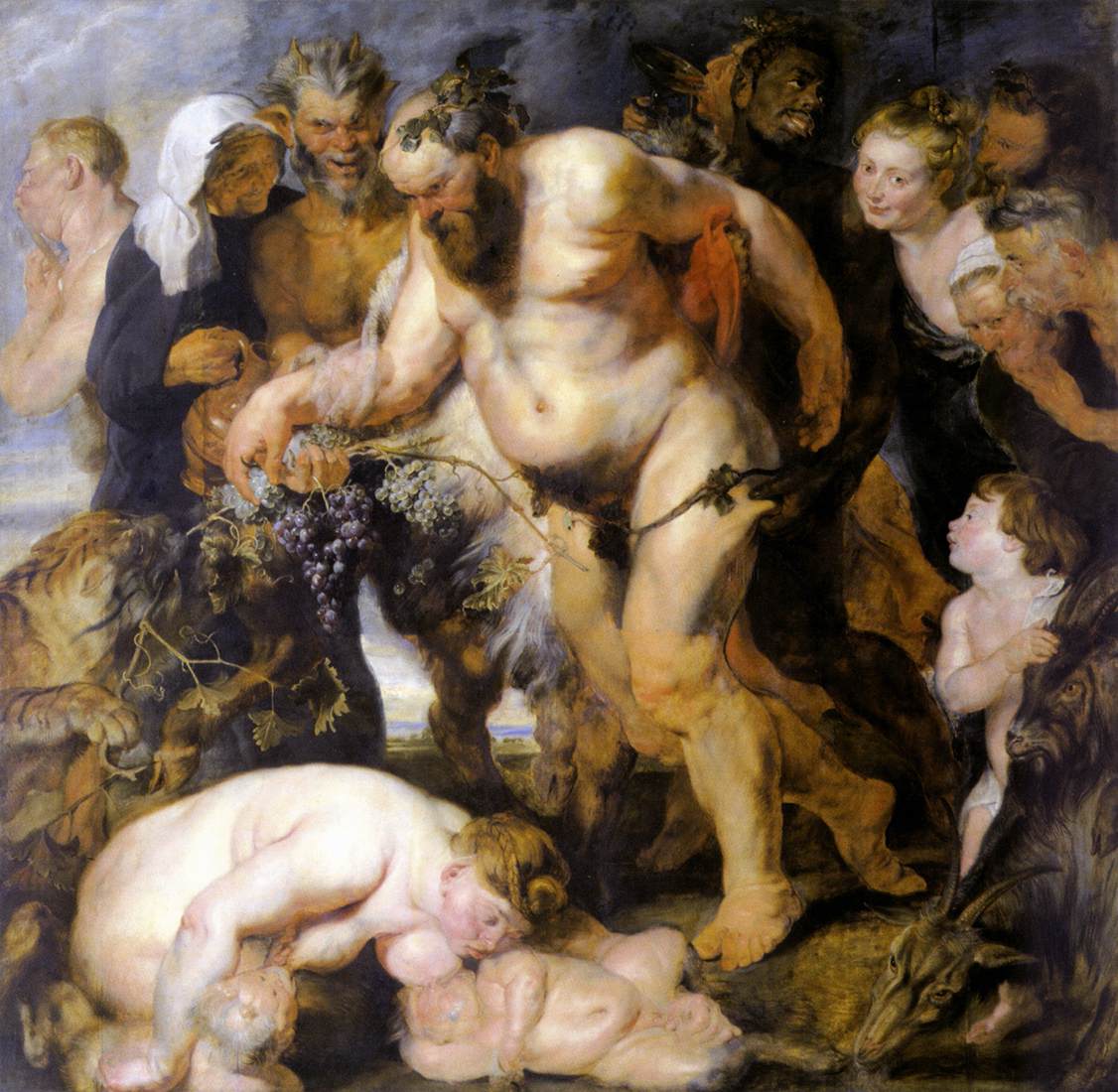
Around 1616, Rubens painted “The Drunken Silenus”. It shows Silenus stumbling along, surrounded by some of Dionysus’s retinue, which included nymphs and satyrs.

27mythol

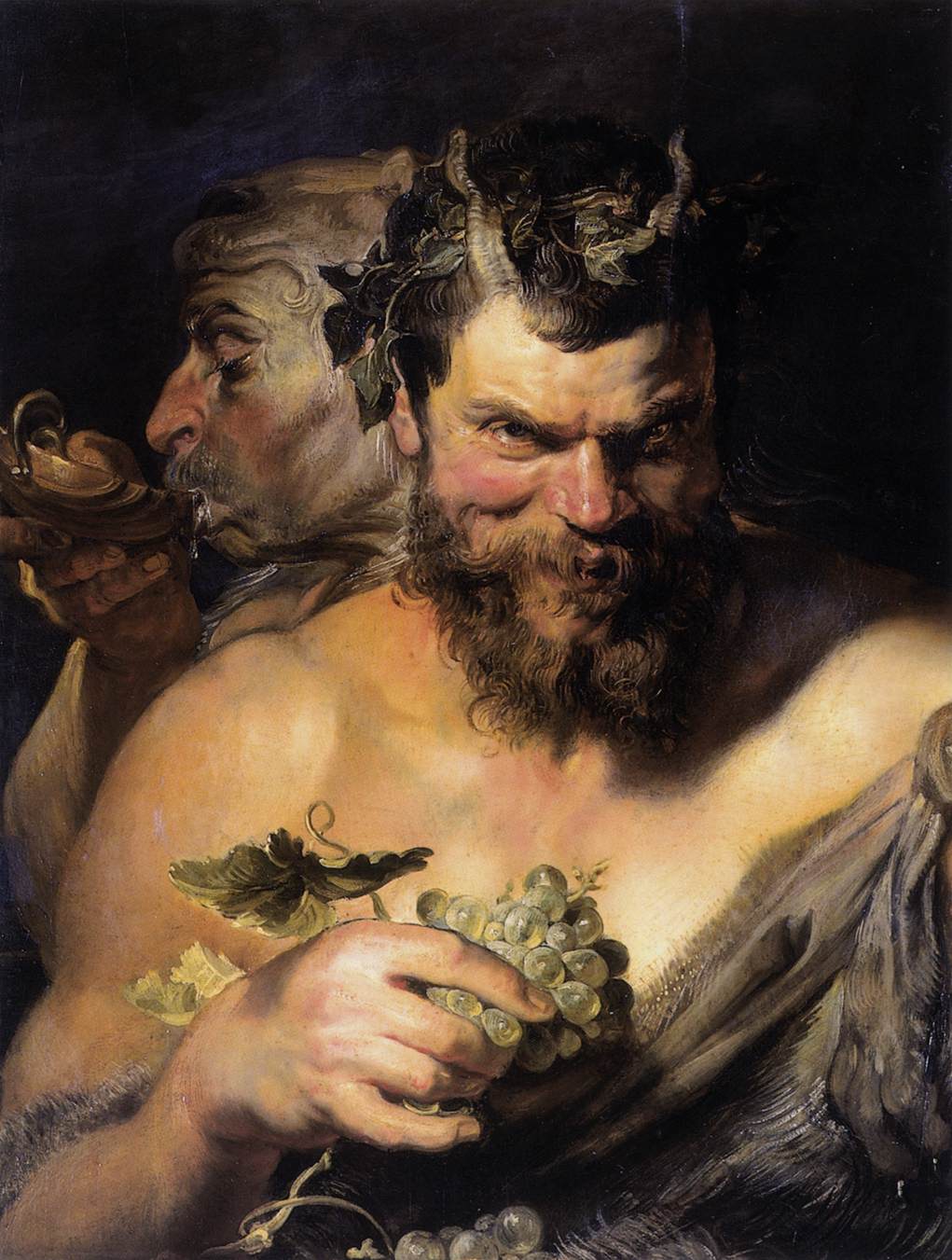
A couple years later, Rubens painted “Two Satyrs”, two more of Dionysus’s pals.

Peter_Paul_Rubens_-_Two_Satyrs_-_WGA20303

A lot of history went by. Millions died during the Thirty Years War. Hapsburgs and Bourbons went at it. The nations of Europe slowly assumed their current positions.

Then, in 1872, the German philosopher Friedrich Nietzsche published The Birth of Tragedy from the Spirit of Music. Wikipedia says:

Nietzsche found in classical Athenian tragedy an art form that transcended the pessimism and nihilism of a fundamentally meaningless world. The Greek spectators, by looking into the abyss of human suffering and affirming it, passionately and joyously affirmed the meaning of their own existence. . . .

. . . Nietzsche discusses the history of the tragic form and introduces an intellectual dichotomy between the Dionysian and the Apollonian (very loosely: reality as disordered  . . . versus reality as ordered). Nietzsche claims life always involves a struggle between these two elements, each battling for control over the existence of humanity.

Which brings us back to Silenus and Dionysus, the nymphs and satyrs, especially the satyrs. And goats. The author of The Drunken Silenus thinks Nietzsche valued the wild and crazy Dionysian approach to life more than the calm and collected Apollonian. I think the key chapter of The Drunken Silenus is “Is God a goat? What possibly could that possibly mean?” 

The way Nietzsche tells it, when Silenus finally reveals to Midas the greatest thing for man, that it is best for man never to have been born and second best for a man to die quickly, Silenus lets out a shrill laugh. Silenus laughs because in telling King Midas the best thing, he actually tells him the worst thing . . . 

Nietzsche thinks the ancient Greeks — the Greeks of the satyr plays and the songs in the forest, the Greeks who came before the classical period of Plato and the brilliant days of Greek rationalism — those Greeks were bold enough to make a health of their pessimism. . . .

The olden Greeks, the ancient Greeks, thinks Nietzsche, understood life under the principle of the goat, the young goat kicking and bucking in the woods. . . Even to ask the question of what is good or bad for a man is to lose touch with the primary intuition that God is a goat. That’s to say, God is not transcendent, imperturbable, untouchable, unknowable. God is none of those things. God, if God is the God of the world, has to have the characteristics of the goat, the randiness and unpredictability, even the stupidity of the goat. . . 

And so, the question of good and bad for man is canceled before it can be asked. It is preempted. The satyr would never think to ask that question. . . . Goats don’t ask questions like “what is the best thing for goats?” Goats just go out and express goatlieness [35-38].

Getting back to Rubens, I suppose Rubens’s father and Anne of Saxony (who was also imprisoned by her husband) were the Dionysians. Rubens’s forgiving mother Marie was the Apollonian. And Rubens himself, the great artist, was a proto-Nietzsche:

When Rubens took to painting Silenus he wasn’t grabbing randomly at the bits of ancient mythology floating around in the intellectual breeze. Rubens had a whole program of satyrs and Dionysus and Silenus. . . Rubens was being very Nietzschean here, if we can be anachronistic — literally anachronistic, since it was . . . Rubens who came first and Rubens who first painted Silenus as a central figure within this story of Dionysus.

So that’s The Drunken Silenus. You might find it interesting, but I should mention that, even though it’s a short book, it’s repetitious. The author likes to repeat himself, often in the same paragraph. It also gets tedious near the end, as he starts getting more abstract and paradoxical, suggesting that life is death, and reality is unreal, that kind of thing (I’m not quoting here). It’s the kind of book that’s hard to put down until it’s easy.