Republicans and Liberty, Part 4 (the End?)

When I think of what it means to be a Republican economic libertarian, I think of someone I know — call him “Bob”. He is a very affluent periodontist who lives in an enormous house in a beautiful suburb. Some years ago, Bob expressed his outrage over being forced to pay property taxes in support of the local public schools, since his own children were being educated privately. That’s an attitude that perfectly captures the essence of economic libertarianism:

What’s mine is mine and the rest of you, the damn government, shouldn’t take it away from me for something I don’t care about and isn’t doing me any good!

If Bob had read a certain book by another Bob (the late Robert Nozick), he might have expressed his outrage with a brief argument: 

1) It’s the most fundamental principle of morality that people should be treated as ends in themselves, not as means toward achieving someone else’s goals or for someone else’s benefit.
(2) Taking my property against my will in order to benefit other people is treating me as a means, not an end.
(3) When the local government forces me to pay property taxes to fund the local school district, the government is taking my property against my will.
(4) Therefore, the government should not force me to pay taxes to support public schools.

What’s wrong with this argument?

One serious problem is that it depends on a hidden assumption: namely, that the first sentence is not merely an important principle of morality, but the supreme principle that overrides all other moral principles. That’s a questionable assumption. Life, for both philosophers and normal people, is too rambunctious to fit under a single ethical umbrella. There are always exceptions and additional considerations.

When we were teenagers, for example, didn’t we all joke that the Golden Rule doesn’t apply to masochists (you know, do unto others…)? Similarly, imagine an isolated town in Alaska that’s been hit by a dangerous epidemic. The local pharmacist has a drug that will attack the disease but insists on full payment (or 75% of the price or whatever) before distributing his supply. He’s not a bad person — maybe he needs the money because he’s deeply in debt and on the verge of losing his store.

If the single overriding principle of morality is that we should always treat everyone else as an end, not a means, the town’s residents should accept the situation and either come up with the cash or do a lot of praying. Or are they justified in confiscating the drug, distributing it among themselves and watching the pharmacist go bankrupt? Can we apply principle (1) all by itself to solve this problem? I don’t think so. Principle (1), the philosophical basis for economic libertarianism, doesn’t say whose ends are more important when they conflict.

Fortunately, there are other ethical rules that come into play in situations like this (even though those rules aren’t foolproof or all-encompassing either). The British utilitarian Jeremy Bentham, if he were available as an ethical consultant, would probably agree that treating everyone as a means, not an end, is a decent enough moral principle. But only because it tends to support a more important moral principle: “It is the greatest happiness of the greatest number that is the measure of right and wrong”. In other words, we should always do what will ultimately result in the most happiness for the most people (including a town full of sick Alaskans and kids going to public school in New Jersey). 

Here’s another problem with this argument. It’s incredibly self-centered. If it’s valid, the principle that people should be treated as ends, not means, applies to those kids at the public school just as much as it applies to my acquaintance Bob. But how can Bob treat those children as ends? A really excellent way would be to pay the taxes that will help them get an education.

In fact, if Bob refuses to help those kids, he seems to be treating them as means, not ends. Some of them will grow up and take jobs in the community, working in stores, or maintaining roads, or performing heart surgery. Will Bob benefit from their labor? It’s true he might directly pay for their services one day, but he’ll also benefit from living in a community that’s safe and prosperous because of the work performed by people he’ll never bump into.

Consider what his life would be like if the few people selling groceries in his town were the only people selling groceries in the state of New Jersey. His town would still be a great place to live if he could find food on the shelves and didn’t mind checkout lines that were 20 miles long.

There’s also a problem with how this argument seems to identify me with my property. How do people acquire property anyway? The French anarchist Proudhon had an opinion: “Property is theft!” How was the first piece of property acquired? It was a long time ago, so we don’t know. But we do know that not one of us begins life as a clean slate and grows up in perfect isolation. The argument above suggests that taking any of my property against my will is a violation of my humanity regardless of where my property came from. That probably sounds plausible to whoever wrote the sentence I quoted in an earlier post, the one that referred to “the sanctity of private property”.

But are property rights sacred? Are they more sacred than anything else, like kindness or compassion? Are property rights so sacred that the tax collector who takes part of your paycheck against your will — for purposes other than the common defense and the maintenance of a free market — is committing a sin or a crime against humanity? Maybe if you think every penny you earn is solely the result of your God-given wonderfulness and had nothing to do with your genes or your upbringing. Or if you identify yourself with your property.

Like it or not, as everyone knows, we are social animals who grow up and survive in communities. Economic libertarianism, however, is a radically individualistic doctrine. It’s also simplistic and atomistic (in the social sense, not the physical sense). It reeks of adolescence.

A teenager, usually a boy for some reason, trying to figure out how to navigate the world, in the process of breaking away from his parents, looks for words that will explain other people and help him feel good about himself. Maybe he makes the mistake of reading Atlas Shrugged instead of The Lord of the Rings or The Brothers Karamazov: 

“Pleasure is all that really matters.”
“Do unto others as you would have them do unto you.”
“Poor people are stupid or lazy”.
“If God doesn’t exist, all is permitted.”
“Asking for help shows you’re a loser.”
“When I earn money, I should be able to keep it.”

Taken to its extreme, in fact, economic libertarianism reeks of infancy. We all have to share. That’s what we’re supposed to learn before we get to kindergarten.

Of course, there are probably few economic libertarians who hold the doctrine in its purest form. No doubt there are some who debate the finer points, however, like Russian intellectuals who debated the finer points of communism before the revolution. A wonderful person can have libertarian tendencies along with common sense. It’s all a matter of degree. Where on that chart above should people reside? Where does Senator RP reside? Where do you reside? 

I’m not sure, but I’m proud to say I’m not a Republican or an economic libertarian. I’m also not a “social liberal and fiscal conservative”. That’s too often code for comfortable people who enjoy their station in life while consistently supporting right-wing candidates and policies, the kind that “comfort the comfortable and afflict the afflicted”, not the other way around.  

NOZICK 2

(Photo courtesy of Philosopher Shaming.)
Republicans and Liberty, Part 3 (It’s Doubled in Size!)

Having pondered the difference between so-called “civil” and “economic” libertarians for a few days now, and having analysed the issue summaries on Senator RP’s website beyond all reason, it’s now time for a few thoughts on the type of libertarians who tend to gravitate toward the Republican Party.

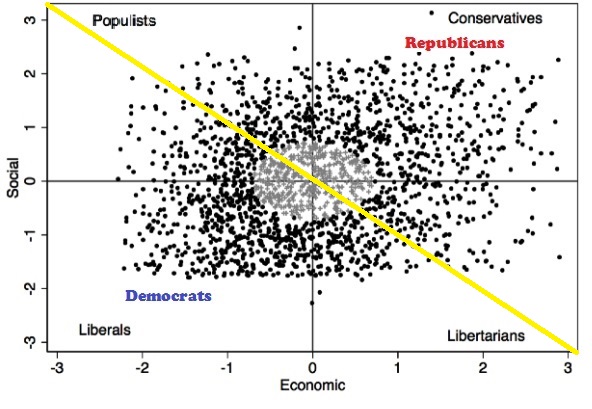
A few months ago, I posted the chart below, which was borrowed without permission from some political scientists who have studied the political ideologies of American voters.

Voters (the little dots) in the two rectangles on the left side of the chart are left-wingers on economic issues, e.g., in favor of increasing the minimum wage. Voters in the rectangles on the right side, however, are right-wingers on those issues, e.g., against increasing the minimum wage.

Going in the other direction, voters in the top rectangles are right-wingers on social issues, e.g. most likely against gay marriage. Those in the bottom two boxes are left-wingers on those issues, e.g. favoring gay marriage. (It’s a known fact that life is much simpler if you diagram it using x and y coordinates.)

Dems and Reps pops yellow

Now, however, the chart has some color to represent people who tend to vote for Democrats and those who tend to vote for Republicans. (Another interruption: did whoever picked blue for Democratic states pick that color instead of red — the traditional color of the left — because red would have suggested Democrats are a bunch of commies?)

Since we’ve only got two big political parties, the populists and libertarians who want to participate in elections often end up choosing between Democratic and Republican candidates. As a rule, the populists and libertarians to the right of the yellow line will vote for Republicans, while the populists and libertarians to the left of the yellow line will tend to vote for Democrats. In similar fashion, people who run for public office will generally join the Democratic or Republican party, depending on the relative strength of their various social and economic beliefs (putting aside any tactical reasons for running in one party or the other).

To use the standard terminology, the left-of-the-yellow-line libertarians tend to be “civil” libertarians (maybe even members of the ACLU), while the right-of-the-yellow-line libertarians tend to be “economic” libertarians (maybe they donate to the Cato Institute). 

Unfortunately, aside from allowing me to play with this great chart, the only point of this discussion so far is to emphasize that there are degrees of commitment to the four political ideologies the chart represents. Someone like Senator RP, for example, who is known for his libertarian tendencies, decided at some point to identify himself as a Republican, apparently because his left-wing, social, civil libertarian views (of which he seems to have some) were weaker than his right-wing, economic libertarian views (of which he definitely has some).

All of which serves, finally, as preface to some general remarks about Republican-leaning economic libertarians (which I’ve reorganized as Part 4, because Part 3 doubled in size, even corrected for inflation).

Republicans and Liberty, Part 2

In yesterday’s post, I asked whether libertarian Republicans support the work of the American Civil Liberties Union and decided that they generally don’t. That’s because libertarian Republicans are generally “economic” libertarians, not “civil” libertarians.

One way to understand the difference is to consider controversies like the recent one in Arizona. Should business people be allowed to refuse service because of a customer’s sexual orientation? A strict economic libertarian would say yes, arguing that the government shouldn’t compel one group of people to associate with any other group, while a civil libertarian would argue that everyone has an equal right to purchase goods and services regardless of their sexual orientation.

To better understand what economic libertarianism amounts to in practice, I visited the official website of Senator RP, today’s most famous Republican libertarian and a contender for the 2016 Republican presidential nomination.

Some of RP’s positions are simple platitudes. For example, he thinks we should only go to war if it’s necessary and the tax system should be simplified. The Senator may have interesting libertarian views on these subjects, but doesn’t mention them.   

Some of his other positions are clearly consistent with libertarian principles, although any economic libertarianism is muted. As expected, he thinks the federal government is too big (he also claims the federal government has doubled in size in the past decade — a statement that is ridiculously untrue; the real numbers are provided in a note at the bottom of this post).

In addition, he thinks the government has become too powerful and intrusive (apparently since 9/11). This opinion is the only one included under the category “Civil Liberties”. Lastly, he says the Affordable Care Act is bad because it expands the role of government. He doesn’t mention an alternative, although an economic libertarian would presumably prefer a completely private system in which healthcare is just another product, either freely donated or sold to people who could afford it. 

I’m obviously no expert on economic libertarianism, but his other positions seem questionable from that perspective: 

Life begins at conception, so abortion is unconstitutional – Even if we grant for the sake of argument that a fertilized egg is a person with constitutional rights, this would still be a case in which one individual’s single right take precedence over another individual’s various rights (without, of course, the latter’s consent). It’s certainly arguable that in this case, RP wants to impose his religious views on pregnant women, regardless of their own beliefs.

Our schools are suffering from too much government spending and interference – Some economic libertarians think mandatory public education is wrong. RP merely favors spending less money and exerting more local control. It isn’t clear in this context whether RP thinks school-age children have any rights at all, for example, the equal right to an education that will allow them to properly compete in the free market. 

We should increase domestic energy production even more than we already have – Encouraging energy efficiency (that would be government interference in the marketplace) and discouraging pollution (which affects us all, not just polluters) aren’t mentioned.

Illegal immigration is a threat to our national security – It isn’t explained why it’s dangerous for foreigners to participate in our free market. Some economic libertarians favor immigrant rights, apparently holding that people should be able to live and work where they want without government interference.

There should be no restrictions on gun ownership, except by irresponsible people and criminals – In practice, this means there should be very few restrictions and conflicts with other people’s right to be protected from violence (the main reason we have a government, according to economic libertarians).

Social Security covers more people than in the past and they’re living longer – No policy position is stated, although it’s implied that something is wrong. In particular, there is no mention of reducing benefits or cutting Social Security taxes, which would seem to be the obvious economic libertarian position.

Nobody should be allowed to serve in the Senate or the House for more than 12 years – This is despite the obvious fact that term limits infringe upon an individual’s fundamental right to engage in a law-abiding career of his or her choice for as long as he or she chooses.

Veterans should be given special assistance – It isn’t clear whether this means veterans should receive benefits beyond what was promised when they freely chose to enlist.

Based on the above, Senator RP’s libertarianism seems rather limited, perhaps because taking stronger libertarian positions would scare away voters. Cutting Social Security benefits and allowing more foreigners into the country aren’t popular positions. Legalizing drugs, which isn’t mentioned, is controversial, especially among Republicans. On the other hand, most Republicans favor forcing pregnant women to give birth, term limits and special benefits for veterans, none of which are clear libertarian positions.  

So, the impression I get from RP’s website is that he has some libertarian tendencies, but is just another right-wing politician. He’s found a home in the Republican Party even though Republicans tend to favor things like prayer and creationism in public schools, a worldwide military presence, government surveillance, harsh drug laws, farm subsidies and vote suppression, despite the fact that those positions seem to conflict with libertarianism of any kind.

I was planning to include some general thoughts on economic libertarianism today, but for now I’ll end with a related observation (author unknown) and that promised footnote):

There are two novels that can change a bookish fourteen-year old’s life: Tolkien’s “The Lord of the Rings” and Ayn Rand’s “Atlas Shrugged”. One is a childish fantasy that often engenders a lifelong obsession with its unbelievable heroes, leading to an emotionally stunted, socially crippled adulthood, unable to deal with the real world. The other, of course, involves orcs.


That promised (long) footnote: Has the federal government doubled in size in the past decade, as RP’s website claims?

The precise decade isn’t specified, but that’s not important, since the numbers are clear whichever recent 10-year period we choose. For example, starting in 2002 and ignoring inflation, total federal spending was 2.0 trillion dollars. In 2012, it was 3.5 trillion, a truly large increase of 75% (although less than 100%). However, corrected for inflation (using constant 2005 dollars), total spending went from 2.0 trillion to 3.0 trillion, an increase of 50% (well, it was a rough decade, what with the wars and the free-market financial crisis and the resulting unemployment).

Alternatively, as a percentage of the country’s Gross Domestic Product (a measure commonly used by economists, because it reflects the nation’s increasing economic activity), federal spending rose from 19% of GDP in 2002 to 24% of GDP in 2012, an increase of 26%.

Finally, there were 4.15 million people working for the federal government in 2002. In 2012, there were 4.31 million, an increase of only 3%.

So much for the size of the federal government doubling in the last decade. 

By the way, the other statistic cited to help us understand this supposed astonishing growth of more than 100% is an increase of roughly 40%. Quote: “To put this in perspective, the federal government spends more than $10,280 per person, over $3,000 more per individual than what we were spending in 2001”.

Republicans and Liberty, Part 1

It’s one of those enduring questions: why are there Republicans?

I don’t know the answer, but I’ve been thinking about the existence of one kind of Republican lately: the Libertarian. The principal libertarian Republican in the news these days is a Senator from Kentucky whose initials are RP. Some of the people who spend their time on Earth guessing about such things think RP is the front-runner for the 2016 Republican presidential nomination (even though the primaries and caucuses are still two years away). 

I started thinking about RP and other Republican libertarians when this question popped into my head: do Republican libertarians support the American Civil Liberties Union? The ACLU famously devotes itself to protecting various rights and liberties, especially those enumerated in the Bill of Rights. Shouldn’t Republican libertarians be in favor of their work? Yet that seemed unlikely, since the ACLU is a well-known “liberal” organization and we all know how Republicans feel about liberals.

A little bit of research suggests that Republican libertarians support some of the ACLU’s work, but definitely not all of it. The reason for this mixed attitude is that Republican libertarians are generally “economic” libertarians, while the libertarians at the ACLU are (as you might suppose) “civil” libertarians.

Economic libertarians believe the individual is supremely important, especially when it comes to private property and the fruits of one’s labor.They hold that government’s principal purpose is to protect the rest of us from criminals and foreign aggressors, not to provide for the general welfare. They believe we should all be allowed to do what we want so long as we don’t infringe on other people’s rights.

Hence, economic libertarians favor laissez-faire, the principle that private parties should be allowed to engage in economic activity with minimal government interference, involvement or assistance. The government should only tax, regulate or subsidize economic activity in order to insure the existence of a free market, in which all of us, being responsible for our own success or failure, can fairly compete.

The basic argument for economic libertarianism was strongly stated by the philosopher Robert Nozick (who borrowed some of it from Immanuel Kant) in his classic book Anarchy, State and Utopia: all human beings should be treated as ends, not means, so it’s wrong to take from one person to help another. Basically, my tax dollars should not benefit you without my consent. Otherwise I’ve been made a kind of slave.

To sum up, in the words of one self-described libertarian: “Real libertarians understand that freedom of speech and other civil liberties depend on the sanctity of private property – not its violation by anti-discrimination laws and other forms of government intervention.”

So, economic libertarians endorse some of the ACLU’s work, such as supporting freedom of speech and the right of assembly, but oppose a lot of it, such as the ACLU’s support for anti-discrimination laws (because an employer should be able to discriminate against potential employees on the basis of race or gender) and the supposed right of all children to an equal public education at taxpayer expense. 

Economic libertarians appear to disagree among themselves on other issues. One troublesome example is abortion rights, which the ACLU obviously supports. Economic libertarians would presumably support abortion rights too (it’s my body) but not if they think a fetus is already a person (in which case, the fetus already has rights that need to be protected). Voting rights is another interesting case. The ACLU strongly favors voting rights for all Americans, including ex-prisoners, but some economic libertarians think that committing a felony means you’ve forfeited your right to vote.

To test my understanding of the difference between economic and civil libertarians, and to see what that famous libertarian Republican has to say, I spent some time on Senator LP’s website. More about that tomorrow, as well as some thoughts on economic libertarianism in general.

A Guide to Reality, Part 10

Chapters 5 and 6 of Alex Rosenberg’s The Atheist’s Guide to Reality are all about morality. In chapter 5, he lays out what he calls the “bad news”: there is no “cosmic value” to human life and moral questions have no correct answers. Rosenberg explicitly endorses ethical nihilism:

Real moral disputes can be ended in lots of ways. by voting, by decree, by fatigue of the disputants, by the force of examples that changes social mores. But they can never really be resolved by finding the correct answers. There are none….All anyone can really find are the answers that they like [96].

To be completely consistent, Rosenberg would probably have to admit that there is no “bad” anything, not even news. Since, on his view, “physics fixes all the facts” and there is nothing truly good or bad in the world at all. After all, one quark is just the same as another.

Rosenberg explains that nihilism isn’t the same as relativism or skepticism. It’s not the case that ethical views can be correct at some times and not at others, or that we can never know for sure which ethical views are right or wrong. Nihilism doesn’t even mean that “everything is permitted”, since nothing is morally “permitted” or “forbidden”:

[All moral judgments] are based on false, groundless presuppositions. Nihilism says that the whole idea of “morally permissible” is untenable nonsense. [Nihilism] can hardly be accused of holding that “everything is morally permissible”. That, too, is untenable nonsense [97].

Nothing at all is morally valuable in itself  (“intrinsically”) or even as a means to something that is.

Notice, however, that Rosenberg isn’t a nihilist about everything. At least, he gives the strong impression that he believes some ideas are true and some are false, and some beliefs are justified and some aren’t. But it’s generally accepted that truth and justification are “normative” concepts just as much as “right” and “wrong”, i.e., they are value-laden. True statements are those which “correctly” describe some state of affairs, while justified beliefs are those that have “good” reasons for believing them. But physics has nothing to say about correct descriptions or good reasons.

In the rest of chapter 5, Rosenberg offers an argument for the truth of ethical nihilism. He begins with a version of the famous question Plato asked in his Euthyphro dialogue: If our favorite moral rule (whatever it happens to be) is both morally correct and favored by God, is it correct because God favors it or does God favor it because it’s correct? Some Christian theologians have tried to deal with the question by invoking the Trinity or by claiming that the question presupposes a misunderstanding of God’s nature, but most people would probably agree that God favors moral rules because they are correct, not the other way around.

Rosenberg, of course, isn’t really interested in a theological version of the question. He brings it up because he thinks it presents an important challenge to his own scientistic position.

He next argues that there is a core set of moral principles common to all cultures. These principles are so common and so obvious, in fact, that they are rarely discussed. For example, we all agree that parents should protect their children; self-interest is acceptable until it becomes selfishness; and it’s wrong to punish people at random. Rosenberg thinks this core morality is the product of millions of years of human evolution (which sounds right to me, too).

He then asks a Euthyphro-like question: did evolution result in our core morality because it’s the correct morality, or is it the correct morality because it resulted from evolution?

Is natural selection so smart that it was able to filter out all the wrong, incorrect, false core moralities and end up with the only one that just happens to be true? Or is it the other way around: Natural selection filtered out all but one core morality, and winning the race is what made the last surviving core morality the right, correct, true one [109].

This question seems more difficult to answer than the theological version. Rosenberg, in fact, argues that the question has no answer. On one hand, evolution is blind, so there was no way for evolution to “know” which morality is correct. Furthermore, evolution has resulted in common views and practices that don’t seem ethical at all, like patriarchy and xenophobia. For that matter, the fact that religion is so common implies that evolution is good at generating false (but useful) beliefs.

On the other hand, just because our core morality resulted from evolution doesn’t make it right. Lots of things have evolved that we’d be better off without (like using the same anatomical feature to eat and breathe). More fundamentally, Rosenberg suggests that there is nothing morally right about having children who tend to survive and have other children, which is the principal thing natural selection makes happen.

But if our core morality isn’t correct because it evolved, and it didn’t evolve because it’s correct, the reasonable conclusion to draw is that our morality isn’t correct at all. In other words, morality isn’t true. It’s merely useful:

Scientism cannot explain the fact that when it comes to the moral core, fitness and correctness seem to go together. But neither can it tolerate the unexplained coincidence. There is only one alternative. We have to give up correctness…

Scientism starts with the idea that the physical facts fix all the facts, including the biological ones. These in turn have to fix the human facts – the facts about us, our psychology and our morality…The biological facts can’t guarantee that our core morality (or any other one, for that matter) is the right, true or correct one. If the biological facts can’t do it, then nothing can. No moral core is right, correct, true. That’s nihilism. And we have to accept it [113].

We might immediately object that the biological facts might not justify morality, but the social facts do. Rosenberg claims that lower-level facts, like the biological, determine higher-level facts, like the psychological. That may indeed be true (I think it is anyway), but isn’t it likewise the case that psychological facts determine social facts, which in turn determine ethical facts? If there are ethical facts (if ethical evaluations can have truth values – which is, by the way, a controversial view among philosophers), aren’t those facts determined by lower-level facts as well?

Those who think ethical statements can be true or false would probably argue that evolution has generated morality, but moral disagreement occurs because we simply haven’t figured out what all the ethical facts are. We know some ethical facts (it’s wrong to hurt people at random and other elements of Rosenberg’s core morality) but not others (is paternalism good in some cases? how about euthanasia?). 

I’ll end for now with the comment that philosophical arguments, even interesting ones like Rosenberg’s, hardly ever destroy the opposition. They almost always lead to more arguments. 

In our next installment, we’ll proceed to chapter 6, in which Rosenberg argues that nihilism is nothing to worry about, since nihilism can be nice.Â