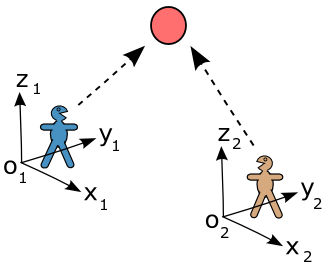
Perspectives and Perspectives

In writing about perspective, I’m a little concerned that I may be conflating or improperly jamming together two different kinds of perspective. But I think the two kinds have enough in common to justify discussing them at the same time. One kind of perspective is the personal or individual kind. The other is more social or abstract. 

Here’s an example of the first kind. On her first day of kindergarten, this little girl’s parents strapped a movie camera to her chest so she could film everything that happened “from her perspective”.
school

That’s a kind of perspective each of us has. It’s even fair to say that the camera has a perspective (as in “the teacher was visible from the camera’s perspective, but her desk wasn’t”). Cameras lack consciousness, but they do record data from a particular point of view. Do all inanimate objects have perspectives? There doesn’t seem to be any reason to say that a bottle of water has a perspective, but there are probably some difficult cases. At any rate, every individual perspective begins with a physical location (the here and now) from which the world is perceived or, as in the case of the camera, from which data is recorded.

However, there is more to a perspective than location, because a location from which nothing is being perceived or recorded isn’t really a perspective. We might say, for example, that the ocean is visible from the perspective of that mountaintop, but that would only be another way of saying that an observer on top of that mountain could see the ocean. Mountaintops don’t actually have perspectives. Like any other location, a mountaintop can only play a role in someone or something else’s perspective (and it can be a very helpful role, which is why telescopes are often put on mountaintops).

I don’t mean to suggest that there’s very little difference between a camera’s perspective and a person’s. But I think perspectives occupy a range from the very simple to the very complex. Cameras and bacteria have relatively simple perspectives; you and I have more complex perspectives; redwoods (?) and rabbits fall somewhere in between. (The HAL 2000 computer had a perspective, although I’m not sure where it fit on the continuum.)

How is a person’s perspective (or HAL’s) more complex than a camera’s? If it worked properly, the camera above was able to roughly capture some of what the little girl saw. If it was set to record sound, it also captured sounds similar to the ones she heard. But the camera couldn’t do more than that. It couldn’t even approximate how her new shoes felt or how her lunch tasted. Relatively complex organisms like us have a variety of senses that allow us to gather information about our bodies and the world around us, giving us relatively complex perspectives (some neurologists think we have as many as twenty-one senses; it’s agreed we have more than five).

But other factors besides sense perception affect our perspective. For example, it’s said in this review of The Diary of a Teenage Girl that the movie “aims to tackle a coming-of-age story from a girl’s perspective”. That doesn’t mean the director filmed the movie so that every scene was shot as if we in the audience were looking through the girl’s eyes (some directors do that kind of thing, and it gets annoying fairly quickly). A film being made from a certain character’s perspective means that the events and characters in the film are portrayed as they might have been experienced by that particular character, for example, by a teenage girl who had a certain background and a certain set of memories, beliefs, emotions and needs. The director tells the story as if this particular teenage girl were telling it. 

This is the broad sense of perspective that’s captured by the phrase “this is where I’m coming from”. During a conversation, I might express my opinion on the topic at hand, but simultaneously admit that my opinion is partly determined by who I am and where I’ve been. We all understand, or should understand, that how we experience and evaluate the world depends to a significant extent on our individual perspectives.

So what’s the other kind of perspective I mentioned hundreds of words ago? That’s the social or abstract kind referred to in titles like these: “Spender’s Anthropological Perspective Was An Eye-Opener”; “Forgiveness From a Humanist Perspective”; and “The Russian Perspective”. Anthropological, humanist and Russian perspectives aren’t the same as personal perspectives, but they don’t float around in the ether either. They’re connected to the individual perspectives of, in these three cases, anthropologists, humanists and Russians. I think I’ve got something to say about that kind of perspective, and how the two kinds are related, but, from my perspective, that’s enough for now. 

Highlighted Passages From 40 Years Ago

The Culling of the Books has begun again. It’s the process in which old friends and acquaintances (and a few new ones) are (1) put up for sale on eBay, (2) offered to used bookstores, (3) left at the city’s book exchange shed, (4) recycled or (5) even consigned to the trash. It happens as regularly as an atomic clock ticks, but not quite so often.

Some will survive the process, only to be assessed at the next CotB. No one will be safe forever!

This is why I picked up my 1975 paperback edition of Fields, Factories and Workshops this afternoon. First published in 1898, it’s a classic statement of anarchist principles written by Peter Kropotkin, more formally known as Prince Pyotor Alexeyevich Kropotkin.

maxresdefault1

Kropotkin was a Russian aristocrat who favored the overthrow of both capitalism and the state. He envisioned a future in which small communities, linked together by modern technology, would grow much of their own food and do much of their own manufacturing. He championed cooperation over competition and rejected the authoritarian socialism of the Bolsheviks.

This is the kind of book I was reading in the 1970’s when I started wondering why our economic system leaves so many people idle when there is so much work to be done.

But now, before deciding on this old book’s future, I’m going to share two paragraphs I highlighted back then. First, here’s Kropotkin predicting a future that now seems unlikely:

Each nation – her own agriculturist and manufacturer; each individual working in the field and in some industrial art; each individual combining scientific knowledge with the knowledge of a handicraft – such is, we affirm, the present tendency of civilized nations.

And here’s Kropotkin on the purpose of education:

Be it handicraft, science or art, the chief aim of the school is not to make a specialist from a beginner, but to teach him the elements of knowledge and the good methods of work, and, above all, to give him that general inspiration that will induce him, later on, to put in whatever he does a sincere longing for truth, to like what is beautiful, both as to form and contents, to feel the necessity of being a useful unit amidst other human units, and thus to feel his heart at unison with the rest of humanity.

Finally, to quote from the editor’s introduction:

Fields, Factories and Workshops is one of those great prophetic works of the nineteenth century whose hour is yet to come…His book is really a thesis … on the economic consequences of the humanization of work.

Good and Bad Behavior From a Perspectivist Perspective

And God said: “Take now thy son, thine only son Isaac, whom thou lovest, and get thee into the land of Moriah; and offer him there for a burnt offering.”

A few days later: “They came to the place which God had told him of; and Abraham built an alter there, and laid the wood in order, and bound Isaac his son, and laid him on the alter upon the wood…And Abraham stretched forth his hand, and took the knife to slay his son.”

But God presented Abraham with a ram to sacrifice instead!

Now, some people think God would never have let Isaac be sacrificed. God does not or cannot do bad things. Other people think God could have let the sacrifice proceed. In that case, depending on who you ask, Abraham should have killed Isaac, because that was God’s will, or he shouldn’t have, because it would have been immoral (and maybe God was hoping Abraham would spare Isaac anyway, just like the tricky aliens in Star Trek often test the humans). Then there are people like me who think these verses from Genesis are nothing but a provocative story.

What makes the story provocative, of course, is that it sets up a supposed conflict between God’s commands and morality. On one hand, disobeying a direct order from God might be a very big mistake, not just because of the lighting bolt thing, but because the Supreme Being presumably knows what’s best for all of us. On the other hand, morality is often thought to be the ultimate perspective from which to evaluate behavior, whether human or divine. The ethical thing to do is always the right thing to do. 

So what should Abraham have done? It’s relatively easy for the non-religious or anti-supernatural among us, comfortably moralizing in 2015, to say Abraham should have refused to sacrifice Isaac. But from a religious perspective, one can easily conclude the opposite. From that perspective, our fundamental responsibility is to obey God’s commandments, whether they’re truly ethical or not. The theologians who argue that God can’t do anything immoral seem to be trying to glorify God, rationalizing like those of us who do bad things but want to believe our actions are ethically justified. If the religious perspective is different from the ethical perspective, perhaps the ethical perspective isn’t supreme after all. Not for everyone anyway.

If you don’t think a religious perspective could ever trump the ethical one, consider a perspective we might call the “relational”. In 1793, William Godwin asked his readers to consider which of two people they would rescue from a fire: a great humanitarian who would serve mankind for years to come or a lowly chambermaid who would never rise above her station. Godwin thought it was obvious from an ethical perspective that the humanitarian should be saved first, risking the life of the chambermaid, since that would have the best consequences for the most people. You might agree, but what if the chambermaid was your mother? 

It could be argued that saving your mother would be the ethical choice because of your special relationship. What kind of unfeeling, disloyal child would let his or her mother burn to death instead of some stranger, even a world-famous humanitarian? But giving special consideration to the members of one’s family is questionable from an ethical perspective. We can try to explain how favoritism can be ethical but that’s simply more rationalization.

Kant, for example, took morality so seriously that he once claimed we should never tell a lie, not even to “a murderer who asks us whether a friend of ours whom he is pursuing has taken refuge in our house”. If there is an absolute ethical prohibition against telling a lie, and the ethical perspective is the supreme guide to life, so much the worse for your relatives hiding in the basement when the Nazis show up. Or consider the ethical argument for donating much of your income to help refugees in Africa or the Middle East. Is it ethical to pay for music lessons for your children when you could use that money to make a Somali child’s life more bearable? Perhaps favoritism should trump morality sometimes (where the “should” isn’t meant in the ethical sense). We know it often does.

Of course, I’m not saying that the ethical perspective is unimportant. Society could hardly exist without it. But I think there are other perspectives that are also important. They come into play whenever we make a decision or evaluate behavior. In fact, the only way to justify ethical behavior as a whole is by appealing to non-ethical perspectives (just as you cannot justify being practical from a practical perspective or viewing the world scientifically from a scientific perspective). 

Why should we concern ourselves with morality at all? Historically, it’s often been justified from a religious perspective (God commands us to behave ethically) or from a practical perspective (society couldn’t function without it; you’ll get into trouble if you’re unethical) or from a personal perspective (I want to act like a virtuous person). Another justification that’s been popular among philosophers is from a rational or logical perspective (we should treat all people equally since there are no relevant differences between us).

I think it’s important to understand the various perspectives from which we view the world and try to live in it, as well as the relationships between those perspectives. Admitting that we don’t always behave as if the ethical perspective is paramount is a good first step. We might then do a better job figuring out how to balance our many perspectives, such as the ethical, religious, “relational”, practical and scientific; as well as my perspective, your perspective and the perspectives of other living things. After all, even when it comes to morality, the fundamental rule we first learned is to evaluate behavior from other people’s perspectives as well as our own.

What’s It All About, Woody?

In Woody Allen’s latest movie, Irrational Man, Joaquin Phoenix plays Abe, a moody philosophy professor, while Emma Stone plays Jill, a cheerful undergraduate, who etc. etc. etc.

New York Times critic Manhola Dargis describes Jill as “an eager A student who’s attracted to Abe because that’s how she was written”. That’s very nicely put, but our topic isn’t cinema or gender. Our topic is whether life is meaningless.

From the Times review of Irrational Man:

In Woody Allen’s 1987 drama “September,” a writer and a physicist walk into a room … when the writer asks the physicist, “Is there anything more terrifying than the destruction of the world?” The physicist, sunk deep in gloomy shadow, answers, “Yeah, the knowledge that it doesn’t matter one way or the other — that it’s all random, radiating aimlessly out of nothing and eventually vanishing forever.” The physicist says that he’s not talking about the world. “I’m talking about the universe,” adding, “all space, all time, just a temporary convulsion.”

The exchange is in keeping with Mr. Allen’s oft-repeated insistence, on-screen and off, that life is meaningless, which may be true even if he seems feverishly bent on refuting it with his prodigious cinematic output.

Nobody has ever accused me of always, or even generally, looking on the bright side of things, but I don’t see any connection at all between the end of the universe and the meaning of life. So maybe Woody Allen, who is rather intelligent and can be relatively funny, is having a bit of fun when he suggests that life is meaningless because, meaningless because, in the distant future, the whole shebang will come to nothing.

Apparently not. It was easy to find videos in which Allen, speaking as himself, not through one of his characters, expresses an extremely bleak view of our situation. In one video, for example, when asked to comment on Macbeth’s complaint that life is “full of sound and fury, signifying nothing”, Allen offers this:  

You die and eventually the sun burns out … eventually all the planets and all the stars … the entire universe goes, disappears, and nothing is left at all … and you think to yourself, it is a lot of noise and sound and fury and where is it going? It’s not going anyplace.

He then imagines a cycle in which all of humanity is replaced every 100 years. Each time, people take their lives very seriously, yet “it seems like a big meaningless thing”. Strangely, however, he concludes that “even knowing the worst … it’s still worthwhile …it’s still important to go on”. Further, it’s the artist’s job to help the rest of us understand why this is so.

Not that it makes any difference, but physicists aren’t really sure how the universe will end. Will there be a Big Freeze? Big Rip? Big Crunch? Big Bounce? One reason they’re not sure is that they don’t know enough about dark energy, the strange force that seems to be making the universe expand more quickly. But however it ends, the universe should keep going for billions of years. Its ultimate destination may be nowhere at all, but in the meantime, a whole lot of stuff, including us, will be traveling every which way.

Citing events like the end of the universe or the explosion of the sun as reasons for the meaninglessness of life could be the most ridiculous thing I’ve ever heard a public figure say. It’s like saying that traveling around the world or visiting the Moon is pointless because you’re going to end up back in your own bed and, besides, you’re not going to live forever. 

Life has meaning for anyone who finds it meaningful. None of our experiences, memories, expectations, accomplishments or relationships are inherently meaningful – meaningful in themselves – but they are often meaningful to us and other people. That’s why we say things like “that really meant a lot to me” or (as I heard in a movie this week) “you mean nothing to me”.

To be meaningful in this sense is to be significant. It’s true that we sometimes perceive significance where there really isn’t any, but we don’t always get it wrong. Was it meaningful to you when you finished that task, visited that place, played that song, met that person? Well, no it wasn’t, because billions of years from now, there won’t be anything in the universe except black holes, and they’ll eventually disappear too! Making this supposed connection explicit – “life can only have meaning if the universe lasts forever” – shows what an absurd, lazy idea it is.

To be fair to Woody Allen, however, he might have another idea in mind. When people say life is meaningless, they sometimes mean that life has no ultimate purpose. Our individual purposes (putting food on the table, learning how to surf, becoming a banker) don’t seem important enough in the grand scheme of things. Isn’t there a bigger purpose to all of this?

Perhaps we’re here to propagate the species (until there’s no room on Earth for one more person?). Or help the universe or the Absolute become aware of itself (good one, Hegel). Or to fulfill a divine plan, like glorifying the supreme being forever and ever (the ego!). Or maybe we humans are only here as unwitting contestants in a vast competition run by the rulers of the galaxy to see which planet can produce the best muffins? That’s a possibility.

In addition to the difficulty of identifying which particular cosmic purpose we’re here to serve, there’s another big problem with this idea. Whatever purpose we’re serving, it most likely isn’t ours (especially if we don’t know what it is). Living in order to serve someone or something else’s higher purpose means that we are being treated as a means, not an end. That’s the opposite of what Kant argued is the basis of morality: to treat people as ends in themselves, not as means to achieving something else. Unless we can correctly identify a higher purpose and then adopt it as our own, the desire to serve a higher purpose is the desire to be used. 

In a similar context, Nietzsche criticized what he called “the ascetic ideal”, a way of thinking that helps the less psychologically advanced among us (the “herd”) avoid “suicidal nihilism”. The ascetic ideal, as embodied by Christian morality, requires that:

there is nothing on earth of any power which does not first have to receive a meaning, a right to existence, a value from it, as a tool to its work, as a way and means to its goal [On the Genealogy of Morality, III, 23).

Knowing that we were being used to serve an overriding purpose in the way Nietzsche describes service to the ascetic ideal would certainly add meaning to our lives. That’s true. But whether it would be a desirable meaning is another question.

The world in which we find ourselves should make us wonder what higher purpose would justify or explain what goes on around here. Nature is red in tooth and claw for most living beings. We humans do have Beethoven and Michelangelo, as Woody Allen often says, and surprisingly many people around the world are fairly satisfied with their lives, but consider all the horrendous crap we have to deal with (often at the hands of other humans).

Finding out that all of humanity’s pain and suffering happens for a reason would be adding insult to injury. The world is like this on purpose? It’s more agreeable and understandable that it just worked out this way. If I learned that this whole enterprise was set in motion by some higher-ups (or -up), I’d be very surprised, but also very disappointed. Couldn’t they do a better job? Are we living in a beta version?

They better damn well enjoy our muffins.

Postscript of 7/27/15:

From the 16th century French essayist Michel de Montaigne: “Life should be an aim unto itself; a purpose unto itself” (Essays, III, 12).

It’s a Matter of Perspective

One afternoon, about four years ago, I was walking along in our neighborhood when it occurred to me that every perception or thought we have, every emotion we feel, every conclusion we reach, every command we issue or question we ask is from our particular, individual perspective.

Well, of course. That’s a truism, a statement so obviously true it’s hardly worth stating. We each have our own perspective. So what?

I don’t know, but ever since then I’ve been thinking about what it means to have a perspective or be from a perspective, and how different perspectives relate to each other. Not every waking moment, of course. But you might be surprised how often you’ll see the word “perspective” or a similar expression like “point of view” or “frame of reference” once you start paying attention.

For instance, there’s the way paintings or drawings give the impression that a two-dimensional surface has three dimensions. Turner used perspective when he painted Oxford’s High Street: 

high_turner

Underlying the artistic technique is the fact that we each have a physical perspective from which we observe the world. Each observer has what physicists call a “reference frame”, a “coordinate system attached to [the] individual observer’s perspective”, from which measurements are made. It’s one of the key concepts in Einstein’s theory of relativity.

Frame_of_reference

In addition to our physical perspective, we each have what our own “personal” perspective. It includes our particular desires, needs and interests. Personally speaking, It seems like a good idea — from my perspective — to be writing this (I have my reasons). From your personal perspective, it might be better to take a walk or go to bed.

Another type of perspective depends on what conceptual schemes or ways of thinking. We usually deal with the world from what we think is a practical or prudential perspective, but sometimes opt for a perspective that’s ethical or religious. We complain about politicians who function from a purely political perspective and celebrate those who champion a scientific or global perspective. There are so many perspectives that library shelves sag under books with inviting (?) subtitles like “Ecological and Experimental Perspectives”, “A Probabilistic Perspective”, “Perspectives from Philosophy, Psychology and Theology”, “Multicultural Perspectives” and “A Supply-Chain Perspective”.

In future posts, I’d like to occasionally discuss perspective from various perspectives. For example, why choose one perspective instead of another? Are multiple perspectives always better? How can a perspective be justified? Can it only be done from another perspective? Is there or should there be a hierarchy of perspectives? Is it really possible to adopt someone else’s perspective? Does morality depend on being able to do so? How does the philosophical position called “perspectivism”, associated with Nieztsche, differ from relativism? And is perspectivism preferable to the better-known view? 

For now, here’s a passage from Sarah Bakewell’s How to Live: Or a Life of Montaigne in One Question and Twenty Attempts at an Answer:

In the view of William James, as of Leonard Woolf and Montaigne, we do not live immured in our separate perspectives, like Descartes in his room.We live porously and sociably. We can glide out of our own minds, if only for a few moments, in order to occupy another being’s point of view. This ability is the real meaning of “Be convivial”, this chapter’s answer to the question of how to live, and the best hope for civilization.