The American Pragmatists by Cheryl Misak

This is an entry in a series called The Oxford History of Philosophy, written by an expert on the philosophical school known as “pragmatism”. Here’s how Oxford University Press describes the book:

Cheryl Misak presents a history of the great American philosophical tradition of pragmatism, from its inception in the Metaphysical Club of the 1870s to the present day. She identifies two dominant lines of thought in the tradition: the first begins with Charles S. Peirce and Chauncey Wright and continues through to Lewis, Quine, and Sellars; the other begins with William James and continues through to Dewey and Rorty. This ambitious new account identifies the connections between traditional American pragmatism and twentieth-century Anglo-American philosophy, and links pragmatism to major positions in the recent history of philosophy, such as logical empiricism. Misak argues that the most defensible version of pragmatism must be seen and recovered as an important part of the analytic tradition.

According to Professor Misak, “the most defensible version of pragmatism” is the version initiated by C. S. Peirce and Chauncey Wright in the 19th century and carried forward by C. I. Lewis, W. V. Quine and Wilfrid Sellars in the 20th. She argues that it is more defensible because it considers truth to be less subjective. In the caricature or simplification of pragmatism as set forth by William James and criticized by G. E. Moore and Bertrand Russell, true statements are those that “work for us”. If religious beliefs make your life better, for example, they’re true. By contrast, the tradition that began with Peirce treats truth more objectively. Statements may “work for us” even though they’re false. The Peircean pragmatists see a stronger relationship between truth and how the world is, regardless of human goals or interests.

It isn’t easy to briefly explain what pragmatism is, but Prof. Misak gives it a try in the Preface:

Pragmatists are empiricists in that they require beliefs to be linked to experience. They want their explanations and ontology down-to-earth (natural as opposed to supernatural) and they require philosophical theories to arise out of our practices. As Peirce put the pragmatic maxim, we must look to the upshot of our concepts in order to understand them….

[But] pragmatists reject the part of empiricism that says that all of our beliefs originate in experience and that our beliefs can be linked in an atomistic way to discrete experiences…. They reject any naturalism that gives ontological priority to matter or physicality — they want to consider whether value, generality, chance, etc. might be part of the natural world. They are holists, taking their view to encompass all of science, logic, mathematics, art, religion, ethics and politics. Unlike most of their empiricist predecessors, they fence off no realm of inquiry from the principles they set out.

In the Conclusion, she adds:

The core pragmatist thought is about the human predicament. We must try to explain our practices and concepts, including our epistemic norms and standards, using those very practices, concepts, norms and standards. This is the pragmatist’s task and we have found that, within the pragmatist tradition, there are different ways of trying to fulfill it.

I’ll finish with a brief example of pragmatist thinking. The great Scottish philosopher David Hume is sometimes viewed as a skeptic (e.g. he believed there is no rational basis for ever thinking that one event causes another). The pragmatist John Dewey, however, saw Hume as a predecessor:

While in his study, Hume finds skepticism compelling, but as soon as he leaves that secluded place of theoretical philosophizing, skepticism loses any force it might have had. The skeptic’s doubts, as Peirce would put it, are paper doubts [107].

According to the pragmatists, what matters, even from a philosophical perspective, is how our ideas connect with our lives outside the philosophy class.

Update (January 2020): Without realizing I’d already read it, I read it again. More here.
They Really Are Different From the Rest of Us

If you’re like me, you often wonder whether right-wing media people and politicians believe the nonsense they pass on to the rest of us. For instance, did they really think Hillary Clinton’s email server was a horrendous, disqualifying breach of national security? Or that the FBI, one of the most conservative agencies in the federal government, plotted to elect her, despite all evidence to the contrary (like the fact that they helped elect her opponent)?

Granted, some “conservatives” are sufficiently stupid or ignorant to buy that kind of crap. But the people who run Fox News or the major right-wing websites are smarter and better-informed than the average right-wing boob who watches Hannity or listens to Limbaugh.

Brian Beutler, one of the best people writing about politics today, argues that the purveyors of right-wing nonsense really are different from the rest of us:

Outside of the specific American context, the word “liberal” describes … a philosophical approach to organizing society [that reflects] a common commitment to basic Enlightenment-era ideals like equality, democracy, and empiricism [i.e. evidence].

In recent years, political science tells us, the two American parties have polarized, and the polarization has been asymmetric. Republicans have become more conservative faster than Democrats have become more progressive.

It is increasingly clear that asymmetric polarization is the wrong metaphor for what has happened in American politics. To say the parties are asymmetrical is to imply that they’re fundamentally similar, but that one has become distorted in some way—that while Democrats and Republicans are still committed to basic Founding values, Republicans are rapidly adopting more extreme policy prescriptions. They’ve changed, but they can change back.

Whether or not that was ever true, it clearly no longer is. The parties aren’t two different animals of the same species. They have speciated [become different species].

Democratic politicians, liberal activists, and journalists have different purposes and respond to different incentives, but they are all liberal in that global sense. Two decades after Newt Gingrich redefined what it meant to be a Republican, it is clear that Republican politicians, conservative activists, and the right-wing media have become adherents to a fundamentally different political tradition.

Most conservatives are not aware of this anymore than liberal people walk through life meditating regularly on their historical connections to John Locke and John Dewey. But some conservatives are perfectly conscious that they’ve rejected the small-l liberal canon.

Paul Ryan is an Ayn Rand acolyte. In his political biography of Steve Bannon, Bloomberg writer Joshua Green details how Bannon became enthralled with the anti-modernist thinking of philosophers like RenĂ© GuĂ©non and Julius Evola, the latter of whom helped create the intellectual foundation of Italian fascism. Bannon is an admirer of the great propagandists of totalitarian Europe, including Leni Riefenstahl and Sergei Eisenstein, who used information instrumentally to mobilize (rather than inform) … Nazi Germany and the Soviet Union. For years now, Bannon and his acolytes in right-wing media have made no secret of their desire to destroy mainstream journalism as a vocation in America. His understudy Matthew Boyle has boasted that his organization’s goal is nothing less than “the full destruction and elimination of the entire mainstream media,” through the “weaponization of information.”

Bannon has been banished from the Trump White House and driven from his chairmanship of Breitbart for saying mean things about the president to reporters, but his imprint on the modern conservative media is enormous and undeniable…. It is impossible to watch Fox News in prime time, or Devin Nunes at the helm of the House Intelligence Committee, or Rush Limbaugh bellowing at dittoheads, and not conclude that they have done the same, consciously or otherwise.

Mr. Beutler sees here a crucial lesson for the “mainstream” (i.e. reality-based) media:

The job of the mainstream media isn’t to cast judgment on people with different value systems, but journalists can’t do their jobs well if they aren’t aware that the value systems of mainstream journalism and American conservatism are different and in conflict. It should be perfectly possible to apply the neutral rules of modern journalism to both American political parties while accepting that Democrats (and journalists and scientists) descend from the Enlightenment tradition, while Republicans (and their allies in conservative media) descend from a different, illiberal tradition—and that this makes the parties behave in different ways.

It is why the right has felt comfortable spending the past weeks fabricating whole-cloth conspiracy theories about the FBI and setting about to cajole and intimidate impartial journalists into taking the theories seriously—or at least into offering liars big platforms to spread disinformation. Journalists have spent decades responding to this kind of manipulation with varying levels of appeasement, hoping to escape the curse of the “liberal” epithet. They should try instead to embrace their own particular kind of liberalism instead, and let their bad-faith critics scream into the void.

Other Minds: The Octopus, the Sea and the Deep Origins of Consciousness by Peter Godfrey-Smith

Peter Godfrey-Smith is an Australian professor of philosophy who has spent many hours scuba-diving in order to observe the behavior of octopuses and cuttlefish. The book is an attempt to trace the evolution of mental activity from its earliest beginnings hundreds of millions of years ago, when bacteria began reacting to their surroundings. The author believes that mind and consciousness didn’t suddenly spring into existence; they developed gradually through millions of years. But he admits that nobody knows for sure.

Neither do we know what it’s like to be an octopus. We don’t even know for certain that it’s like anything at all. Maybe octopuses go about their business without feelings or anything like consciousness. Godfrey-Smith, however, argues that it’s reasonable to believe that creatures of many sorts feel pain when they are injured. But where to draw the lines (if there are any lines) between bacteria that simply react, animals that feel pain and creatures like us who are self-conscious is a mystery.

Octopuses are especially interesting because our common ancestors lived about 500 million years ago. Octopuses developed complex nervous systems, arranged differently than ours, independently from most other animals, including us. That means, in Godfrey-Smith’s words, “meeting an octopus is, in many ways, the closest we’re likely to get to meeting an intelligent alien”. It’s really too bad that they can’t tell us what it’s like to be them.

I wish the book ended with a summation of the author’s conclusions. I do remember the idea that nervous systems first evolved in order to respond to a living thing’s surroundings, and then to monitor its internal states and control its movements. And I remember a lot about the interesting behavior of octopuses and their close relations, cuttlefish. But I can’t say I came to any solid conclusions about the deep origins of consciousness. If the author reached any conclusions, he should have reminded his readers what they were.

My Country, ‘Tis of Thee

I was thinking about writing a post based on recent statements by Sen. Orrin Hatch (Republican, Utah) and Sen. Charles Grassley (Republican, Iowa), but an actual writer beat me to it.

From Paul Waldman of The Washington Post:

With Republicans well on their way to passing a dramatic overhaul of the tax code, they have presented to the public a sweeping, comprehensive vision not just of what taxes should look like, but of what government is there for, what our obligations are to one another, and even how each of us should think about our value as human beings. This is a moment of uncommon clarity.

…. Let’s start with Iowa’s Chuck Grassley, who made this comment on the estate tax:

“I think not having the estate tax recognizes the people that are investing,” Grassley said, “as opposed to those that are just spending every darn penny they have, whether it’s on booze or women or movies.”

Right now, the first $5.5 million of any estate is not subject to the tax. Because of that, fewer than one in 500 estates owes any tax at all. So Grassley is saying that 99.8 percent of Americans lead contemptible lives of waste and folly, while only that remaining sliver of the extra-wealthy have shown the virtue that should win their heirs the ability not to pay taxes on the fortunes bequeathed to them. The Senate bill would double the tax’s exemption, while the House bill would eliminate the tax entirely; depending on how the final version turns out, Eric Trump may finally be free of the fear that he’ll have to pay taxes on his inheritance.

Now let’s turn to Utah’s Orrin Hatch, who explained why, despite his support of a bill offering trillions of dollars in tax breaks to the wealthy and corporations, we absolutely must start slashing the social safety net immediately:

“I have a rough time wanting to spend billions and billions and trillions of dollars to help people who won’t help themselves, won’t lift a finger, and expect the federal government to do everything.”

… There isn’t much political advantage in saying that if you die with less than $5.5 million in assets, like nearly all Americans do, that means you were lazy and self-indulgent, while only the wealthy have proven their moral worth by the size of their bank accounts. So when someone says something like that, you can be pretty sure he’s expressing his actual beliefs….

Those are value judgments, rooted in how Republicans tend to view the worth of different people. They operate on the presumption that the economic system is fair, and the results of that system provide a measure of different people’s virtue. If you’re rich — even if you got rich by choosing the right parents — they presume that you deserve to be taxed as lightly as possible, while if you’re in need of the kinds of help we offer low-income people, then it reflects a moral failing. If we give you any help at all, it should be as grudging as possible, accompanied by stern lectures and even rituals of humiliation like drug tests.

Their tax bill, and their upcoming assault on the safety net, will weave these principles more deeply into our laws. And these principles are their real rationale; ignore all the practical claims they make about the explosion of economic growth these tax cuts will supposedly produce, and how the benefits will trickle down to everyone, and how it will all pay for itself. Those arguments are transparently bogus. A recent survey of 38 prominent economists found that only one said the tax bill would significantly increase growth…

Confronted with this comprehensive debunking of their practical claims, Republicans are undeterred and undaunted. That’s because they’re driven by a moral imperative, one that says that no matter what effect cutting taxes on the wealthy and corporations might have on the economy, it’s just the right thing to do. It rewards the virtuous, and you can tell who the virtuous are by how much money they have. If you’re asking why they wrote the bill the way they did, that’s just about all you need to know.

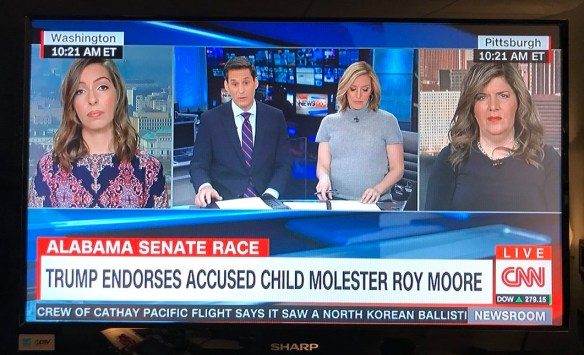
Meanwhile, our law-and-order president (sexual predator D. Trump) has endorsed former judge Roy Moore, who will probably join Grassley and Hatch in the Senate later this month:

DQNlvbQW0AEcCWY

My country, ’tis of thee,
Sweet land of liberty,
Of thee I sing….

Ideology: A Very Short Introduction by Michael Freeden

This is volume 95 in the Very Short Introduction series published by Oxford University Press. I suppose it was worth reading, although I expected more about particular ideologies as opposed to the general nature of ideology.

Freeden defines a political ideology as: “a set of ideas, beliefs, opinions and values that

(1) exhibit a recurring pattern
(2) are held by significant groups
(3) compete over providing and controlling plans for public policy
(4) do so with the aim of justifying, contesting or changing the social and political arrangements and processes of a political community.”

He identifies four main political ideologies (socialism, liberalism, conservatism and fascism) but argues convincingly that none of them can be precisely defined. What they share are general commitments to certain fundamental principles, which can also be understood as preferred ways of applying certain key terms. For example, a liberal and a fascist may both be in favor of “freedom” and “justice” but define those terms differently and apply them to different situations.

Freeden doesn’t think that having an ideology is a bad thing. He clearly favors some ideologies over others, but suggests that having a political ideology is like having fundamental principles or preferences, and that it’s almost inescapable to have an ideology if you take politics seriously. At least in the Western world, the four mentioned above, although they have evolved through the years, have been the most frequently adopted.

Throughout the book, Freeden emphasizes the importance of language in the study of ideology:

Ideologies compete over the control of political language as well as competing over plans for public policy; indeed, their competition over plans for public policy is primarily conducted through their competition over the control of political language.