Leopardi and Yeats weren’t the only poets with opinions on the subject of political passion. The following is attributed to the American poet Robert Frost (1874-1963):
A liberal is a man too broadminded to take his own side in a quarrel.
Leopardi and Yeats weren’t the only poets with opinions on the subject of political passion. The following is attributed to the American poet Robert Frost (1874-1963):
A liberal is a man too broadminded to take his own side in a quarrel.
Giacomo Leopardi (1798-1837) was a great Italian poet. He was also one of Western civilization’s great pessimists. Below is an 1821 extract from his Zibaldone di pensieri (“Commonplace Book of Thoughts”):
The power of nature and the weakness of reason. I’ve said elsewhere that for opinions to have a real influence on people, they must take the form of passions…. One could quote endless examples to demonstrate this point. But since all opinions that aren’t, or don’t seem to be, prejudices will have only pure reason to support them, in the ordinary way of things they are completely powerless to influence people.
Religious folks (even today, and maybe more these days than ever before, in reaction to the opposition they meet) are more passionate about their religion than their other passions (to which religion is hostile); they sincerely hate people who are not religious (though they pretend not to) and would make any sacrifice to see their system triumph (actually they already do this, mortifying inclinations that are natural and contrary to religion), and they feel intense anger whenever religion is humbled or contested.
Non-religious people, on the other hand, so long as their not being religious is simply the result of a cool-headed conviction, or of doubt, don’t hate religious people and wouldn’t make sacrifices for their unbelief, etc., etc. So it is that hatred over matters of opinion is never reciprocal, except in those cases where for both sides the opinion is a prejudice, or takes that form.
There’s no war then between prejudice and reason, but only between prejudice and prejudice, or rather, only prejudice has the will to fight, not reason. The wars, hostilities and hatreds over opinions, so frequent in ancient times, right up to the present day, in fact, wars both public and private, between parties, sects, schools, orders, nations, individuals—wars which naturally made people determined enemies of anyone who held an opinion different from their own—only happened because pure reason never found any place in their opinions, they were all just prejudices, or took that form, and hence were really passions.
Poor philosophy then, that people talk so much about and place so much trust in these days. She can be sure no-one will fight for her, though her enemies will fight her with ever greater determination; and the less philosophy influences the world and reality, the greater her progress will be, I mean the more she purifies herself and distances herself from prejudice and passion. So never hope anything from philosophy or the reasonableness of this century.
About 100 years later, William Butler Yeats (1865-1939) expressed a similar thought in The Second Coming:
Turning and turning in the widening gyre
The falcon cannot hear the falconer;
Things fall apart; the centre cannot hold;
Mere anarchy is loosed upon the world,
The blood-dimmed tide is loosed, and everywhere
The ceremony of innocence is drowned;
The best lack all conviction, while the worst
Are full of passionate intensity.
In the 21st century, nobody believes in pure reason anymore. The question now is whether the more reasonable have enough passion to counteract the less reasonable. Leopardi would have been doubtful.
Note: the Leopardi quote is from a New York Review of Books blog post that is much less interesting: http://www.nybooks.com/blogs/nyrblog/2013/oct/17/headline-headaches/
“Sapient” means “wise or knowing”. That’s why Carl Linnaeus, the father of modern taxonomy, called our species “Homo sapiens“. In fact, we’re all members of the sub-species “Homo sapiens sapiens“. We must be really smart (given the competition).
On a less optimistic note, however, studies show that our species suffers from various cognitive impairments. For example, there is “motivated reasoning”: our emotions often affect the conclusions we reach. The existence of the “backfire effect” is especially counter-intuitive: when our deepest beliefs are confronted by contrary evidence, our deepest beliefs can become even stronger. It’s a cognitive defense mechanism frequently on display at family gatherings and in the House of Representatives.
Once we accept the widespread irrationality of Homo sapiens sapiens, it’s much easier to understand why certain politicians say such crazy things. They aren’t necessarily lying. Too often, they actually believe what they’re saying.
Yesterday, Republican Senator Ted Cruz of Texas criticized the agreement to end the shutdown and raise the debt ceiling: “Unfortunately, once again, it appears the Washington establishment is refusing to listen to the American people”. The Senator may really believe that most of America was enjoying the shutdown and looking forward to the government running out of money. Public opinion polls indicating that most of us weren’t happy about it at all must be non-existent or seriously flawed.
Somehow it’s comforting to know that our political opponents aren’t lying bastards. They’re merely irrational, like so many of our species.
Fortunately, this doesn’t mean that all of us are equally irrational. Some people are more in need of cognitive defense mechanisms because they feel more threatened by what’s going on in the world. If you strongly prefer how things were back in the 19th century, when we didn’t have things like an income tax or child labor laws, you’ll have a lot of mental defending to do. Having that black guy in the White House clearly bothers a lot of people, who conclude that he must be the Antichrist or at least working for Al Qaeda. The Affordable Care Act scares the hell out of some people who think the government is becoming too powerful, so they hold on to the idea that death panels will soon be deciding who should live or die.
Of course, you might point out that many of us feel threatened by the radical Republicans among us. So maybe we are being irrational about them?
That’s possible, but it’s not what the evidence shows. Those people really are crazy! It’s just that their behavior is more common than some of us (the optimists among us?) would like to think.
For more on the backfire effect and whether journalists can do anything about it, here’s an article in the Columbia Journalism Review:
http://www.cjr.org/behind_the_news/the_backfire_effect.php?page=all
Last month, the philosopher Robert Paul Wolff gave his answer to that pressing question: “why does the Right hate Obamacare?”. I’m sure he wouldn’t mind me quoting a few paragraphs:
“There is now a sizable fraction of the American public, and a considerable number of Representatives and Senators, who say that they consider Obamacare an assault on everything they hold dear, a fatal blow to the American Way, a Socialist plot to destroy life as we know it, an evil so great that it is worth bringing the government to a halt and threatening the world financial system to defund it or even slow marginally the pace at which its provisions go into effect….
The Civil Rights Movement, launched by African-Americans half a century ago, threatened, and eventually began to break down … legal, customary, residential, and employment barriers. It was at this time that the old familiar political rhetoric about “working men and women” also began to change. The new rhetoric spoke of “middle-class Americans,” which, although no one acknowledged it, was a thinly veiled code for “not Black.” As economic pressures mounted on those in the lower half of the income pyramid, Whites wrapped themselves in the oft-reiterated reassurance that at least they did not live in the Inner City (which is to say, Black neighborhoods), that they were “Middle Class.” All of the political discourse came to be about the needs, the concerns, the prospects of the Middle Class, which to millions of Americans, whether they could even articulate it, meant “not Black.”
All of this crumbled, frighteningly, calamitously, disastrously, when a Black man was elected president. “Free, white, and twenty-one” ceased to be the boast of the working-class White man. Statistics do not matter, trends do not matter, probabilities do not matter, income distribution differentials do not matter. If a Black man with a Black wife and two Black children is President of the United States, then a fundamental metaphysical break has occurred in the spiritual foundation on which White America has built its self-congratulatory self-image for three centuries and more.
Hysterical Whites tried every form of denial. Obama’s election was theft. Obama is not an American. Obama is a Muslim. Obama is a socialist…. When Obama was reelected, vast numbers of Americans went into terminal denial. They seized upon the ACA simply because it was, as everyone knew, Obama’s signature domestic accomplishment. To repeal it, to defund it, to make it as though it had never existed, would be in some measure to deny that he had ever been President. The actual details of the ACA matter not at all. Neither do the actual felt medical needs of those driven insane by the very fact of Obama’s tenure in the White House. None of that has anything at all to do with the real cause of the hysteria. Why are millions of Americans driven beyond hysteria by the ACA?
BECAUSE OBAMA IS BLACK.”
The full text is here:
http://robertpaulwolff.blogspot.com/2013/09/why-does-right-hate-obamacare.html
Everybody of a certain age has some kind of 9/11 story to tell. Mine isn’t especially interesting, but unlike most people, I was on my way to the World Trade Center that morning.
It was my usual route to work: a commuter train to Hoboken, a PATH train under the Hudson River to the Trade Center, followed by a subway to Brooklyn.
On our way to Hoboken, the conductor announced that a plane had flown into one of the towers, resulting in the train station under the Trade Center being temporarily closed. I assumed it was some disgruntled, suicidal guy in a Cessna.
Since I needed to get to work, I took a PATH train to Greenwich Village, a couple miles north of my original destination. Up on the street, walking to the subway, I could see one of the towers burning.
By the time I got to work in Brooklyn, the second tower had been attacked. We could see the smoke from the upper floors of our building, but I wasn’t watching when the towers fell.
The stock exchange closed that week, but we back office people still had work to do, mainly preparing for the exchange to open again.
I read the paper as the days went by, but didn’t watch much television. I avoided the TV news coverage. I didn’t watch the same videos over and over again, or see the Mayor or the President visit the site.
A week or so later, I had to visit Lower Manhattan for a meeting. What I remember most walking through those gray, relatively empty streets was the terrible, acrid smell. It seemed like the air had been poisoned.
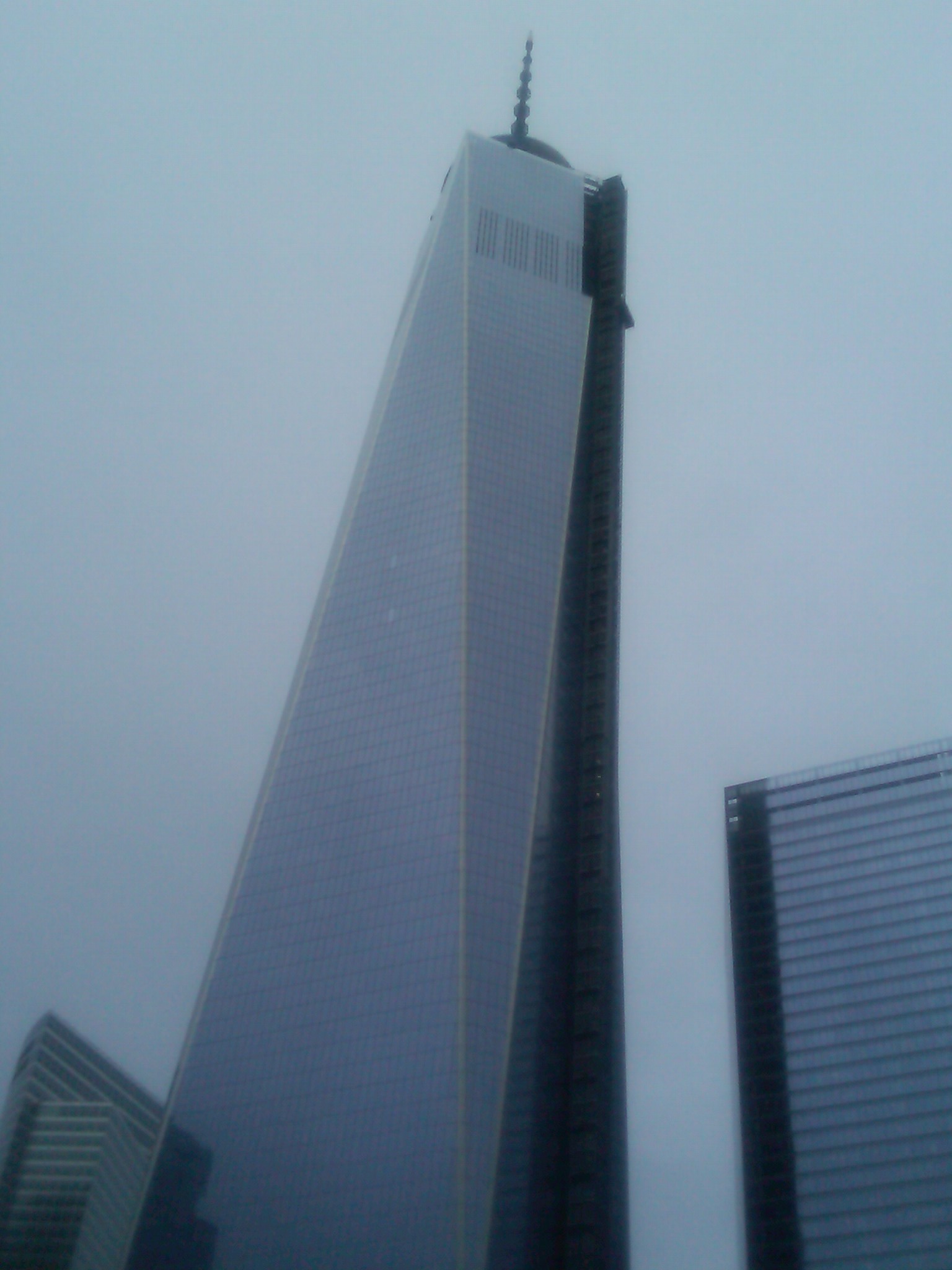
Yesterday, 12 years later, I happened to be in the Wall Street area with some time on my hands, so I decided to visit the 9/11 memorial, not knowing how much of it has been completed.
You can print out a free ticket from the memorial’s website, which allows you to get inside the memorial more quickly. But even on a cool, cloudy October weekday, there were hundreds of people with tickets waiting in line. And, of course, there was a security checkpoint, with the standard grey plastic tray for your wallet, keys, phone and belt.
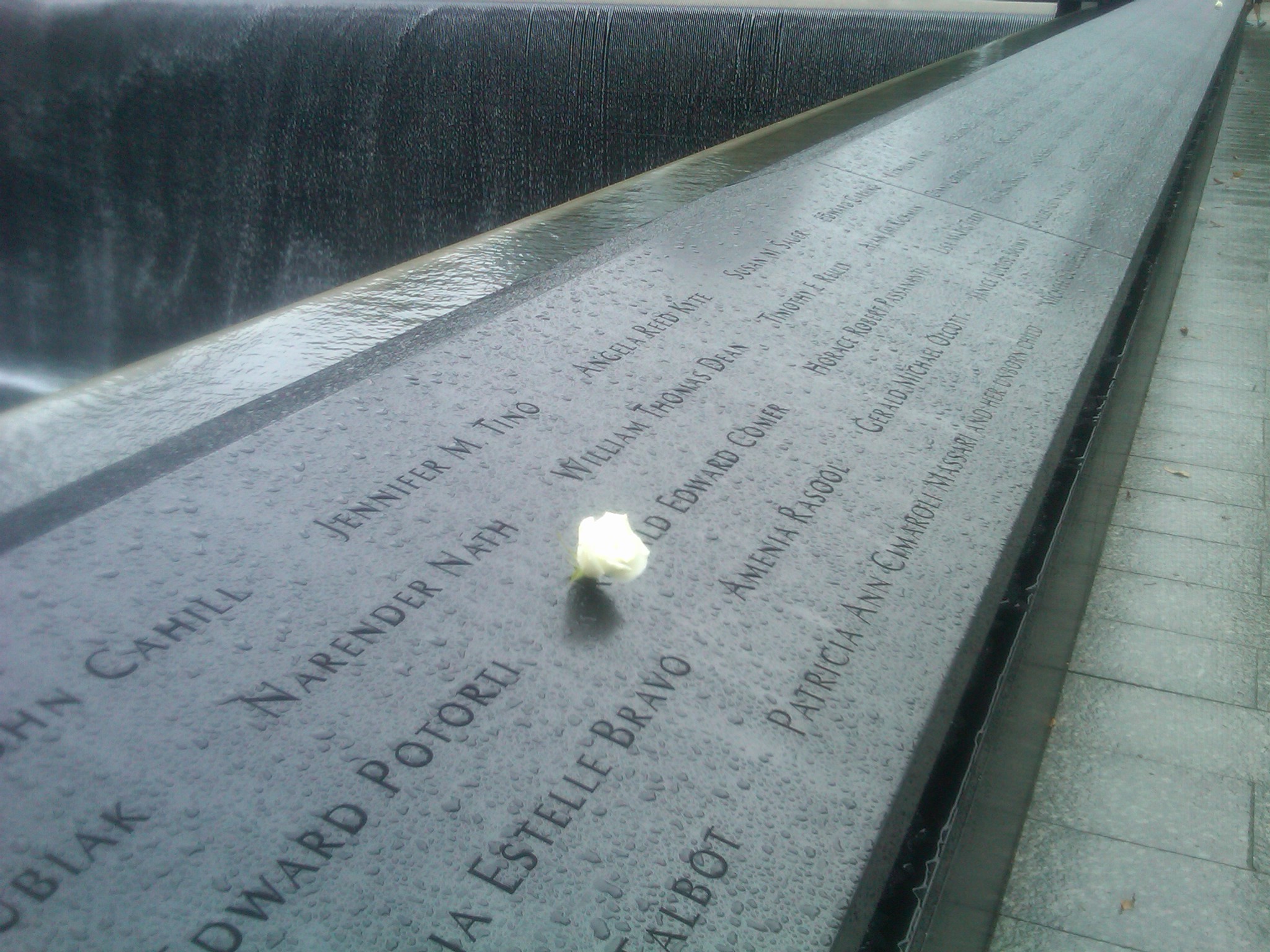
When you finally get inside, you’re in a kind of park, in the large space between the new buildings. You hear the water falling down the sides of the enormous fountain that marks the outline of the South Tower. The visitors are crowded along the nearest sides of the fountain, looking over the edge, taking pictures and reading the names inscribed in the black marble.
To get away from the crowd, you can walk around the fountain, stopping to read some of the names, which I did. On my way to the exit I noticed the fountain that marks the outline of the North Tower. Hardly anyone was there.
I suppose if you’ve seen one enormous black fountain with thousands of gallons of water plunging down it sides into an apparently bottomless pit, you’ve seen them all.
After walking around the second fountain, I headed for the exit again.
People say the site is sacred. I thought it was sad.
And human. There are lots of visitors, the regular people you see at other tourist attractions: a lot of miscellaneous, casually-dressed people taking pictures of the place and each other, some being a little loud, some being led around by tour guides, most of them crowded together where a fountain is closest to the entrance. Some of them have bought souvenirs at the stores in the neighborhood that sell trinkets and t-shirts. I suppose it’s all a reminder that those were regular people killed 12 years ago, in fact, the same kind of people you’ll see if you visit the memorial.



 Whereof One Can Speak 🇺🇦
You must be logged in to post a comment.