A Pessimist’s Pessimist

Giacomo Leopardi, born in 1798, was the son of a minor Italian aristocrat. He spent most of his youth in his father’s extensive library. By the time he was ten, he had taught himself Latin, Greek, German and French. Leopardi suffered from poor health throughout his life and died at the age of 38. He is now considered one of Italy’s greatest poets.

He is also revered as the author of a massive intellectual diary, first published in 1898 in seven volumes. Originally titled Pensieri di varia filosofia e bella letteratura (“Various thoughts on philosophy and literature”), it’s now known as Zibaldone (“Hodge-podge”). Last year, a complete English translation was published for the first time. (The translated text is 2,000 pages long, so if you’re interested, an electronic edition might be a good idea.)

In addition to being a great poet, Leopardi was one of Western culture’s great pessimists. Arthur Schopenhauer, probably philosophy’s most famous pessimist, had this to say about him: 

But no one has treated [the misery of our existence] so thoroughly and exhaustively as Leopardi…. He is entirely imbued and penetrated with it; everywhere his theme is the mockery and wretchedness of this existence. He presents it on every page of his works, yet in such a multiplicity of forms and applications, with such a wealth of imagery, that he never wearies us, but, on the contrary, has a diverting and stimulating effect [The World as Will and Idea].

More recently, Tim Parks summarizes Leopardi in The New York Review of Books (behind a paywall):

Obliged by frequent illness to pass his firstborn’s right to inherit to his younger brother, troubled by constant problems with his eyes, frail and almost grotesque, Giacomo saw before him a life without physical love or financial independence. Studying was the one thing he knew how to do, but the knowledge so gained only revealed to him that knowledge does not help us to live; on the contrary it corrodes those happy errors, or illusions as he came to call them, that give life meaning, shifting energy to the mental and rational and away from the physical and instinctive, where, in complicity with illusion, happiness lies.

In a later biography of his son, [Leopardi’s father] would write of Giacomo in this period that “setting himself to thinking about how one breathes” he found he could no longer breathe… “Thought,” Giacomo wrote in a letter in his early twenties, “can crucify and torment a person.”

Maybe more careful thought, perhaps a life devoted to philosophy, might help? That’s what Plato and Spinoza recommended. Leopardi is skeptical:

Those innumerable and immense questions about time and space, argued over from the beginnings of metaphysics onward,…are none other than wars of words, caused by misunderstandings, and imprecision of thought, and limited ability to understand our mind, which is the only place where time and space, like many other abstract things, exist independently and for themselves…”

In his review, Tim Parks suggests that if Leopardi were writing Zibaldone today, it would be a blog. I wonder if he’d throw in a few lighthearted posts to generate traffic.

Hearing Amanda Knox

Amanda Knox has again been found guilty of Meredith Kercher’s murder in Perugia, Italy, four years ago. Fortunately, she has no plans to visit Italy again. It also seems highly unlikely that she will ever be extradited, given the highly questionable evidence in the case and the way in which she has been treated by the Italian criminal justice system. It’s worth repeating that there was no physical evidence implicating her, the prosecution couldn’t come up with a motive and she (a 19-year old in a foreign country) was pressured into confessing.

A few months ago, I wrote a few posts about my experience as a prospective juror in a criminal trial (not murder, just insurance fraud). For some reason, people (or computer programs) kept accessing those posts as the months went by. Maybe it was because I expressed some relatively “non-liberal” opinions about our own legal system. But cases like Amanda Knox’s should make us wonder how often innocent people confess or plead guilty in order to stop their interrogations or get a shorter sentence.

In a similar vein, it’s amazing how often our legal system plods along, refusing to respond when new evidence comes out showing that someone in prison was wrongly convicted. It’s as if the judges and prosecutors are more committed to defending their earlier decisions and victories than in serving justice (maybe that shouldn’t be amazing at all). That’s one of the points Amanda Knox makes in a recent interview she gave to the Guardian (the video is available here). Some in the British press were especially merciless in depicting her as a sex-crazed nut job. I hope this interview gets widespread attention. It shows her in a very different light.

After a Major Event, Life Goes On, But Surreptitiously

gnote1A major event? Yes, finally replacing my aging but handy Blackberry with a new Android smartphone (good-bye, Verizon, you bloodsuckers!).

Some might say it’s only a phone. It feels more like a lifestyle. You can’t do that anymore. Do this now. How do I do that? Guess! Or download an app. Which app? That app! Wait, what did I just do? I must have touched something. Oh, no!

Come on, why do you zoom in on Google Maps by pinching your fingers together instead of spreading them apart? Isn’t spreading them apart a more expansive gesture? And why can’t I spread my fingers apart in the prescribed way? It’s probably a genetic defect. Those of us who can easily carry out the correct two-finger spreading motion are now better-suited to getting around and finding mates. The rest of us will tend to stay put and die alone. If only I could remember the Alternate Zoom Technique:

In addition to pinching the screen to zoom, you can also double-tap on your map, hold, and then scroll down to zoom in, or scroll up to zoom out.

Coincidentally, the New York Times reported more from the Snowden Files today:

When a smartphone user opens Angry Birds, the popular game application, and starts slinging birds at chortling green pigs, spy agencies have plotted how to lurk in the background to snatch data revealing the player’s location, age, sex and other personal information, according to secret British intelligence documents.

In their globe-spanning surveillance for terrorism suspects and other targets, the National Security Agency and its British counterpart have been trying to exploit a basic byproduct of modern telecommunications: With each new generation of mobile phone technology, ever greater amounts of personal data pour onto networks where spies can pick it up….

[Among] the most valuable of those unintended intelligence tools are so-called leaky apps that spew everything from users’ smartphone identification codes to where they have been that day.

Fortunately, I don’t play with angry birds. But Google Maps is said to be one of the best sources of information for the intelligence agencies. The Times quotes a secret report from Britain’s G.C.H.Q. suggesting that “anyone using Google Maps on a smartphone is working in support of a G.C.H.Q. system”. Thank you. No problem.

We know that corporations collect whatever information they can about us. Now we know that the NSA and GCHQ are doing the same.

But assuming that we don’t want to stop using our phones or the internet and we can’t get our governments to stop this spying, we can take some solace in the fact that these people are collecting so much data, they don’t know what to do with it. Most of us will never stand out in the crowd.

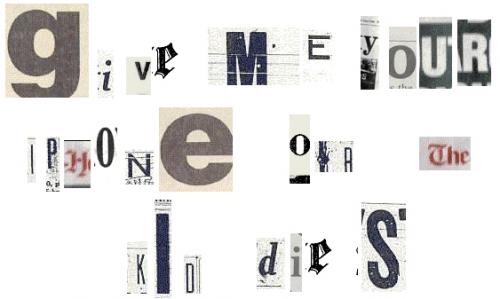
However, if you happen to be planning a terrorist attack, or want to tell the President he or she is a jerk, you should definitely avoid Angry Birds. Or communicate the old-fashioned way:

ransom-note

Reasonable and Customary

We just received a notice in the mail telling us we are part of another class action lawsuit. This time the defendant in the case is our health insurance company. When we’ve been included in a class action lawsuit in the past, it’s usually meant that a small check was coming our way. It’s always good to get an unexpected check in the mail, even a small one. And there’s the justice angle, too. Some corporation or other is paying for its bad behavior.

In this case, our health insurance company has agreed to stop relying on two questionable databases when they determine those wonderful “reasonable and customary” charges: “We could give you 80% of what your doctor charged. Instead, we’ll give you 80% of the reasonable and customary charges where you live”.

Unfortunately, as we all know, everyone’s doctor always seems to charge more than what is “reasonable and customary”, according to the insurance companies.

So it’s good news that the company will stop short-changing its customers by underestimating “reasonable and customary” charges. That’s the principal result of our class action lawsuit being settled.

Another result is that the two named plaintiffs in the case (the “class representatives”) are going to receive a total of $35,000 as “incentive payments”. In other words, they’re being rewarded for bringing the lawsuit, and to encourage other injured parties to bring their own lawsuits in similar cases. 

Ok, that’s all well and good, but how about that check for $25 or $11.95 that’s going to be coming our way? The settlement is supposed to be “fair, reasonable and adequate to the members of the Class”, and we are definitely members of the unfortunate class shortchanged by our insurance company, so some financial compensation is in order, even if it’s only enough to buy lunch.

To our surprise, however, the settlement doesn’t include cash compensation to anyone but the two named plaintiffs. Maybe the lawyers forgot about us (we’ve never been introduced).

What the lawyers clearly did remember was to collect their fees. The settlement calls for our insurance company to pay “an award of attorneys’ fees and costs for Class Counsel not to exceed the sum of $2,500,000”.

So the two plaintiffs get $35,000, the rest of us get a notice in the mail and a promise of good behavior from our insurance company, while the lawyers who handled the lawsuit get no more than $2.5 million, which the insurance company can pay off by adding a few pennies to its rates. 

I believe that’s what lawyers call “reasonable and customary”.

Housekeeping

If it weren’t 11 degrees outside (-12 C), this post might be called “Spring Cleaning”. But “Housekeeping” is probably better.

As we all know, comments on Internet sites are a touchy subject. Sometimes, it’s hard to read them without feeling dirty afterward (and not “dirty” in a good way).

This blog doesn’t attract a lot of comments (or readers, for that matter), but according to WordPress’s statistics, my 259 posts have received 161 comments (probably half of which were my responses). Most of them have been fine, but a few have been obnoxious. I’ve had a few repetitious exchanges in which no communication occurred. I’ve also been called a “racist”, “ridiculous” and “juvenile” and told to fuck myself (which wasn’t offered as helpful advice).

WordPress offers several ways to deal with comments. I could ban them completely, for example, or only allow them on certain posts. Freedom of speech and the exchange of ideas generally being a good thing, however, I’ve decided to continue allowing comments on all posts, but severely edit those that are especially rude or silly. So a 500-word comment that I find especially objectionable might show up as “What you said …” or “You’re really …” or “How about … ” or “Why don’t … ” and be followed by “The comment above was too rude or obnoxious to print in full.” The ellipsis can be our friend.

On a somewhat related note, I’ve removed three posts regarding my recent experience with jury duty: “On Not Being a Juror”, “On Whether I Am a Judgmental Racist” and “Maybe the Defendant’s Lawyer Should Have Kept Me on the Jury”.

For some reason, these three posts continue to draw attention. Maybe they’re being passed around by students at prestigious law schools. Or maybe they appeal to a bunch of white supremacists in Idaho. The only comment they’ve received wasn’t complimentary, as you can tell from one of the titles. But since they express a few opinions of mine that some people consider right-wingish, I’ve decided to remove them from public view. I’d rather not feed the prejudices of real right-wingers, at the risk of leaving brilliant law students uninformed.