Isaac Asimov Meets the Terminator and Guess Who Wins

According to The Atlantic, the Pentagon is going to award $7.5 million for research on how to teach ethics to robots. The idea is that robots might (or will) one day be in situations that demand ethical decision-making. For example, if a robot is on a mission to deliver ammunition to troops on the battlefield but encounters a wounded soldier along the way, should the robot delay its mission in order to take the wounded soldier to safety? Or risk the deaths of the soldiers who need that ammunition?

Since philosophers are still arguing about what ethical rules we should follow, and ethical questions don’t always have correct answers anyway, futuristic battlefield robots may need a coin flipping module. That way they won’t come to a halt, emit clouds of smoke and announce “Does not compute!” over and over.

Of course, the talented software developers who program these robots with a sense of right and wrong will avoid really poor error processing like that (presumably, they’ll have seen Star Trek too, so they’ll know what situations to code for). The big question isn’t whether robots can eventually be programmed to make life-and-death decisions, but whether we should put robots in situations that require that kind of decision-making.

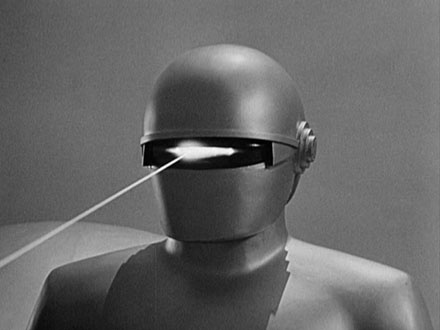
the-day-the-earth-stood-still-special-edition-20081204031732410-000

Fortunately, Pentagon policy currently prohibits letting robots decide who to kill. Human beings still have that responsibility. However, the Pentagon’s policy can be changed without the approval of the President, the Secretary of Defense or Congress. And although a U.N. official recently called for a moratorium on “lethal autonomous robotics”, it’s doubtful that even a temporary ban will be enacted. It’s even more doubtful that the world leader in military technology and the use thereof would honor such a ban if it were.

After all, most politicians will prefer putting robots at risk on the battlefield instead of men and women, even if that means the robots occasionally screw up and kill the wrong men, women and children. And, of course, once the politicians and generals think the robots are ready, they’ll find it much easier to unleash the (automated and autonomous) dogs of war.

(PS – The actual quote from Julius Caesar is “‘Cry Havoc!’, and let slip the dogs of war”. Serves me right for trying to be a bit poetic.)

A Paragraph About Memory

There was a review in the New York Times this weekend of the third volume of Karl Ove Knausgaard’s six-volume, autobiographical novel My Struggle. I especially liked this paragraph from the reviewer Rivka Galchen:

In and out of the book, Knausgaard repeatedly claims to have a weak memory, a claim one might argue the book belies, but I believe him. Knausgaard forgets most everything (which is very different from everything) the way we all forget most everything, and he might forget even a little bit more than the rest of us. His grandfather tells him a story about having once joined a rescue mission for a plane that crashed in nearby mountains. No one survived, the grandfather says, but he remembers seeing the captain’s head: “His hair was perfect! Combed back. Not a strand out of place.” It’s a kind of gruesome metonymy for memory itself: So much life gone, and this one head in the snow is what remains in the mind’s eye. The past returns to us like light almost entirely obscured by a heavy, dark screen in which memory has made a few pinholes; we see very little, really, yet we look upon it as if at the starry vault of the heavens.

But why are bad memories often more powerful than good ones? I wonder if Knausgaard has anything to say about that.

(Thanks to linuxgal of Terminal Cruise for motivating me to remember reading the paragraph about memory. According to Professor Rosenberg, of course, it was just a matter of electricity flowing in and out (see previous post).)

In a Way, It All Turned Out For The Best (Wolf of Wall Street Edition)

Even for Netflix customers, curiosity sometimes wins out and it’s worth $1.28 to rent a DVD from one of those big vending machines at the grocery store. That’s how we ended up watching The Wolf of Wall Street the other night, instead of waiting to see how long a “Very long wait” would be. Unfortunately, the minority of critics who said The Wolf of Wall Street is a bad movie were right.

Maybe it was a good idea for Martin Scorsese to use the story of these crooked stock brokers if he wanted to make another Goodfellas. But he ended up with a movie that is ridiculously long (3 hours) and repetitious. It isn’t funny or suspenseful. It’s merely excessive. Since I never cared about the characters, I should have given up, like I did with Scorsese’s Shutter Island. But since I’ve seen almost all of his movies (all the way back to 1967’s Who’s That Knocking At My Door), I kept watching (in three installments), partly out of respect and partly to see if it would get better. It didn’t. It was just more of the same.  

If you’re open to watching a movie about terrible people who look like they’re having a wonderful time, consider watching Goodfellas again. But not The Wolf of Wall Street.

Needing to return the DVD to the store in order to avoid being charged another $1.28, I figured I’d use the trip to buy some more milk. The wait at the express lane wasn’t too long, but the best part of the transaction was when the clerk handed me the receipt and announced that I had just saved $1.40 on my purchase. Simply by using my A&P customer card. 

But wait! That meant my rental of The Wolf of Wall Street and subsequent visit to the store had returned a profit of over 9%! Not bad at all!

Of course, there was the time spent traveling to the store, the cost of gasoline and three hours of weak entertainment that could have been better spent. But if you put all that on one side, and balance it with the curiosity I satisfied, the knowledge I gained and that 12 cent profit, it all turned out pretty darn well. 

Plus, if I convince just one of you to skip The Wolf of Wall Street, our collective life on Earth will be a little bit better (“saving the world since 2012”). Unless you could have made a profit.

There Are Values and Then There Are Values

People got a lot of letters from Isaiah Berlin, the philosopher and historian of ideas. The New York Review of Books published a review several months ago (I’m behind on my reading) of the third volume of Berlin’s letters, covering the years 1960 to 1975. There’s one more volume to go.

One of the ideas Berlin argued for in his letters and elsewhere during his long career was “value pluralism”, the view that there is no one ultimate value. Instead, there are many values, some of which can conflict in ways that cannot be easily resolved (there is no “right” answer). Liberty and equality are two such values.

In Berlin’s words, from the review, value pluralism is:

The conception that there are many different ends that men may seek and still be fully rational, fully men, capable of understanding each other and sympathizing and deriving light from each other.

Nothing is less popular today than to say that there is no millennium, that values collide, that there is no final solution, that one can only gain one value at the expense of another, that whatever one chooses entails the sacrifice of something else—or that it is at any rate often so. This is regarded as either false or cynical or both, but the opposite belief is what, it seems to me, has cost us so much frightful suffering and blood in the past.

John Banville, the author of the NYRB review, writes:

[Berlin] was keenly aware of the potential destructiveness of ideas, “ideas about what relations between men have been, are, might be and should be,” which in time become transformed into visions of a supreme good, and therefore a supreme goal, in the minds of leaders, “above all of the prophets with armies at their backs.” 

Ideas can be dangerous or beneficial, and also mistaken. Although he vigorously campaigned to “ban the bomb”, the great philosopher Bertrand Russell once supposedly said “I would never die for my beliefs because I might be wrong”. But would Russell have accepted death if ending his life resulted in global nuclear disarmament? (That’s not a likely scenario, of course, but it’s the kind of question philosophers have to deal with.)

So how much importance should we attach to our most favored values if we accept value pluralism and simultaneously recognize that our values might not be the best ones? I don’t know the answer to that, but it brings me to an article called “How To Win Your Next Political Argument” from New York Magazine.

The thesis of this article is that there are better ways to win an argument than by citing facts or by being confrontational. People will just dig in their heels if you hit them with too many facts or make them feel threatened. It’s better to get your opponent to try to explain his or her position, since people often can’t explain their position even to their own satisfaction and will thereby become less confident that they know what they’re talking about.

Another recommended tactic is to “change the frame”, which means appealing to values your opponent holds dear, not necessarily your own. So, us left-wingers are said to focus on “care/harm” and “fairness/cheating”, while right-wingers are equally attached to “loyalty/betrayal”, “authority/subversion” and “sanctity/degradation”. If you want to convince a Republican that Edward Snowden was justified in releasing government secrets, you’re going to have to keep in mind that “betrayal” and “subversion” are big concerns for Republicans.

I was coasting along through this article until I got to the end, at which point the author presents an example of how to argue in favor of gay rights with a right-wing opponent. For example:

“I think my main reason in favor of allowing gay people to be scout leaders is that I have some gay friends who were Boy Scouts growing up, and who seriously treasure the lessons they learned during that time.”

What a load of mealy-mouthed crap! I suddenly thought of the Sophists, the ancient Greeks who were somewhat unfairly criticized for teaching their students how to argue successfully in favor of any position at all. Plato claimed the Sophists were mere hired guns (swords?) with no respect for the truth and no principles of their own. 

It’s a good idea to tailor your argument somewhat to meet your opponent’s concerns, and it’s an excellent idea to recognize that values can conflict and none of us own the truth. On the other hand, I especially enjoyed what Isaiah Berlin had to say about the Republican Party in 1964:

I wonder…whether Goldwater followers are not simply the old 20 percent … who were isolationists during the war, did not want to go to Europe but to Japan towards the end of it, supported McCarthy and McCarran [both paranoid anti-Communists], and are in fact the old combination of Southern “Bourbons,” Texas industrialists, Catholic bigots, Fascists, lunatics, political neurotics, embittered ex-Communists, unsuccessful power-seekers of all kinds, as well as rich men and reactionaries, in whom America has never been poor…. This is the optimistic view.

Brutal honesty has its place too.
Nebraska in Black, White and Gray

Since I recently expressed great disappointment with Gravity, one of the movies nominated for Best Picture last year, it’s only fair that I express great appreciation for one of the others: Nebraska. That’s the one in which Bruce Dern plays a cantankerous, confused old man who thinks he’s won a million dollars from an outfit that’s pushing magazine subscriptions.

It’s an old-fashioned picture, beautifully filmed in black and white, with some wonderful performances, especially by Dern (a healthy 77-year old runner in real life) and June Squibb as his extremely outspoken wife. Their performances were both nominated for Oscars, as were the screenplay, directing and cinematography. 

I had a little problem with the premise of the movie — hadn’t Dern’s character ever gotten one of those “We are authorized to award you one million dollars!” notices in the mail before? And when his wife and sons try to convince him he hasn’t really won anything, don’t they point out the very big “if” in the small print?

Putting that quibble aside, Nebraska is the most consistently enjoyable movie I’ve seen in months. I don’t know how a young person would respond to it (a lot of old people, plus black and white?), but the characters and relationships in the movie resonated with me. My parents didn’t age gracefully, I had an uncle who wouldn’t stay put, and I’m wondering what kind of old man I’m turning into. Contented, grumpy, quiet, outspoken, wise, befuddled? Probably all of the above.

NEBRASKA