Arthur Schopenhauer, “On the Sufferings of the World” (1836):
In early youth, as we contemplate our coming life, we are like children in a theater before the curtain is raised, sitting there in high spirits and eagerly waiting for the play to begin. It is a blessing that we do not know what is really going to happen.
You tell ’em, Art.
Craig Unger, “Trump’s Russian Laundromat”, The New Republic:
A review of the public record reveals a clear and disturbing pattern: Trump owes much of his business success, and by extension his presidency, to a flow of highly suspicious money from Russia. Over the past three decades, at least 13 people with known or alleged links to Russian mobsters or oligarchs have owned, lived in, and even run criminal activities out of Trump Tower and other Trump properties. Many used his apartments and casinos to launder untold millions in dirty money…. Others provided Trump with lucrative branding deals that required no investment on his part. Taken together, the flow of money from Russia provided Trump with a crucial infusion of financing that helped rescue his empire from ruin, burnish his image, and launch his career in television and politics….
By 2004, to the outside world, it appeared that Trump was back on top after his failures in Atlantic City. That January, flush with the appearance of success, Trump launched his newly burnished brand into another medium.
[The Apprentice] instantly revived his career. “The Apprentice turned Trump from a blowhard Richie Rich who had just gone through his most difficult decade into an unlikely symbol of straight talk, an evangelist for the American gospel of success, a decider who insisted on standards in a country that had somehow slipped into handing out trophies for just showing up,” … Michael Kranish and Marc Fisher observe in their book Trump Revealed. “Above all, Apprentice sold an image of the host-boss as supremely competent and confident, dispensing his authority and getting immediate results. The analogy to politics was palpable”….
Without the Russian mafia, it is fair to say, Donald Trump would not be president of the United States.
I sometimes wonder how many of the millions of people who watched The Apprentice for years and years voted for this “poor person’s idea of a rich person” and whether DT’s shady business deals will ever catch up with him.
Rolf Mowatt-Larssen, “Trump Jr.’s Russia meeting sure sounds like a Russian intelligence operation”, The Washington Post:
….everything we know about the meeting — from whom it involved to how it was set up to how it unfolded — is in line with what intelligence analysts would expect an overture in a Russian influence operation to look like. It bears all the hallmarks of a professionally planned, carefully orchestrated intelligence soft pitch designed to gauge receptivity, while leaving room for plausible deniability in case the approach is rejected. And the Trump campaign’s willingness to take the meeting — and, more important, its failure to report the episode to U.S. authorities — may have been exactly the green light Russia was looking for to launch a more aggressive phase of intervention in the U.S. election….
Had this Russian overture been rejected or promptly reported by the Trump campaign to U.S. authorities, Russian intelligence would have been forced to recalculate the risk vs. gain of continuing its aggressive operation to influence U.S. domestic politics. Russian meddling might have been compromised in its early stages and stopped in its tracks by U.S. intelligence and law enforcement agencies before it reached fruition by the late fall.
So the suggestion that this was a nothing meeting without consequence is, in all likelihood, badly mistaken.
Paul Krugman, “Takers and Fakers”, The New York Times:
… throughout the whole campaign against Obamacare, Republicans have been lying about their intentions.
Believe it or not, conservatives actually do have a more or less coherent vision of health care. It’s basically pure Ayn Rand: if you’re sick or poor, you’re on your own…. Specifically:
1. Health care, even the most essential care, is a privilege, not a right. If you can’t get insurance because you have a preexisting condition, because your income isn’t high enough, or both, too bad.
2. People who manage to get insurance through government aid, whether Medicaid, subsidies, or regulation and mandates that force healthy people to buy into a common risk pool, are “takers” exploiting the wealth creators, aka the rich.
3. Even for those who have insurance, it covers too much. Deductibles and co-pays should be much higher, to give people “skin in the game”…
4. All of this applies to seniors as well as younger people. Medicare as we know it should be abolished, replaced with a voucher system that can be used to help pay for private policies – and funding will be steadily cut below currently projected levels, pushing people into high-deductible, high-copay private policies.
This is … what conservative health care “experts” say when they aren’t running for public office, or closely connected to anyone who is. I think it’s a terrible doctrine … because buying health care isn’t and can’t be like buying furniture….
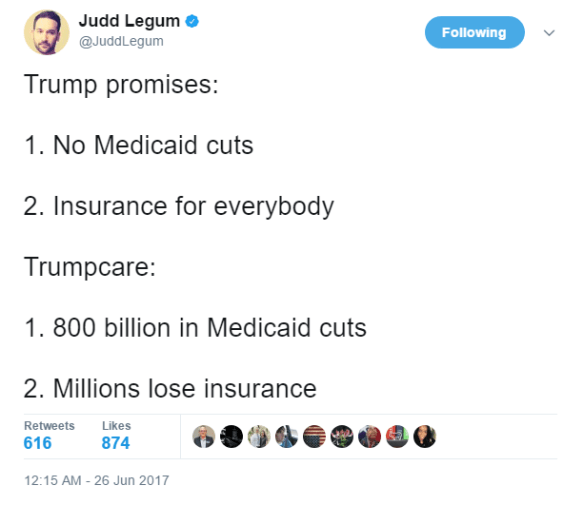
But think of how Republicans have actually run against Obamacare. They’ve lambasted the law for not covering everyone, even though their fundamental philosophy is NOT to cover everyone, or accept any responsibility for the uninsured. They’ve denied that their massive cuts to Medicaid are actually cuts, pretending to care about the people they not-so-privately consider moochers. They’ve denounced Obamacare policies for having excessively high deductibles, when higher deductibles are at the core of their ideas about cost control. And they’ve accused Obamacare of raiding Medicare, a program they’ve been trying to kill since 1995.
In other words, their whole political strategy has been based on lies – not shading the truth, not spinning, but pretending to want exactly the opposite of what they actually want.
And this strategy was wildly successful, right up to the moment when Republicans finally got a chance to put their money – or actually your money – where their mouths were. The trouble they’re having therefore has nothing to do with tactics, or for that matter with Trump. It’s what happens when many years of complete fraudulence come up against reality.
As Krugman writes elsewhere:
… everyone, and I mean everyone, who knows something about insurance markets is declaring the same thing: that the [Republican] bill would be a disaster. We’ve got the insurance industry declaring it “simply unworkable”; the American Academy of Actuaries saying effectively the same thing; AARP up in arms; and more [doctors, nurses, state governors, voters].
And yet, it still might become law this month. Why?
Jennifer Rubin, “The GOP’s Moral Rot Is the Problem, Not Donald Trump”, The Washington Post:
… for decades now, demonization — of gays, immigrants, Democrats, the media, feminists, etc. — has been the animating spirit behind much of the right. It has distorted its assessment of reality, … elevating Fox News hosts’ blatantly false propaganda as the counterweight to liberal media bias and preventing serious policy debate. For seven years, the party vilified Obamacare without an accurate assessment of its faults and feasible alternative plans. “Obama bad” or “Clinton bad” became the only credo — leaving the party … with “no attachment to any external moral truth or ethical code” — and no coherent policies for governing.
We have always had in our political culture narcissists, ideologues and flimflammers, but it took the 21st-century GOP to put one in the White House….
Out of its collective sense of victimhood came the GOP’s disdain for not just intellectuals but also intellectualism, science, Economics 101, history and constitutional fidelity….the GOP became slaves to its own demons and false narratives. A party that has to deny climate change and insist illegal immigrants are creating a crime wave — because that is what “conservatives” must believe, since liberals do not — is a party that will deny Trump’s complicity in gross misconduct. It’s a party as unfit to govern as Trump is unfit to occupy the White House. It’s not by accident that Trump chose to inhabit the party that has defined itself in opposition to reality and to any “external moral truth or ethical code”.
Helen Keller, Optimism: An Essay (1903):
The test of all beliefs is their practical effects in life. If it be true that optimism compels the world forward, and pessimism retards it, then it is dangerous to propagate a pessimistic philosophy. One who believes that the pain in the world outweighs the joy, and expresses that unhappy conviction, only adds to the pain. Schopenhauer is an enemy to the race. Even if he earnestly believed that this is the most wretched of possible worlds, he should not promulgate a doctrine which robs men of the incentive to fight with circumstance.
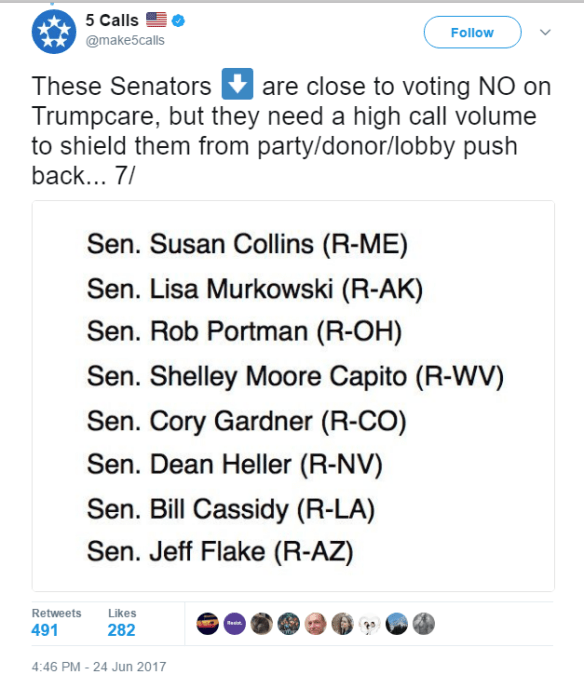
All right, Helen, the good news is that a Republican senator is recovering from surgery and won’t be in Washington this coming week. His vote would be needed to move the Republican bill forward, so the vote has been delayed, giving the opposition more time to terminate this horror show with extreme prejudice.

 Whereof One Can Speak 🇺🇦
You must be logged in to post a comment.