Tribalism On Parade

People often say left-wingers and right-wingers aren’t that different. Whichever side we’re on, we all belong to a political tribe. We’re all live in our own bubbles. None of us really think for ourselves. We simply go along with the rest of our tribe.

It’s not true. Left-wingers are open to more sources of information and less likely to automatically follow their side’s leaders. Compared to the Democratic Party, the Republican Party is a cult.

Here’s an example. In 2013, a poll showed that 38% of Democrats supported bombing Syria because of the government’s use of chemical weapons. So did 22% of Republicans.

Last year, when asked the same question, the same poll showed 37% of Democrats still supported bombing Syria. But, remarkably, 86% of Republicans did!

DawAoZxUwAIyOM6

You might say, well, 64% of Republicans must have changed their minds over the course of four years because the situation in Syria changed. Maybe Democrats were too stupid or ignorant to recognize how different Syria 2017 was from Syria 2013. 

You could say that, but, from the Republican perspective, the real difference between 2013 and 2017 was which tribe occupied the White House and which position was being pushed by Fox News.

The Most Ridiculous Ever

Dana Milbank of The Washington Post has performed a public service by collecting a remarkably reassuring series of YKW’s (You Know Who’s) self-evaluations.

Outgoing national security adviser H.R. McMaster … said this week that “we have failed to impose sufficient costs” on Russia — joining a consensus view that [YKW] has been inexplicably soft on Vladimir Putin’s assaults on democracy and stability. 

But we can all stand down.

“Nobody has been tougher on Russia than I have,” [YKW] announced.

I felt similar relief when, even though he used anti-Semitic themes in his campaign and hesitated to condemn vandalism against Jewish targets, [he] informed us that “I am the least anti-Semitic person that you’ve ever seen in your entire life.”

I likewise was not troubled by [his] talk about “shithole” countries in Africa, or his defense of white supremacists in Charlottesville, because, as [he] assured us, “I am the least racist person you have ever interviewed.”

I don’t share the stock market’s jitters over the trade war [he] started, because I recall his assurance that “nobody knows more about trade than me.”

The allegations about his infidelity and his boasts about assaulting women are not troubling, because “nobody respects women more than I do,” and “nobody loves the Bible more than I do.”

The outrage about him mocking a disabled journalist on the campaign trail? Misplaced — because “nobody’s better to people with disabilities than me.”

You think he’s foul-mouthed and his insult-an-hour leadership is unpresidential? WRONG! “I have one of the great temperaments,” he said.

And on those occasions when [he] pits Americans against each other by race and ethnicity, fear not: “There’s nobody that’s done so much for equality as I have.”

… In rare moments of self-doubt, [he] admits he may not be quite as great as the Great Emancipator, but, he said, “with the exception of the late, great Abraham Lincoln, I can be more presidential than any president that’s ever held this office.”

It’s a signature [YKW] move: Don’t just deny the charge but declare yourself to be the polar opposite (while accusing your opponents of whatever you were accused of: You’re the puppet!). He can’t be a racist, or soft on Russia, or anything bad — because he’s the furthest possible thing from that.

It’s all terribly reassuring.

[His] biggest-and-greatest talk defines him, of course, and ranks him at the pinnacle of all human endeavors. His “I.Q. is one of the highest.” He has “the best words.” He is a “stable genius.” He has “one of the great memories of all time.” He was “always the best athlete.” His building makes “the best taco bowls.” He knows more about the Islamic State than the generals, and nobody “in the history of the world” knows more about taxes….

Some might quibble, saying his claim to be “the most militaristic person ever” is unfair to Genghis Khan, or that his claim that “nobody in the history of this country has ever known so much about infrastructure as [him]” forgets the people who built the Panama Canal. But to point this out would be to further the historic persecution of [YKW], victim of “the single greatest witch hunt of a politician in American history.” In fact, “no politician in history . . . has been treated worse or more unfairly.”

… I was concerned about the flood of international criticism of [YKW] — until [he] said that he received “red carpet like I think probably nobody has ever received” in Asia, and that his speech in Poland “was the greatest speech ever made on foreign soil by a president.”

I worried about his cowboy talk of raining fire and fury on fat Rocket Man and his puny nuclear button, but I’m comforted to know that “there’s nobody that understands the horror of nuclear better than me.”

The rash of ethical scandals among Cabinet members was troubling, until I remembered that [his] Cabinet has “by far the highest IQ of any Cabinet ever.”

[His] tweets seem to show he’s unaware of policy details, so I’m relieved to discover that he understands legislation better “than any president that’s ever been in office.”

And despite figures showing Congress has ground to a halt, I’m delighted to learn that “never has there been a president . . . who’s passed more legislation,” except for Franklin D. Roosevelt.

In coming months, I expect … a new caravan of superlatives: Most faithful spouse in history. Least nepotistic person in America. Greatest gentleman in the world. Least susceptible to flattery. Most polite Twitter user. Least likely to watch cable news. And the humblest person — by far…. 

So far, but only so far, he’s left out the most fitting superlative of all. He’s the most ridiculous ever.

Sometimes It Still Feels Good To Be An American

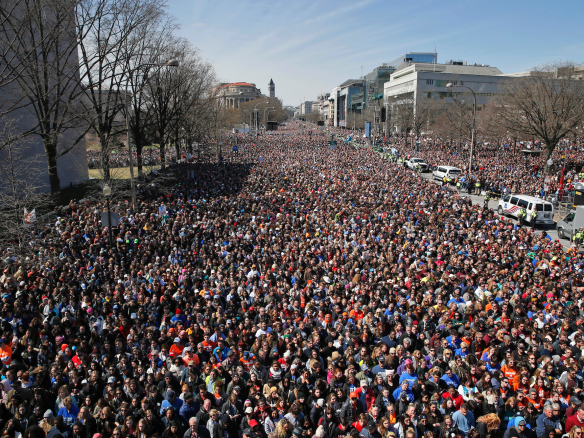
As I’ve gotten older and learned more about our history, it doesn’t feel as good to be an American as it used to. But there are days like yesterday that remind me how good it used to feel and sometimes still does.

21fcb__organizers-estimated-that-roughly-800000-people-turned-up-to-the-main-event-in-dc

Jennifer Rubin of The Washington Post said it much better than I could:

By the hundreds of thousands, they came. They gave impassioned and articulate speeches. The shared their experiences in Chicago, South Los Angeles and Florida. They gave one TV interview after another, displaying remarkable poise and heart-breaking sincerity. Adults decades older watched with awe. These are teenagers. How did these kids learn to do  this? 

The sense of amazement among adults, including jaded members of the media, was palpable — both because supposedly sophisticated adults had not pulled off this kind of change in attitudes about guns in the decades they’d been trying and because the teenagers shredded the talking points, the lies, the cynicism and the indifference that we’ve become accustomed to in our politics.

If this was a movie, you’d think it was inauthentic. However, it may be our image of our fellow Americans and teenagers that has been wildly inaccurate and unfairly negative. Too many of us have bought into the notion that teenagers are passive, addicted to their phones and lacking civic awareness. Too many have been guilted into accepting that “real Americans” are the Trump voters, and that the rest of us are pretenders, pawns of “elites.” The crowd reminded us of the country’s enormous geographic, racial, gender and age diversity. (Plenty of teachers, parents and grandparents turned out.) And in the case of guns, these people are far more representative of the views of the country than the proverbial guy in the Rust Belt diner. 

Social media has its downsides, we have come to learn all too well. But we’ve forgotten amidst the Cambridge Analytica and Facebook scandal and the daily torment of President Trump’s tweets that social media merely amplifies what is there already. It gives the Russians, the haters, the xenophobes a louder voice and the tools to disguise their true identities, but it can also amplify sincere, empathetic voices and knit together a community — an overused but underappreciated phenomenon — without which the students’ organization on a scale of this magnitude would have been impossible. It is all too convenient to blame social media; the actual problem is the small but significant segment of the population behind the nastiness, anger, aggression and refusal to grapple with reality. As is always the case, the solution to bad speech is more speech. If we had forgotten that, the students who have grown up never knowing a world without iPhones surely hadn’t. 

The decision to let only children and teenagers speak was key to the entire endeavor. No canned political speeches; no feigned emotion. The experience of the more than 180,000 students who have been  exposed to gun violence in schools over the past few decades was suddenly very real, very immediate.

Those on the event stage talked about their friends, their certainty in political change, their solidarity with other victims, and their fearlessness in the face of naysayers and cynics. They mocked and condemned the National Rifle Association and the politicians who take their money…. They sounded angry, sad and serious. They spoke about democracy and urged the crowd to vote; they inveighed against party politics….

And so we are left with the stark contrast — the sincerity of the students vs. the canned platitudes of the gun absolutists; the speed and vibrancy of a mass movement vs. the gridlock and sameness of our politics; the dogged determination of teenagers not yet world-weary vs. the sense of futility that pervades our politics. The outcome is not preordained. Yes, democracies are under assault. Xenophobes and nativists certainly have come out from under the rocks. The president has tried to make the abnormal commonplace and the unacceptable  inevitable. But if nothing else, the marchers reminded us we have a choice. We can be fatalistic and passive, or determined and active. If teenagers can take the capital by storm, surely the rest of us can do something more than complain and yell at the TV.

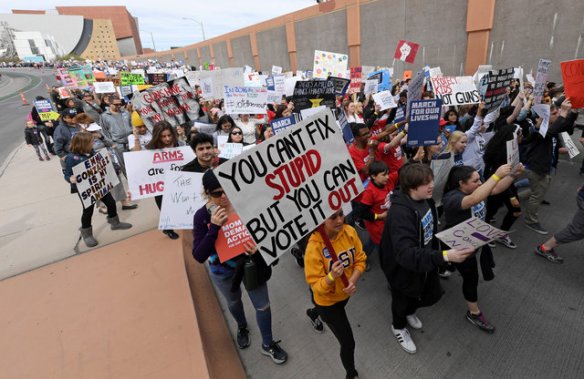
The young lady in the yellow sweatshirt gets the last word:

5ab6d0ae3a2e7828008b48ea-640-416

A Genuine Risk

The president won’t read it, but Vox has an important article called “Here’s What War with North Korea Would Look Like”:

For all the talk of nuclear exchanges and giant buttons, there has been little realistic discussion of what a war on the Korean Peninsula might mean, how it could escalate, what commitments would be required, and what sacrifices would be demanded.

So I’ve spent the past month posing those questions to more than a dozen former Pentagon officials, CIA analysts, US military officers, and think tank experts, as well as to a retired South Korean general who spent his entire professional life preparing to fight the North. They’ve all said variants of the same thing: There is a genuine risk of a war on the Korean Peninsula that would involve the use of chemical, biological, and nuclear weapons. Several estimated that millions — plural — would die.

Even more frightening, most of the people I spoke to said they believed Kim would use nuclear weapons against South Korea in the initial stages of the fighting — not just as a desperate last resort….

War is inherently unpredictable: It’s possible Kim would use every type of weapon of mass destruction he possesses, and it’s possible he wouldn’t use any of them.

But many leading experts fear the worst. And if all of this sounds frightening, it should. A new war on the Korean Peninsula wouldn’t be as bad as you think. It would be much, much worse.

Since you’re not the president, you can read it here.

Things Are Not Getting Better

The news has not been good, leading various journalists to summarize the past few days the way Jamelle Bouie did for Slate:

After months of sustained public criticism from Trump, Andrew McCabe stepped down as deputy director of the FBI. The rationale behind McCabe’s decision is still not entirely known, but there’s little doubt it involves the Russia investigation. In addition to being a verbal target of Trump’s, McCabe had become a bĂŞte noire of conservative media, the subject of baroque conspiracies about a “deep state” that is allegedly conspiring against the president….

Republicans on the House Intelligence Committee voted to release a … memo [that] accuses the FBI of abusing its surveillance powers, using partisan opposition research in order to attack Donald Trump’s campaign and undermine his presidency, and singling out officials like McCabe, Deputy Attorney General Rod Rosenstein, and former FBI Director James Comey, all targets of Trump and his allies in the GOP and conservative media… Democrats on the committee have called the document a “misleading set of talking points”, and federal law enforcement officials had warned that releasing the memo would be “extraordinarily reckless”….

In the wake of this vote, Republicans on the Intelligence Committee also opened an inquiry into the FBI and the Justice Department… On Tuesday, House Speaker Paul Ryan announced his support for both moves, calling for a “cleanse” of the FBI….

What began as Trump venting on Twitter has now become official administration policy, carried out with the blessing of White House aides who were at one time seen as bulwarks against such behavior. Bloomberg reported on a phone call between White House chief of staff John Kelly and senior officials in the Justice Department, where the former conveyed the president’s “displeasure” and reminded them of his expectations, albeit adding that the White House doesn’t expect them “to do anything illegal or unethical”.

To all of this, add the fact that—during this same period of time—President Trump declined to sanction Russia for its interference in the 2016 presidential election [after Congress voted almost unanimously for new sanctions to be imposed].

Senator Claire McCaskill, a Missouri Democrat, said this about the president’s decision:

Congress voted 517-5 to impose sanctions on Russia. The President decides to ignore that law. Folks, that is a constitutional crisis. There should be outrage in every corner of this country.

There should be, but there hasn’t been. Most of us are suffering from outrage overload.

Earlier in the week, Mr. Bouie wrote about “ICE Unbound”:

[The president has unleashed] the Immigration and Customs Enforcement agency, giving it broad authority to act at its own discretion. The result? An empowered and authoritarian agency that operates with impunity, whose chief attribute is unapologetic cruelty.

…. The most striking aspect of ICE under this administration has been its refusal to distinguish between law-abiding immigrants, whose undocumented status obscures their integration into American life, and those with active criminal records—the “bad hombres” of the president’s rhetoric.

Erasing that distinction is how we get the arrest and detention of Lukasz Niec, a Polish immigrant and green card holder who was brought to the United States as a young child. Last week, ICE agents arrested Niec …, citing two misdemeanor convictions for offenses committed when he was a teenager… A practicing physician, Niec now sits in a county jail, awaiting possible deportation….

Bouie didn’t mention Amer Othman Adi, a 57-year-old Palestinian who had been in the U.S. since he was 19. A married man with four daughters, he helped revitalize the city of Youngstown by opening several businesses. He was deported to Jordan on Monday night.

It all makes these Twitter thoughts from author G. Willow Wilson worth thinking about:

It may be time to start thinking about how we can effectively push back against authoritarianism once the last of the checks and balances have fallen.

It’s a mistake to think a dictatorship feels intrinsically different on a day-to-day basis than a democracy does. I’ve lived in one dictatorship and visited several others–there are still movies and work and school and shopping and memes and holidays.

The difference is the steady disappearance of dissent from the public sphere. Anti-regime bloggers disappear. Dissident political parties are declared “illegal”. Certain books vanish from the libraries.

The press picks a side. The military picks a side. The judiciary picks a side. This part should already feel familiar.

The genius of a true, functioning dictatorship is the way it carefully titrates justice. Once in awhile it will allow a sound judicial decision or critical op-ed to bubble up. Rational discourse is never entirely absent. There is plausible deniability.

People still have rights, in theory. The right to vote, to serve on a jury, etc. The difference is that they begin to fear exercising those rights. Voting in an election will get your name put on “a list”.

So if you’re waiting for the grand moment when the scales tip and we are no longer a functioning democracy, you needn’t bother. It’ll be much more subtle than that. It’ll be more of the president ignoring laws passed by congress. It’ll be more demonizing of the press.

Until one day we wake up and discover the regime has decided to postpone the 2020 elections until its lawyers are finished investigating something or other. Or until it can ‘ensure’ that the voting process is ‘fair’.

A sizable proportion of the citizenry will support the postponement. Yes, absolutely, we must postpone elections. The opposition is corrupt! Our leader is just trying to protect us! A dictator is never without supporters.

And hey, if we pull ourselves back from the brink and the midterms go ahead and the 2020 election is free and transparent and on time, you are cordially invited to point at me and laugh. Honestly. No one will be happier to be wrong than me.