Smith teaches philosophy at the University of Paris. This book is more of a survey than a history. He has chapters on irrationality as it relates to logic, nature, dreams, art, myth, pseudoscience, humor, the internet and death. He occasionally discusses the fact that the American president is a dangerous buffoon. (Or, as a New York Times columnist put it so well: “The most powerful country in the world is being run by a sundowning demagogue whose oceanic ignorance is matched only by his gargantuan ego”. Or, as a Washington Postcolumnist concluded: “If he can’t argue that he has delivered prosperity, all that remains is the single most repugnant human being to ever sit in the Oval Office, befouling everything he touches”. But back to the book.)
Smith argues that the difference between rationality and irrationality often depends on one’s perspective. For example, is it rational or irrational to concern ourselves so much with the future when we’re all going to die anyway? It depends on what our goals are. His principal thesis is that “irrationality is as potentially harmful as it is humanly ineradicable, and that efforts to eradicate it are themselves supremely irrational” [287].
It’s an interesting book, but I’d say the first part of that last sentence didn’t need to be proved (irrationality is harmful, both actually and potentially, and will never be eliminated) — and that Smith fails to prove the second part (that efforts to eliminate irrationality are supremely irrational).
This is from his chapter on death and one of the best passages in the book:
… what lifted the soldier out of his foxhole was not his faculty of reason, but rather something deeper, something we share with the animals, which the Greeks called “thumos” and which is sometimes translated as “spiritedness”. It is a faculty that moves the body without any need for deliberation. It is like something that propels us when we are driven by desire, when we dive into a mosh pit or into bed with someone we don’t quite trust. It is something to which we are more prone when we are drunk, or enraged, or enlivened by the solidarity and community of a chanting crowd.
These manifestations of irrationality, it should be clear, are, as he saying goes, beyond good and evil. Life would be unlivable if they were suppressed entirely. But to what precise extent should they be tolerated or, perhaps, encouraged? It will do no good to say flatly that they should be tolerated “in a reasonable balance” or “in moderation”. For the ideal of moderation is one that is derived from reason, and it is manifestly unfair to allow reason to determine what share it should itself have in human life in a competition between it and unreason. So if we can neither eliminate unreason, nor decide on a precise amount of it that will be ideal for human thriving, we will probably just have to accept that this will always remain a matter of contention, that human beings will always be failing or declining to act on the basis of rational calculation of expected outcomes, and that onlookers, critics and gossipers will always disagree as to whether their actions are worthy of blame or praise.
The speeder and the duelist and the others seem guilty of no failure to correctly infer from what they already know, in order to make decisions that maximize their own interests. Rather, in these cases, there is a rejection of the conception of life that it must be a maximization of one’s own long-term interests in order to be a life worth living [263-264].
We hear a lot about criminal justice in America and how it adversely affects the lives of black men in particular. A similar story should be told about housing in America and how it adversely affects the lives of black women. Lots of black men get convicted. Lots of black women get evicted.
Katha Pollitt’s 2016 review of “Evicted”, by Matthew Desmond, in The Guardian:
What if the dominant discourse on poverty is just wrong? What if the problem isn’t that poor people have bad morals – that they’re lazy and impulsive and irresponsible and have no family values – or that they lack the skills and smarts to fit in with our shiny 21st-century economy? What if the problem is that poverty is profitable? These are the questions at the heart of Evicted, Matthew Desmond’s extraordinary ethnographic study of tenants in low-income housing in the deindustrialised middle-sized city of Milwaukee, Wisconsin.
You might not think that there is a lot of money to be extracted from a dilapidated trailer park or a black neighbourhood of “sagging duplexes, fading murals, 24-hour daycares”. But you would be wrong. Tobin Charney makes $400,000 a year out of his 131 trailers, some of which are little better than hovels. Sherrena Tarver, a former schoolteacher who is one of the only black female landlords in the city, makes enough in rents on her numerous properties – some presentable, others squalid – to holiday in Jamaica and attend conferences on real estate.
Desmond follows the intertwined fortunes of eight families and a host of minor characters. Arleen Belle and Doreen Hinkston are black mothers clinging to the edge of low-wage employment; Crystal and Trisha are fragile young black women whose upbringing was violent and chaotic; Lamar is a genial black father of two who lost both his legs to frostbite when he passed out on crack in an abandoned house; Scott is a white male nurse who lost his licence when he stole opioids from his patients; Larraine, also white, is a slightly brain-damaged sweet soul. It is sometimes a little hard to keep up with the storylines as they weave in and out of the text, but no matter. What is important is that Desmond takes people who are usually seen as worthless – there is even a trailer-dweller nicknamed Heroin Susie – and shows us their full humanity, how hard they struggle to retain their dignity, humour and kindness in conditions that continually drag them down.
The main condition holding them back, Desmond argues, is rent. The standard measure is that your rent should be no more than 30% of your income, but for poor people it can be 70% or more. After he paid Sherrena his $550 rent out of his welfare cheque, Lamar had only $2.19 a day for the month. When he is forced to repay a welfare cheque he has been sent in error and falls behind on rent, he sells his food stamps for half their face value and volunteers to paint an upstairs apartment, but it is not enough. People such as Lamar live in chronic debt to their landlord, who can therefore oust them easily whenever it is convenient – if they demand repairs, for example, like Doreen, or if a better tenant comes along. Sherrena liked renting to the clients of a for-profit agency that handles – for a fee – the finances of people on disability payments who can’t manage on their own. Money from government programmes intended to help the poor – welfare, disability benefits, the earned-income tax credit – go straight into the landlord’s pocket and, ironically, fuel rising housing costs. Public housing and housing vouchers are scarce. Three in four who qualify for housing assistance get nothing.
Even in the Great Depression, evictions used to be rare. Now, each year, hundreds of thousands, perhaps millions, of renters are put out on the street. Even a paid-up tenant can be easily evicted. Arleen loses one apartment when her son Jori throws a snowball at a passing car and the enraged driver kicks in the front door, and another when the police come after Jori when he kicks a teacher and runs home. Any kind of trouble that brings the police can lead to eviction, which means women can lose their homes if they call 911 when their man beats them up. Think about that the next time someone asks why women don’t call the cops on violent partners.
As Desmond shows, the main victims of eviction are women. Why? They are paid less than men for doing the same job. They are less able to make deals with their landlord, who is almost always a man, to work off part of their rent with manual labour. The main reason, though, is that women are raising children as single mothers. They not only have all the costs and burdens of childrearing, they need bigger apartments – which, since landlords dislike renting to families with young children, are harder to find and a lot harder to keep. Other sociologists – Kathryn Edin, for example – have found that single mothers often get help under the table from their children’s fathers, but Arleen, Doreen and Doreen’s adult daughter Patrice get mostly trouble from men, who are variously abusive, addicted, vanished or in prison. In one of the book’s many small sad moments, Arleen claims she receives child support in order to seem more stable and respectable to a prospective landlord. In fact, she gets nothing.
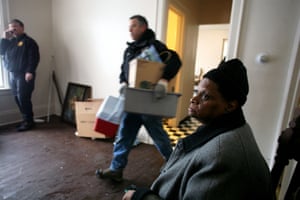
Desmond lays out the crucial role housing plays in creating and reinforcing white privilege. In Milwaukee, one of the most segregated cities in the US, all black people suffer from housing discrimination and all white people benefit at least a little from the racial dividend – a landlord who will rent to them but not to black people, for instance, or offer them a nicer apartment. Black people have the worst housing in the worst neighbourhoods – the great fear of the trailer-park people, who are all white, is that they will end up on the black side of town. Eviction hits black women hardest of all, and the bleak benches of housing courts, which deal with disputes between landlords and tenants, are full of black women and their children: “If incarceration had come to define the lives of men from impoverished black neighbourhoods, eviction was shaping the lives of women. Poor black men were locked up. Poor black women were locked out.”
An evicted woman watches as employees of a storage company remove her belongings to place them on the pavement in front of her rented apartment. Photograph: Sally Ryan/Zuma Press/Corbis
What are the social costs of eviction? It puts incredible stress on families. It prevents people from saving the comparatively small sums that would let them stabilise their situation. They are always starting over from scratch, losing their possessions in the chaos of removal, or putting them in storage and losing them when they can’t pay the fees. An eviction on your record makes the next apartment harder to get. Eviction damages children, who are always changing schools, giving up friends and toys and pets – and living with the exhaustion and depression of their parents. We watch Jori go from a sweet, protective older brother to an angry, sullen boy subject to violent outbursts who is falling way behind in school.
Eviction makes it hard to keep up with the many appointments required by the courts and the byzantine welfare system: several characters have their benefits cut because notices are sent to the wrong address. Eviction destroys communities: when people move frequently, they don’t form the social bonds and pride in place that encourage them to care for their block and look out for their neighbours. “With Doreen’s eviction, Thirty-Second Street lost a steadying presence – someone who loved and invested in the neighbourhood, who contributed to making the block safer – but Wright Street didn’t gain one.”
“There is an enormous amount of pain and poverty in this rich land,” Desmond writes in his conclusion. That is easy to say, and many books by journalists and academics have done so. By examining one city through the microscopic lens of housing, however, he shows us how the system that produces that pain and poverty was created and is maintained. I can’t remember when an ethnographic study so deepened my understanding of American life.to all and safeguarding our independence.
Someone gave me this book, but I don’t remember when. It’s been sitting in the smallest room in the house for quite a while, because it’s the kind of book that’s best to dip into. It consists of more than 200 questions that you might think you know the answer to, but probably don’t.
So the first question is: “What’s the name of the tallest mountain in the world?” Mount Everest, you say? Well, actually, according to the current convention, the “tallest” mountain in the world is Hawaii’s Mauna Kea. It boasts the greatest distance between its top and bottom (33,465 feet). It just so happens that its bottom is in the ocean. Mount Everest, on the other hand, is the “highest” mountain, measured from sea level up to its summit (at 29,029 feet).
It’s that kind of book.
One more:
“What shape did medieval people think the earth was?” The authors don’t actually say. What they do say is that hardly anyone thought it was flat. The idea that Columbus was trying to prove the earth was round most likely originated in a book by Washington Irving written in 1828. Ten years later, an Englishman seriously tried to prove it was round. The subtitle of his book was “A Description of Several Experiments Which Prove That the Surface of the Sea is a Perfect Plane and That the Earth Is Not a Globe”. Columbus thought it was pear-shaped and about a quarter of its actual size. (Back around 200 B.C., a very smart man named Eratosthenes of Cyrene got within 10% of the actual circumference.)
Ok, just one more: “What is the loudest thing in the ocean?” This one I found hard to believe. The blue whale produces the loudest noise of any individual animal in the ocean or on land, but the loudest natural noise of all is made by shrimp. So-called “snapping shrimp” live in tropical and subtropical waters. Trillions of them will get together and snap their single over-sized claw all at once. The sound they make has been measured at 246 decibels (the equivalent of 160 decibels in the air, or louder than a jet plane taking off). The sound of this “shrimp layer” can damage a submarine’s sonar and make dents in a ship’s propeller. Really?
Lillian Ross was a writer for the New Yorker magazine for many years. In 1950, John Huston, the director of The Maltese Falcon and The Treasure of the Sierra Madre, invited her to come to California and see how a movie was made. The movie in question was The Red Badge of Courage, based on Stephen Crane’s classic Civil War novel of the same name. It’s the story of a young soldier who runs away from a battle but overcomes his fear.
When Ross arrived in California, Huston and the movie’s producer, Gottfried Reinhardt, were still working on the script. Ross closely observed the whole movie-making process, up until the film’s release in late 1951, spending hours with everyone invovled. She even lived in Huston’s guest house. The process may have changed since then, but I have a feeling the personalities and the power plays haven’t.
On one side, there was John Huston, the acclaimed director with a big personality, and the less flamboyant Reinhardt, an Austrian émigré from a theatrical family. They wanted to make an excellent movie that would also make money. On the other side were Louis B. Mayer, the head of Metro-Goldwyn-Mayer, and the management of Loew’s Theaters, the New York corporation that owned MGM. Mayer thought it was a mistake to make the movie, arguing that it had no stars and no story and wouldn’t sell tickets. Loew’s management was even less interested in the movie’s quality. They saw it as a pure business proposition.
The only reason MGM agreed to make the movie was the man in the middle, Dore Schary. He was Head of Production at MGM. He was enthusiastic about the project and convinced Mayer and Loew’s to fund it for $1.5 million, a substantial sum in 1950. Mayer probably agreed to make it so he could tell Schary “I told you so”. The head of Loew’s, who everyone called Mr. Schenk, probably allowed it so Dore Schary would learn a valuable lesson about art vs. commerce.
Ross describes how closely Huston and Reinhardt worked together, trying to keep the budget under control but still making something they’d be proud of. The suspense builds as the film is shot, mostly on location; as batches of film are reviewed at the studio; as the final product is scored and edited, with changes being made all along for both financial and artistic reasons. We see Huston, Reinhardt and Schary constantly reassuring each other that it would be a great picture and also sell tickets.
Finally, The Red Badge of Courage is presented to a “sneak preview” audience. The preview doesn’t go well. That leads to even more changes and more previews. Dore Schary eventually takes control and institutes bigger changes over Reinhardt’s objections, while John Huston sails away to make The African Queen.
The main things I took away from Picture are that a movie’s producer probably has a much bigger role than I realized; that most directors aren’t in total control of their movies, unlike what’s sometimes suggested; that people in Hollywood circa 1950 talked a lot, but rarely listened to anyone they didn’t think was important; and that nobody called it a “movie”, a “film” or a “motion picture” — it was always simply a “picture”, as in “It’s going to be a great picture, isn’t it, sweetie? It sure is, kid!”
Having spent so much time with The Red Badge of Courage, and having closely followed the addition of this scene and the elimination of that one, I want to read the novel again (it didn’t impress me in high school) and then see the picture again (I think I saw it once and it didn’t impress me either). As they say, that’s Hollywood!
I’ve found it very difficult to read about the way our government is treating refugees and children at the border. Without going into details, The Salt Lake Tribune, a newspaper in Utah, one of America’s most conservative states, describes the situation in an editorial entitled “Yes, We Do Have Concentration Camps”:
Yes, we do have concentration camps.
They are not work camps. They are not death camps. At least, not on purpose. Our government is not building massive gas chambers and industrial crematoria. It is not conducting sick medical experiments on members of an unfavored class.
But that does not mean that the places into which we are herding tens of thousands of migrants, refugees and asylum-seekers are not properly called concentration camps. Because that is precisely what they are.
When some in the public eye dare to tell that truth, as the media-savvy Rep. Alexandria Ocasio-Cortez did the other day, enablers of the administration’s cruel policies cry foul. They say that using correct terms such as “concentration camps” — or, worse, invoking the term “Never again” — unfairly equates what is going on now at our southern border with the Nazis’ “Final Solution” — the deliberate murder of millions of people.
It is true that we are not doing that. We are doing this. The two are not morally equivalent. And we probably don’t have reason to fear that this is necessarily going to become that.
But, then, we never do.
Because that starts as this. Some of the people who study, and some of the people who survived or are descended from survivors of the Holocaust, are pointing out that that crime against humanity did not arrive overnight.
It worked its way up, from nasty political speeches (check) to politicians seeking and gaining power with promises to protect the purity of the nation from foreign invasion (check) to denying basic human rights and decency to people of an unfavored class (check).
The same warning is being raised by past residents of the internment camps — concentration camps — in which we confined Americans of Japanese origin or descent during the dark days of World War II.
The places where these tempest-tossed humans are being held are kept deliberately uncomfortable and largely out of view of the public, the press, members of Congress and even the courts. The whole point is to keep them beyond the reach of the rights and protections that, by our Constitution and international treaties, are afforded to all persons, not just citizens.
The people being held there are cold, hungry, dirty and often sick. Children are separated from parents. Children are caring for children. Medical care is not to be found. A few — not millions, but a few — have died.
The administration [in the person of a Department of Justice lawyer] actually told the 9th Circuit Court of Appeals the other day that it is under no obligation to provide refugee children with soap, toothbrushes or anywhere to sleep but cold cement floors in overcrowded cages. They’ve already cut off funding for education, counseling and recreation.
The argument that our government’s failings don’t matter because the migrants have broken the law is legally and morally bankrupt.
People have a moral right to seek a better life, and a legal right to seek asylum. If our border and immigration system isn’t up to the task, that’s not their fault, it is ours.
Federal officials, from the White House on down, work for us, spend our money, act in our name. We hold them to account, not the huddled masses. Complaining that we shouldn’t have to deal with this crisis is like carping that forests shouldn’t burn and rivers shouldn’t rise.
And what are the elected officials from Utah — home of a global church, the welcoming Utah Compact and a population generally decent when it comes to refugees — doing?
Well, Sen. Mitt Romney has a bill to boost the use of the E-Verify system that is supposed to tell employers if job applicants are legally allowed to work in the U.S. Not a bad idea, probably, but kind of like bringing a roll of paper towels to a hurricane.
Good, caring, moral Utahans, and their elected representatives, should be shouting bloody murder over this extended and deliberate abuse of human rights…
Our nation is operating concentration camps for refugee children. We need to stop denying that and decide if we are comfortable with that fact. And how we will explain it to our children.
The president and his administration have committed so many outrages that it is difficult to keep up. The barrage of corruption and cruelty can make decent people numb. When challenged on this atrocity, the president denies there’s a problem or blames the Democrats. When questioned, members of his cult blame the children’s parents. Democrats in the House of Representatives have passed legislation to fix the problem. Republicans in the Senate have refused to consider it. Last week, lawyers and a physician visited two of the camps in Texas and made news when the doctor compared them to “torture facilities”. Rep. Ocasio-Cortez made news when she called them “concentration camps”.
Maybe more Americans are now paying attention. Maybe that attention will be translated into meaningful action (including impeachment — how many grounds do we need?).
Charles Blow of The New York Times wrote his own piece this weekend under the title “Trump’s Concentration Camps”:
Folks, we can use any form of fuzzy language we want, but the United States under Donald Trump is currently engaged in an unconscionable act. He promised to crack down on immigrants and yet under him immigrants seeking asylum have surged. And he is meeting the surge with indescribable cruelty. Donald Trump is running concentration camps at the border. The question remains: what are we going to do about it?
Of course, they’re not just Trump’s concentration camps. As the Salt Lake City editorial says, they’re ours now too. Is there any doubt that we need to act in order to shut them down?
 Whereof One Can Speak 🇺🇦
You must be logged in to post a comment.