Let’s Escalate! Another Perspective

From The Onion (five years ago):

Good afternoon, sir. Go ahead and roll your window all the way down for me. My name is Officer Daniel McEwen from the Greene County Police Department. Now, do you know why I’m pulling you over today, being overly aggressive, and charging you with a felony count of assaulting a police officer?

I’m going to need to see your driver’s license, vehicle registration, and proof of insurance. Thank you, sir. Now, just sit tight in your car while I take a look here and grow increasingly hostile. I’m just going to start addressing you in an unmistakably threatening tone that is specifically meant to intimidate and provoke, and then drastically escalate the situation so that it quickly gets out of hand.

Are you aware of the speed limit on this road, sir? It’s 35. I had you clocked at 52 miles per hour, which is why I had to stop you and exhibit a nakedly confrontational, antagonistic, and condescending attitude, practically daring you to challenge my authority in any way whatsoever. You can’t be driving that fast around here, so I’m going to have to write you a ticket and then violently place you under arrest the moment you do or say anything that isn’t in complete and utter compliance—or which could even be remotely construed as noncompliant—with every single instruction I give to you.

Do you understand all that, sir?

If you have any questions about this ticket, I’d be happy to wildly overreact to anything you say that shows the slightest hint of resentment, annoyance, or resistance. Really, while you have me here, I can easily interpret any snide remark or frustrated comment as a potential threat to my safety—even so much as an angry look—and respond in a disproportionately combative way by erupting in unwarranted rage, taking out either my 50,000-volt Taser or my handgun, and pointing it directly at you through the driver’s side window.

Now, I have to head back to my patrol car real quick, so please bear with me here for a few minutes. Then you can be on your way to jail in no time as soon as I come back and forcibly remove you from your vehicle, slam you into the asphalt, cuff you, and jam my knee into your back as I radio in that I need backup right away because you’re resisting arrest—all the while both outright ignoring your vocalized concerns for your safety and directing my own petty, barbed insults at you. Just so we’re on the same page here, you’ll be getting three points on your license for speeding and also assault charges that carry a minimum sentence of one year in prison, but you’ll be assumed guilty of both while I automatically receive the benefit of the doubt despite any and all evidence to the contrary.

You know what, why don’t you step out of the car, sir? And put that goddamn cell phone away.

Let’s Escalate! What Could Go Wrong?

A long article in Jacobin, a socialist magazine, asks “Why Are the Police Like This?” and then offers an answer. I wasn’t convinced that they got it totally right:

As it turns out, the institution [urban police forces] emerged to police all people whose freedom the ruling class feared. In the United States, as in other countries, the police were created to manage the social problems of a capitalist society — poverty, crime, and class conflict — while suppressing radical challenges to that society. As those challenges became more serious, the police became more militarized. The institution that in the United States has been directed with special force and ferocity against black people is, today, the most visible and violent part of an all-purpose apparatus of discipline and control. Once we grasp the origins of the police and why they militarized, we can recognize why all workers share an interest in transforming the police.

As evidence, however, consider what happened when a black man, Rayshard Brooks, fell asleep in a Wendy’s drive-through lane in Atlanta. From The New York Times:

Police dashboard and body-camera videos show that Mr. Brooks was compliant and friendly with the officers when they first approached him and for some time after that, and the encounter turned to a struggle when the officers tried to handcuff him.

The police were called to the scene initially because Mr. Brooks had fallen asleep on the drive-through line of the restaurant. The video shows Officer Brosnan waking Mr. Brooks in the driver’s seat of a car and asking him to move the car to a parking space. Officer Brosnan appears to be unsure whether to let Mr. Brooks sleep there or to take further action.

He calls for another police officer, and Officer Rolfe arrives twelve minutes later. Officer Rolfe searches Mr. Brooks and then puts him through a sobriety test, which he fails. Mr. Brooks asks the officers if he can lock his car up under their supervision and walk to his sister’s house, which is a short distance away. “I can just go home,” he says.

Officer Rolfe asks Mr. Brooks to take a breath test for alcohol. Mr. Brooks admits he has been drinking and says, “I don’t want to refuse anything.” When the test is complete, Officer Rolfe tells Mr. Brooks he “has had too much drink to be driving,” and begins to handcuff him; only then is Mr. Brooks seen offering any resistance.

It wasn’t necessary for somebody to call the police (i.e. bring well-armed law enforcement officers into the situation). It wasn’t necessary for the police to escalate the matter by introducing hand cuffs.

Everything that happened, however, up to the moment when Officer Garrett Rolfe shot and killed Mr. Brooks, is consistent with Jacobin‘s explanation.

41r8EuVHoXL._AC_SX425_

Update:

Rayshard Brooks was shot twice in the back, according to a release by the Fulton County, Georgia, Medical Examiner’s Office.

Relevant Comments from the Last Century

Ken Makin of the Christian Science Monitor says that, at times like this, it’s too easy to quote the final words of Martin Luther King’s “I Have A Dream” speech, when King looked forward to the day “all of God’s children … will be able to join hands and sing … Free at last! Thank God almighty, we’re free at last!” Mr. Makin suggests we remember some of Dr. King’s other, more specific words.

From his last book, Where Do We Go From Here: Chaos or Community?:

Ever since the birth of our nation, white America has had a schizophrenic personality on the question of race. She has been torn between selves – a self in which she proudly professed the great principles of democracy and a self in which she sadly practiced the antithesis of democracy. This tragic duality has produced a strange indecisiveness and ambivalence toward the Negro, causing America to take a step backward simultaneously with every step forward on the question of racial justice, to be at once attracted to the Negro and repelled by him, to love and to hate him. There has never been a solid, unified, and determined thrust to make justice a reality for Afro-Americans.

From his final speech, “I’ve Been to the Mountaintop”, delivered in Memphis, Tennessee, the day before he was shot:

Let us keep the issues where they are. The issue is injustice. The issue is the refusal of Memphis to be fair and honest in its dealings with its public servants, who happen to be sanitation workers. Now, we’ve got to keep attention on that. That’s always the problem with a little violence. You know what happened the other day, and the press dealt only with the window-breaking. I read the articles. They very seldom got around to mentioning the fact that one thousand, three hundred sanitation workers were on strike, and that Memphis is not being fair to them, and that Mayor Loeb is in dire need of a doctor [the mayor being one of our “sick white brothers”]. They didn’t get around to that.

And from the “I Have a Dream” speech five years earlier:

It would be fatal for the nation to overlook the urgency of the moment. This sweltering summer of the Negro’s legitimate discontent will not pass until there is an invigorating autumn of freedom and equality. Nineteen sixty-three is not an end, but a beginning. And those who hope that the Negro needed to blow off steam and will now be content will have a rude awakening if the nation returns to business as usual. And there will be neither rest nor tranquility in America until the Negro is granted his citizenship rights. The whirlwinds of revolt will continue to shake the foundations of our nation until the bright day of justice emerges.

Desecration in Washington

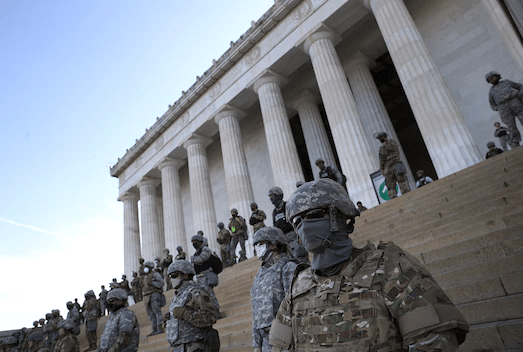
An art and architecture critic, Phillip Kennicott of The Washington Post, examines yesterday’s disturbing image of troops at the Lincoln Memorial:

Who in the Pentagon, or the leadership of the National Guard of the District of Columbia, thought this was a good look? Who thought what America needs now is a viral image of the American military in camouflage and body armor occupying a memorial that symbolizes the hope of reconciliation, that has drawn to its steps Marian Anderson to sing for a mixed-race crowd during a time of segregation and Martin Luther King to proclaim “I have a dream,” and millions of nameless souls, of all races, who believe there is some meaning in words like “the better angels of our nature”?

A photograph of members of the District’s National Guard on the steps of the Lincoln Memorial began racing around Twitter and other social media Tuesday, as the country was still digesting a violent assault by Secret Service, police and guard troops on peaceful protesters outside the White House on Monday. The photo showed troops standing resolutely, perhaps provocatively, on the memorial’s wide and inviting steps, as if they owned it. To many, it symbolized the militarization of Washington, of our government and country, and the terrifying dissolution of old boundaries between partisan politics and the independent, professional military….

Anyone who has photographed the Lincoln Memorial knows that it is hard to find a spot sufficiently distant to include the whole thing in the frame. That, in part, may explain some of the of ominous power of one of the images that circulated widely Wednesday, taken by Getty Images photographer Win McNamee.
Untitled

That picture was taken from the side of the steps, such that the cornice and frieze of the memorial, emblazoned with the names of the states that Lincoln helped stitch back to political unity, plunge precipitously at an angle to the lower left of the frame. A soldier looms large in the foreground, his face covered by a mask, his eyes hidden by sunglasses, his thoughts and his humanity obscured by a carapace of military resolve and inscrutability.

Throughout the crisis of the past week, there have been images, scattered but reassuring, of National Guard troops and some law enforcement officers joining in expressions of common purpose with protesters, speaking respectfully, even taking a knee with people who have flocked to the streets…

The image of troops arrayed on the steps of the Lincoln Memorial only added to the sense of crisis and civil disintegration. No matter their intent and purpose, the D.C. Guard looked not like protecting sentinels, but possessive custodians. Ultimately, their orders came from the president, and so it is inevitable that many people will see their presence there not as protective, but aggressive, as if they are facing off with the city and its residents, whom they are meant to serve.

The District, which is not a state, has long been at the mercy of the federal government and opportunistic politicians, despite having no voting representatives in Congress. The guards, who were local troops, looked like outsiders, like a colonial force.

Given the volatility of the current moment, images like this suggest that a worrying trend — of the military being co-opted into partisan politics — is accelerating, from the president signing Make America Great Again hats on an Army base in Iraq, to last summer’s display of military hardware during a traditionally nonpartisan Fourth of July celebration at the Lincoln Memorial, to new concerns about Trump’s plans for another display of the military during a pandemic, this coming Independence Day.

The decision of Gen. Mark A. Milley, chairman of the Joint Chiefs of Staff, to march with the president across Lafayette Square, which had been violently purged of peaceful demonstrators, and the participation of Defense Secretary Mark T. Esper in a religious-themed photo op at St. John’s Episcopal Church, is yet more worrisome.

The power of the image is also directly connected to the fraught power of the Lincoln Memorial, which is architecturally one of the most beautiful in the country….

The bulk of the memorial’s substance and content is about who goes there, the history of who has stood on its steps, facing the Capitol in the distance, and the obelisk devoted to George Washington, simultaneously the founder of the country, the American Cincinnatus and a slaveholder. The memorial is about the concerts and speeches and protests that have transpired there, about the continuing impulse of ordinary Americans to make it a pilgrimage site.

But one dark truth of the memorial, accidentally amplified by this image of soldiers on its steps, is: For many white Americans, it symbolizes a fantasy of society made whole by Lincoln, of a country that skipped from the trauma of civil war straight to the reconciliation and healing that was adumbrated but not achieved by him, nor any of his successors…

Now we have an image that suggests that raw, naked power — old-guard, old-style, patriarchal military power — has taken possession of something that is already a fragile cultural symbol. To many people looking at this photograph, it seemed to say, “they own it,” not us, not we, not the people.

And that raises an even deeper fear, one that recalls memories of the National Guard at Kent State and atrocities committed by U.S. troops in its wars overseas…. It exacerbates a fear that Washingtonians feel keenly, as more troops pour in, military hardware rattles through the streets, helicopters shatter the calm of night, and as the president’s bellicose rhetoric continues to spew like a fire hose. It’s a simple fear, and a question every soldier, no matter his or her rank, must answer: If the president tells you to shoot us, will you do it?
A Look at the President’s Promenade

A fashion critic, Robin Givhan of The Washington Post, evaluates the president’s attempt to appear presidential:

The president could have opened the Bible. He could have read Psalm 23. The Lord is my shepherd. Federal law enforcement had just fired tear gas at peaceful demonstrators, pelted them with rubber bullets and chased them away on horseback. Txxxx now had the secured space to stand in front of cameras in front of a historic church. And he couldn’t even be bothered to crack the spine on the holy book.

Instead, he corralled members of his staff for a photograph that, in its nightmarish awkwardness, revealed all the ineptitude, cowardliness and pettiness for which the whole charade was a grotesque cover.

After a law-and-order speech in the White House Rose Garden, President Txxxx strode across Lafayette Square to the unassuming facade of St. John’s Episcopal Church. He didn’t go inside. Instead, the structure loomed behind him — a lemon-yellow, three-dimensional set for his tortured stage play.

The president was accompanied by a throng of staff, but the person who stood out in the blur of dark suits crossing the square was his daughter and adviser Ivanka. Always Ivanka. She stood tall on her stilettos. She rose, golden-haired, above the group. She was dressed in black cropped pants and blazer. She was toting a very large white handbag and later was wearing a matching face mask with tiny metallic stars.

Ivanka long ago perfected the art of playing the part, of moving through life like an Instagram feed made real. Over the weekend, she’d tweeted a Bible verse. That was followed by an acknowledgment of Pride Month with a rainbow line of heart emoji. And now she was in the park just violently cleared of peaceful protesters. She was surrounded by police in riot gear. The chairman of the Joint Chiefs of Staff, Mark A. Milley, was in camouflage.

If other members of the administration were trudging across the plaza to a kind of doomed publicity stunt, Ivanka looked as though she were just gliding through — on her way home after a busy day in a comfortable corner office doing important things. As one of the few women in the group, she already stood apart. Her mask made her a laudable loner. The handbag clasped in her right hand announced that she was not sticking around. She was there, but not committed — not to empathy, not to the militaristic display of strength, not to this gamesmanship, not to the horrors of this national stress test, not to anything but the Ivanka-ness of her public image, which is always about being power-adjacent.

Ivanka doggedly inserts herself into the center of photographs and conversations where she does not seem to belong, but this time she remained on the sidelines when the posing started.

Attorney General William P. Barr, national security adviser Robert O’Brien and White House spokeswoman Kayleigh McEnany were among those pulled center stage with Txxxx. Barr stared slack-jawed in an open-collar shirt, no tie. His jacket was open. O’Brien was buttoned up in a gray suit with a pale blue tie that was a shade lighter than the president’s, which trailed below his waistband as usual. McEnany was in a closefitting double-breasted blazer with gold metallic buttons and skinny trousers. She was perched atop a pair of stiletto pumps — a style of footwear that this White House, all on its own, may be keeping in circulation.

None of them was wearing a mask, because that would remind everyone that the world is still facing a pandemic, and besides, the masks would ruin the picture. Everyone stood apart, but not six feet apart. They didn’t lower their head in prayer or silent tribute to George Floyd — the man whose death after nearly nine minutes under the knee of a white Minneapolis police officer sparked this uprising. Their arms dangled at their side. No one seemed to know where to look or what to do or how long to stand there.

In some of the photographs, one can see Chief of Staff Mark Meadows, as well as Defense Secretary Mark T. Esper. They don’t elevate the images; they only make them more desperate — just two more faces looking blankly into the distance.

The photographs in front of St. John’s captured the president’s fundamental discomfort with what it means to exist out in the open where people do not soothe him with flattery, where brute force is an accelerant, not an answer, and where imperfect lives spill outside their borders. Txxxx worked so hard for his flaccid, sanitized photograph: a man standing with nothing but white bureaucrats — most of them men — on the plaza in front of a neatly boarded-up house of worship. Txxxx isn’t even really at the church; he’s in its vicinity.

At one point, standing alone, he’s holding the Bible not like it’s a source of enduring comfort but like it’s a soiled diaper.The choreographed group picture captures none of the agonizing emotion of this moment. But it was out there, in the wild, and Txxxx had to pass by it. The pain was scrawled in jagged, vulgar graffiti on the walls abutting his path, on walls that couldn’t be scrubbed clean for his benefit.

The picture he orchestrated shows no hint of a commander in chief rising above or binding up anything. The photograph doesn’t convey power or competence. From every angle, in every iteration, it’s an image of a whitewashed group turning a deaf ear to a country convulsing over racial injustice.

Before Txxxx crossed the street, he announced with great fanfare to the American people that he was going to “pay my respects to a very, very special place,” one that was [slightly] damaged in a fire Sunday. But it wasn’t a building that was calling out for care.