Smiles from 1967, 2004, 2011 and even 2002

After releasing Pet Sounds and “Good Vibrations” in 1966, Brian Wilson tried to keep it all going with Smile in 1967. Things didn’t work out, so Smile became rock music’s most famous, most well-regarded, unfinished, semi-existing album. Brian and the other Beach Boys went on to lesser things (as did Brian’s lyricist for the project, Van Dyke Parks), while the legend of Smile grew.
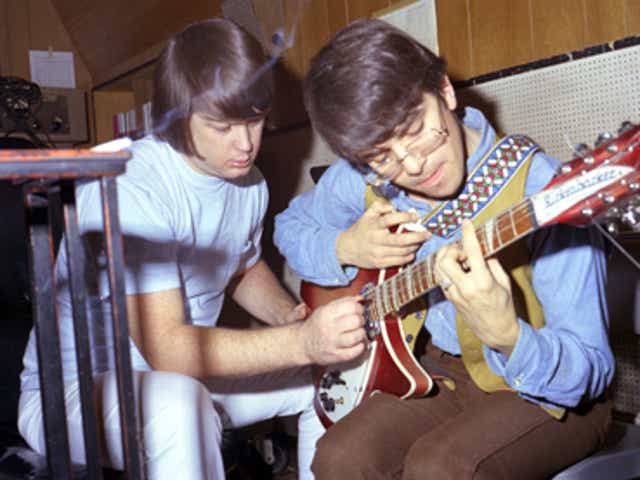
d93426a7-f061-49ab-8580-b35a48ebb43f-Van_Dyke_Parks_and_Brian_Wilson

I use the word “legend” because in this case it’s appropriate. The story was told again and again. Unreleased recordings were quietly shared. Speculation abounded among certain Beach Boys fans. Would the group ever finish Smile? What would it be like when we finally got to hear it? What would people have thought in 1967 if Smile had come out before Sergeant Pepper? The Beach Boys and Beatles were having a friendly competition in the mid-60s. We know how that came out.

Brian Wilson, having begun a solo career in the 80s, changed the Smile story in a big way in 2004. Overcoming considerable obstacles, he and his band debuted Smile at a February concert in London. From The Guardian:

So how good, finally, is Smile, the great lost song cycle that Brian Wilson kept the world waiting 37 years to hear? The only possible answer, after Friday night’s world premiere in London, is that it is better than anyone dared hope. Multiple spontaneous ovations were the reward for the former Beach Boy and his musicians, whose pristine performance breathed life into a 45-minute work previously known only through various shattered and dispersed fragments.

Seven months later, Brian Wilson presented us with Brian Wilson Presents Smile. Metacritic, a site that tries to synthesize critical opinion, has it down as the third-best reviewed album of the 21st century:

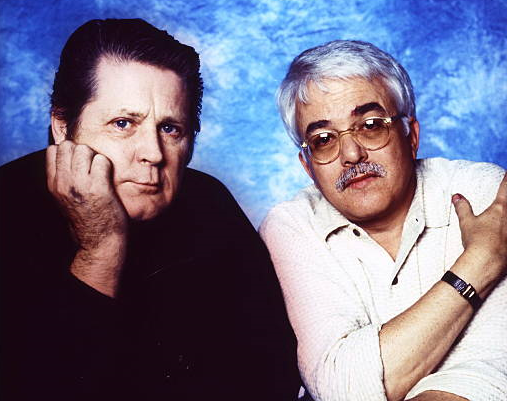
Well, better 37 years late than never. Originally intended to be the Beach Boys’ 1967 follow-up to their legendary ‘Pet Sounds,’ ‘Smile’ was finally recorded as originally intended in April 2004 by Wilson and his current band, including co-songwriter Van Dyke Parks.

“Originally intended” is a stretch, since nobody, including Mr. Wilson, really knows how he intended to put Smile‘s pieces together in 1967. (Not being able to put the pieces together was a very big part of the problem.)

In 2011, Capitol Records released a big set of Beach Boys recordings from the 60s, The Smile Sessions, also to great acclaim. And that was that.
gettyimages-86110974-612x612

Except that while we were waiting those 37 years, a number of us (hundreds of us? thousands?) created our own versions of Smile, using whatever pieces were available (legally and otherwise). I did one in 2002, two years before Brian did. If only he’d asked me for help in 1967!

Mine differs from the typical unofficial arrangement, mainly in two ways. I started with something someone put together from mostly instrumental tracks and called “The Elements”. I think it’s an excellent prelude to what comes later. I also used a version of the song “Wonderful” from the Smiley Smile album (what the Beach Boys released in lieu of Smile), not the original “Wonderful” with a harpsichord that most fans seem to prefer. I like the later one a lot more.

Anyway, here’s my Smile from 2002 in two formats up in the Microsoft cloud (YouTube objected due to copyright):

Audio only (MP3, 55 mb)

Audio plus unsophisticated video that identifies the tracks (MP4, 52 mb)

unnamed

(By the way, whether or not you watched any of that ridiculous “debate”, please vote and send the maniac back to private life and almost certain criminal prosecution.)

At Least We Know Death Is a Certainty

Despite being on a news vacation, I heard that The New York Times got copies of some of Txxxx’s tax returns. I read the Times article, but will let a few other Times readers comment.

Ralph from Nebraska:

This stunning report takes some time to read and digest and we will all find numbers that amaze and annoy us. I was once a bankruptcy lawyer and I often had to explain this scenario to clients: If you borrow money and don’t repay the money the IRS sees the money that you didn’t repay as income on which you need to pay taxes. Here’s the number that jumped screaming off of my I Pad: $287,000,000. During the last ten years our President has stiffed his creditors to the tune of $287 million.ย 

STSI from Chicago:

There is something rotten in our tax system that allows someone like Dxxxx Txxxx to spend years litigating the IRS so that he can pay little or no taxes owed. Dxxxx Txxxx is the poster child for how the US tax code has been exploited and scammed by individuals who use taxpayer money to fund their legal battles with the IRS. Congress needs to address this issue and level the playing field so that every American pays his or her fair share of taxes due.

Ron S. from Los Angeles:

I run two small, moderately profitable businesses. I deduct legitimate business expenses, but I also make monthly estimated tax payments to the IRS, knowing full well if I claim losses year after year I will be audited. That Dxxxx Txxxx cheats the system is not only no surprise, it also shows how the U.S. tax system is set up one way for the rich and another way for everybody else.

B. Reed from Washington DC:

Txxxx is a crook who deserves to be prosecuted. But I wish this was an anomaly because it isnโ€™t. . . . How people can see this stuff and not be radicalized and demand dramatic change is beyond me. . . .ย 

It’s beyond me too.

By the way, we have an election 36 days from now, in which Dxxxx Txxxx and lots of his Republican enablers are candidates for high office.

Why Indeed?

Another in what has turned into a series of selections from Charles Lindblom’s Politics and Markets: The World’s Political-Economic Systems (1976):

A set of unifying beliefs that assert the virtues of the fundamentals of social organization will be found in any stable society. . . . In the market-oriented polyarchies [where there is “rule by the many”], the beliefs show a distinctive character. They are greatly influenced by inequality of wealth and by the existence of a dual set of leaders who enjoy a privileged position in politico-economic organization [that is, government leaders and business leaders]. Many of the unifying beliefs of the society are those beliefs communicated by a favored class to all other classes, with enormous advantage in a grossly unequal competition of ideas.

. . . Deep-seated beliefs and attitudes that persist over time, some people will say, have to be understood as the product of random “spontaneous” social forces. What does that mean? It cannot mean that they arise without cause. Perhaps, then, it means that they arise without deliberate intent. No person or group or government plans them. They are unintended consequences of mutual influences of persons on each other.

Granted. Yet we know that, although people do indeed influence each other’s attitudes in countless unintended ways, they also intend a great deal of control over attitudes, beliefs and volitions. Parents and teachers, for example, teach children — explicitly and through their own behavior as example — the virtues of obedience to authority. In most societies, they also teach children that improvement in their position in life will and ought to depend on their own personal qualities (rather than on an alteration in social structure).

Moreover, many of the unintended influences of people on each other reinforce the intended indoctrinations, as when someone who repeatedly challenges authority makes his friends so uncomfortable that they gradually drop [them]. Much unintended mutual influence among persons is therefore patterned control rather than random, because it reflects a pattern in intended influence, which is itself not random.

Why the particular pattern of intentions that we perceive? Why the emphasis on such a theme as obedience to authority (rather than a skeptical, only conditional, and selective acceptance of it)? Why deference toward the wealthy (that does not even discriminate between earned and inherited wealth)? Why individual responsibility for improvement in the quality of life (rather than social cooperation to improve polity and economy)? Why genialized privilege for the wealthy and powerful (rather than offsetting constraints and responsibilities to balance their advantages in wealth or power)? Why so profound a respect for property as to lead many people to think it immoral to steal a loaf of bread to save one’s family from hunger?

These are not random themes. They confer advantages on persons in the favored social class. How do they come to be “spontaneous”? How do they come to be near universally taught? They have been endlessly communicated to the population — explicitly and through behavior as example — through the church, the media, the schools, the family and the pronouncements of business and government leaders. Since they have been in this way communicated for centuries, they have passed into folklore and common morality, with the result that almost everyone joins in the intended and unintended or “spontaneous” processes by which they are passed on to the young and reinforced for the old [230-231].

Unquote.

Maybe there’s more skepticism about our common beliefs than there was in 1976. If so, such skepticism hasn’t translated into very many progressive government policies. In the US, at least, with a few exceptions, it’s been the reverse. But as skepticism justifiably grows, will our politics lean toward the alternatives Lindblom put in parentheses? I sure hope so.

(A giant blue wave 40 days from now would help.)

Can 2020 Get Any Worse?

Of course it can.

But think how good 2021 can be by comparison.

The Shocks That Flesh Is Heir To

26JOAN3-jumboThe Kronos Quartet was founded in 1973. They released the first of their 43 studio albums in 1979. I went looking for a copy of the rather obscure Music of Dane Rudhyar after I’d bought several of their more accessible albums, including Monk Suite: Kronos Quartet Plays Music of Thelonious Monk; Terry Riley: Cadenza on the Night Plain; and White Man Sleeps. I’m sure I saw them perform in person at least once. I was a fan.

They were known for playing a range of music not usually associated with string quartets (“Purple Haze”, most famously) and also for wearing cool clothes on stage. They were very modern.

My interest wasn’t totally musical though. One of their members was a blonde woman, a cellist with a mellifluous name: Joan Jeanrenaud. I wondered what she was like when she wasn’t playing cello.

1498075787017

As these things happen, the Quartet and I eventually went our separate ways. 

Then, what should pop up yesterday on YouTube but a video of the Kronos Quartet? They were playing a piece of medieval English music: Thomas Tallis’s Spem In Alium

There was something different, however. Where there used to be a blonde woman, there was now a dark-haired man. Where was Joan Jeanrenaud?

From The New York Times in 2012:

It’s still hard to picture the ubiquitous Kronos Quartet without Joan Jeanrenaud. For 20 years there they were: three hip-nerdy guys and one willowy, glamorous woman.

Then, in what seemed eerie emulation of an early role model, the British cellist Jacqueline du Prรฉ, Ms. Jeanrenaud was diagnosed with multiple sclerosis. She took a long-term leave, starting in 1999, that morphed into retirement from the quartet and its arduous six months of annual touring. . . .

. . . the impact of the illness has, in her case, been relatively benign. Ms. Jeanrenaudโ€™s condition affects her legs. Du Prรฉโ€™s began with a loss of sensitivity in her fingers, disastrous for any instrumentalist.

Jeanrenaud has had a solo career that’s included teaching, performing, recording and composition. When the Times article was written, her multiple sclerosis was under control. More recently, however, she was filmed entering a room in a wheelchair and slowly repositioning herself before beginning to play. 

Suddenly seeing her again 20 or 30 years later, dealing with partial paralysis, well, what is there to say?

JoanJ-raw

Growing old sneaks up on us. But I suppose gradual is better than sudden when it comes to aging.

YouTube has Jeanrenaud’s 2008 album Strange Toys. This track is called “Waiting”.

PS: The all-American Ms. Jeanrenaud was born Joan Dutcher in Memphis, Tennessee. She attended Indiana University before studying in Europe.