A Significant Minority of Our Fellow Americans

It looks like we’ve reached the Crazy Times that science fiction writers of the 1950s and other distant decades set in the 21st century. From The New York Times:

It’s not just the notion that the election was stolen that has caught on with the former president’s supporters. QAnon, an outlandish and ever-evolving conspiracy theory spread by some of X’s most ardent followers, has significant traction with a segment of the public — particularly Republicans and Americans who consume news from far-right sources.

Those are the findings of a poll released today by the Public Religion Research Institute and the Interfaith Youth Core, which found that 15 percent of Americans say they think that the levers of power are controlled by a cabal of Satan-worshiping pedophiles, a core belief of QAnon supporters. The same share said it was true that “American patriots may have to resort to violence” to depose the pedophiles and restore the country’s rightful order.

And fully 20 percent of respondents said that they thought a biblical-scale storm would soon sweep away these evil elites and “restore the rightful leaders.”

“These are words I never thought I would write into a poll question, or have the need to, but here we are,” Robby Jones, the founder of P.R.R.I., said in an interview.

The teams behind the poll determined that 14 percent of Americans fall into the category of “QAnon believers,” composed of those who agreed with the statements in all three questions. Among Republicans only, that rises to roughly one in four. (Twelve percent of independents and 7 percent of Democrats were categorized as QAnon believers.)

But the analysts went a level further: They created a category labeled “QAnon doubters” to include respondents who had said they “mostly disagreed” with the outlandish statements, but didn’t reject them outright. Another 55 percent of Republicans fell into this more ambivalent category.

Which means that just one in five Republicans fully rejected the premises of the QAnon conspiracy theory. For Democrats, 58 percent were flat-out QAnon rejecters.

Mr. Jones said he was struck by the prevalence of QAnon’s adherents. Overlaying the share of poll respondents who expressed belief in its core principles over the country’s total population, “that’s more than 30 million people,” he said.

“Thinking about QAnon, if it were a religion, it would be as big as all white evangelical Protestants, or all white mainline Protestants,” he added. “So it lines up there with a major religious group.”

He also noted the correlation between belief in QAnon’s fictions and the conviction that armed conflict would be necessary. “It’s one thing to say that most Americans laugh off these outlandish beliefs, but when you take into consideration that these beliefs are linked to a kind of apocalyptic thinking and violence, then it becomes something quite different,” he said.

The Public Religion Research Institute and the Interfaith Youth Core found a strong correlation between where people get their news and how much they believe in QAnon’s ideas. Among those who said they most trusted far-right news outlets, such as One America News Network and Newsmax, two in five qualified as full-on QAnon believers. Fully 48 percent of these news consumers said they expected a storm to wipe away the elites soon.

That puts these news consumers far out of alignment with the rest of the country — even fans of the conservative-leaning Fox News. Among respondents who preferred Fox News above other sources, 18 percent were QAnon believers. . . .

Those who expressed belief in QAnon’s premises were also far more likely than others to say they believe in other conspiracy theories, the poll found. Four in 10 said they thought that “the Covid-19 vaccine contains a surveillance microchip that is the sign of the beast in biblical prophecy.”

Unquote.

Meanwhile, it was reported that the former president wanted the Department of Justice to ask the Supreme Court to nullify the presidential election and order a new one. The government lawyers ignored that directive. However, a new poll says 50% of Republicans believe reviews of certain state election results will show that their candidate won, while an earlier poll indicated that 30% of them think he’ll be “reinstated”, perhaps via the little-known and rarely-used procedure set forth in the “Oops Clause” of the Constitution.
Where’s the Justice?

It’s better to be frustrated and impatient than angry and horrified, so getting a new president and administration that isn’t made up of idiots, creeps and criminals is a blessing.

Nevertheless, I never expected to be thinking so much about a few Democratic senators, especially that two-headed, pro-filibuster creature we might as well call “Manchinema”. There is so much that could be accomplished with Joe Biden as president, a small majority in the House and 50 votes in the Senate.

Unfortunately, another source of frustration and impatience at the moment is Attorney General Merrick Garland and the talented lawyers who work for him.

As Jennifer Rubin of The Washington Post points out:

[Garland] has . . .  never indicated as to whether, now that former president X is out of office, the department would follow up on alleged illegal conduct examined by special counsel Robert S. Mueller III (e.g., obstruction of justice, perjury, witness tampering). 

Here’s more on that story from Washington Monthly’s Jennifer Taub:

Special Counsel Robert Mueller’s Report on Russian Interference in the 2016 Election was released to the public on April 18, 2019 (in redacted form). Volume II provided a clear, detailed roadmap for a post-term prosecution of X for a variety of obstruction-of-justice offenses. The Report noted that while the Justice Department policy forbids prosecuting a president while in office, “Recognizing an immunity from prosecution for a sitting President would not preclude such prosecution once the President’s term is over or he is otherwise removed from office by resignation or impeachment.”

This should have been a bombshell. But, thanks to [former Attorney General] Barr’s words and actions almost a month earlier, selling the report as an exoneration of X, [it] fizzled. (In a particularly egregious headline, the New York Times said that Mueller exonerated X, not even attributing it to Barr.) By the time we got to read the report, Barr’s characterizations had been disproved, but by then the press and public yawned.

Let’s recall what Barr did. On March 22, 2019, the Justice Department received a confidential copy of the 448-page Mueller Report. A former AG and political player for decades, Barr surely saw how damaging it was, so he did not share it. Instead, two days later, on March 24, Barr delivered a four-page letter to Congressional leaders (which was then released to the public). The letter purported to “summarize” the Mueller Report’s “principal conclusions.” But Barr did not provide a truthful summary; he concocted a cynical spin.

Regarding obstruction of justice, Barr said Mueller had concluded that “while this report does not conclude that the president committed a crime, it also does not exonerate him.”

This was a shocking revelation. . . .  In a Politico roundup published that day, I contended that “Barr’s conclusions are not credible.”  It took reading between the lines to appreciate his hustle. But, instead of respecting Mueller’s refusal to clear X, Barr told Congress that this meant it was now his job to come to a legal conclusion. But, it was not. Doing so undermined the entire purpose of the Special Counsel statute, which was NOT to leave such a decision in the Attorney General’s hands. Barr claimed that “the evidence developed during the Special Counsel’s investigation is not sufficient to establish that the President committed an obstruction-of-justice offense.”

Thanks to Barr, many wrongly believe Mueller exonerated X. Around 60 percent of Americans either thought the president had been cleared or were unsure. Only 40 percent correctly understood that Mueller did not exonerate X.

Disappointingly, Merrick Garland’s Justice Department [has chosen] to continue the cover-up. Here’s a little background to explain how this happened and the alternative path Garland could have taken.

Back in April of 2019, Barr said that he relied on advice from the Justice Department’s Office of Legal Counsel before drafting his March 24 communication to Congress about the Mueller Report. In response, the non-partisan, public interest organization Citizens for Responsibility and Ethics in Washington (CREW) sued the Department under the Freedom of Information Act (FOIA), requesting all related documents.

[The Justice Department] told the judge that one of the documents that CREW wanted was protected from public disclosure under the FOIA law under the “deliberative process privilege.” They argued this particular March 24, 2019 memo from the Office of Legal Counsel to Barr was “pre-decisional” as they claimed it was given to Barr before he made his final decision on whether Trump obstructed justice. And they claimed that it was “deliberative” because it was provided to aid him in his decision-making process.”

On May 4 of this year, Judge Amy Berman Jackson called bullshit on those claims, to put it mildly. In a stinging opinion, she ruled in favor of CREW and ordered Garland’s Justice Department to hand over the memo. . . . Berman Jackson wrote that “there was no decision actually being made as to whether the then-President should be prosecuted.” She saw the DOJ as “girding for a preemptive strike on the Mueller report.” The memo was not shielded as pre-decisional legal advice.

As I wrote in the Washington Monthly at the time, this was Garland’s inflection point. It would have been so very easy to decide not to appeal and to allow the memo to be released. Instead, Garland’s DOJ lawyers doubled down on the deception. On May 25, Garland had his team ask Judge Jackson to stay her order (put it on hold) so they could keep the memo hidden while they appealed her decision. . . . 

Garland’s decision shocked and disappointed many experts. Former Solicitor General Neal Katyal penned an opinion piece arguing that “the American people have a right to see the memo. Then they can decide whether Mr. Barr used his power as the nation’s chief law enforcement officer as a shield to protect the president” . . . 

Garland, who served on the D.C. Circuit Court of Appeals from 1997 to 2021, might have additionally justified releasing the memo to the public on principle. Anyone with eyes could see that both Barr and Justice Department lawyers (still employed by Garland) misled a federal judge. A strong manager would make it clear that dishonesty would no longer be tolerated under his leadership. As a former DOJ prosecutor—after the Oklahoma City bombing Garland left private practice to prosecute domestic terrorism—Garland should have been incensed. As Bob Dole used to say, “Where’s the outrage?” . . . 

Unquote.

Whether that memo is ever made public is much less important than whether our former president (aka the unindicted co-conspirator) is ever prosecuted. Now that he’s no longer shielded by the presidency, he needs to face the music for his obstruction of justice, perjury and witness tampering. Prosecuting him would outrage his crazy supporters. That’s too damn bad. Attorney General Garland needs to demonstrate that powerful people, even presidents, can’t trample on the law and avoid the consequences.

Pandemic Cash Made a Difference

Millions needed help and got it. From The New York Times:

In offering most Americans two more rounds of stimulus [or relief] checks in the past six months, totaling $2,000 a person, the federal government effectively conducted a huge experiment in safety net policy. Supporters said a quick, broad outpouring of cash would ease the economic hardships caused by the coronavirus pandemic. Skeptics called the policy wasteful and expensive.

The aid followed an earlier round of stimulus checks, sent a year ago, and the results are being scrutinized for lessons on how to help the needy in less extraordinary times.

A new analysis of Census Bureau surveys argues that the two latest rounds of aid significantly improved Americans’ ability to buy food and pay household bills and reduced anxiety and depression, with the largest benefits going to the poorest households and those with children. The analysis offers the fullest look at hardship reduction under the stimulus aid.

Among households with children, reports of food shortages fell 42 percent from January through April. A broader gauge of financial instability fell 43 percent. Among all households, frequent anxiety and depression fell by more than 20 percent.

While the economic rebound and other forms of aid no doubt also helped, the largest declines in measures of hardship coincided with the $600 checks that reached most people in January and the $1,400 checks mostly distributed in April.

“We see an immediate decline among multiple lines of hardship concentrated among the most disadvantaged families,” said H. Luke Shaefer, a professor at the University of Michigan who co-authored the study . . .

Given the scale of the stimulus aid — a total of $585 billion — a reduction in hardship may seem like a given, and there is no clear way to measure whether the benefits were worth the costs. . . . Still, the aggressive use of stimulus checks coincides with growing interest in broad cash payments as a tool in social policy, and the evidence that they can have an immediate effect on the economic strains afflicting many households could influence that debate.

Starting in July, the government will mail up to $300 a month per child to all but the most affluent families in a yearlong expansion of the child tax credit that Democrats want to make permanent. . . .

“Cash aid offers families great flexibility to address their most pressing problems, and getting it out quickly is something the government knows how to do,” Mr. Shaefer said. Extrapolating from the survey data, he concluded that 5.2 million children had escaped food insufficiency since the start of the year, a figure he called dramatic.

The experience of [Chenetta Ray], a warehouse worker at a recycling company in Houston, captures the hardships that the pandemic imposed and the varied ways that struggling families have used stimulus checks to address them. Earning $13 an hour, Ms. Ray had an unforgiving budget even before business closures reduced trash collection and cut her hours by a third.

Her car insurance lapsed. Her lights were shut off. She skipped meals, even with food pantry aid, and re-wore dirty work clothes to save on laundromat costs. When her daughter discovered that they owed thousands in rent, she offered to quit high school and work, which Ms. Ray forbid. A stimulus payment in January — $1,200 for the two of them — let her pay small parts of multiple bills and restock the freezer.

“It bridged a gap,” Ms. Ray said, while she waited for slower forms of assistance, like rental aid.

Then she got cancer. To confirm the diagnosis and guide her treatment, she had to contribute $600 to the cost of a CT scan, which she did with the help of a payment in April totaling $2,800.

In addition to providing for the test, Ms. Ray said, the checks brought hope. “I really got down and depressed,” she said. “Part of the benefit of the stimulus to me was God saying, ‘I got you.’ Spiritual and emotional reassurance. It took a lot of stress off me.”

Maybe We Can Use Their Advanced Technology to End the Filibuster

Video from Las Vegas local news: “Radar confirms UFO swarm around Navy warship”. They say the Navy says it’s legitimate.

More Good News, Bad News

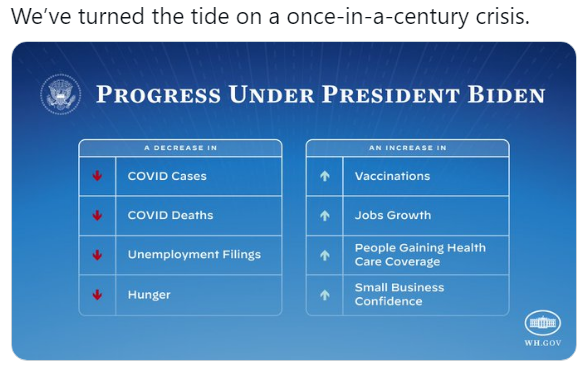
There’s good news about the economy, which means good news about people’s lives. From Paul Krugman:

At the beginning of this year, the United States was still very much in the depths of the pandemic. Daily deaths were higher than ever, with Covid-19 taking more than 3,500 lives in the country every day. Parts of the economy that depend on close physical contact were largely frozen. . . .

Then came an extraordinarily successful vaccination campaign. Deaths have plunged more than 85 percent and are still dropping. As fear recedes, the economy is surging, in what may end up being the fastest recovery ever. . . . 

Why would anyone imagine us able to achieve that kind of sudden acceleration without leaving a few skid marks, and maybe even burning some rubber?

So yes, sawmill operators, who expected a longer slump, got caught short, leading to sky-high lumber prices. Rental car companies, which sold off a large part of their fleets last year, are now scrambling to buy vehicles again, helping to send used-car prices soaring. And so on.

What about those reports of labor shortages? Some of this is what always happens after a period of high unemployment: Businesses grow accustomed to having job applicants lined up at their doors, and get cranky when the buyers’ market ends. . . .

Mainly, however, we’re just seeing the problems you’d expect when the economy tries to roar ahead from a standing start, which means that we’re calling on suppliers to ramp up production incredibly fast and expecting employers to quickly attract a large number of new workers. These problems are real, but they’ll mostly resolve themselves in a few months.

So what do these probably temporary problems say about the longer term, and in particular about President Biden’s economic plans? That’s easy: nothing. Politicians gonna politician, and Biden’s opponents are seizing on every negative bit of news as proof that his entire agenda is doomed. But none of it should be taken seriously. . . . None of this tells you anything at all about how much we should worry about overheating, let alone how much more we should be spending on infrastructure and family support (answer: a lot) or how we should pay for these initiatives (answer: tax corporations and the rich).

. . . There is some bad news out there, but most of it is a temporary byproduct of extraordinary good news: The virus is losing, and the economy is winning.

Or more succinctly, from the White House:

Untitled

On the other hand — and it’s a giant hand with about twelve dangerous fingers — one side is trying to rig the game even more than it already is. This is part of an interview from Vox:

Sean Illing

You were urging Democrats in 2018 to pass the sorts of reforms that are still on the table today, like packing the courts or granting statehood to DC and Puerto Rico. Are we beyond that now?

David Faris (political scientist and author of It’s Time to Fight Dirty)

What needs to be done has gotten more complex. The structural problems are even worse than I anticipated. I also didn’t fully anticipate the unapologetically authoritarian turn in Republican politics. But the fixes are still there. You have to abolish the filibuster in the Senate, you have to mandate national nonpartisan redistricting, you have to make voting easier, and you have to outlaw some of these Republican voter suppression tactics.

Sean Illing

I’ve had conversations with some Democrats and when these ideas about nuking the filibuster or court-packing or granting statehood to DC and Puerto Rico come up, the argument is often that it’s a nonstarter because [senators] Joe Manchin or Kyrsten Sinema simply won’t do it. What’s wrong with that thinking?

David Faris

Certainly the laws that you can pass are contingent on getting the most moderate member of your caucus on board. . . .

Where Manchin seems to be very far away from what House Democrats want to do is on the democracy reform stuff. It’s maddening because nothing that Manchin wants to do policy-wise can get done without abolishing the filibuster. Democrats are not going to have a majority after next year if they don’t do some of these things now. So it’s a mistake to assume Manchin can’t be moved. That’s the job of leadership. That’s Joe Biden’s job. That’s Chuck Schumer’s job.

Sean Illing

Let’s just say that Manchin and Kyrsten Sinema, for whatever reason, refuse to respond to the realities of the moment — then what?

David Faris

It’s bleak. I don’t know what else to say.

Democrats have to get extremely lucky next year. They either need to luck into the most favorable environment for the president’s party that we haven’t ever had for a midterm election or … I don’t know. There’s not much else they can do. None of these democracy reforms can get through on a reconciliation bill. If Democrats don’t pass nonpartisan redistricting, they’re going to be fighting at a huge disadvantage in the House. That’s the ballgame.

Progressive activists are going to pour a billion dollars into the Florida Senate race and then [Marco] Rubio is going to win by 10 points. So if they don’t act, it’s very simple. The Democrats will have to fight on this extremely unfair playing field against a newly radicalized Republican Party that is going to pull out all the stops in terms of voter suppression to win these elections, on top of the situation where they’re making other changes to state laws that could allow them to mess around with results in other ways, like what we’re seeing in Georgia now.

There’s a very circular structure to this kind of proto-authoritarianism. You have anti-democratic practices at the state level that produce minority Republican governments that pass anti-democratic laws that end up in front of courts that are appointed by a minoritarian president and approved by a minoritarian Senate that will then rule to uphold these anti-democratic practices at the state level.

And so there is no path to beating some of these laws through the courts. The Supreme Court has already said it’s not going to touch gerrymandering. And so there’s nothing left except Congress using its constitutional authority under the elections clause to do some regulation to the elections. I just don’t see another way.

Sean Illing

It feels like we’re sleepwalking into a real crisis here, but it’s hard to convey the urgency because it’s not dramatic and it’s happening in slow motion and so much of life feels so normal. And yet our democratic system is losing any semblance of legitimacy and down that road is a range of possibilities no one wants to seriously consider. …

David Faris

When people think of democracy dying, they think of some very dramatic event like Trump riding down Pennsylvania Avenue in a tank or something. That’s not the reality here.

Take the scenario where Republicans don’t have to steal the 2024 election. They just use their built-in advantages in which Biden wins the popular vote by three points but still loses the Electoral College. Democrats win the House vote but lose the House. Democrats win the Senate vote, but they lose the Senate.

That’s a situation where the citizens of the country fundamentally don’t have control of the agenda and they don’t have the ability to change the leadership. Those are two core features of democracy, and without them, you’re living in competitive authoritarianism. People are going to wake up the next day and go to work, and take care of their kids, and live their lives, and democracy will be gone. . . .