A Different View of “Peace For Our Time”

The recent deal regarding Iran’s nuclear program evoked lots of references to Prime Minister Neville Chamberlain negotiating with Hitler in 1938. Chamberlain infamously came back from Munich, waved a “scrap of paper” and promised “peace for [not “in”] our time”. Germany immediately absorbed part of Czechoslovakia and eleven months later invaded Poland.

How could Chamberlain have been such a fool? If only he had stood up to Hitler! Was he a coward? What happened in Munich was appeasement at its worst.
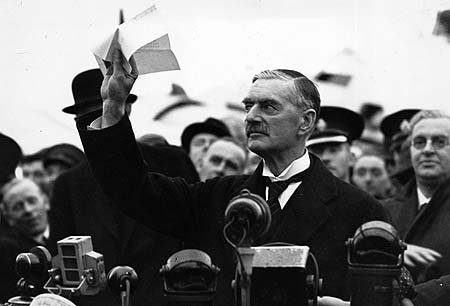
chamberlain-plane-ticket-pic-collect-178249005

As is often the case with famous or infamous historical events, the common view isn’t necessarily correct. Historians who suggest a new interpretation of the past are called “revisionists”. Sometimes they’re right, especially when their revisions are based on new evidence.

I’m not qualified to judge the merits of the standard view of the Munich Agreement, but, according to this article at Salon:

… among historians, that view changed in the late 1950s, when the British government began making Chamberlain-era records available to researchers. “The result of this was the discovery of all sorts of factors that narrowed the options of the British government in general and narrowed the options of Neville Chamberlain in particular,” explains David Dutton, a British historian who wrote a recent biography of the prime minister. “The evidence was so overwhelming,” he says, that many historians came to believe that Chamberlain “couldn’t do anything other than what he did” at Munich. Over time, Dutton says, “the weight of the historiography began to shift to a much more sympathetic appreciation” of Chamberlain.

The author suggests several reasons why, in his opinion, Chamberlain made the right decision: (1) most historians believe the British military wasn’t prepared for war with Germany in 1938; (2) Chamberlain’s military advisors told him that British forces couldn’t stop Germany from invading Czechoslovakia, but could eventually defeat Germany given time to prepare; (3) by 1938, Australia, New Zealand and Canada were no longer required to participate in a British war; (4) the Soviet Union was considered a potential enemy, not an ally; (5) America’s neutrality laws made it unlikely that America would join the fight; (6) although France was a likely major ally, British authorities had a very low opinion of France’s unstable government and the French military; (7) the British public, still traumatized by World War I, was strongly in favor of negotiation; (8) preserving the territorial integrity of Czechoslovakia wasn’t seen as justification for war, partly because Czechoslovakia had only existed for 20 years and many ethnic Germans in Czechoslovakia wanted to be part of a Germany; (9) the British generally believed that Hitler was similar to Mussolini, a fascist leader they knew, who was “more bravado than substance”.

The Munich agreement between the United Kingdom, France, Germany and Italy was greeted in Britain as a success: “cheering crowds filled the streets and the press rejoiced”. The French reaction was similar. When Germany took more of Czechoslovakia six months later, however, Chamberlain realized that war was inevitable, increased the pace of British rearmament and instituted Britain’s first peacetime draft.

Maybe Chamberlain and his supporters should have known better. After all, some of the British, as well as observers in other countries, correctly predicted that Hitler’s ultimate goal was the subjugation of Europe. We know the rest.

Still, it’s impossible to say whether Hitler would have been stopped sooner or more easily if Chamberlain (and the French president Daladier) had never made a deal in Munich. Nick Baumann, the author of the Salon article, concludes:

The story we’re told about Munich is one about the futility and foolishness of searching for peace. In American political debates, the words “appeasement” and “Munich” are used to bludgeon those who argue against war. But every war is not World War II, and every dictator is not Hitler. Should we really fault Chamberlain for postponing a potentially disastrous fight that his military advisers cautioned against, his allies weren’t ready for, and his people didn’t support?

At any rate, removing some economic sanctions in exchange for limits on Iran’s nuclear program isn’t the same as letting Hitler take part of Czechoslovakia in exchange for a promise of peace. 

By the way, the author of The Atheist’s Guide to Reality, the book I’ve been writing about recently, argues that we can learn nothing from history, since circumstances are always changing. In other words, history is bunk. But that’s consistent with his view that science is the only true path to knowledge. A more reasonable view is that there are recurring patterns in history, even if history doesn’t repeat itself. Looking back, it’s reasonable to conclude that negotiation is generally better than war.

People Come and Go So Quickly Here

It’s estimated that there were 1 billion human beings in 1800. We made it to 7 billion in 2011. With that many people doing what people do, we’ll hit 8 billion in another 15 years or so, assuming nothing out of the ordinary happens.

The Atlantic has “A Real-Time Map of Births and Deaths”. It’s an impressive visual simulation of the world’s rapid and uneven population growth. It’s based on statistics, of course, since we haven’t yet reached the point where every birth and death is instantly recorded (unless someone isn’t telling us). 

By the way, the United States is the 3rd most populous country in the world, after China and India. For some reason, I find that surprising (maybe I got used to the Soviet Union being in the 3rd position). The Census Bureau provides the latest estimated numbers for America and the world on their population clock:  http://www.census.gov/popclock/

Meanwhile, You Don’t Want To Be Poor In America

The Center on Budget and Policy Priorities, a Washington think tank, has issued a report relating to “welfare reform”, the law that Congress passed and President Clinton signed 17 years ago.

Federal funding for the Temporary Assistance to Needy Families program (what used to be called “Aid to Families with Dependent Children” or “welfare”), hasn’t increased since 1996, so inflation has eaten away at the program’s benefits:

Because TANF benefits have declined substantially in value, they do much less to help families escape deep poverty than they did in 1996.  With the exception of Maryland and Wyoming, a poor family relying solely on TANF to provide the basics for its children (such as during a period of joblessness, illness, or disability) in every state is further below the poverty line today than in 1996.

In fact, the inflation-adjusted value of benefits has decreased by more than 20% in 14 states and by more than 30% in 26 states.

Believe it or not, the monthly cash payment to an unemployed woman with two children in Mississippi is $170. Where I live, in one of the highest income states in the country, it’s $424 for a family of three, exactly what it was in 1996 (that’s a 32% decrease in real value).

Of course, there are other Federal programs for poor people, whether they have jobs or not, like the Supplemental Nutrition Assistance Program (SNAP or “food stamps”). But you can’t pay the rent or buy shoes with food stamps. Next week, by the way, people receiving food stamps will start getting less. A family of four, other things being equal, will receive $36 less per month.

The CPBP report (with charts):

http://www.cbpp.org/cms/index.cfm?fa=view&id=4034

The food stamp news:

http://www.nbcnews.com/business/food-stamp-benefits-going-down-holidays-8C11418632

To B Or Not To B

That is a question. If Hamlet were with us today, would he ask himself: “To blog or not to blog?”

That’s what I asked myself this morning. Whether I should put this blog on hold.

But how can I save the world (one blog post at a time) or find out what I think if I don’t speak whereof I can?

Especially today, after a respected reader shared this letter to the editor:

When seniors started enrolling in the new Medicare system, hardly anyone touched a computer, there was no internet, or broadband connection. The system worked. Today, the same tools are available to us as were available then: applications, telephone, person-to-person help. The preferred method of access is the Internet, but the Internet is really just a way to get one into the system. The media is spending way too much time complaining about the method by which people sign up. They should be pointing out that millions of people who have not had access to health coverage will now have it. We need more stories about people with sick children who can now get coverage, not how much trouble people are having logging in to a web site. (BTW, just to see how it would work, I went to healthcare.gov and created an account. No problems. Maybe they kick in when you try to actually sign up for something.) 

I hate the media.

Me too, much of the time.

Now, in this autumn of our discontent, everyone with access to a media bullhorn should keep in mind that large information technology projects almost always have problems, especially when a “drop-dead date” is involved. The Republicans will “investigate”, silly people on TV and the radio will say stupid things (except in Afghanistan), columnists will draw the wrong conclusions, but the problems will be fixed, millions of people will benefit and, as someone said the other day, the ACA isn’t just a website.

We should also remember that most people sign up for things as the deadline approaches, and in this case the deadline (March 31, 2014) isn’t “drop-dead” at all – it’s a soft deadline that can be delayed a while, if necessary.

On the even brighter side, healthcare.gov is getting all kinds of free publicity! Let’s hope everyone spells the name right – although that’s not required these days (“did you mean healthcare.gov?”).

For the icing on the cake, take a look at how Republican politicians defended the problem-plagued rollout of the Medicare prescription drug benefit eight years ago, when one of their own was in the White House:

http://thinkprogress.org/health/2013/10/24/2828261/hearing-post/

“The empty vessel makes the greatest sound.” (Henry V, act 4, scene 4)

Reason, Prejudice, Passion, Pessimism

Giacomo Leopardi (1798-1837) was a great Italian poet. He was also one of Western civilization’s great pessimists. Below is an 1821 extract from his Zibaldone di pensieri (“Commonplace Book of Thoughts”):

The power of nature and the weakness of reason. I’ve said elsewhere that for opinions to have a real influence on people, they must take the form of passions…. One could quote endless examples to demonstrate this point. But since all opinions that aren’t, or don’t seem to be, prejudices will have only pure reason to support them, in the ordinary way of things they are completely powerless to influence people.

Religious folks (even today, and maybe more these days than ever before, in reaction to the opposition they meet) are more passionate about their religion than their other passions (to which religion is hostile); they sincerely hate people who are not religious (though they pretend not to) and would make any sacrifice to see their system triumph (actually they already do this, mortifying inclinations that are natural and contrary to religion), and they feel intense anger whenever religion is humbled or contested.

Non-religious people, on the other hand, so long as their not being religious is simply the result of a cool-headed conviction, or of doubt, don’t hate religious people and wouldn’t make sacrifices for their unbelief, etc., etc. So it is that hatred over matters of opinion is never reciprocal, except in those cases where for both sides the opinion is a prejudice, or takes that form.

There’s no war then between prejudice and reason, but only between prejudice and prejudice, or rather, only prejudice has the will to fight, not reason. The wars, hostilities and hatreds over opinions, so frequent in ancient times, right up to the present day, in fact, wars both public and private, between parties, sects, schools, orders, nations, individuals—wars which naturally made people determined enemies of anyone who held an opinion different from their own—only happened because pure reason never found any place in their opinions, they were all just prejudices, or took that form, and hence were really passions.

Poor philosophy then, that people talk so much about and place so much trust in these days. She can be sure no-one will fight for her, though her enemies will fight her with ever greater determination; and the less philosophy influences the world and reality, the greater her progress will be, I mean the more she purifies herself and distances herself from prejudice and passion. So never hope anything from philosophy or the reasonableness of this century.

About 100 years later, William Butler Yeats (1865-1939) expressed a similar thought in The Second Coming:

Turning and turning in the widening gyre
The falcon cannot hear the falconer;
Things fall apart; the centre cannot hold;
Mere anarchy is loosed upon the world,
The blood-dimmed tide is loosed, and everywhere
The ceremony of innocence is drowned;
The best lack all conviction, while the worst
Are full of passionate intensity.

In the 21st century, nobody believes in pure reason anymore. The question now is whether the more reasonable have enough passion to counteract the less reasonable. Leopardi would have been doubtful.

Note: the Leopardi quote is from a New York Review of Books blog post that is much less interesting: http://www.nybooks.com/blogs/nyrblog/2013/oct/17/headline-headaches/