Which Side Are You On?

Journalist Edward McClelland lays it on the line at Salon in “The ‘Middle Class’ Myth: Here’s Why Wages Are Really So Low Today”.

Some key points:

In the relatively recent past, an “unskilled” worker straight out of high school could get a union job and earn enough to buy a car and rent an apartment.

Workers aren’t simply paid according to their skills. They’re paid based on how much they can get from their employers.

The anti-union movement’s biggest victory hasn’t been the elimination of existing union jobs. It’s been preventing the unionization of other jobs.

Companies claim that low-paid jobs were never meant to support a family or lead to a career, but that’s simply a way to justify paying low wages. And they can do that because they don’t have to deal with unions.

Today’s workers have to stop thinking of themselves as middle-class, just because they don’t work in a factory or they went to college: “Unless you own the business, you’re working class”.

“The smartest people I ever met were guys who ran cranes in the mill…They were smart enough, at least, to get their fair share of the company’s profits.”

It’s an excellent article and not very long. 

While we’re on the subject, Pete Seeger sings “Which Side Are You On?”, written in 1931 by Florence Reece, the wife of a union organizer, during Kentucky’s Harlan County War.

PS – Wikipedia says Florence Reece took the melody from a Baptist hymn. Pete Seeger was only 12 in 1931.

No Wonder The Foreign Bastards Hate Us

Some foreigners may hate us for “our freedoms”, as Bush the Younger once said. But many surely hate us, justifiably, for our willingness to kill recklessly and with minimal regret.

It hardly made the news here, but a few days ago our government attacked a “wedding convoy” in Yemen, murdering 14 people and maiming 22. At least three more have since died. Meanwhile, our government (including the Democrat in the White House) hasn’t commented.

At the Atlantic, Conor Friedersdorf asks how we would react if something similar happened here:

Can you imagine the wall-to-wall press coverage, the outrage, and the empathy for the victims that would follow if an American wedding were attacked in this fashion? Or how you’d feel about a foreign power that attacked your wedding in this fashion? …  and all for the sake of five people suspected of ties to al-Qaeda.

We might as well be broadcasting a message worldwide on Voice of America: “We don’t give a shit about you foreign bastards”.

The whole article, which is brief, is worth reading, especially if you’re still proud to be an American. 

Wartime: Understanding and Behavior in the Second World War by Paul Fussell

Paul Fussell’s best-known book is The Great War and Modern Memory. In that book, he wrote about the effect of World War I, especially trench warfare, on British writers. Wartime is Fussell’s similar book about World War II. This one isn’t mainly concerned with the war’s effect on writers, however. It has a much broader scope. There are discussions, for example, of the myth of “precision” bombing; the frequency of military foul-ups; rumors; rationing; stereotypes; accentuating the positive; casualty rates; popular songs; swearing; hunger; and sexual frustration. There is even a whole chapter devoted to “chickenshit” – the petty crap that superiors inflict on subordinates.

Fussell wrote from experience. He was awarded the Bronze Star and the Purple Heart as an infantry officer in France. His goal in Wartime was to capture the reality of World War II as it was endured by American and British soldiers, sailors and airmen, especially those who actually saw combat (a small minority of those who served). He often does this by contrasting military reality with the sanitized version presented to the people back home. If you were in the service but not in combat, your main emotions were boredom and anger. If you were in combat, it was fear and horror.

According to Fussell, the authorities eventually realized that engaging in more than 240 days of combat (not consecutive days, but total days) would drive anyone insane. That sums up World War II for the men who did the actual fighting.

Moe Should Have Watched “The Wire”

David Simon, the creator of The Wire, spoke recently at a conference in Australia. The Guardian has an edited transcript of his talk here. Some selected paragraphs:

You know if you’ve read Capital or if you’ve got the Cliff Notes, you know that [Marx’s] imaginings of how classical Marxism – of how his logic would work when applied – kind of devolve into such nonsense as the withering away of the state and platitudes like that. But he was really sharp about what goes wrong when capital wins unequivocally, when it gets everything it asks for.

That may be the ultimate tragedy of capitalism in our time, that it has achieved its dominance without regard to a social compact, without being connected to any other metric for human progress.

From this moment forward unless we reverse course, the average human being is worth less on planet Earth. Unless we take stock of the fact that maybe socialism and the socialist impulse has to be addressed again; it has to be married as it was married in the 1930s, the 1940s and even into the 1950s, to the engine that is capitalism.

Mistaking capitalism for a blueprint as to how to build a society strikes me as a really dangerous idea in a bad way. Capitalism is a remarkable engine again for producing wealth. It’s a great tool to have in your toolbox if you’re trying to build a society and have that society advance. You wouldn’t want to go forward at this point without it. But it’s not a blueprint for how to build the just society. There are other metrics besides that quarterly profit report.

And that’s what The Wire was about basically, it was about people who were worth less and who were no longer necessary, as maybe 10 or 15% of my country is no longer necessary to the operation of the economy. It was about them trying to solve, for lack of a better term, an existential crisis. In their irrelevance, their economic irrelevance, they were nonetheless still on the ground occupying this place called Baltimore and they were going to have to endure somehow.

Moe really should have watched The Wire.

Criticizing Israel and the Fundamental Problem

Max Blumenthal is the 35-year-old son of former Clinton adviser Sidney Blumenthal. The younger Blumenthal published his second book in October. It’s called Goliath: Life and Loathing in Greater Israel.

In an interview at Salon, he discusses the right-ward shift in Israeli politics, the rise of some scary racism and the reaction to his book. The Amazon reviews indicate the reaction the book is getting:

5 stars…………71
4 stars…………..7
3 stars…………..3
2 stars…………..4
1 star…………..65

That’s what’s called a “distinct pattern”.

What interested me most about the interview was Blumenthal’s description of Israel as a “settler colonial ethnocracy”. That is, after all, an accurate description of colonial America’s treatment of both the native population and African slaves. It’s doubtful that the Indians or slaves would have considered the United States to be a straightforward constitutional democracy.

Blumenthal points out an important difference between America and Israel, however. He says that the Israeli government’s official policy is to maintain a Jewish population in the country of at least 70%. The United States has controlled immigration, but has never had a policy aiming at a specific percentage of the population being, for example, white Christians.

This demographic policy, Blumenthal argues, leads to oppressive policies toward Palestinians, non-Jewish Africans and, most recently, Bedouins:

The Jewish state requires [holding non-Jews] in detention centers like the Saronim, where thousands of non-Jewish Africans are staying right now in shipping containers in the Negev desert; or the Prawer Plan, which mandates the removal of 30- to 40,000 veteran [Bedouin] citizens of Israel to Indian reservation-style communities from their ancestral lands; or the fact that Palestinians face constant home demolitions — we’re talking about 26,000 home demolitions since 1967. The Jewish state mandates the creation of the separation wall, which is said to prevent “demographic spillover”; and it requires the Gaza Strip to be under siege perpetually, because 80 percent of its population is refugees who have legitimate claims to the land and property inside what is now the state of Israel.

(Note: Demonstrations against the Prawer Plan were in the news recently.)

I haven’t been able to confirm Israel’s 70% demographic target, but did find an article by Israel’s most respected demographer, Sergio DellaPergola, a professor at Hebrew University. He lays out the basic existential issue Israel faces (putting aside any threats from its neighbors):

…it has been suggested that [Israel] faces a conundrum because it has three fundamental goals, but can achieve only two of the three at the same time. The three goals are to preserve the Israeli state’s Jewish identity, democratic character, and territorial extent.

Thus, Israel can choose to apply a Jewish cultural identity to the whole territory and population between the Mediterranean Sea and the Jordan River, but in that case it cannot be a democracy. Israel can opt for the same territorial extension and apply to all residents the democratic principle of “one man, one vote,” but in that case it will not be a Jewish state. Or Israel can choose to be a Jewish and democratic state, but in that case it will have to withdraw sovereignty from significant parts of the territory and population.

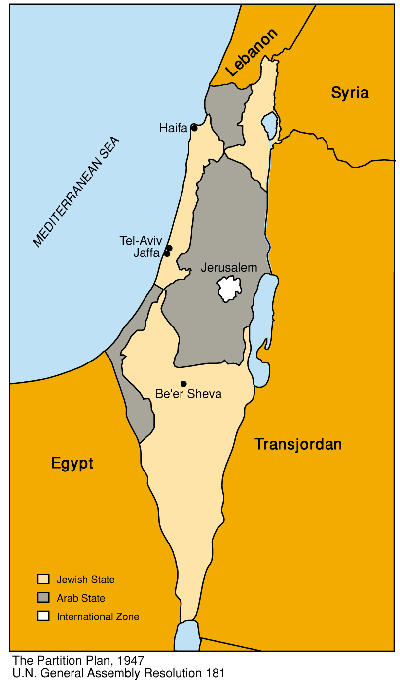
Professor DellaPergola points out that 1947’s U.N. resolution 181 called for the establishment of a Jewish state, an Arab state and a U.N.-administered area around Jerusalem (in the diagram below, the proposed Jewish state is yellow and the Arab state is gray). The 1948-49 war resulted in Israel expanding its borders beyond those in the U.N. resolution. DellaPerfogla believes that “the real bone of contention is what happened in 1947-1949, not the outcome of the Six Day War in June 1967”.
MFAG007y0

If the non-Jews living in Palestine and surrounding regions back in 1947 had welcomed the creation of Israel, the Middle East would be a much calmer place today. They didn’t and it isn’t.